
Corporate social responsibility programs are your company’s chance to show the world its heart. This isn’t about cutting a check for a photo op. It's about rolling up your sleeves, finding the courage to care, and weaving purpose right into the fabric of your business—uplifting communities, acting with fierce integrity, and building a brand people fall in love with.
CSR Is Your Brand's Story Told Through Action

Let’s be fearless for a second. Forget the stuffy press releases and the giant, awkward check-passing ceremonies. Real Corporate Social Responsibility (CSR) isn’t a performance. It’s about being good, not just looking good. It's a brave choice to weave kindness right into the soul of your business.
Picture your company as a character in the world’s unfolding story. Is it the hero who steps up? The quiet mentor who lifts others? Or just another face in the crowd? CSR is your chance to stop being a background player and step into a leading role for positive change.
And this isn't some labyrinthine strategy only giant corporations can afford. It's a deeply human adventure. A quest that kicks off with one simple, brave choice.
Why Your Story Matters More Than Ever
People today don't just buy products; they buy into a mission. A company that stands for something more than its bottom line earns a totally different kind of loyalty. It’s the difference between a fleeting transaction and a lifelong fan.
True impact is born from bravery and kindness. It’s about seeing a problem—whether it’s litter on your street or a crack in your community’s foundation—and deciding, with courage, to be part of the solution. This is how you write a better story for your brand and the world.
When what your brand does matches what it believes, you build something that can't be bought: trust. Your CSR programs become the thrilling chapters in a story people are excited to follow and proud to share. They stop seeing you as just a business and start seeing you as a neighbor, a friend.
This single shift creates a tidal wave of goodness:
- Deeper Customer Connection: People are drawn to brands that mirror their own values, forging a bond that laughs in the face of price tags.
- Inspired and Engaged Teams: Employees are yearning to work for companies they believe in. A strong CSR mission fuels a wildfire of passion and pride from the inside out.
- Stronger Communities: When businesses invest their heart and hands right where they live, they help build a more vibrant, supportive home for everyone. We talk more about this profound impact in our article on building resilient communities.
Finding Your Brand's Authentic Voice
Authenticity is the secret sauce. Your CSR work should feel as natural as breathing. If you're a tech company, maybe you ignite a love of code in local kids. If you're in the food business, you could wage a joyful war on hunger in your town. The only rule is that it has to feel true.
The most breathtaking CSR programs aren't about enormous, dramatic gestures. They spring from a real desire to help, nurtured by small, consistent acts of kindness and courage. It’s about showing up, truly listening to what your community needs, and finding creative—even ridiculously fun—ways to pitch in.
This is your shot to prove that making an impact is way easier than most people think. It all begins with one brave step, one kind act, one decision to write a new, more meaningful chapter for your brand.
The Unstoppable Rise of Purpose-Driven Business
Something’s different out there, isn't it? The air has changed. People aren't just buying stuff or clocking in for a paycheck anymore. They’re joining missions. They’re investing their hearts. This isn’t a fleeting trend—it's a deep, seismic shift in what we expect from the world of business.
Think of it like this: for decades, a business was like a planet held in orbit by a single sun: profit. But now, a second sun has ignited in the sky: purpose. And it’s just as powerful. It’s creating a whole new gravitational pull, shaping everything from who buys your products to who begs to work for you. Companies ignoring this new reality are sputtering, while the ones who bravely fly toward it are soaring.
What's driving this cosmic shift? It’s a very human hunger for meaning. We want the brands we support and the companies we work for to stand for something more than a healthy bottom line. We’re all starting to ask a brave, simple question: What good are you doing in the world?
The Data Behind the Demand
This isn't just a feeling; the numbers are shouting it from the rooftops. People are voting with their wallets and their careers, and they’re consistently choosing companies that reflect their own values.
The data tells a story of a revolution. A recent analysis found that 63% of consumers would rather buy from brands that stand for something real. Even more telling, a staggering 95% of employees now believe their companies should be benefiting society, not just the shareholders. This isn't a niche market anymore. It’s the new mainstream. You can dig into these CSR trends to see for yourself how this groundswell of support is fueling the purpose-driven movement.
"Purpose is the new currency for trust. In a world of infinite choices, what a company stands for is often the only thing that truly sets it apart. It’s your greatest competitive advantage, and it can't be copied."
All this means that having a genuine corporate social responsibility program isn't just a "nice-to-have" bullet point in an annual report. It's the beating heart of any business that wants to grow, thrive, and stick around for the long haul.
Winning Hearts, Minds, and Talent
The companies that are getting this right are winning. Big time. They’re building brands that feel less like faceless corporations and more like partners in creating a kinder world. And the rewards aren’t just warm fuzzy feelings; they’re tangible business results that create a powerful, self-sustaining cycle of success.
- Attracting Top Talent: The best people want to do meaningful work. A strong CSR program acts like a beacon for passionate, skilled individuals who are looking for more than just a salary. They want to pour their soul into a cause they believe in.
- Building Unshakable Loyalty: When customers see you showing up for your community time and time again, they form a real emotional bond with your brand. That kind of loyalty transcends price wars, turning casual buyers into fierce advocates who will sing your praises from the mountaintops.
- Fueling Innovation and Morale: Getting your team out of the office to solve a real-world community problem is a game-changer. It builds camaraderie and a sense of shared purpose that spills right back into the workplace, sparking creativity and boosting morale into the stratosphere.
At the end of the day, the rise of purpose-driven business shows that doing good isn't a cost. It’s your most powerful engine for growth. It’s about understanding that kindness and bravery are just plain smart business. It’s about building a company that not only thrives financially but leaves the world a little brighter than you found it.
And that’s a mission anyone can get behind.
Four Powerful Ways to Build Your CSR Program
Feeling that spark? That little whisper that says, "We could do some good here"?
Amazing. This is where inspiration gets its hands dirty. Building a real-deal corporate social responsibility program doesn't require a ten-person department or a million-dollar budget. It starts with a single, brave choice. Then it grows, wild and beautiful.
Think of it as a 'choose your own adventure' for making a difference. There are many paths up the mountain, but they all lead to the same breathtaking view: a business that gives back, a team that feels connected, and a community that's stronger because you're in it. This isn't about finding the one "right" way—it's about finding the path that feels true to you and your people.
Let’s dig into four of the most common—and powerful—models. You might find one that fits like a glove, or you might mix and match a few. The goal is simple: stop just thinking about it and start doing it.
Choosing Your Path to Impact: Four CSR Models
Every company has its own unique spirit, so what works for a global giant might not be the right fit for a plucky startup. The beauty is, you don't have to follow a rigid formula. Below is a quick breakdown of the four main ways businesses can create an impact. Feel into your company's strengths, culture, and the change you want to see in the world.
| CSR Model | What It Looks Like | Best For Companies That… | Real-World Example |
|---|---|---|---|
| Philanthropy | Directly donating money or resources to nonprofits and charities. | Have the financial resources to make a direct impact but may lack the time for hands-on programs. | Wells Fargo donates up to 1.5% of its revenue annually to thousands of nonprofits. |
| Employee Volunteering | Organizing opportunities for staff to donate their time and skills to community causes. | Want to boost team morale, build stronger internal bonds, and leverage their team's unique talents. | Disney's "VoluntEARS" program, where employees have given millions of hours to community service. |
| Cause Marketing | Tying product sales directly to a charitable donation or social cause. | Have a strong consumer product and want to give customers a clear reason to choose their brand. | TOMS Shoes' original model: for every pair of shoes bought, one pair was donated to a child in need. |
| Impact Investing & Operations | Integrating social and environmental goals into core business operations and investments. | Are ready to make a deep, long-term commitment by aligning their entire business model with their values. | Johnson & Johnson's goal to power its facilities with 100% renewable energy. |
Each of these paths offers a powerful way to connect your business to a bigger purpose. The best programs often blend elements from a few, creating a unique strategy that reflects who they are.
1. The Heart of Giving: Philanthropy
This is the classic approach to CSR, and for good reason. It’s direct, clear, and powerful. Philanthropy is the simple act of writing a check or transferring funds to a cause that needs it. It’s your company stepping up and saying, “We have enough, and we want to share.”
Think of it like being the rain for a garden. You might not be the master gardener, but you can provide the life-giving water that helps dedicated experts—the nonprofits on the front lines—do their best work. This could be a one-time donation to a disaster relief fund, a recurring grant to a local food bank, or even setting up a foundation for the long haul.
It's a brave act to give without expecting anything in return. But the truth is, the return is immense—it comes back in the form of community trust, brand integrity, and the quiet pride of knowing you helped make something better.
This path is perfect for companies that want to make a significant financial difference but don't have the bandwidth for more hands-on initiatives.
2. Hands-On Help: Employee Volunteering
This is where the magic really happens. Employee volunteering is about giving your most valuable resource—the time, talent, and passion of your people. It’s about getting out from behind the desk and physically showing up for your community.
Imagine your team is a crew of superheroes, each with a unique power. Volunteering is how you unleash those powers for good. Your accounting wizards could help a nonprofit untangle its finances. Your marketing team could design a brilliant campaign for a local shelter. Or your entire company could just spend a day laughing together while cleaning up a park. It’s about action.
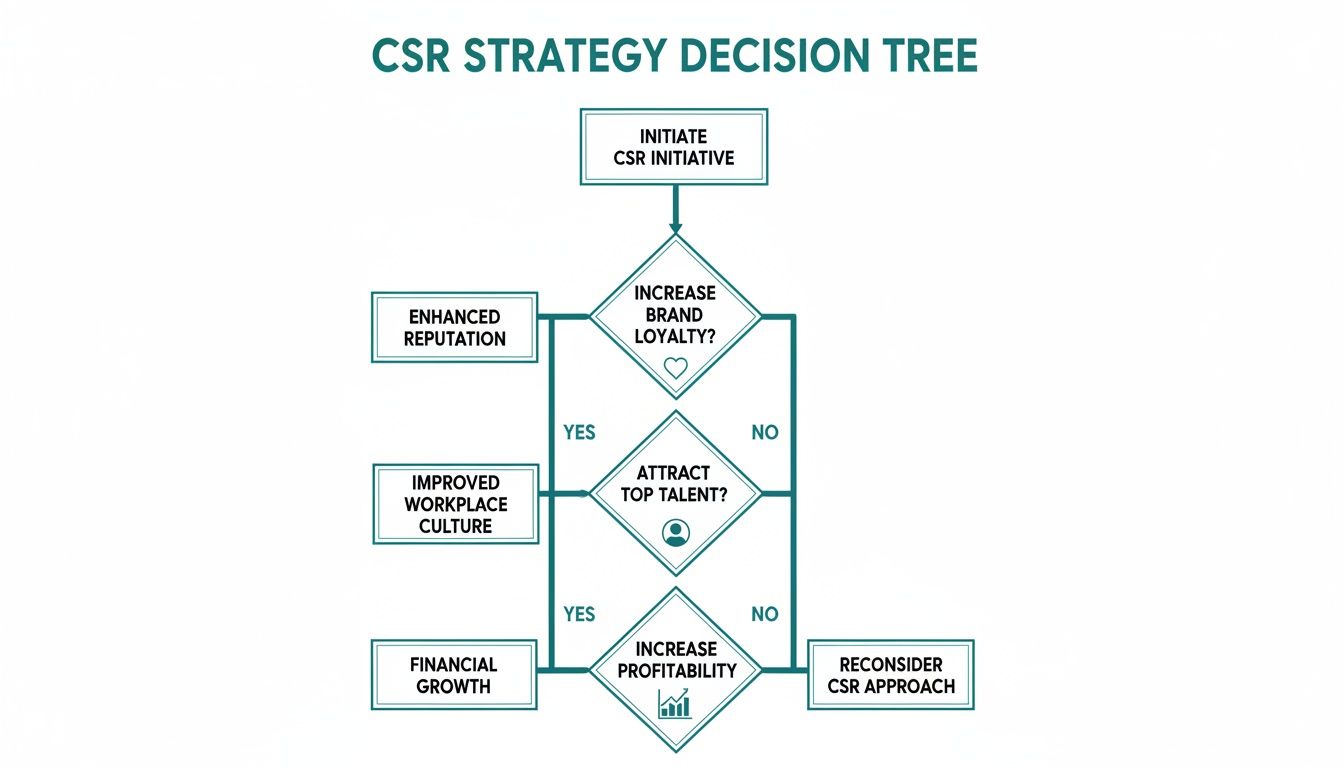
As this decision tree shows, no matter your primary business goal, an authentic CSR program is a validated path forward.
Volunteering is incredible for team building. It forges bonds and memories that no office happy hour ever could. It also lights a fire of purpose in people that they carry back to their day jobs. Of course, keeping that fire lit takes work, which is why exploring effective volunteer retention strategies is so important for building a program with real staying power.
3. Business With a Cause: Cause Marketing
Cause marketing is a beautiful dance that connects your business success directly with community impact. It's a partnership where every sale you make helps a cause you care about. You’re telling your customers, "When you support us, you’re also supporting this."
The most famous story here is TOMS Shoes. Their original "one-for-one" model was simple and powerful: buy a pair of shoes, and they give a pair to a child in need. They’ve since shifted their model to donating a third of their profits, but the core idea remains the same. It transforms a simple purchase into an act of giving.
This model is a true win-win. It drives sales by giving customers a compelling reason to choose you over a competitor, and it creates a steady stream of support for your chosen cause. It's about weaving purpose so deeply into your business that your growth and your impact become one and the same.
4. Investing in a Better World: Impact Investing & Operations
This is the most visionary approach, where you use your company's investments to create positive social and environmental outcomes. It’s about putting your money where your values are—not just in donations, but in your core financial strategy.
Think of it as planting an entire forest instead of just picking the fruit. You’re investing in the long-term health of the whole ecosystem. This can look like:
- Impact Investing: Directly funding companies that are solving big social or environmental problems.
- Sustainable Operations: Investing in things like clean energy for your own facilities.
- Ethical Supply Chains: Making sure your partners and suppliers meet high standards for how they treat people and the planet.
This approach proves that profitability and purpose are not enemies. In fact, they can be powerful allies. It’s a deep commitment to building a business that is a force for good from the inside out.
Building Partnerships That Create Real Impact

An idea without action is just a daydream. You’ve felt that spark, you've chosen a cause, but now comes the real adventure: turning that vision into dirt-under-your-fingernails reality. This is where your corporate social responsibility program truly comes alive—not in a boardroom, but right on the streets of your community.
The secret? You don't have to go it alone. In fact, you shouldn't. The most powerful way to make a difference is by joining forces with the people already doing the work.
Think of it less like a legal agreement and more like making a new friend. You show up, you listen with an open heart, and you find ways to help that feel right for everyone. This is about forging genuine connections that create visible, tangible change—one brave step at a time.
The Power of Showing Up
The world is filled with incredible grassroots organizations, often powered by pure volunteer heart, who know their community's needs inside and out. They are the heroes on the ground. Partnering with them isn't just smart; it's an act of respect. It’s a way to amplify the good they’re already doing instead of trying to reinvent the wheel.
Your role is to be the ally, the friend who brings extra resources to the party. The goal is a relationship built on mutual respect and shared dreams, where your company’s energy lifts up the folks on the front lines.
And here’s the good news: businesses are finally getting it. A recent industry report revealed that a surprising number of corporate social responsibility (CSR) teams reported budget increases, signaling a real commitment to making a bigger impact. While overall operational budgets stayed flat, the biggest boosts went to employee engagement programs—the very initiatives that get your team out into the community. Find out more about key trends in corporate social impact.
Your Partnership Playbook: A Simple Guide
Ready to make that first move? It’s easier than you think. Forget about intimidating outreach plans and just focus on being a good human. Here’s a simple playbook to get you started.
Step 1: Listen First, Act Second
Before you offer a single thing, do your homework. Find local groups whose mission makes your heart beat a little faster. Follow them on social media. Read their newsletters. If you can, show up to one of their events as just another volunteer. Your first job is to understand their world—their struggles and their victories.
Step 2: Reach Out With Humility
When you’re ready, send a simple, honest email. Introduce yourself and your company, but lead with what you admire about their work. Ask if they’d be open to a conversation about how you might be able to support them. That key phrase, "support them," changes everything. It shows you’re there to serve, not to take over.
The best partnerships begin with a simple question: "What do you need, and how can we help?" It shifts the dynamic from a transaction to a relationship built on trust and kindness.
Step 3: Ask What They Truly Need (It’s Not Always Money)
While funding is almost always helpful, it’s not the only resource you have to offer. Many grassroots groups are starved for other kinds of support. During your conversation, explore all the ways you could chip in.
You have more treasures than you realize:
- Your Team's Skills: Can your marketing team design a flyer? Can your accountants help with bookkeeping? Offering pro bono professional services can be a total game-changer for a small nonprofit.
- Your Physical Space: Do you have a conference room they could use for a board meeting? Or a bigger space for a volunteer training event?
- Your Voice and Network: Can you feature their work in your company newsletter or on social media? A signal boost from you can bring in new volunteers and donors they'd never otherwise reach.
- Your People Power: This is the big one. Can you rally a team of volunteers for their next big event? The energy of a dedicated group showing up to help is priceless.
By offering a menu of support options, you empower the organization to choose what’s most valuable to them right now.
Step 4: Start Small and Build Trust
Don’t try to launch a massive, year-long campaign on day one. Start with one small, specific project. Commit to providing volunteers for their annual park cleanup. Offer your office space for one meeting.
Then, deliver on that promise with genuine enthusiasm. Prove you’re reliable. Trust is built through small, consistent actions over time. As that relationship deepens, the opportunities for bigger, bolder collaborations will naturally appear. This is how you build a partnership that doesn't just create a press release—it creates real, lasting change.
How Transparency in CSR Builds Unbreakable Trust
If you do something amazing and nobody knows about it, how can it possibly inspire a movement?
When it comes to your corporate social responsibility program, telling your story isn’t about bragging. It’s a brave act of trust-building. It’s an open invitation for others to join you on the adventure.
Think of it like a ship’s log. A good captain doesn't just record the sunny days and smooth sailing. They document the storms, the repairs, the tough calls—all of it. That complete, honest story is what proves the journey was real.
From Data Points to Human Stories
For too long, CSR reporting has felt like a homework assignment: dry, dense, and packed with charts nobody really understands. But trust isn't built on spreadsheets; it's built on shared human experience. The secret weapon here is authentic, heart-centered communication.
This isn’t about showing off. It's about showing up, fully and honestly. It’s a huge, courageous shift from saying, "Look how perfect we are," to "Look what we’re learning along the way."
Perfection is a myth. Progress is the goal. Your community doesn't expect you to have all the answers. They just want to know your heart is in the right place and that you're genuinely trying.
Sharing your journey—the messy, imperfect parts included—is what builds that unbreakable bond. It proves your commitment is real, not just another marketing tactic. It's the difference between a press release and a real, honest-to-goodness conversation.
The Art of Authentic Reporting
So, how do you actually tell your story in a way that feels real? You let the people doing the work share their own experiences. You trade the corporate jargon for kindness and courage.
Here are a few simple ways to bring your impact to life:
- Spotlight Your Volunteers: Share a short quote or a candid photo of a team member at a cleanup event. Let them explain in their own words why the work matters to them. Their passion is infinitely more powerful than any metric.
- Show, Don't Just Tell: Post a quick video of your team laughing while planting trees or a before-and-after picture of a park you helped restore. Visuals connect with the heart in a way numbers never can.
- Share the Bumps in the Road: Did a project not go as planned? Talk about it! Sharing what you learned from a setback shows humility and proves you’re committed to getting it right, not just looking good.
This whole shift toward transparency is becoming the new standard. In fact, a whopping 91% of companies by global market capitalization now disclose sustainability-related information. This global trend shows that being open about your efforts isn't optional anymore; it's essential. You can discover more about this global corporate sustainability report and see how the biggest players are doing it.
Your Story Is a Ripple Effect
Every story you share does more than just report on the past; it creates the future. It inspires another company to start its own program. It encourages an employee to sign up for their first volunteer event. It shows a community that someone out there genuinely cares.
For instance, when we share stories from a Litter Caterpillars cleanup, we're not just showing bags of trash. We're showing friendship, resilience, and the pure joy of reclaiming a neighborhood. This storytelling is part of a much larger effort, just like our commitment to finding ways to reduce plastic use in the first place.
Your transparency becomes an act of kindness in itself. It’s a brave declaration that you believe in a better world and you’re willing to do the work—openly and honestly—to help build it.
By sharing your journey, you give others the courage to start their own. You prove that making an impact is easier, and more fun, than anyone thinks. And that is how a single brave action transforms into a movement.
Your First Brave Step on the Path to Purpose
Every big, meaningful journey starts exactly where you are right now. This isn't just a summary; it's an invitation. A call to be brave, get out of your own head, and just start.
We’ve talked about how corporate social responsibility programs are your brand’s story in action, how purpose is flipping the script on business, and how partnerships make good things happen faster. But honestly, none of that matters without one small, courageous move. Your first step.
If there’s one thing to take away from all this, it's that real change kicks off the moment you decide to clean up a mess. It could be the litter on your block or a broken system in your industry. The scale doesn't matter. The brave decision to do something about it does.
You don't need a grand plan to start making a difference. You just need the kindness to see a need and the bravery to do something about it. That’s it. That’s the entire secret.
What Will Your First Step Be?
Making an impact is simpler, more fun, and way more rewarding than you probably think. It’s not about getting it perfect; it’s about picking a direction and starting to walk. The momentum you build from that first action will carry you farther than you can imagine.
Choose one thing you can do today:
- Start a Conversation: Ask your team, "If we could help our community in one small way, what would it be?" Then just listen.
- Do 15 Minutes of Research: Find one local, volunteer-driven group that genuinely inspires you. Follow them on social media. See what they're up to.
- Take a Walk: Step outside and just look around your neighborhood with fresh eyes. What do you see that needs a little help?
You're ready. You already have everything you need to be a force for good in your own unique way. All that's left is to take that first brave step.
Go on. The world is waiting.
Still Have Questions? Good.
It's smart to ask questions. It means you're already thinking about how to do this right. Here are some of the things we hear most often from companies trying to figure out their first steps.
We're Just a Small Business. Can We Really Make a Difference?
Heck yes, you can. Impact isn’t about the size of your bank account; it's about the size of your heart. It’s about showing up, consistently.
Honestly, a small team getting their hands dirty at a neighborhood cleanup creates a much bigger ripple effect—in team spirit and in the community—than some giant corporation just cutting a check from an office tower. Start with who you are and what you have. That genuine desire to help is your most powerful asset.
How Do We Find the Right Cause to Support?
Don't overthink it. Look for that spark—the thing that gets your team genuinely excited. The best partnerships feel natural, not like a homework assignment. Your company’s values are a good starting point, but the real magic happens when you tap into what your people are passionate about.
What’s going on in your own backyard? What issues do your employees talk about? When you rally around a cause your team truly cares about, the energy is unstoppable. It becomes a mission, not just a program.
"The best partnerships feel like friendship. They are built on mutual respect, shared goals, and the simple desire to help each other succeed. Listen first, then act with kindness."
How Can We Possibly Measure the ROI on This?
Forget "Return on Investment." Let's talk about your “Return on Impact.” This is the stuff that tells a story much deeper and more powerful than anything on a spreadsheet.
It’s not just about the numbers, but you can still track what matters:
- Team Vibe: Are people happier? Is the energy in the office better? Are your best people sticking around longer?
- Hiring Magnetism: Do new recruits bring up your community work in their interviews? That's a huge tell.
- Good Buzz: Are people sharing positive stories about your company online without you even asking?
- Real Stories: What are your partners and volunteers saying? Collect those quotes and testimonials. That’s pure gold.
This is the proof that you're building something real.
At Litter Caterpillars, we're all about the power of just showing up. If you want to see how a few hours of simple, honest work can change your team and your city, come join a cleanup. We make it easy, and dare we say, fun. Find an event and see for yourself at https://www.littercaterpillars.com.