
So, what exactly is environmental restoration? I find the textbook answer a bit dry: assisting the recovery of an ecosystem that has been degraded, damaged, or destroyed.
That definition misses the soul of it. A better way I think about it is giving nature a helping hand, like a friend, so it can start to heal itself. It's an act of hope.
What Is Environmental Restoration Anyway?
Have you ever felt like your own life was a total mess? I know I have. There were times my apartment got so cluttered, old food piling up in the fridge, that every single object felt like it weighed 500 pounds, loaded down with stories I just couldn't let go of. My life felt just as disorganized as my living space.
This personal struggle I faced is the perfect analogy for understanding environmental restoration. Imagine a vacant city lot. It's choked with weeds. It's covered in trash and broken glass. This is a space that's been neglected, damaged, and forgotten. You can't just leave it alone and hope for the best; the damage is already done.
That’s where you and I come in. Environmental restoration is our act of stepping into that lot, clearing out all the junk, and actively working to bring it back to life. I want you to see that it’s not just about cleaning up—it’s about rebuilding from the ground up, with purpose.
More Than Just a Cleanup Job
Honestly, the real reason I started Litter Caterpillars was to clean up my own life. I discovered something strange: cleaning up someone else’s mess—the city's mess—was way easier and more empowering. This is the exact same idea in restoration. We aren't just tidying up a space; we are creating the right conditions for life to come roaring back.
This process involves a few key, deliberate steps I've learned to take:
- Removing Harm: This means you get rid of the bad stuff first. Think pollutants, invasive weeds, or all the physical trash that’s stopping the ecosystem from working properly.
- Reintroducing Life: Once the junk is gone, we bring back the good stuff. You can plant native flowers, trees, and grasses that actually belong in that specific place.
- Rebuilding Structure: Sometimes you have to rebuild the foundation itself, like restoring the natural bends in a stream or rebuilding the soil health so new plants can actually take root.
Essentially, we’re giving that little piece of land the tools it needs to start its own healing journey. I see it as a true partnership with nature.
It helps me to see how restoration stacks up against other environmental actions people talk about. They're all important, but you'll see they are not the same thing.
Restoration vs Other Green Actions
Understanding the key differences between common environmental terms.
| Action | What It Means | Real-World Analogy |
|---|---|---|
| Restoration | Actively rebuilding a damaged ecosystem to its former state. | Performing surgery and physical therapy after a serious injury. |
| Conservation | Protecting existing healthy ecosystems from future harm. | Eating healthy and exercising to prevent future health problems. |
| Remediation | Focusing specifically on cleaning up pollutants from soil or water. | Detoxing the body by removing a specific harmful substance. |
| Rehabilitation | Improving a degraded ecosystem without aiming for its original state. | Helping someone walk again with a prosthetic leg—it's functional, but not the original. |
Each of these plays a role, but restoration is unique because it's about actively turning back the clock on damage.
A Journey of Transformation
My own transformation started the moment I decided to face the things that were hardest for me: cleanliness, consistency, and bravery. I started a trash pickup group to intentionally build my social circle with givers and to prove to myself I could actually show up, week after week.
This act of service became a mirror for my own restoration. By cleaning up our city, I was cleaning up my own internal landscape. We are all caterpillars, trying to transform ourselves. Helping our environment is a powerful way for you to begin.
This is the core of what environmental restoration feels like. It’s an active, hopeful process. It’s about taking a broken piece of the world and, with our own two hands, helping it become whole again.
For anyone curious about how this connects to a broader sense of responsibility, you might be interested in our guide on environmental stewardship. It's a powerful framework for understanding our role in protecting and healing the planet.
From Your Block to the Entire Planet
Have you ever picked up a single plastic bottle and wondered, does this even matter? I’m here to tell you: it’s everything. That one small act connects you to a massive, global movement of healing. Each piece of trash you bag, each native seed you plant, creates a ripple that travels far beyond your block.
I’ll never forget our first Litter Caterpillars outing. A wild story. There were only three of us, and in classic Chicago fashion, a beautiful spring day turned on us and unleashed a freak hailstorm. We huddled under a tree, shivering, watching every single Uber cancel on us one by one. And in that moment, I had a strange thought: this is actually fun. The suffering added a kind of flavor to it.
Cold and miserable, that's where our identity was forged. We learned that cleaning up other people's messes is incredibly empowering. I realized it takes a certain kind of bravery to serve your community, especially when it’s uncomfortable.
The Power in a Single Action
That spirit of "bravery in service," born in a hailstorm, is the exact same energy that fuels enormous international restoration projects. Your effort on a Saturday morning isn't some isolated good deed; you are part of something huge. The core of what is environmental restoration is simply taking action, no matter how small it feels.
The decision to show up for your patch of earth—your park, your block, your riverbank—is the first and most important step. It’s a vote of confidence in the future, a declaration that you believe things can get better.
This is what we're talking about. Restoration isn't some fuzzy concept; it's about real work.
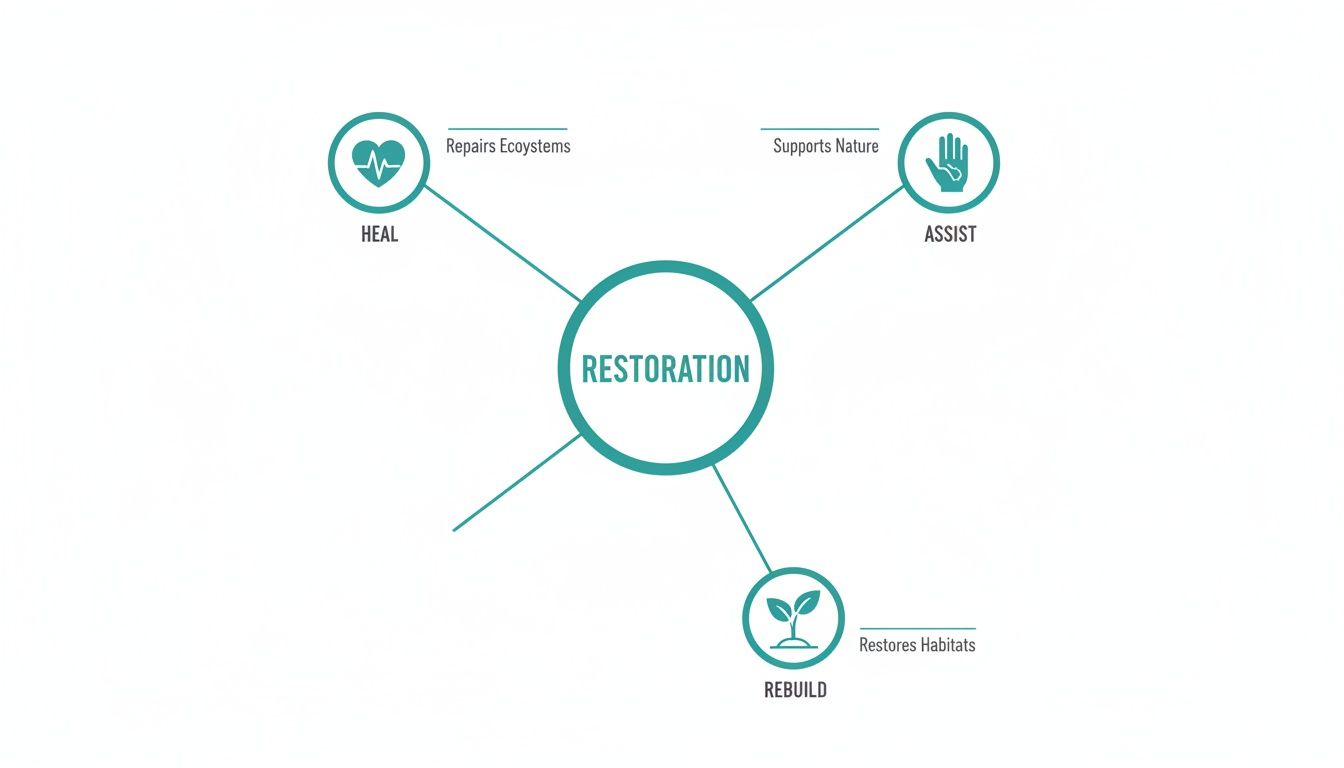
It boils down to healing what's broken, giving nature a helping hand to recover, and actively rebuilding habitats that have been lost. It’s a powerful mix of hands-on help and letting nature do what it does best.
A Global Ripple Effect
Those small, local actions you take? They add up to a tremendous global force. Our planet is facing huge challenges from deforestation, unchecked city growth, and a climate that’s spinning out of control. But people everywhere are responding. They're creating not just ecological change but massive economic momentum, too.
The push to restore degraded lands is now a booming industry. In 2023, the global ecological restoration market was valued at an incredible USD 14.25 billion. It’s projected to surge to USD 24.65 billion by 2033, growing at a steady 5.63% each year. This isn't just about planting trees; it’s about creating jobs, building resilient communities, and investing in a healthier planet. You can see the explosive growth for yourself in recent market reports.
This growth proves that governments and big industries are finally catching on to what volunteers like you have known all along: healing our environment is one of the best investments we can possibly make. It's proof that the work you do matters on a scale you might not even be able to see.
You Are Part of the Wave
When we started Litter Caterpillars, we weren’t thinking about global markets. I was thinking about the trash on our streets in Chicago. But the truth is, the two are directly connected.
Community-led projects like ours create waves. They inspire others, they build local skills, and they show what's possible when people work together. This local momentum often pushes for bigger, system-wide changes.
- You build community resilience: Cleaning a park with your neighbors isn't just about picking up litter. You're building relationships and a shared sense of ownership.
- You create a proof of concept: A small, successful project can attract more resources for bigger efforts down the line. It shows the world what works.
- You inspire a culture of stewardship: Your actions show others that they can make a difference, too, creating a cycle of positive change.
So, the next time you’re out there, know that your hands are part of a global force for good. That one bottle you grab is one less piece of plastic in the ocean. That one invasive weed you pull gives a native plant a fighting chance. You are part of the answer.
The Different Ways We Heal Our World
Environmental restoration isn’t some magic wand you can wave over a trashed-out landscape. It’s more like a doctor's bag, but for the Earth. You wouldn't put a band-aid on a broken bone, right? Same idea here. You can’t use the same technique for a forest after a wildfire as you would for a polluted river snaking through a city.
Every single place has its own story of what went wrong. Our job is to listen to that story—really listen—and then pick the right tools to help it start healing. The real skill behind what is environmental restoration is knowing what to do and when. It’s creative, it’s hands-on, and it’s happening all around you.
From Forests to Floodplains
When most people I talk to think of restoration, they probably picture planting trees. And yeah, reforestation is a huge one. After a fire torches a mountainside, I see replanting as giving it a fresh start. It stops the soil from washing away and brings back a home for all the critters that lost theirs.
Then you have wetland restoration. I think of this as unclogging our planet's kidneys. Wetlands are supposed to be these incredible natural filters that clean our water and soak up floods. But for centuries, we've just been draining them to build stuff. Bringing them back means restoring that natural sponge, which is one of our best defenses against pollution and crazy weather.
And of course, you've got coastal restoration. This is all about rebuilding sand dunes, replanting marshes, and even restoring oyster reefs to protect our shorelines. These living barriers honestly work better than concrete seawalls, and they’re usually cheaper too.
This isn't just some niche hobby for nature lovers anymore; it's becoming a massive global movement. The market for this kind of work is projected to be worth $5 billion in 2025 and is expected to shoot up to $9 billion by 2033. That growth is happening because we’re finally getting serious about biodiversity loss and climate change, and people are realizing nature has the best solutions. You can read more about these exciting market trends to see how healing nature is becoming big business.
Urban Restoration: A Special Kind of Healing
My passion, and the work we do every single week at Litter Caterpillars, is a special category: urban restoration. Here in Chicago, we see firsthand how even the most forgotten, junk-filled corners of a city can be brought back to life. We’re turning trashed-out lots into vibrant green spaces that actually serve the community.
Urban restoration is different because it’s not just about healing the land; it’s about healing people and neighborhoods, too. When we turn an empty lot into a little park, we're not just planting flowers. We’re creating a place for neighbors to meet, for kids to play safely.
There are some amazing techniques we can use right here in the city:
- The Miyawaki Method: This is an incredible approach where you plant a super-dense, diverse mix of native plants in a small area. Because they have to compete for sunlight, they grow insanely fast—up to 10 times faster than normal. You can basically create a tiny, self-sufficient forest in just a few years.
- Soil Bioremediation: Sometimes the ground itself is sick, contaminated with all sorts of nasty stuff. We can actually use special plants and microbes to "supercharge" the soil, helping it break down those toxins and become healthy enough to support life again.
- Green Infrastructure: This just means using nature to solve city problems. Think rain gardens that soak up stormwater so our sewers don't overflow, or green roofs that cool down buildings and cut energy bills.
At its heart, urban restoration is an act of hope. It’s a declaration that no space is too small or too damaged to be healed. It’s about seeing the potential for life in a patch of dirt and having the bravery to help bring it forth.
From a massive coastline to a small park down your street, the idea is the same. We figure out what’s wrong, pick the right remedy, and give nature the support it needs to come roaring back. You have the power to be a part of this healing, right where you are.
Stories of Transformation: Real Restoration in Action
It’s easy for me to talk about restoration methods, but seeing a place change with your own eyes? That’s something else entirely. The real power is in the stories. They show that behind all the science, there are people—full of hope and bravery—making a real difference.
Let me tell you one of those stories. It’s one that’s still being written, and it’s one that I and the Litter Caterpillars are incredibly proud to be a part of. It’s the story of Caterpillar Park.
From Abandoned Lot to Community Asset
In the heart of Englewood, on Chicago’s South Side, there was an empty lot. Like a lot of them, it was just a forgotten space, collecting trash and telling a story of neglect. But we looked at it and saw something totally different. We saw potential.
So we did something that felt a little nuts at the time: we entered a city auction and bought it. Just like that, this abandoned piece of land was ours. This wasn't just a purchase; it was a commitment. It was us putting our values of bravery, kindness, and unity into action.
Our dream for this lot is to turn it from a forgotten space into a living, breathing part of the community. This is what environmental restoration is all about on the ground floor. It’s about taking ownership, getting your hands dirty, and believing you can bring life back to a place that desperately needs it. Caterpillar Park is our living experiment in urban restoration.
This project is more than just planting flowers. It's about planting roots in a community and showing that with a little courage and a lot of teamwork, we can create pockets of beauty and hope right where we live.
The Big Picture: A Global Goal
Our work in Englewood is just one tiny piece of a huge puzzle. While we’re focused on a single lot in Chicago, it’s inspiring to know we’re not alone. People all over the world are working toward the exact same goal, but on a massive scale.
In fact, the world has set some incredibly ambitious targets. One of the boldest is a global agreement to get at least 30% of the world’s degraded lands and seas under effective restoration by 2030. This isn't some vague promise; it's a real, measurable target that countries are working on right now under the Kunming-Montreal Global Biodiversity Framework. Starting in 2026, nations will report their progress, turning these big ideas into real action. If you're curious, you can learn more about countries advancing their restoration monitoring.
It just goes to show that from a small group of volunteers in one city to a coordinated global effort, the mission is exactly the same: to heal our planet, piece by piece.
Inspiring Projects Near and Far
This spirit of restoration is catching fire everywhere, with incredible stories popping up all over. These projects, big and small, show the amazing creativity and dedication people bring to healing their own local environments.
Here are a few that I find really inspiring:
- Oyster Reef Restoration: On Long Island Sound, I see groups rebuilding oyster reefs. This isn't just about seafood; these reefs are natural walls that protect coastlines from erosion and act as powerful water filters, cleaning the entire area.
- Indigenous-Led Learning: A project in Connecticut is building a center that mixes modern green design with traditional Tribal knowledge. I find this a beautiful example of how respecting cultural heritage can lead to stronger, more sustainable communities.
- From Soil to Sound: A college in New York is showing urban agriculture students how soil health directly impacts the health of nearby waterways. They’re learning firsthand how to use green infrastructure to fight city pollution.
These stories, from our own Caterpillar Park to the shores of the Atlantic, are all part of the same powerful movement. They prove that restoration is happening everywhere, driven by people who believe in a better future. The problems we face, like waste and pollution, are everywhere, which is why actions even far from the coast matter. For a closer look at that connection, you can read also about the impact of littering on our beaches. Every piece of land is connected to our water.
Why This Is So Much Bigger Than a Clean Park
The benefits of environmental restoration go way beyond just having a cleaner-looking neighborhood. When we get our hands dirty, we’re not just picking up litter; we’re transforming ourselves and our communities from the inside out. I see it happen every single week.
This work sparks change on three different levels all at once: for nature, for us as people, and even for our wallets. It's an investment that pays you back in ways you’d never expect.
The Big Win for Nature
First, let's talk about the ecological win. When we restore a piece of land, we’re doing a lot more than just making it look nice. We’re bringing back biodiversity. A healthy ecosystem isn't some neat, tidy lawn; it’s a chaotic, beautiful symphony of different plants, insects, and animals all working together.
Think of a restored area as a stronger, more resilient community. I've seen how a single native garden can support hundreds of species of bees and butterflies. A mowed lawn? It supports almost nothing. By bringing back what's supposed to be there, we’re creating a much tougher, more adaptable environment.
It's like building an immune system for our planet. A diverse ecosystem can handle shocks like droughts or floods, just like a healthy body can fight off a cold. Restoration makes our shared home stronger.
This resilience is everything. I've read about how a healthy floodplain can soak up massive amounts of rainwater, protecting homes from getting destroyed. Restored coastal marshes become natural shields against storm surges. We're not just planting flowers; we're rebuilding nature's own defense system.
The Big Win for People
This is the part that gets me the most fired up. When I first started Litter Caterpillars, I had a secret mission: I wanted to engineer my social circle with givers. I was sick of selfishness and wanted to surround myself with people who show up. It worked better than I ever could have imagined.
Our weekend morning meetups do exactly that. They build real, solid friendships. When you work side-by-side with someone—sweating, laughing, and getting dirty for a cause you both believe in—you build a kind of trust you just can't get anywhere else.
- Building Real Community: These projects become magnets for people who actually care. You meet your neighbors, you hear their stories, and you build a shared pride in the place you all call home.
- Fixing Your Headspace: Being outside, working with your hands, and seeing the direct impact of your effort is unbelievably good for the soul. I find it fights that feeling of helplessness and gives you a powerful sense of purpose.
- Learning to Trust Yourself: This has been a huge one for me personally. The simple act of service—of just showing up, again and again—helps you learn to trust and forgive yourself. It’s not just about the trash; it’s about personal growth, unity, and the redemption that comes from serving something bigger than yourself.
The Big Win for Your Wallet
Okay, let's talk about the money. It might sound weird to connect volunteer work with economic benefits, but the link is there and it's crystal clear. Environmental restoration is actually an economic engine.
It all starts with jobs. I see ecologists, landscape architects, equipment operators, and nursery workers—all these people are needed for bigger projects. This creates stable, green jobs that put money directly back into local communities.
But the benefits don't stop there. Study after study shows that green spaces jack up property values. A clean, beautiful park makes a neighborhood a place where people want to live. That empty lot we turned into a garden? It just made the whole block more valuable.
So, the next time you see a group of volunteers out on a Saturday morning, remember what’s really going on. They aren’t just cleaning a park. They’re rebuilding an ecosystem, forging a stronger community, and creating real economic value—all at the same time. This is the profound, layered impact of what we do.
How You Can Step Up and Join Us
Okay, so you feel it, right? That little fire starting inside you. The voice that says, "I can do that. I want to do that." Good. That's exactly how this whole thing starts. The best part is, you don’t need a special degree or a bunch of free time to make a real, visible impact.
I get it, though. It can feel like a big leap. But joining a group like ours, the Litter Caterpillars, is about as simple as it gets. We post all our cleanups on Meetup and Instagram. There are never any strings attached. We put the happiness and safety of our volunteers above all else—it’s our core belief. Just show up, and we'll put everything you need right in your hands.
Find Your Crew (Or Build It)
If you're in Chicago, finding us is easy. But what if you're not? The spirit of environmental restoration isn't confined to one city. You can bring this energy right to your own hometown. Remember Tom Sawyer? He was stuck with a boring chore—painting a fence—but he convinced all his friends it was the most fun thing they could possibly do.
You can create that exact same magic. Here's a simple way I'd start:
- Find Your Spot: Is there a park, a street corner, or a local trail that’s been bugging you? That’s it. That’s your ground zero.
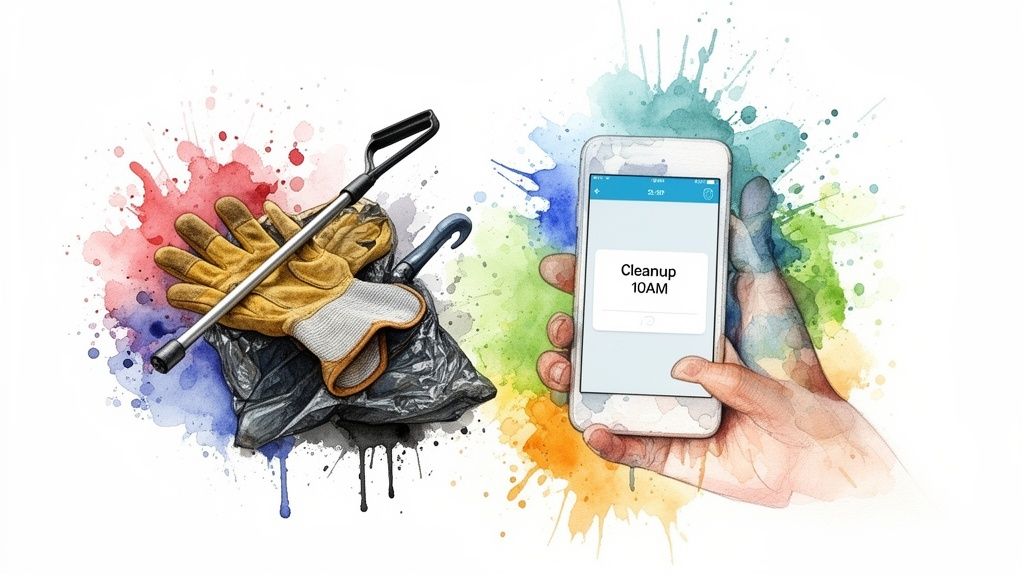
- Rally a Couple of Friends: Just send a text. "Hey, I'm going to clean up this spot on Saturday at 10 AM. Want to join for an hour?" Keep it simple.
- Embrace the Adventure: Bring some gloves, bags, and just begin. I promise, the first five minutes might feel a little awkward, but that feeling will melt away fast. You might even get hailed on, and you’ll walk away with an amazing story to tell.
This is your chance to step into your power, make new friends, and become a part of your city's transformation story. It’s not just about picking up trash; it’s about choosing to be a giver.
It All Starts With One Small Step
The most critical part is simply starting. The journey from a trashed-out lot to a beautiful community garden begins with one person deciding to pick up one piece of litter. Every single restoration project, no matter how big, starts with that one small act of bravery.
You have that bravery in you. You have the power to organize a small group and carve out a pocket of beauty and hope in your own neighborhood. We’ve put together some practical advice if you'd like to learn more about how to start a volunteer trash pickup. I think you'll find it's a lot simpler than you imagine.
Your community is waiting for someone just like you to take that first step. Will it be you?
Your Questions, Answered
Whenever I share our story, people get fired up. I love it. But then the questions start bubbling up—the "buts" and "what ifs" that can stop you from taking that first step. I get it. I’ve been there. Let's tackle some of the big ones.
"But I Don't Have Any Skills… Or a Grabber."
You don't need them. Seriously. The only thing you need to bring is yourself.
Your willingness to show up on a chilly Saturday morning is the only skill that matters. At Litter Caterpillars, we handle the rest—gloves, bags, the plan. My job is to make sure you're safe and that you connect with someone new. A positive attitude is the only tool we require. Just show up.
"How Do I Know It's Not Just a Waste of Time?"
This is a real question. You want to know that your sweat and effort are actually changing things, not just a feel-good moment. I respect that. Look for the groups who are obsessed with the "after" picture.
The best projects are the ones that are in it for the long haul. They use native plants, they bring in local experts, and they build a community that keeps coming back. If a group is tracking things—like counting the birds that return or testing the water to see if it’s getting cleaner—that’s a huge sign they’re serious about real, lasting change.
"Isn't This Just Conservation?"
Ah, yes. The classic. They sound the same, but they're worlds apart. Let me break it down the way I see it:
- Conservation is about protecting what's already perfect. It's building a fortress around a pristine, untouched forest to keep it safe. It’s important, but it's a defensive game.
- Restoration is about healing what's broken. It's active. It's like being a surgeon for the land, stitching wounds and helping that struggling patch of earth grow back stronger than before.
One prevents the wound; the other heals it. Both are crucial, but restoration is where we get our hands dirty. It’s where we get to bring life back to the places our cities forgot.
Ready to stop asking questions and start making a difference? Litter Caterpillars is your crew. We make it simple to find a cleanup, meet other givers, and become part of your city's comeback story. Check out our upcoming events and join us!