Tag: corporate sponsorship

  • Create Nonprofit Sponsorship Packages for Your Small Group

    Create Nonprofit Sponsorship Packages for Your Small Group

    The first time someone told me to get sponsors for our cleanup group, I almost laughed them out of the conversation. I pictured trash bags covered in logos, weird corporate slogans, and the whole soul of the thing getting flattened into a sales deck.

    I was wrong.

    What changed my mind was simple. A sponsor isn't always buying you. Sometimes they're joining you. That's a very different posture, and if you build your nonprofit sponsorship packages the right way, you can bring in money, gear, food, printing, and real long-term allies without turning your group into a billboard.

    Your Sponsorship Journey Starts Here

    A few years ago, I was standing in a parking lot after a cleanup, sweaty, tired, and half-annoyed that we were already out of gloves again. One of the volunteers said, “Why don't you get a sponsor?”

    I rolled my eyes.

    At the time, “sponsorship” sounded like code for selling out. I pictured a slick company wanting their logo bigger than the mission, a bunch of fake smiles for photos, and a volunteer group slowly turning into somebody else's marketing project. Small groups tell themselves that story all the time, especially when they have no staff, no budget, and no patience for corporate theater.

    I told myself the same thing. I was wrong.

    What changed my mind was watching how people behaved. A shop owner offered drinks. A local company asked if they could cover supplies. Someone else wanted to feed volunteers after a cleanup. They were already raising their hands. The problem was not lack of interest. The problem was that I had framed every offer as charity instead of partnership.

    That mindset will keep a scrappy group small for longer than necessary.

    You are not asking people to rescue your mission. You are giving the right business a chance to stand beside something real.

    That difference matters, especially for volunteer-led groups. If you walk in acting grateful for scraps, you get scraps. If you walk in clear about who you are, what you do, and what kind of support fits, you sound like a group worth backing.

    Small organizations have an advantage here. You do not need polished language, a gala, or a development department. You need a story people can repeat, visible work in the community, and enough self-respect to say no to bad-fit money. Big nonprofits can drown in their own branding. Small groups can move faster, feel more human, and build trust face to face.

    Start there.

    What small groups get wrong

    Volunteer-run groups often make the same mistake at the start. They assume sponsorship begins with a PDF, a rate card, or a fancy list of benefits. It begins earlier than that.

    It begins with knowing what you stand for.

    If your identity is fuzzy, your package will be fuzzy. If your mission sounds borrowed, your ask will sound borrowed. And if you will say yes to anyone with a check, good partners will smell that from a mile away.

    I learned this the hard way. Early on, I was tempted to make our group sound bigger and shinier than it was. That instinct is poison. Small groups do better when they sound honest, local, and specific. “We clean this corridor every week and people know us by name” is stronger than a bunch of puffed-up language about impact.

    Ask yourself the questions that actually matter

    Before you draft a single sponsorship tier, answer these:

    • What do you do that people remember?
    • What part of your work makes locals trust you?
    • What kind of support helps without hijacking the mission?
    • What will you refuse, even if the money is good?

    That last question saves a lot of pain. Boundaries make you easier to trust. A sponsor worth having does not need to be tricked into respecting your values. They either respect them or they do not.

    Get that straight first, and the rest of the process gets much easier.

    Find Your Real Value Before Asking for Money

    A sponsor once asked me a simple question I was not ready for.

    What are we backing here?

    If your answer is a pile of logo placements, you are in trouble. Small volunteer-run groups lose deals right here because they describe surface-level benefits instead of the thing that makes people care. Nobody writes a check because their logo might end up on a flyer. They write a check because your group stands for something specific, shows up consistently, and has earned trust the hard way.

    We learned that on a highway cleanup during a bike event shutdown. It was dirty, inconvenient, and easy to ignore. We did it anyway. That gave us something stronger than ad space. It gave us proof. A sponsor connected to that story gets to stand next to visible effort, local credibility, and people who do the work without waiting for permission.

    A woman holding a wooden heart symbol with a background collage representing community, volunteerism, and social impact.

    Audit the value you already have

    Start with what your community would miss if your group disappeared for six months.

    That answer gets you much closer to your real sponsorship value than any template ever will. For a scrappy group, value usually comes from reputation, relationships, and repeated presence. You know the block. People know your volunteers. You keep showing up after the photo-op crowd goes home. That matters.

    Write down assets like these:

    • Local trust: Neighbors recognize your team and believe you will follow through.
    • Consistency: You show up on a schedule, not just when it is convenient.
    • Specific place knowledge: You understand one park, route, school, or corridor better than outsiders do.
    • Volunteer culture: People stick around because your group feels real, warm, and useful.
    • Visible proof: Photos, cleaner spaces, repaired areas, grateful residents, repeat turnout.
    • Community bridge-building: You can connect businesses with residents in a way that feels respectful instead of extractive.

    If a company wants to support community work through local corporate social responsibility programs, this is the kind of value they care about. Real presence. Real trust. Real outcomes people can see.

    Describe your audience without pretending to be bigger than you are

    Small groups get weirdly insecure here. They think they need polished market research, perfect demographics, and shiny charts to sound credible.

    You do not.

    You need an honest picture of who pays attention to your work and why that audience matters. If your volunteers are mostly neighborhood residents, say that. If local parents share your events, say that. If small business owners know your name because they see you in the same corridor every month, say that. Specific beats inflated every time.

    A plain table works well:

    What you know Why a sponsor should care
    Your supporters live nearby The sponsor reaches people in the exact community it wants to serve
    Your volunteers return regularly The sponsor gets repeat visibility, not a one-day cameo
    Your work happens in named neighborhoods The sponsor gains relevance in a real place, not a vague region
    Residents interact with your team face to face The sponsor is tied to trust, not just impressions

    That is enough to start.

    Stop treating your story like decoration

    Your story is part of the offer. For small groups, it may be the strongest part.

    Corporate-sounding groups blur together. Scrappy groups win by being unmistakable. If your origin story started with three volunteers, borrowed trash grabbers, and a block everybody else ignored, say that. If your people worked through rain, complaints, and burnout before the community noticed, say that too. Sponsors remember honest effort because honest effort is rare.

    I made the mistake early on of sanding off the rough edges so we would sound more professional. Bad move. We got more traction when we told the truth plainly. We were small. We were stubborn. We knew our area better than anyone. The right partners respected that. The wrong ones drifted away, which saved us time.

    Good sponsorships start when you can answer this in one clean sentence: why does your group matter to this community, and why would a business be proud to stand next to that work?

    Get that sentence right first. Everything else gets easier.

    Design Sponsorship Tiers That People Understand

    The first sponsorship sheet I made looked polished and useless.

    It had Gold, Silver, and Bronze across the top. Nice spacing. Clean logos. Zero clarity. One business owner looked at it and asked, "What am I buying here?" That was the right question, and I had done a bad job answering it.

    Small groups cannot afford vague tiers. You do not have a sales department to clean up confusion later. Your package has to make sense in one skim.
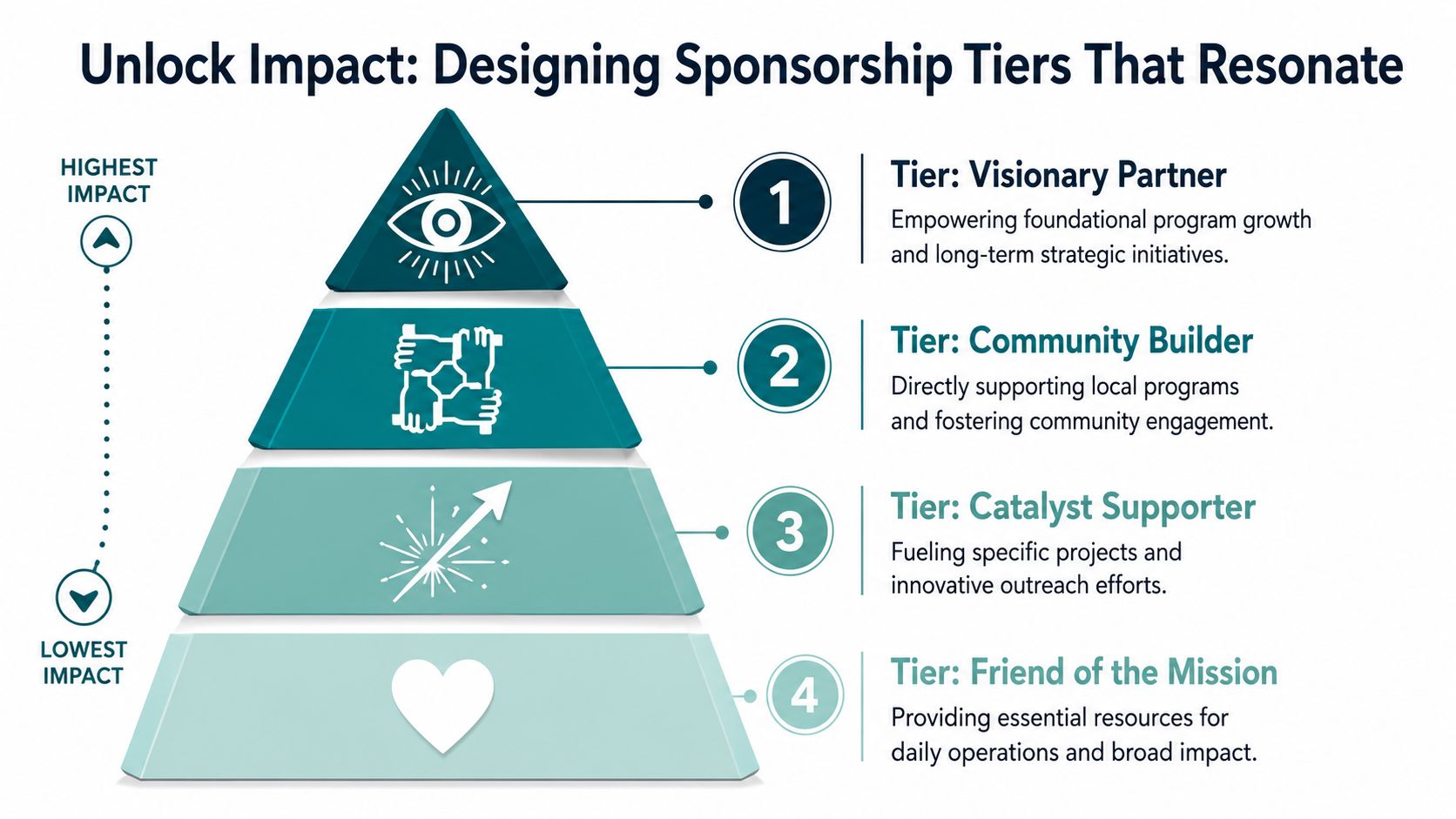
    A four-tier pyramid chart illustrating sponsorship levels for nonprofits, ranging from Visionary Partner to Friend of the Mission.

    Name the levels after the work, the role, or the result. A cleanup group could use Cleanup Crewmate, Block Captain, Route Builder, and Neighborhood Champion. A tutoring nonprofit could use Reading Buddy, Classroom Backer, Family Partner, and Learning Builder. Plain language wins because it tells a sponsor where they fit without making them decode your jargon.

    Keep the ladder short. Three or four tiers is enough for almost every volunteer-led group. More than that and your one-pager starts looking like a catering menu.

    Each tier should answer one question fast: what changes at this level?

    Here's the structure I recommend:

    • Entry tier: Simple recognition, thank-you visibility, maybe a logo on one item
    • Middle tier: Support tied to one event, one program day, or one recurring activity
    • Upper tier: Named support for a route, project, neighborhood, or program area
    • Top tier: Limited partnership tied to a major initiative or a year-round commitment

    The jump between levels should feel real. Do not add five tiny perks just to make the chart look full. Add one meaningful difference. Maybe the sponsor moves from logo placement to named support of a volunteer day. Maybe they move from one shoutout to recurring recognition tied to a visible neighborhood project. Clear progression beats clutter.

    I also like making the middle option the easiest yes. That is usually where a local business gets enough visibility to care, and your team can still deliver without turning volunteers into unpaid account managers.

    Show the choices side by side

    Sponsors compare fast, so help them do it.

    Tier Best for What they get
    Friend of the Mission First-time local supporters Simple recognition and thank-you visibility
    Catalyst Supporter Project-focused businesses Tied to a specific cleanup, outreach push, or volunteer day
    Community Builder Businesses that want repeated visibility Ongoing recognition and stronger community connection
    Visionary Partner A small set of anchor backers High-touch partnership and custom activation

    That table works because it explains fit, not just benefits. A sponsor should be able to point at one row and say, "Yep, that's us."

    If you want a real-world example of how mission-driven groups frame business relationships beyond a generic ask, look at these corporate social responsibility programs.

    A short video can help you think through how to present levels clearly without drowning people in text.

    Don't cram junk into every tier

    Volunteer-led groups get in trouble here. They start promising extra posts, extra signage, extra mentions, extra everything. Then the event arrives, the team is tired, and fulfillment turns into a scramble.

    Keep each benefit concrete and easy to deliver. If you cannot explain it in one line, track it in a simple checklist, and fulfill it without chasing three volunteers for favors, cut it.

    A clean package beats a bloated package every time.

    Save some requests for add-ons instead of stuffing them into the base tiers. Gloves, snack tables, route signage, shirts, or a one-off beautification push can sit outside the main package. That keeps your tier sheet simple and gives you room to shape a partnership around what a sponsor values.

    Put a Price on Your Passion Without Underselling

    The first time we priced a sponsorship, we lowballed it so hard it hurt. We were scared to ask for real money, so we built a package that looked generous on paper and miserable in practice. The sponsor was happy. Our team was exhausted. We spent weeks delivering extras that should never have been included for that price.

    That mistake taught me something fast. If your package is cheap because you feel guilty asking, your mission ends up subsidizing the sponsor.
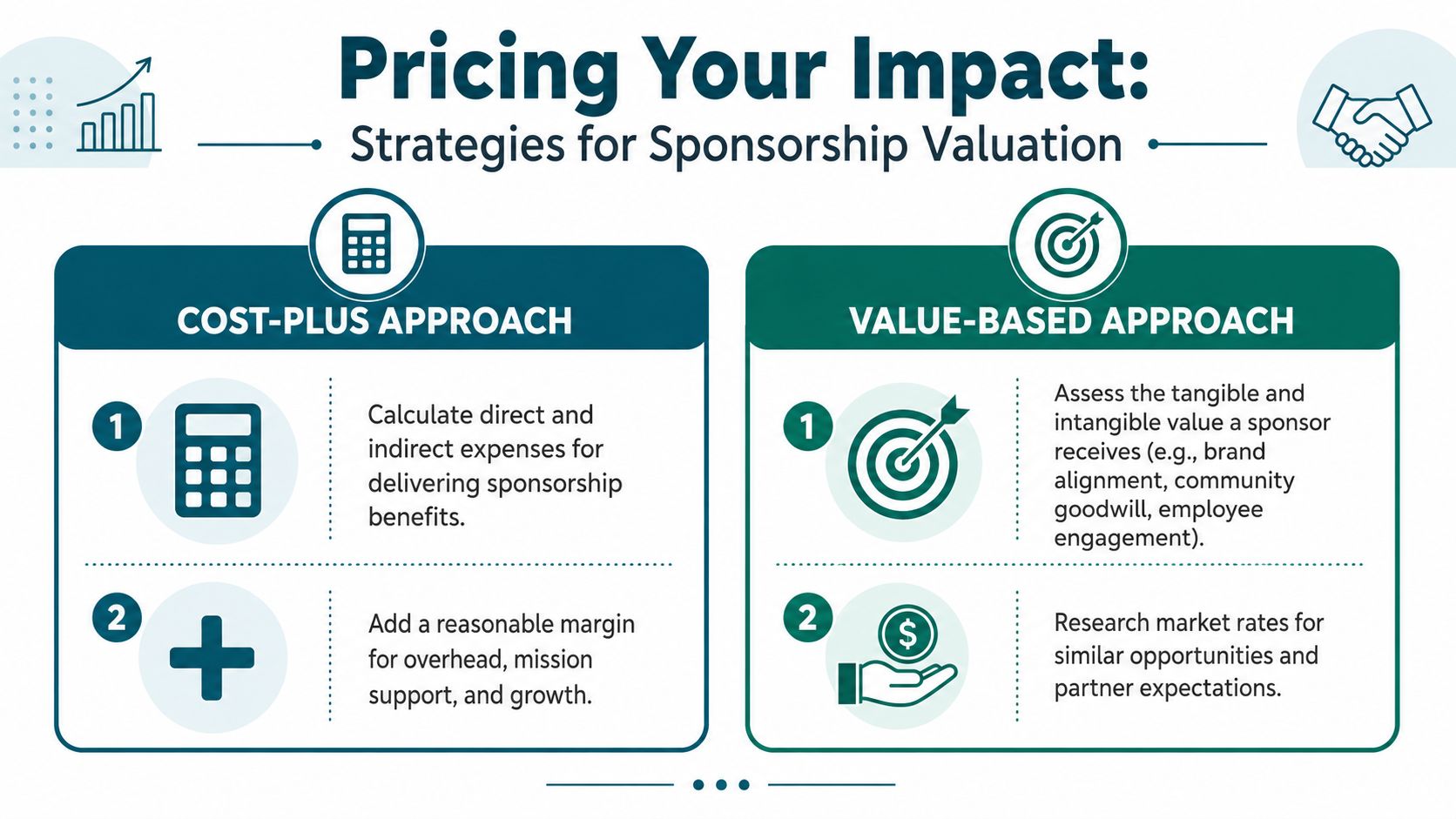
    An infographic titled Pricing Your Impact outlining Cost-Plus and Value-Based strategies for valuing nonprofit sponsorship packages.

    Price the work first

    Start with the plain math.

    List every real delivery cost tied to the package. Shirts. Signs. Printing. Food. Video. Setup. Cleanup. Staff time. Volunteer coordination. Follow-up photos. If three volunteers have to spend two hours making a sponsor look good, that time belongs in the price.

    Small groups skip this because the labor feels invisible. It is not invisible. You are paying for it with nights, weekends, and goodwill.

    Then price the outcome

    Sponsors are not buying a banner by itself. They are buying association with a credible local effort that people care about.

    For a scrappy community group, that value often has nothing to do with polished branding. It comes from trust. It comes from being the organization people see in the park, on the block, or at the school, doing the work instead of talking about it. A local business may support you because they want their team involved, because neighbors will notice, or because your mission fits how they want to show up in town.

    Price for that.

    If you only charge based on materials, you train sponsors to treat you like a discount print shop with a cause attached.

    Use a three-part gut check

    Before I send a number, I ask three questions:

    1. What will this cost us to deliver without chaos?
    2. What are comparable opportunities going for in our area?
    3. What is this worth to the sponsor if we do it well?

    You need all three.

    If you only know your costs, you will probably ask for too little. If you only focus on sponsor upside, you will drift into fantasy pricing and disappoint people. Good pricing sits in the middle. It protects your team and still makes business sense.

    Stop apologizing for your ask

    Volunteer-led groups do this all the time. They soften the number. They offer to throw in extra posts. They say, "We know this isn't much."

    Cut that out.

    If your group brings out families, residents, volunteers, local press, or trusted word of mouth, that has value. If you can organize people and get something done in public, that has value. If your community would notice if you disappeared, that has value.

    Ask like you believe it.

    Keep in-kind sponsorships on the table

    Cash solves plenty. So do donated goods and services.

    A print shop that covers flyers and banners can save your budget. A restaurant that feeds volunteers can remove a real expense. A hardware store that provides gloves, grabbers, or storage bins can make an event possible without cash changing hands.

    Just be careful. In-kind support still needs a price tag on your side. If a sponsor wants the same recognition as a cash partner, assign a fair value to what they are providing and write it down clearly.

    My take: Price with backbone. Deliver with discipline.

    That is how small groups punch above their weight. You do not need slick corporate language or a giant staff. You need honest numbers, a clear sense of your worth, and enough nerve to stop giving away the store.

    Write a Proposal That Gets Read

    Most sponsorship proposals are dead on arrival because they read like insurance paperwork. Nobody wants that. Your proposal should feel like a real invitation from a real group doing real work.

    I like short proposals. Two or three pages is plenty for a small organization. If somebody needs more detail, you can send it after the conversation starts.

    Keep the structure simple

    Your proposal only needs a few pieces:

    • Your story: Why you exist and what kind of people you bring together
    • Your audience snapshot: Who you reach, where they live, and why they care
    • Your sponsorship menu: Tiers or modular options, shown clearly
    • Your deliverables: What you'll do, when you'll do it, and what exclusivity exists
    • Your next step: A direct ask for a call, reply, or meeting

    One of the biggest mistakes I see is trying to make one static package work for everybody. I don't buy that for scrappy groups. Sponsor behavior is shifting toward year-round recognition models instead of purely event-based exposure, and smaller nonprofits may do better with modular assets like cleanup route sponsorship, volunteer gear underwriting, or park-transformation funding, as discussed in Banking Crowded's sponsorship package article.

    Use plain English

    Don't write “integrated activation opportunity.” Write “your team can join the cleanup and we'll thank you in our recap post.”

    Don't write “brand exposure across multiple touchpoints.” Write “we'll put your name on volunteer gear, mention you in our email, and tag you in event photos.”

    That kind of language gets read because normal people can understand it in one pass.

    Leave room for custom deals

    I like having a standard package sheet ready. I also like ignoring it when the right custom idea shows up.

    A hardware store may not care about Instagram. They may love being the official glove and grabber sponsor. A coffee shop may care less about logos and more about fueling volunteers at one monthly cleanup. A neighborhood developer may want to back a specific block transformation.

    So I keep a section at the bottom called “Build Your Own Partnership.” That line opens doors.

    If your proposal answers every question except “why this sponsor,” it still isn't finished.

    Make the close easy

    End with one clean next step. Not five.

    Ask them to book a call. Ask them to reply with the tier they want. Ask if they want a custom version. That's enough. The proposal should start a conversation, not trap them in homework.

    Go Find Partners and Keep Your Promises

    The first sponsorships I ever chased the wrong way went nowhere.

    I sent polished emails to people who did not know us, used language no real person says out loud, and waited for replies that never came. Meanwhile, the businesses two blocks from our cleanup route already knew our volunteers by name. They had watched us drag trash bags past their storefronts for months. I was looking for “sponsors” when I should have been talking to neighbors with budgets.

    That lesson matters if your group is small, volunteer-led, and stretched thin. You do not need a fancy pipeline. You need a short list of local businesses that already trust what they can see.

    Make the first ask human

    Start close.

    Go to the coffee shop that sees your volunteers every month. Talk to the hardware store that sells gloves, buckets, or grabbers. Walk into the small business whose owner has already thanked you for cleaning up the block. Those conversations are warmer, faster, and more honest than chasing a giant company that will bury your email.

    Some of our best sponsor conversations started with a normal visit. I bought a drink, introduced myself, explained what we were doing in plain English, and asked one simple question: would you be open to seeing a one-page partnership sheet? That works because it respects their time and keeps the pressure low.

    If you need help building a prospect list that is grounded in reality, use this guide on how to find corporate sponsors for a small community group.

    Sponsorship is a real budget line for many businesses, as noted earlier in the article. Treat it that way. Stop sounding grateful for the chance to ask. Sound prepared to show value.

    Follow-through decides whether you get renewed

    Getting the first yes feels great. Keeping your word is what turns one check into a relationship.

    Small groups lose renewals for stupid reasons. They forget the thank-you post. They misspell the sponsor's name. They promise photos and never send them. They wait three weeks to recap an event that people barely remember by then. None of that is a strategy problem. It is a discipline problem.

    I have watched groups do good work on the ground and still lose easy sponsor renewals because they got sloppy after the money came in. Do not do that. If you are the scrappy group trying to punch above your weight, reliability is your advantage.

    Use a simple fulfillment routine:

    • Before the event: confirm logo files, business name, contact person, and every promised deliverable
    • During the event: take clear photos, capture signage, and keep quick notes on turnout and outcomes
    • Within 48 hours: send a thank-you with a few strong photos and a short recap
    • After everything is delivered: send one clean summary that shows what happened and what their support made possible

    That last piece matters more than people think. Sponsors want proof that their support did something real. Give them photos, a short result summary, and one or two specific moments from the day. “We removed 40 bags of litter and had 27 volunteers” is good. “Your support helped us clean the bus stop block that parents walk every morning” is better.

    Keep the relationship warm between events

    Do not disappear after the event.

    Send a quick update when the next cleanup happens. Tag them when it fits. Share a win that connects to what they funded. If they backed volunteer water, show the volunteers. If they funded a block cleanup, show the block. Keep it tied to the story they said yes to in the first place.

    The best sponsor relationships feel steady and personal. A volunteer-led group can do this better than a big organization because you are closer to the work and closer to the people around it.

    That is your edge. Use it.

    Your Most Common Sponsorship Questions Answered

    People usually don't struggle with the package itself. They struggle with the fear wrapped around it. Fair enough. Here are the questions I hear most.

    What if they say no

    Then they say no.

    That's all. It doesn't mean your mission is weak. It may mean the timing is bad, the fit is wrong, or the owner is buried. Thank them, keep the relationship warm, and move on. A clean no is better than a vague maybe that drags for months.

    What if a sponsor wants to change our mission

    Don't bend.

    If somebody wants to support you only after you soften your voice, change your values, hide your people, or chase optics over substance, walk away. Money that twists your group out of shape is expensive money.

    Do I need a formal contract

    For a very small local arrangement, a clear written agreement in email can be enough if both sides are straightforward and the deliverables are simple. For bigger commitments, exclusive deals, naming rights, or anything that carries risk, get a proper agreement and legal help if needed.

    What if we're too small to make a package

    Small is fine. Confusing is the problem.

    A tiny group with a clear story, consistent activity, and honest follow-through can beat a larger group with a bloated packet and weak execution. Your size isn't the issue. Your clarity is.

    How do I keep volunteers from feeling used

    Protect them on purpose. Don't promise sponsor perks that make the volunteer experience worse. Keep your people first. If you need a better system for that side of the work, these volunteer management best practices are a useful starting point.

    Should I customize every proposal

    No. That becomes chaos.

    Build one core package. Then adjust around the edges for fit, timing, and sponsor goals. Think modular, not random. You want flexibility with guardrails.

    Good sponsorships should make your mission easier to do, not harder to recognize.


    If you want more direct advice on building grassroots partnerships without turning your group into corporate wallpaper, check out Litter Caterpillars. We share what's worked for a volunteer-led cleanup group trying to punch above its weight, stay brave, and keep the soul intact.


  • Discover how to find corporate sponsors: A practical guide

    Discover how to find corporate sponsors: A practical guide

    Let me tell you something about learning how to find corporate sponsors: it's not about groveling for cash. You're not passing a hat around. You're inviting someone—a real, breathing company—into an adventure. A story. It’s a narrative of pure grit, of neighbors banding together, of making a tangible difference—a story they can’t just buy off a shelf or cook up in some sterile boardroom. The sponsorships that last? They're forged in the fire of a shared mission, not in the cold, hard calculus of metrics.

    Your Sponsorship Journey Begins With Your Story

    Before you dare to dream about sponsorship tiers or see their logo splashed across a banner, you have to excavate your "why." Why did you even begin this crazy thing? What was that single, crystallizing moment when everything shifted? Corporate partners aren't swayed by your immaculate spreadsheets. They're moved by your fire. They need to feel the heat.

    I didn’t kick off Litter Caterpillars with some grand, laminated business plan. I started it because I was suffocating in my own mess, both literally and metaphorically. My apartment was a disaster zone, my life felt like it was stuck in park. A sudden, sharp realization hit me: I couldn't possibly clean up my own life until I started cleaning up for others. That was my escape hatch.

    Unearthing Your Origin Story

    Every truly great group has an origin story. It’s that singular moment, that one vivid memory that perfectly encapsulates the soul of what you do. It’s the anecdote that makes someone stop their mindless scrolling, lean in closer to the screen, and actually listen.

    For me and my crew, it wasn't some polished, strategic summit. It was just three of us, shivering violently under a lone tree during a freak Chicago hailstorm on our very first cleanup. Every. Single. Uber. Canceled. We were drenched, freezing our tails off, and frankly, it was miserable. But right there, in that moment of shared suffering, I had an epiphany. Cleaning up someone else’s mess was profoundly easier than confronting my own, and the struggle, shared, transformed into an adventure.

    That hailstorm didn't crush us; it forged us. It became the beating heart of our story. It’s the raw, unfiltered evidence of our commitment. Your story doesn’t need a Hollywood polish; it just needs to be brutally true.

    Think about your own defining moment. Was it:

    • A specific, electric conversation that ignited the entire idea?
    • A gnawing, frustrating problem that you just knew you were the one to solve?
    • A moment of pure, unexpected euphoria during your very first event?

    This is the nucleus of your pitch. It’s the emotional grappling hook that makes a potential sponsor see you not as just another nonprofit with its hand out, but as a tribe of passionate humans they desperately want to join.

    Translating Your 'Why' Into a Mission

    Once you’ve gripped that core story, you need to sculpt it into a mission and a set of values a company can actually understand and support. Your story forges the emotional bond; your mission shows them the destination.

    Our values—bravery, kindness, and unity—bloomed directly from that hailstorm and all the grueling weekend cleanups that followed.

    • Bravery: Showing up in a blizzard to pick up someone else's trash? That’s bravery.
    • Kindness: Helping to heal a neighborhood that isn't even yours is an act of profound kindness.
    • Unity: Huddling together under a tree, united against the elements, creates a bond that no corporate trust-fall exercise ever could.

    Your mission isn't just a slick sentence you slap on your website header. It's your North Star. And it’s the real thing you’re offering a sponsor: a chance to become part of something that stands for real, admirable ideals. When you build powerful community engagement strategies, you give them a clear, illuminated path to participate in that mission.

    You’re not just seeking funds. You are offering a company the chance to become the hero in a real, unfolding story. And that, my friend, is the bedrock for finding partners who won't just write you a check once, but will march alongside you for the long haul.

    Finding the Right Corporate Partners—Not Just Any Sponsor

    Two smiling professionals shaking hands over a table with a magnifying glass showing 'CSR aligned values'.

    Okay, you've got your story locked and loaded. Now you need to find the right audience for it.

    Forget the shotgun approach—blasting your pitch into the void and praying something hits. Learning how to find corporate sponsors is more like spearfishing in a clear lagoon than casting a giant, indiscriminate net. You're not looking for a hundred tepid "maybes"; you are hunting for that one perfect partner.

    This is a game of intelligent, focused searching to find companies whose very soul resonates with yours. It’s exactly like trying to make a new friend—you don’t just accost random strangers on the street. You look for people who share your weird hobbies and see the world through a similar lens. It's the same principle.

    Start Your Search in Your Own Backyard

    The most potent partnerships almost always bubble up from local soil. These are the companies that witness the direct shockwaves of your work every single day. They’re your neighbors.

    I started my hunt by zeroing in on businesses right in the Chicago neighborhoods where we were doing the most work. Who was already investing their money and, more importantly, their time into these communities? Who had a real, tangible stake in seeing places like Englewood or Pilsen not just survive, but thrive? That’s ground zero.

    Here's how you can assemble your initial hit list:

    • Local Business Journals: Publications like Crain's Chicago Business are absolute treasure troves. They are constantly profiling companies making community investments, launching new local initiatives, or celebrating homegrown leaders.
    • Chamber of Commerce Websites: These directories are a fantastic way to identify the key economic players in your area who are already actively engaged in civic life.
    • Event Sponsorship Lists: Go look at the sponsor pages for local festivals, charity 5Ks, or community block parties. This is literally a list of companies that are already saying "yes" to community involvement.

    Your first list doesn't need to be some epic tome. Just aim for a "dream list" of 10 to 15 companies that feel like a natural, intuitive fit. Quality over quantity is everything.

    Digging Deeper for True Alignment

    A list is just a starting point. Now, the real detective work begins. You must peer beyond the glossy marketing slogans and find concrete, irrefutable proof that a company actually walks its talk.

    This is my exact research ritual. I dedicate about 30 minutes to each potential partner, plunging into their digital footprint to really get a feel for their soul. I’m not just looking for a "Corporate Social Responsibility" (CSR) page—any intern can write one of those. I'm hunting for evidence.

    You are searching for the company's story. Does their story rhyme with yours? You want a partner who doesn't just see a logo placement, but sees a chance to be part of an adventure that truly matters.

    I use a simple mental checklist. Do they speak openly and often about their core values? Can I find actual photos or blog posts about their employee volunteer days? Does their CEO post about community service on LinkedIn? These are the breadcrumbs that tell you their commitment is real.

    Using Digital Tools for Smart Prospecting

    LinkedIn is your absolute best friend during this phase. It’s so much more than a digital Rolodex for job hunters; it’s an incredibly potent intelligence-gathering weapon.

    Here’s a specific tactic I use constantly:

    1. Navigate to the LinkedIn page of a company you’re targeting.
    2. Click on the "People" tab.
    3. In the employee search bar, type in keywords like "Community," "Social Impact," or "Foundation."

    Boom. This instantly reveals the exact people whose job it is to build these very kinds of partnerships. These are your people. You’re not trying to breach the fortress of the general marketing inbox or the CEO’s executive assistant. You're looking for the person who gets a genuine jolt of excitement from the kind of work you do.

    This focused approach is how you transmute a cold email into a warm introduction—because you’re speaking directly to the person who already shares your sacred mission.

    Crafting Sponsorship Packages That Offer Real Value

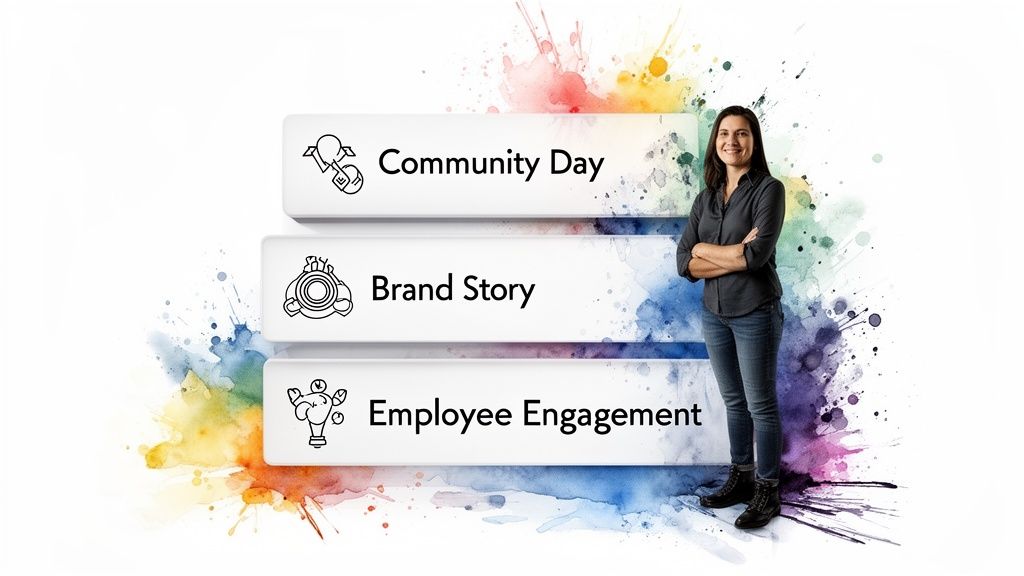
    Smiling woman next to infographic boxes for community, brand, and employee engagement strategies.

    Your sponsorship proposal is not a collection plate you're passing around. Think of it more like an invitation to an exclusive, unforgettable party—one where everyone leaves feeling profoundly inspired. This is your moment to show a company how they can step into the hero role of your story.

    You’re not just asking for money. You are offering a partnership that feels like a powerful, resonant investment in something you both deeply believe in.

    So, let's just toss those tired, generic "Bronze, Silver, Gold" tiers right into the garbage. They’re offensively boring. They make the whole exchange feel like you're just hawking ad space on a bus stop bench. We're going to build packages that offer tangible, thrilling benefits that connect directly to your mission and their strategic goals.

    Beyond Logos To Real, Tangible Benefits

    A logo on a banner is fine, I suppose. But it’s utterly forgettable.

    What a company truly craves is to create a memory. They want their employees to feel a surge of pride and their customers to see them as a genuine force for good. That's the electrifying value you bring to the table.

    When I first started creating packages for Litter Caterpillars, I fixated on experiences. Instead of just offering a logo, I offered them a story they could tell.

    • Brand Visibility with Heart: We don’t offer a generic ad. Instead, we offer them logo placement on our cleanup flags—the very ones our volunteers proudly carry through Chicago's neighborhoods every single weekend.
    • Employee Engagement That Matters: We create dedicated volunteer days where their team can get their hands dirty right alongside us. This isn't some stuffy, awkward corporate retreat; it's a genuine team-building crucible that boosts morale and forges real bonds.
    • Authentic Social Media Content: We capture their team in action—sweating, laughing, winning—and share those powerful, unscripted moments on our Instagram, telling the story of their impact to our deeply engaged community.

    You're giving them something their own marketing department can't manufacture on its own: authenticity. This approach transforms a simple sponsorship into a vibrant, living partnership. To see what this looks like in the wild, check out these powerful corporate social responsibility examples.

    The Psychology Of A Great Ask

    Now, let's talk about the competition. Globally, corporate philanthropic funding swelled to about $71 billion in 2022, yet less than a paltry 5% of that found its way to climate and nature initiatives.

    This means you must be a signal in the noise. You do that by framing your work as a transformative service that builds community resilience and deep, lasting friendships.

    In the U.S., a staggering 65% of Fortune 500 companies offer matching gift programs and 40% provide grants for volunteering. This is enormous. It makes it incredibly smart to pitch sponsorships that directly involve their employees joining your events.

    Your sponsorship packages must tell a crystal-clear story of value. Think of it like a menu at a Michelin-star restaurant. Each dish—or tier—should sound absolutely delicious and promise a unique, unforgettable experience.

    You're not just selling a meal; you're selling the feeling of a perfect night out. Frame your sponsorship ROI not in clicks or impressions, but in brand love, employee pride, and genuine community connection—which is priceless.

    A great way to structure this is with a simple, elegant table that clearly lays out the value at each level. It helps potential sponsors immediately grasp what they get and how they can jump in.

    Sample Sponsorship Tiers

    Here's a template you can adapt. Notice the relentless focus on engagement and storytelling, not just logos.

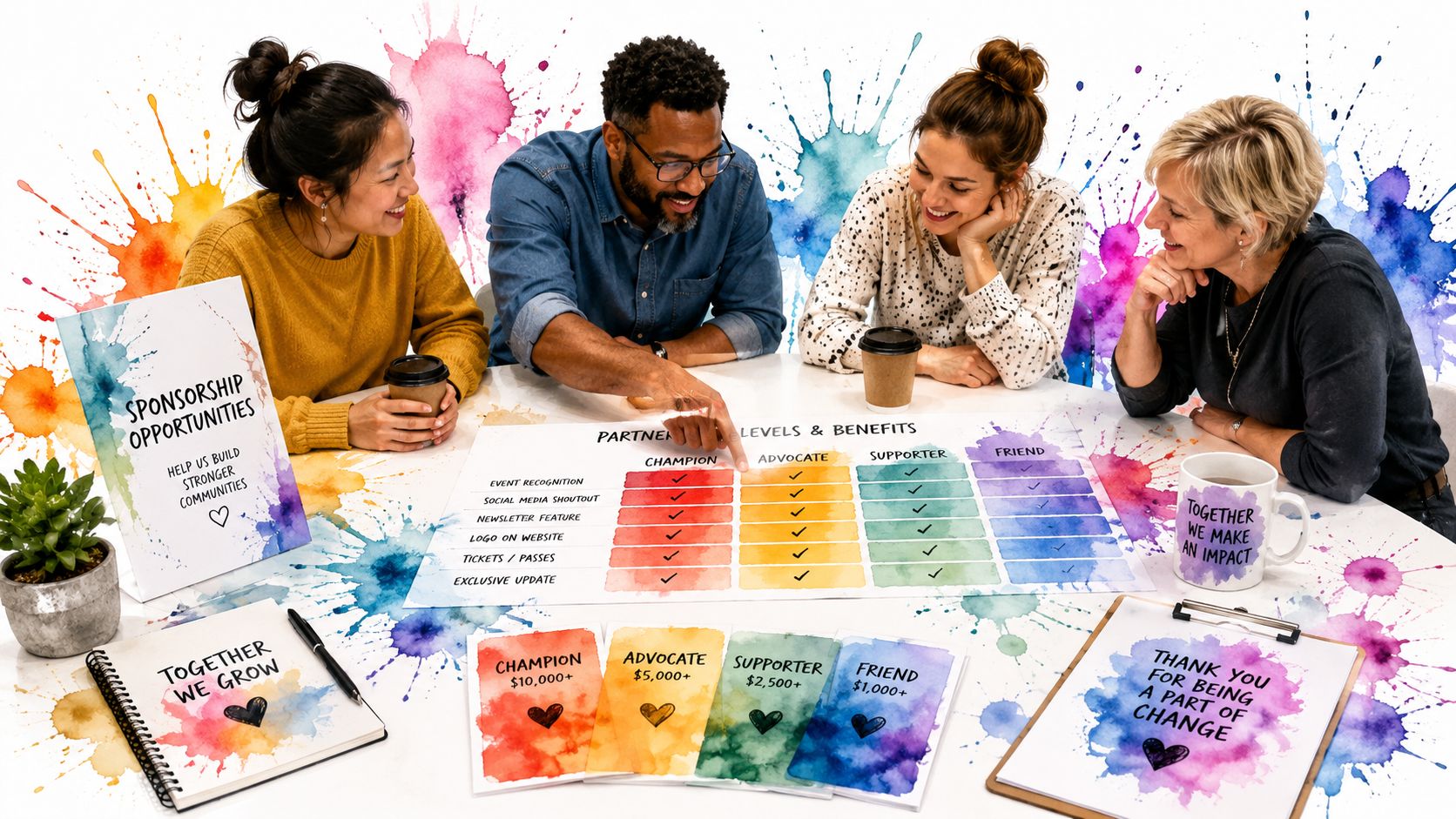
    Tier Level Contribution Brand Recognition Benefits Employee Engagement Opportunity
    Neighborhood Guardian $2,500 Logo on cleanup flags for one month; social media shoutout with team photos. One sponsored volunteer day for up to 20 employees.
    Community Champion $5,000 Logo on all event materials for a quarter; featured story on our blog. Two sponsored volunteer days; priority scheduling.
    City-Wide Hero $10,000 Premier logo placement on our website for a year; co-branded social media campaign. Four sponsored volunteer days; custom team-building activities.

    Giving your tiers evocative names that reflect your mission—like "Neighborhood Guardian" or "Community Champion"—transforms the entire conversation from a cold transaction into a thrilling collaboration.

    Remember, you’re inviting them to join an adventure. Your sponsorship package is the treasure map that shows them exactly how they can become part of something truly special. It’s an invitation to share in the grit, the joy, and the victory of making your community better, one piece of trash at a time.

    Mastering the Outreach and First Connection

    Okay, you’ve got your story, your dream list of companies, and your killer sponsorship packages. Now for the part that requires a deep, centering breath and a little bit of raw courage.

    I get it. Hitting "send" on that first email feels like stepping off a cliff. I’ve been there, stomach in knots.

    But I need you to completely reframe this moment. You aren't bothering anyone. You're not a salesperson or some charity case begging for a handout. You are offering a golden ticket—an invitation for a company to become a main character in a real, unfolding story of impact. This is your moment to be brave.

    Finding the Right Person to Email

    Before you even dream of writing a single word, you have to find the right inbox. Sending your beautiful, heartfelt proposal to a generic [email protected] address is like throwing a message in a bottle into Lake Michigan. Good luck with that.

    And forget the CEO. They’re swimming in a sea of emails. You need to find the person whose actual job it is to care about what you're doing.

    Like I said before, LinkedIn is your secret weapon here. You're hunting for titles that include words like:

    • Community Relations
    • Social Impact
    • Corporate Citizenship
    • Foundation Manager

    These people are the gatekeepers, but more importantly, they are the champions. Their entire professional life revolves around finding inspiring stories just like yours and connecting their company to them. When you email them, you're not interrupting their day; you're actually helping them do their job.

    Crafting an Email That Actually Gets Read

    The perfect first email is short, deeply personal, and hits them right in the heart. It needs to sound like a human being wrote it, not some soulless copy-and-paste bot. Remember, the goal isn't to close the deal in one email; it's just to start a conversation.

    I use a simple, three-part structure for every single outreach email I send.

    1. The Personal Hook: Start with a genuine, specific compliment about their company. Did you see a recent article about their volunteer work? Do you actually use and love one of their products? Show them you’ve done your homework and aren't just spamming a random list.
    2. The Story: In just two or three powerful sentences, share the beating heart of your mission. Don't you dare talk about sponsorship levels or benefits yet. Talk about that hailstorm, or whatever your defining moment is. Make them feel something.
    3. The Easy Ask: End with one simple, low-pressure question. "Would you be open to a quick 15-minute chat next week to hear more about how we're bringing communities together in Chicago?" That's it.

    This isn't about memorizing a script. It's about being devastatingly genuine. Your passion is your superpower. Let it blaze through in your words.

    This approach respects their time and piques their curiosity. You're not overwhelming them with attachments or a daunting wall of text. You're just gently opening a door.

    Nailing the First Meeting

    When you get that "yes" for a meeting—celebrate! Then, it's showtime. But "showtime" doesn't mean you put on some slick performance. It just means showing up as your real, passionate, slightly messy self.

    Forget a memorized 20-page slide deck. I never use one. Instead, I bring our story to life. I show them photos from our cleanups—real people, smiling, covered in a little bit of honest dirt. I tell them about the improbable friendships that have formed during our weekend events.

    The most crucial part of this first meeting is to listen more than you talk. I am dead serious. Kick off the conversation by asking them questions:

    • "What are some of your company's big community goals for this year?"
    • "From your perspective, what does a really successful, knock-your-socks-off partnership look like?"
    • "What kind of stories or projects get your team the most fired up?"

    Their answers are your roadmap. They will literally tell you how to frame your proposal as the perfect, tailor-made solution to their needs.

    You’re not just trying to get a check; you're trying to build a real relationship. And the best way to do that is by showing you care about their world as much as you want them to care about yours. This is how you find the kind of corporate sponsors who stick around for the long haul.

    Turning a Yes into a Lasting Partnership

    Man and woman smiling, exchanging a wooden coin, with a smartphone and watercolor effects.

    That handshake, that signed agreement, that first check—it feels like the finish line, doesn't it? I remember that euphoric feeling. But I learned very quickly that getting a "yes" isn't the end of the race. It's the starting gun.

    The real magic, the part that separates a one-time donation from a true, lasting, soul-deep partnership, happens after the deal is signed. This next phase is all about stewardship. It's about making your sponsors feel like the heroes they are, every single step of the way.

    Beyond the Logo A New Kind of Recognition

    Anyone can slap a logo on a website. It's easy, it's expected, and if I'm being honest, it's a little bit boring. Your partners deserve more. They deserve recognition that feels as real and heartfelt as the work you do together.

    Think of it like giving a gift. You could give someone a generic gift card, or you could give them something thoughtful and specific that shows you truly see them. Stewardship is the thoughtful gift.

    For Litter Caterpillars, we brainstormed ways to make our partners feel like they were truly part of the crew.

    • Custom Badges: We designed a special "Litter Caterpillars Hero" digital badge for their entire team, something they could proudly share internally to celebrate their collective impact. It’s a small gesture, but it builds immense pride.
    • Instagram Story Takeovers: We’ll feature a heartfelt, emotional story on our Instagram, not just about the company, but about their people who showed up for a volunteer day. We share pictures of them smiling, working hard, and making a visible difference.
    • Personalized Impact Videos: I'll sometimes record a quick, raw video on my phone right from a cleanup site and send it directly to our contact. "Hey, just wanted to show you the huge, undeniable impact your support is having in Englewood today. The team is absolutely buzzing."

    These things don't cost a lot of money, but they are incredibly rich in meaning. They show that you see your sponsors as human beings, not just as a line item in your budget.

    Keeping Them in the Loop with Impact Stories

    Nobody likes feeling like an ATM. A sponsor gives you money, and then they hear nothing but radio silence for a year until it's time to ask again. That’s a terrible feeling, and it’s a surefire way to lose a fantastic partner.

    Communication is the very lifeblood of your partnership. It doesn't have to be some complicated, 20-page impact report filled with mind-numbing charts and graphs. In fact, it's better if it isn't.

    Your updates should be simple, wildly inspiring, and direct. They should tell a story, not just list data. You're not just reporting on metrics; you're sharing the adventure.

    I send our partners short, regular updates that get straight to the heart of the matter. Something like, "Quick update! Your support this month helped us clear 50 bags of trash and two abandoned mattresses from the streets around Caterpillar Park. Here’s a photo of the team celebrating."

    It’s simple. It’s visual. It connects their investment directly to a tangible, feel-good result. This consistent storytelling keeps them emotionally invested in your mission, making the renewal conversation at the end of the year feel like a natural, obvious next step.

    Building a Partnership That Renews Itself

    When you treat your sponsors like true, indispensable partners, you’re not just securing funding for one year. You’re laying the foundation for years to come. The goal is to make their decision to renew a complete and utter no-brainer.

    And this matters now more than ever. A game-changing fact is that 94% of major U.S. corporations plan to maintain or even increase their charitable giving. With 76% of U.S. employees preferring to work for companies that positively impact the world, corporate partnerships are a top strategy for sustained revenue. This reveals a growing, fertile pipeline for those who know how to find corporate sponsors and nurture those precious relationships.

    By the end of the year, your sponsor shouldn't just have a folder of your impact reports. They should have a collection of vivid memories.

    They should remember the feeling of their team laughing together on a cold volunteer day. They should remember the surge of pride they felt seeing their company’s name on your cleanup flags, marching through a neighborhood they helped heal. They should remember the personal, unscripted thank-you video you sent them. Our guide to volunteer management best practices can help you craft those unforgettable experiences.

    When you deliver this kind of profound value, you transform the relationship. You're no longer just an organization they support. You become a part of their story, a key player in how they demonstrate their commitment to the community. You become an indispensable part of their mission, just as they have become a part of yours.

    This is how you turn a one-time sponsor into a lifelong champion.

    Common Questions on Finding Sponsors

    When you're just starting out, the questions can feel like a tangled, chaotic mess. It’s like staring at a giant, knotted ball of yarn and having no idea where to even start pulling. I get it. Here are some of the most common questions people throw at me about getting sponsors, with straight-up, honest answers forged in the fires of building Litter Caterpillars from absolutely nothing.

    How Much Should I Ask For From a First-Time Sponsor?

    Start smaller than you think. I'm serious. Your goal with that first ask isn't to hit a grand slam out of the park; it's just to get on base. You want a confident, easy "yes," not a drawn-out, hesitant "maybe" that eventually withers into a no.

    For a first-time local partner, a range of $500 to $2,500 is a perfect, unintimidating starting point. Think of it as a low-risk trial run for them. It’s an amount they can often approve without needing ten layers of management to sign off on it.

    Once you deliver an absolutely amazing experience, show them their tangible impact, and build that real human connection, you can confidently and boldly ask for more next year. The first ask is all about getting them onto your team.

    Don't let your ambition get in the way of building a solid foundation. That first sponsorship is a seed. Your job is just to get it planted; then you can worry about helping it grow into a mighty oak.

    What if a Company Does Not Respond or Says No?

    Rejection is not a judgment on your mission. It is just data. I cannot possibly tell you how many times I've poured my entire soul into a pitch only to be met with deafening silence or a polite, sterile "not at this time." It stings for a second, but then you have to shake it off and remember why you started this whole crazy thing in the first place.

    A "no" could mean a million different things that have absolutely nothing to do with you. Awful timing. Sudden budget freezes. A recent, chaotic change in who's in charge. It’s rarely, if ever, personal.

    My process is brutally simple:

    1. Thank them for their time. Always, always be gracious.
    2. Ask if it's okay to keep them in the loop on your progress. This leaves the door cracked open for the future.
    3. Move on. Your energy is your most precious and finite asset. Spend it on the prospects who are genuinely, electrically excited about what you're building.

    Remember our Litter Caterpillars value of bravery. Getting a "no" just means you're in the arena, swinging the bat. That, in itself, is something to be incredibly proud of.

    Do I Need to Be a Formal 501c3 Nonprofit?

    This is a big one, and it paralyzes so many people with fear. While being a registered 501(c)(3) is definitely helpful because it makes their contribution tax-deductible, it is absolutely not a deal-breaker.

    Many companies have separate, distinct budgets for marketing or community outreach that don't require that 501(c)(3) status. This is especially true if you can offer them incredible brand visibility and a meaningful way for their employees to get involved. You're not just a charity case; you're a marketing opportunity with a soul.

    You can also explore working with a fiscal sponsor—an established nonprofit that can receive the funds on your behalf for a small administrative fee. Don't let paperwork paralyze you before you even start. Focus on building a powerful story and strong, authentic relationships first. The formal structure can and will follow the momentum you create.


    At Litter Caterpillars, we believe in the raw power of showing up and taking that first brave step. If our story of transforming ourselves and our city inspires you, come join us for a weekend cleanup. Learn more and find your next event at https://www.littercaterpillars.com.