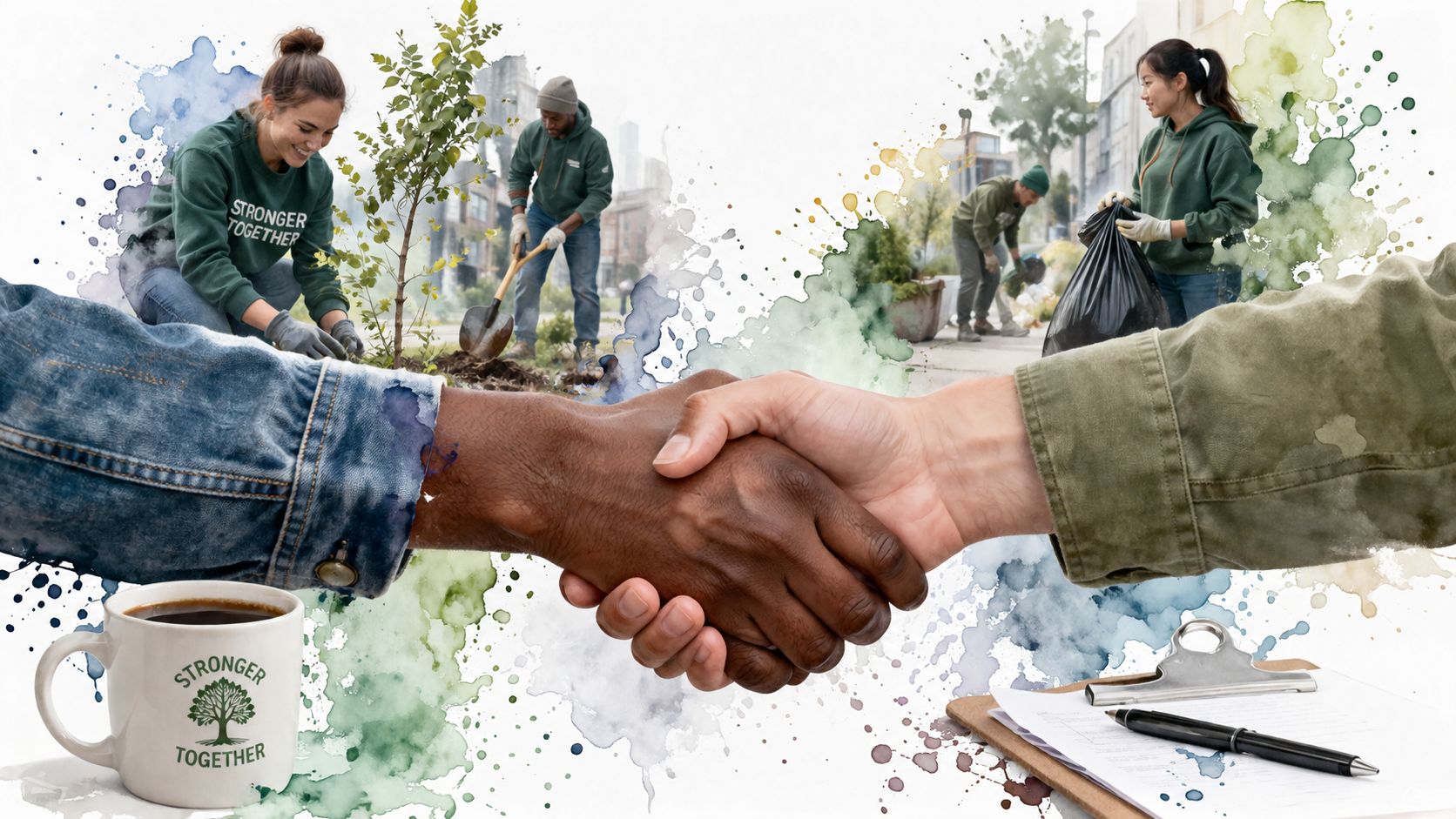
Three of us stood under a tree in a Chicago hailstorm, watching Ubers cancel one after another while trash bags flapped at our feet. We were cold, laughing, and weirdly thrilled, because the cleanup had turned into something more than a cleanup.
I still think about that afternoon every time a partnership gets messy. The rain, the waiting, the tiny burst of joy, that's where I learned that community work doesn't need to feel polished to feel real.
A Hailstorm, Three Friends, and a Strange New Kind of Fun
We didn't start with a strategy memo. We started with a storm, a patch of sidewalk, and three people who refused to go home before the block looked better than we found it. The hail came down hard enough to make us hunch our shoulders, and every canceled ride felt like the city was asking whether we were serious.
I remember thinking that cleaning someone else's mess felt easier than cleaning my own apartment. That sounds small, but it changed the way I look at volunteer work. Outside, the task has edges. You can see the bag fill up. You can point at the curb and say, “We did that.”
Why the Weird Part Matters
The strange part was the fun. Not polished-flyer fun. Not “team building” fun. More like, we were cold, annoyed, and still laughing because the whole thing had a pulse. That feeling told me something I still trust, people stay when the work gives them meaning, motion, and a little pride.
That's why I care so much about volunteer-first thinking. If the people doing the work feel used, confused, or unsafe, the whole thing gets brittle fast. If they feel like they belong, they come back, bring a friend, and treat the cleanup like it belongs to them too.
Practical rule: if a partnership would still look good on paper after the volunteers quit, you've probably written the wrong agreement.
I've seen enough neighborhood projects to know that the best ones feel a little homemade. The coffee is never perfect. Someone forgets gloves. Someone else brings a speaker and a flag and suddenly the whole thing has personality. That's the kind of scrappy energy I trust, because it survives bad weather and awkward first meetings.
What Community Partnership Development Actually Means
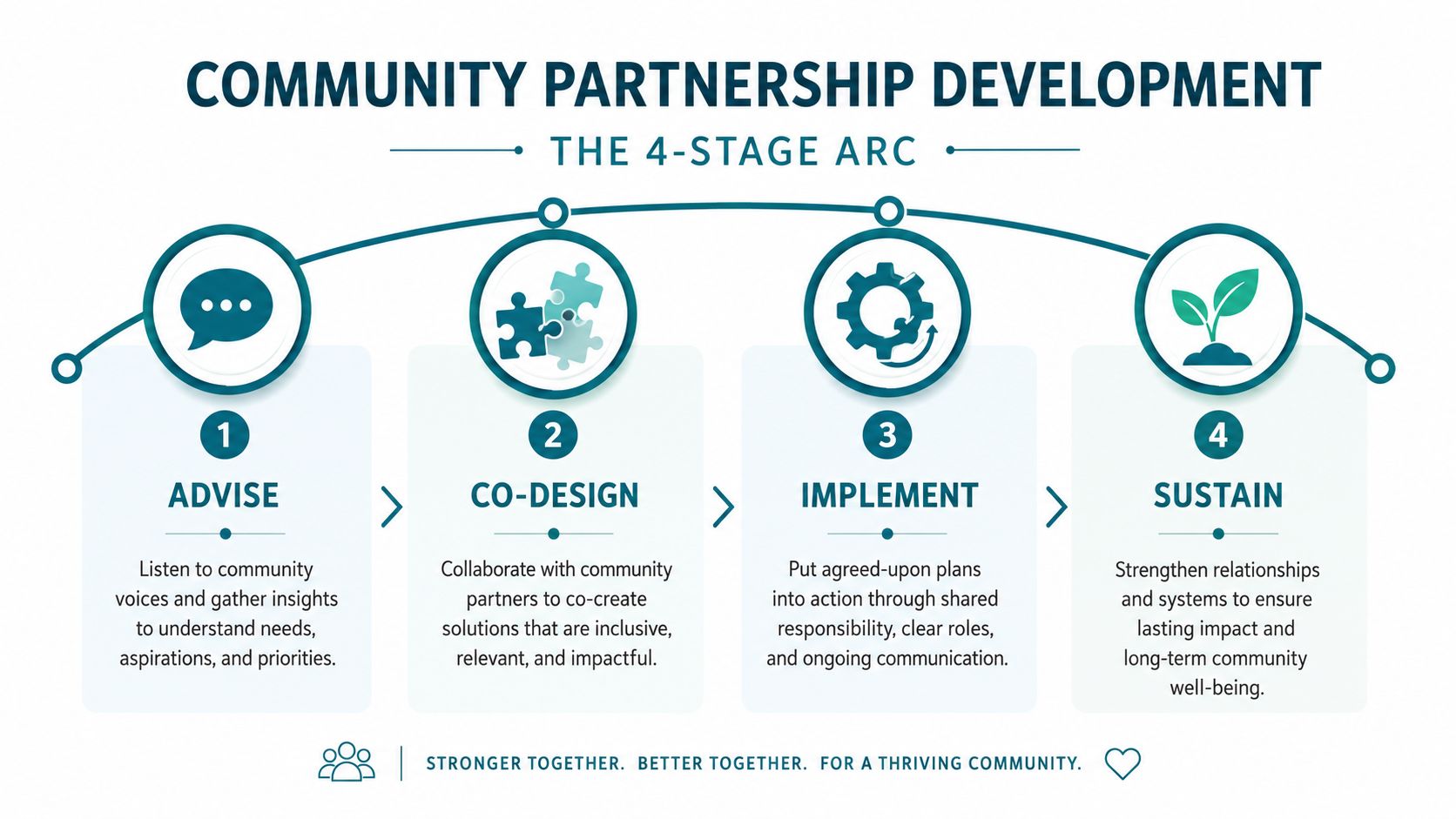
Community partnership development is the work of building a relationship that can hold real shared action, not just a friendly email thread. The strongest versions feel less like a one-time outreach blast and more like a loop, we talk, try something, check it, fix it, and keep going. One widely used framework names four stages, advise, acclimate, activate, and accelerate, and it says partnerships should move through regular check-ins, feedback loops, monitoring, and adaptation instead of one-off outreach (ICRS briefing note on community partnerships).
The Four Stages in Plain English
Advise is the first handshake. I ask, “What's the actual problem here, and who feels it first?” If I skip that, I end up solving my own idea of the problem, which is a fast way to annoy everybody.
Acclimate is where a lot of volunteer groups fall over. I think of it as the “learn the neighborhood” phase, where I listen, show up, and stop trying to move faster than trust. If I rush this part, I get a crowded first event and a dead second one.
Activate is when the work starts moving with shared action. People know the rules, the roles make sense, and the plan has enough shape that no one is guessing mid-cleanup.
Accelerate happens when the partnership can handle bigger effort without turning sloppy. That doesn't mean it gets fancy. It means the group can repeat the work, correct mistakes, and stay honest about what's changing.
The Urban Institute's partnership guidance breaks the work into four habits, do your homework, create equity, commit to transparency, and build and maintain trust, and it says I should be clear about intentions, timelines, funding, and limits from the start (Urban Institute guide). That's the version I keep on my desk, because it cuts through the fog.
If I can't explain who decides what, who pays for what, and who can walk away, I'm not ready to call it a partnership.
What Partnership Is Not
It isn't a nice conversation with no follow-through. It isn't a logo swap. It isn't “we asked the neighborhood once, so we're done.” The best community partnership development work has structure, clear roles, and a reason for both sides to stay in the room.
A school or neighborhood group can make this practical by using a needs-assessment survey with students, staff, families, and community members, then building a site-based leadership team with those same voices plus partners and community members who meet regularly to plan, implement, and evaluate the work (Institute of Education Sciences). I like that model because it keeps me out of guesswork. Guesswork feels creative until it starts burning people out.
The Outreach Script, the MOU Checklist, and the First Joint Event
The first message I send is never long. I want a clear ask, a reason to care, and a clean yes or no. For me, that sounds like, “We're organizing a neighborhood cleanup on Saturday morning, we like your shop, and I'm asking whether you'd want to co-host water and coffee for volunteers or help us share the event. If that's a no, no problem, but I'd still love to meet and learn what your group cares about.”
That message works because it doesn't hide the point. It respects time, and it leaves room for a real answer. A lot of partnership talk gets fuzzy right here, and fuzzy language wastes weeks.
What I Put in the MOU
I keep the agreement short enough that a busy person can read it. I want roles, decision rights, donation rules, branding rules, safety basics, and a clean exit path if the fit is wrong. The Community Partnership Agreement Checklist I use starts with who does outreach, who approves the plan, who pays for supplies, and who can speak for the event.
| Clause | Why It Matters | Example Language |
|---|---|---|
| Roles and responsibilities | Keeps the work from drifting | “Partner A handles site setup. Partner B handles volunteer check-in.” |
| Decision rights | Stops confusion when plans change | “Final event-day calls go to the named site lead.” |
| Safety and weather rules | Protects people who show up to do the work | “We can cancel for extreme weather without penalty.” |
| Donation and pressure rules | Keeps volunteers from feeling cornered | “No volunteer is asked to fundraise on-site.” |
| Branding and credit | Makes credit feel fair | “Both groups can use approved event photos and names.” |
| Exit terms | Lets either side leave cleanly | “Either partner can end the agreement with written notice.” |
If I need a deeper starting point for sponsor-facing language, I'd rather use a practical page like how to find corporate sponsors than invent a slick pitch from scratch. The best outreach feels plain, not performative.
How I Plan the First Joint Event
I keep the first event small enough to survive chaos. A block cleanup with a local coffee shop is enough. One group brings bags, gloves, and a route. The other brings coffee, a table, and a person who knows how to greet strangers without making them feel recruited.
Simple event rule: if the first joint event needs a giant crowd to feel worth it, the plan is too heavy.
I also decide in advance what happens if turnout is thin. We still clean the block. We still thank the partner. We still take photos, because one small win gives the next ask more oxygen.
Volunteer-First Clauses That Protect the People Doing the Work
Most agreements protect the organization. I want the agreement to protect the people in the rain. If I'm writing for volunteers, I need language that treats their time, comfort, and safety like real assets, not afterthoughts. That's where a volunteer-first clause matters.
The clinical community partnership literature names five moving parts groups need to build together, relationship-building, system-barrier fixes, culturally relevant supports, meaningful involvement, and ongoing communication with feedback (active community partnerships paper). I read that as a reminder that a good agreement isn't just about nice feelings. It has to make the work possible for the people carrying it.
The Clauses I Refuse to Skip
I always want a weather escape hatch. If the forecast turns ugly, volunteers shouldn't have to prove bravery by getting soaked. I also want a small budget line for water, gloves, and the little things that make a cold morning bearable. Comfort is not fluff. It's what keeps people coming back.
I also write in a no-pressure donation rule. Volunteers should never feel like they need to hand over money to prove they care. If a partner wants support, I'd rather make that a separate ask, in a separate channel, from people who want to give.
Another clause I care about is media authority. I want to know who can speak to reporters, post official photos, and answer questions if something goes sideways. That keeps the partnership calm when attention shows up uninvited.
Pride Is Part of Protection
I've watched flags, theme songs, and badges do something simple and powerful. They give people a reason to feel seen. When someone puts on a badge before a cleanup, they're not just a pair of hands. They're part of the group, and that changes how they move through the work.
That's why I like agreements that leave room for joy, not just rules. A partnership can be serious and still make room for laughter, music, and a little ritual. The point isn't decoration. The point is that people remember why they came.
If you need the insurance side of this, I'd start with volunteer liability insurance before I'd let the group wing it. A safe partnership is easier to trust, and trust is what gets people to show up twice.
How to Tell If the Partnership Is Actually Working
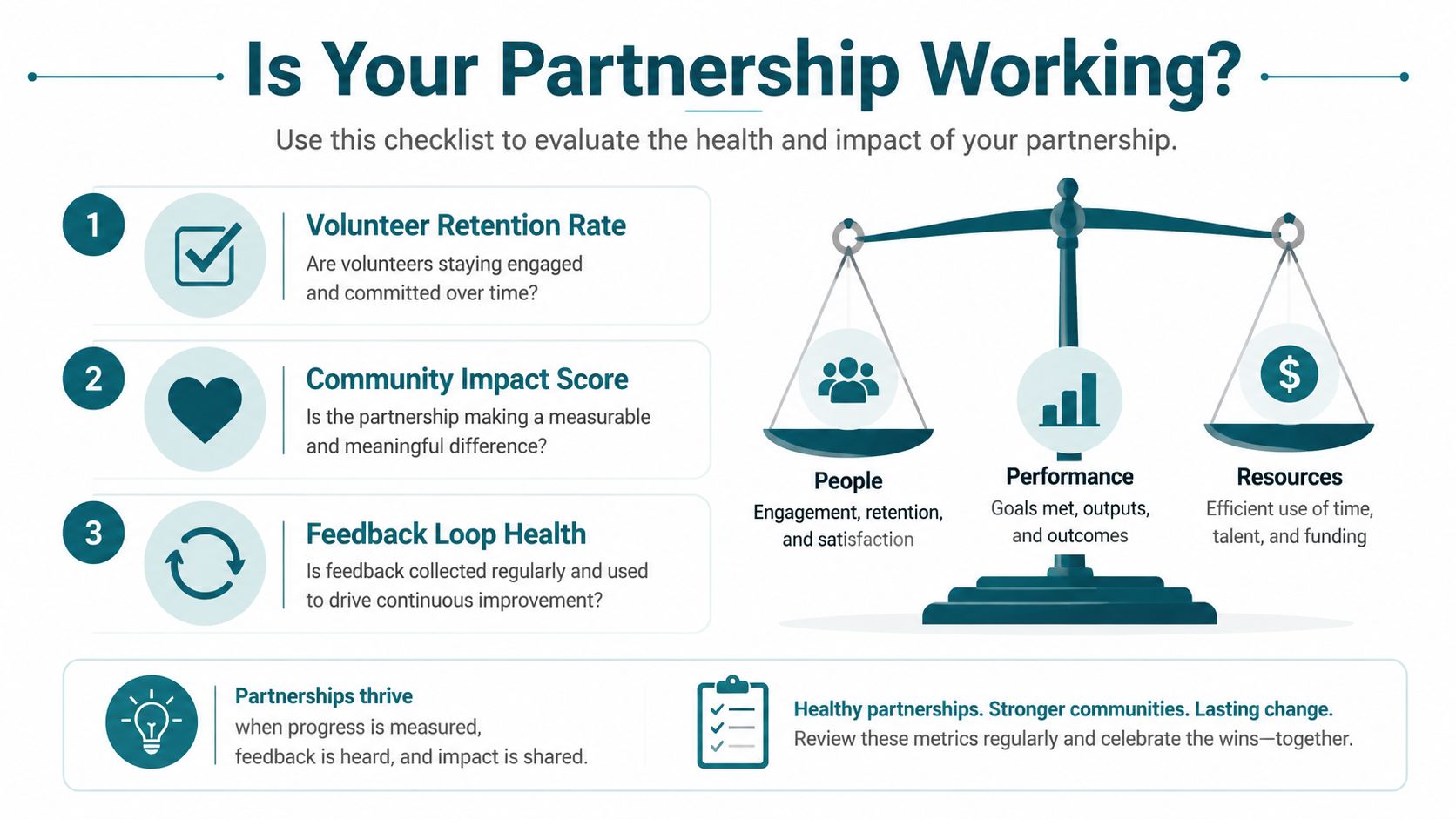
I don't need a giant dashboard to know whether a partnership is alive. I need a short list, a calendar, and enough honesty to face the answer. The U.S. Chamber of Commerce recommends a formal written partnership agreement, regular check-ins, and a quarterly review, and it says to track concrete measures like referrals, website traffic, social media growth, volunteer hours, funds raised, donations, or people served (U.S. Chamber of Commerce).
My Weekend Measurement Setup
I track a few numbers, and I keep them boring on purpose. Pick three to five measures that fit the work, then review them every month. For a cleanup partnership, that might be volunteer hours, people served, referrals, donations, and one basic sign of reach like website traffic or social growth.
I pair the numbers with one short story. Maybe it's the first-time volunteer who came back with a cousin. Maybe it's the coffee shop owner who started greeting people by name. A story makes the numbers feel human, and that matters when you're trying to keep a partner excited instead of audited.
Here's the rhythm I use:
- Monthly pulse check: I ask what happened, what was weird, and what needs a fix.
- Quarterly review: I sit down with the partner and look at the agreement, the numbers, and the friction.
- Ninety-day question: I ask, “What should we stop doing, and what should we start?”
That last question has saved me from stubborn habits more than once. It gives people permission to say the quiet part out loud before resentment settles in.
What Good Tracking Looks Like
I like plain language in review meetings. “We had more people” is weak. “We had more first-time volunteers, and our check-in took too long” is useful. One invites applause. The other invites action.
If you want a simple template for reporting impact without making it feel corporate, I'd pair this practice with how to measure community impact. The point is to keep the feedback loop visible so both sides know the work still fits.
Avoiding the Extraction Trap and Other Hard Lessons
I've learned to flinch when I hear the phrase “community input” with no mention of money, authority, or credit. More engagement isn't automatically better. If the same institution still controls the budget, the decisions, and the public praise, the partnership can start draining trust instead of building it.
Recent public-health guidance says community members should share decision-making power, get compensated, and receive credit through co-authorship or co-branding, and it warns that community organizations are often underfunded and asked to do unpaid short-term work (CHCS guidance). I agree with that direction, and I'd push it one step further. If the resources and authority don't move, I don't call it a partnership.
Two Real Tests I Use
The first test is a highway cleanup during a bike-event shutdown. City partners helped with access and logistics, and we split the work instead of pretending one side could carry it alone. That mattered because the task had moving parts, and nobody got to act like they owned the whole story.
The second test was winning an empty lot at auction and turning it into a park. That process made every weak habit impossible to ignore. If one side had tried to hold all the control, the project would have turned into a fake collaboration fast.
Hard rule: if the community gives time and the institution keeps control, something is off.
I think a lot of groups get tripped up by convenience. It's easy to partner with whoever already sits near you. It's harder to ask whether the work serves the people who live with the result. Community partnership development gets real when I put the cause and the beneficiaries ahead of the institution's comfort.
So I keep asking: who gets to decide, who gets paid, who gets named, and who can say no? If I can't answer those questions cleanly, I'm still in the extraction zone.
Your First Partnership Conversation This Week
Last cleanup, a first-time volunteer showed up quiet, took a bag, and by the end of the morning was leading a ward like she'd been doing it for years. That's the part I never get tired of, the moment someone moves from visitor to builder. It reminds me that the next good partnership often starts with one small, brave hello.
Here's what I'd do this week. Pick one potential partner, send the short outreach script, draft the MOU with safety and role clauses, set one small joint event, and book the first quarterly review before the event even happens. That keeps the relationship from floating away into “we should do this sometime” territory.
I keep three reminders above my desk. Bravery is a renewable resource. Kindness is a strategy. Showing up is most of the job.
If you want a grounded way to build partnerships that respect volunteers, protect safety, and make room for real trust, Litter Caterpillars is where I'd start. We keep things scrappy, human, and built for people who want to do the work without losing their spirit.