
Three of us stood under a tree in Chicago, getting pelted by hail, soaked through, watching Uber after Uber cancel. I remember thinking, this is weirdly fun, and also, these people came out here because I asked them to.
That second feeling is why I care about volunteer liability insurance.
It All Started with a Hail Storm
Before the flags, before the nicknames, before Litter Caterpillars became a real crew, there was one ugly Chicago day and a handful of people who showed up anyway.
We got hit with hail. Our shoes were soaked. Rides kept canceling. Any reasonable person would have called it off. We kept picking up trash.
That was the day this stopped feeling like a casual meetup I organized online. People came because I asked them to come. They trusted my plan, my judgment, and whether I had thought through what could go wrong. Once that clicked, I couldn't unsee it.
The moment fun turned into duty
Volunteer work gets described with soft words. Community. Service. Purpose. I believe in all of that.
I also believe in looking straight at the ugly part. Public sidewalks get slick. Broken glass hides in grass. Grabbers swing wide. Cars pass too close. Someone twists an ankle stepping off a curb. Someone backs into a parked car while unloading supplies. A normal cleanup can turn into a claim faster than leaders want to admit.
That is not fear talking. That is leadership.
If you run a cleanup crew, a church team, a youth group, or a mutual aid operation, you are responsible for more than morale. You are responsible for the conditions you put people into and the backup plan you have when the day goes sideways.
Brave volunteers still need protection
Litter Caterpillars was built on heart. It was also built in alleys, on curbs, near traffic, in bad weather, around sharp objects, and with volunteers who were giving their time because they believed the work mattered.
That combination is beautiful. It also creates real exposure.
I learned that inspiration is not a safety plan. Good intentions do not pay legal bills. A signed waiver does not magically solve everything. If somebody gets hurt, or somebody says your volunteer caused damage, you need an answer that is better than, “I think we're probably fine.”
I'd rather spend one afternoon setting up protection than spend six months cleaning up a preventable mess.
That is how I think about volunteer liability insurance. Not as paperwork. As respect.
You are telling your people, “I didn't just ask you to be generous. I took your safety and this mission seriously.”
That matters. Especially on the days when the sky opens up and your crew shows up anyway.
What Is Volunteer Liability Insurance Anyway
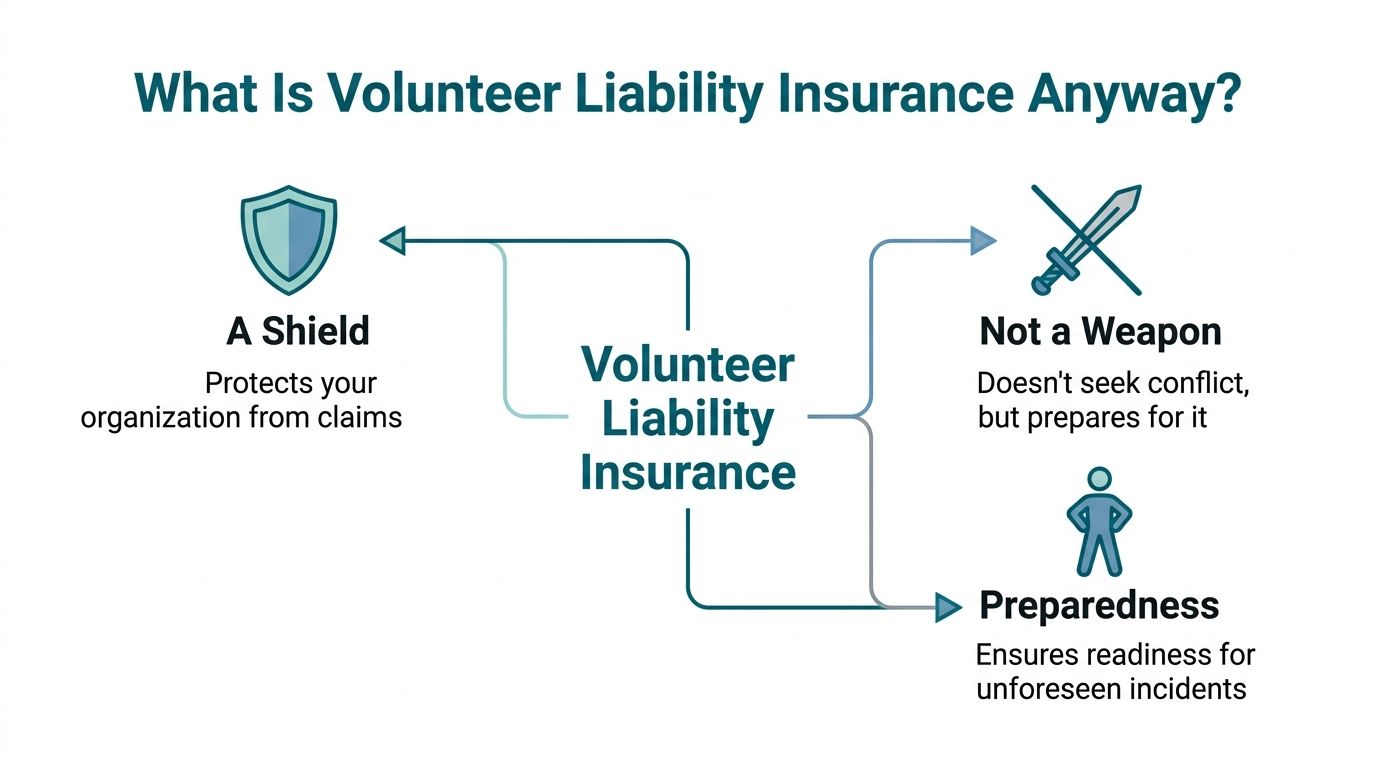
Let's make this simple. Volunteer liability insurance is a shield.
It's not a sword. It doesn't go looking for conflict. It doesn't make your group aggressive or paranoid. It gives your organization a way to survive a bad day.
What it actually covers
At the core, this insurance deals with third-party bodily injury or property damage claims. That means someone outside your volunteer team says your volunteer caused harm.
A plain example works best. A volunteer bends down to grab litter near a busy sidewalk, swings a grabber around too fast, and a passerby falls. Or somebody knocks over a city sign while hauling a bag. Now your group may have a claim on its hands.
Technically, this insurance covers those third-party claims, and it helps pay defense costs and payments up to the policy limit, which is often at least $1 million for groups working in public spaces, according to Atlas Insurance on volunteer and employee nonprofit coverage.
Why I think of it as a shield
A shield doesn't stop every blow from landing. It stops one hit from ending the fight.
That's how I think about this coverage. Your volunteer still may get accused. Your organization still may need a lawyer. You still may have a stressful week. But one awkward accident doesn't have to wipe out your budget, shut down your events, or scare your whole crew away.
Here's the cleanest way to understand it:
- Your volunteer acts by accident: They didn't mean to hurt anyone or damage anything.
- A third party makes a claim: A pedestrian, property owner, partner group, or city agency says your team caused harm.
- The policy responds: It can help with legal defense and covered payouts up to the policy limit.
What it does not mean
Insurance is not permission to be sloppy. If your volunteers are reckless, no policy is going to fix your culture. And if your policy excludes a specific activity, you can still get burned.
That's why I tell people to stop treating insurance like magic. It's paperwork, yes. But good paperwork matters when something goes wrong.
Practical rule: If your volunteers work in public, assume somebody outside your group can get affected by what you do.
That one mindset shift clears up a lot. You stop asking, “Do we really need this?” and start asking, “What exactly are we exposed to?”
The Four Shields in Your Armory
One shield isn't enough for most volunteer groups. You need layers.
A cleanup event looks simple from the outside. People show up, grab supplies, and start helping. But under the hood, several different risks are moving at once. Somebody could injure a stranger. A volunteer could get hurt. Someone could crash a car on the way to the site. A board member could make a decision that creates a legal problem.
The four coverages I'd actually care about
Here's the short version in table form first.
| Insurance Type | What It Covers |
|---|---|
| General Liability | Third-party bodily injury and property damage claims tied to your operations |
| Volunteer Accident Insurance | Medical expense help for volunteers injured during approved activities |
| Non-Owned or Excess Auto Liability | Extra protection when volunteers use personal vehicles for group business |
| Directors and Officers Insurance | Claims tied to leadership decisions, governance, and management conduct |
Now let me translate that into normal language.
General liability is the big shield
This is the one most groups start with. If your event harms someone outside the team, general liability is usually the first line of defense.
If I'm leading a cleanup near traffic, storefronts, or park paths, I assume general liability has to be in place. Public spaces create public consequences. That's just reality.
Volunteer accident insurance is how you treat your own people
This one matters because volunteers aren't employees in the usual sense. If somebody twists an ankle, slips on wet grass, or cuts a hand, you don't want to stare at them blankly and say, “Hope your personal insurance handles it.”
That's bad leadership.
Volunteer accident coverage can help with medical expenses for the injured volunteer. It changes the emotional tone of the whole group. People feel cared for, not used.
Auto coverage matters more than most leaders admit
A lot of volunteer work involves cars, even if the work itself doesn't. People drive to the site. They transport supplies. They pick up water, bags, or signs. They move from one block to another.
For groups like ours, these policies are often layered. Excess auto liability might provide up to $500,000 per accident over the volunteer's personal policy, while excess accident coverage may pay around $25,000 in medical expenses per incident, often as a no-fault benefit, based on the Fairfax County Volunteer Insurance Program.
If your events involve people driving for the group, even casually, don't hand-wave this away.
D and O protects the people making calls
Directors and Officers insurance feels less exciting because it's about decisions, not dramatic field incidents. But if you have a board, formal leadership, fiscal oversight, or partner obligations, this coverage matters.
People can challenge how you governed the organization, handled funds, made policy choices, or managed responsibilities. If you lead anything with structure, this is part of the stack.
My recommendation in plain English
If I were building a volunteer program from scratch, I'd ask about these four in this order:
- General Liability first: Because public-facing harm is the fastest way to face a claim.
- Volunteer Accident next: Because your people need care, not just gratitude.
- Auto protection after that: Because volunteer driving creates exposure even when nobody thinks of it as “transport work.”
- D and O when leadership gets formal: Especially if you have a board, donors, or contracts.
If your group also runs social events, appreciation days, or mixed-format outings, planning safe logistics matters just as much as planning fun ones. I've found that the same discipline that makes volunteer team building activities work well also makes insurance conversations cleaner. Clear roles, clear movement, clear expectations.
Buy insurance that matches what your volunteers actually do, not what your mission statement says you do.
That one sentence will save you a lot of confusion.
The Waiver Myth and Your Real Risks
One of the fastest ways a volunteer leader gets blindsided is by mistaking paperwork for protection.
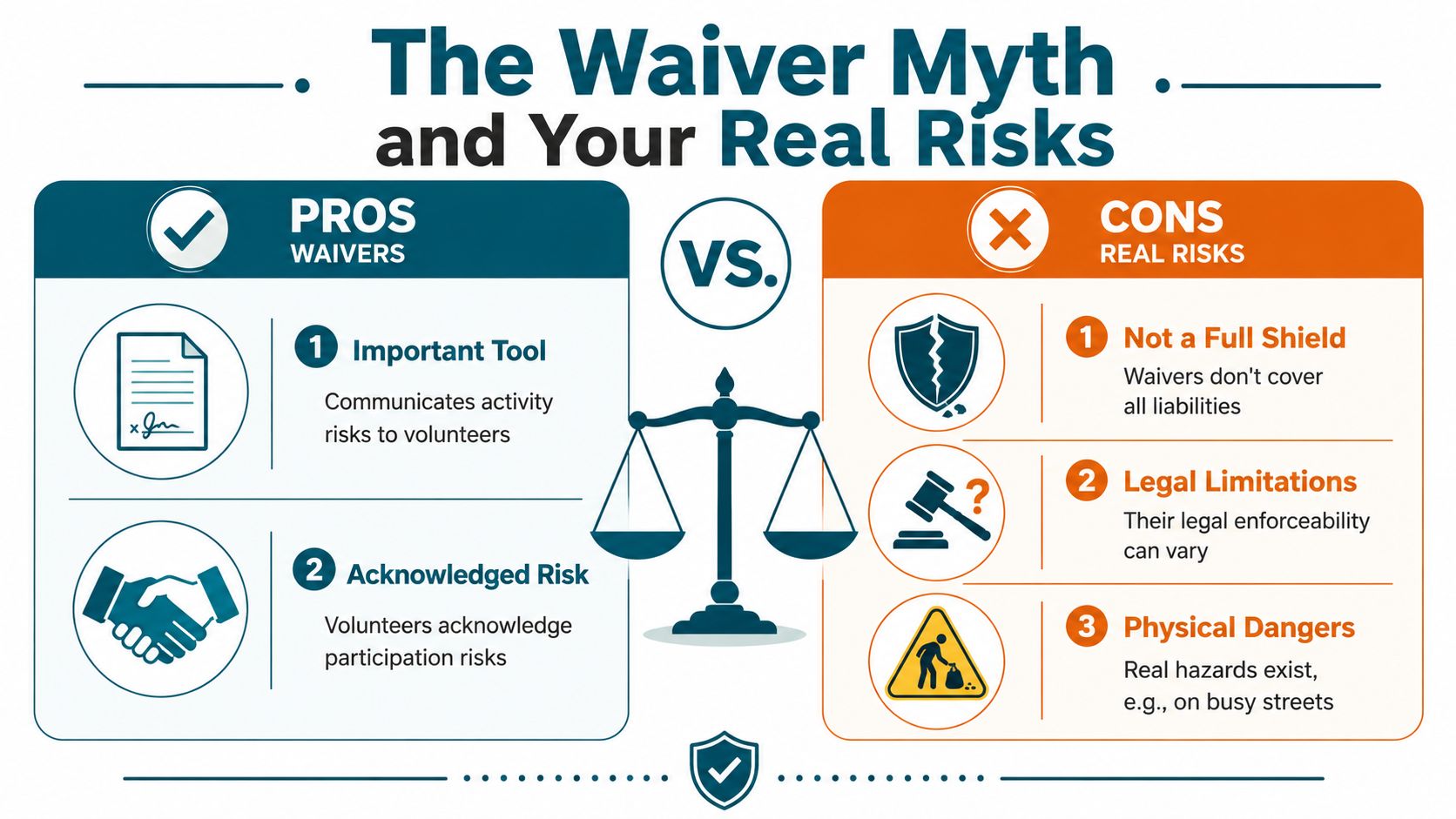
I learned that early. After a cleanup, somebody would ask, “We got the waiver signed, right?” The question sounds responsible. It isn't enough. A signed waiver helps document that a person understood the activity carried risk. It does not pay for a lawyer, a medical bill, or a claim that drags your group into a fight you cannot afford.
A waiver does one job
Use waivers. I do.
For a group like Litter Caterpillars, they matter because they force the risk conversation into the open before anyone grabs a bucket or steps near a curb. We are honest about what happens on a real volunteer trash pickup crew. Broken glass. Rusted metal. Slippery ground. Traffic. Heat. Cold. Fatigue. Public spaces with unpredictable people in them.
That clarity is good leadership.
But keep the role of the waiver straight. It is a record of disclosure and consent. It is not your backup plan after someone gets hurt or claims your group caused harm.
Why leaders get this wrong
Because waivers are cheap, fast, and visible. Insurance is slower and less satisfying. You sign one document and feel like you handled the problem.
You did not.
As noted earlier, a huge share of Americans volunteer every year. With that many people serving in parks, streets, schools, events, and neighborhood projects, accidents and disputes are a practical concern. The risk is not theoretical. It shows up in ordinary moments that go bad quickly.
The risks that actually keep me up at night
I do not worry much about dramatic movie-scene disasters. I worry about the boring stuff, because the boring stuff happens.
- A volunteer steps backward at the street edge while tying a trash bag or talking to another person.
- Someone lifts the wrong thing the wrong way and ends the day with a strained back or a cut hand.
- Wet pavement, gravel, curbs, and tree roots turn a routine cleanup into a fall.
- A well-meaning volunteer improvises and reaches into a storm drain, climbs a slope, or handles something that should have been left alone.
- A driver helping the mission has a problem before, during, or after the event.
That is how things are. Claims come from normal operations, not just extreme mistakes.
What a waiver will not do
A waiver will not fund your defense if someone sues.
A waiver will not cover medical costs.
A waiver will not protect the organization because a volunteer signed a form and later says your team was careless, poorly supervised, or unprepared.
Courts also do not treat every waiver the same way. Wording matters. State law matters. The age of the signer matters. The facts of the incident matter. If your plan depends on one signature page holding up perfectly under pressure, your plan is weak.
If your protection plan starts and ends with a waiver, you are gambling with your volunteers and your organization.
My rule for grassroots crews
Use both. Waivers and insurance. Then add safety briefings, clear roles, site rules, and the discipline to call off work when conditions are bad.
That stack has saved us from sloppy thinking more than once. A waiver sets expectations. Insurance gives your group a way to survive the cost of a claim. Good field leadership lowers the chance that claim happens in the first place.
Cheap answers are seductive. They are also expensive later.
Your Checklist for Getting Covered
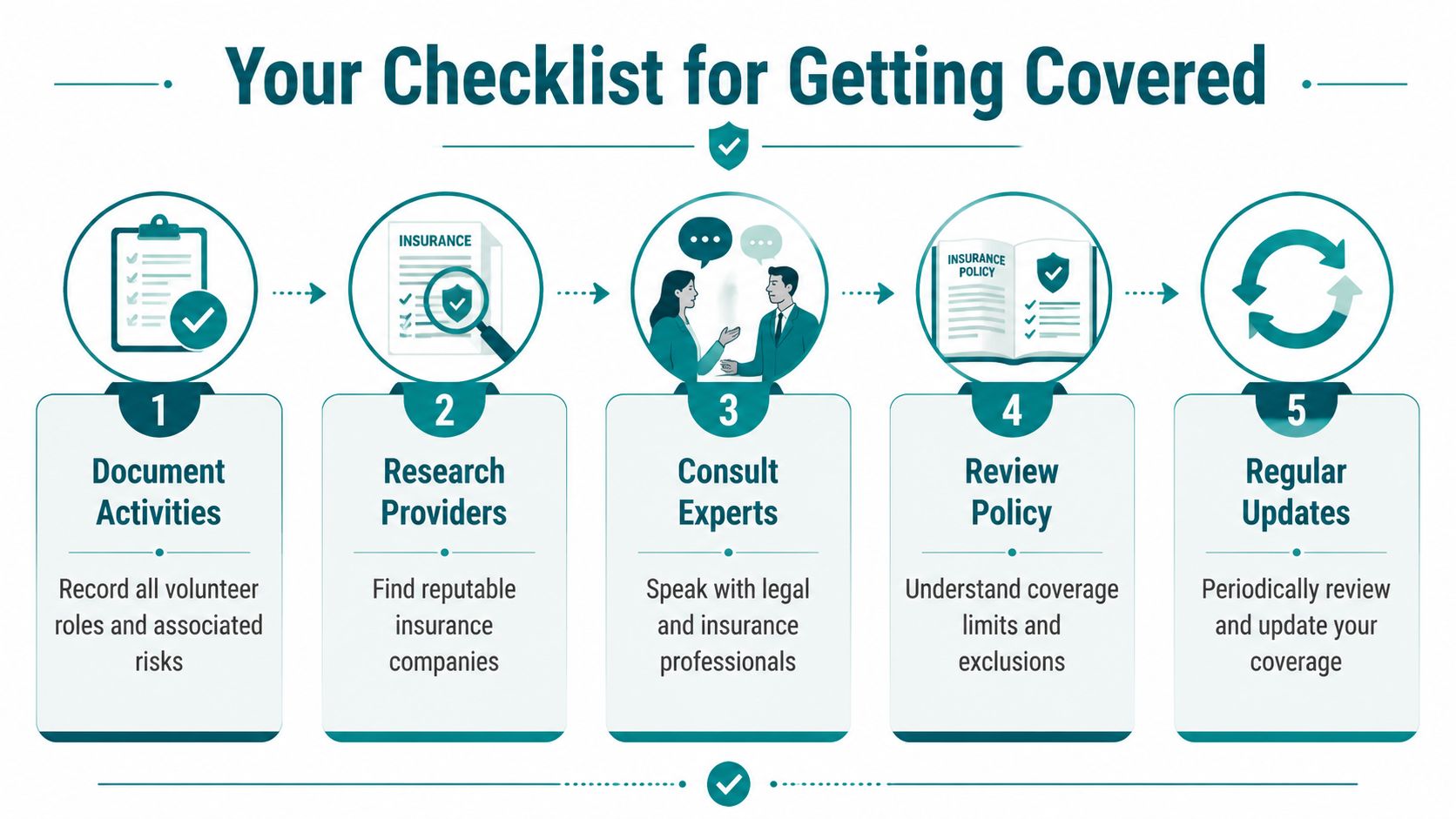
Insurance shopping annoys almost everybody. I get it. It feels slow, vague, and full of jargon. Still, if you break it into steps, it becomes manageable.
Start with the facts of your operation, not your aspirations. Insurance people don't need your poetry. They need a clear picture of what your volunteers do.
Step one is simple documentation
Write down your activities in plain language.
- Where you work: Streets, parks, alleys, school grounds, event spaces, river edges, parking lots.
- What volunteers do: Trash pickup, sorting supplies, sign-in, driving, setup, teardown.
- How often you operate: Weekly, monthly, seasonal, or occasional.
- What conditions show up: Heat, cold, rain, traffic, public interaction, uneven terrain.
This one document saves time later because it keeps you from describing your group differently every time somebody asks.
Pick someone who understands nonprofits
You need a broker or advisor who understands volunteer operations. I wouldn't hire someone who mostly insures restaurants and then hope they'll “figure out” a cleanup crew.
Ask direct questions. Do volunteers count as insureds under this policy? Are there exclusions for outdoor work? How does auto exposure work if volunteers use their own cars? What happens if a partner venue asks for proof of coverage?
If you're running neighborhood cleanup events, your operations page should also be clear and public. A simple example is a page like volunteer trash pickup events, where the activity is obvious and concrete. That kind of clarity helps everyone, including insurers.
Here's a useful walkthrough before you talk to providers:
Compare the policy, not just the price
People often get lazy. They grab the cheapest quote and feel productive. Don't do that.
Read the actual coverage language. Look for exclusions. Look for whether volunteers are named or clearly included. Look at the claim type, the limits, and any conditions tied to vehicles, public events, or partner sites.
Here's the checklist I'd use when comparing options:
- Volunteer status: Are volunteers explicitly covered?
- Activity fit: Does the policy fit outdoor, public-facing work?
- Auto reality: Is there non-owned or excess auto protection?
- Medical backup: Is volunteer accident coverage included or available?
- Proof of insurance: Can you quickly produce documents for venues, cities, or partners?
Read the exclusions with more attention than the sales sheet. The exclusions tell you where the holes are.
Tell the truth about your group
This part matters. Don't downplay the work to get a cleaner quote. If you clean near roads, say that. If volunteers drive supplies, say that. If weather is part of the routine, say that too.
Bad surprises during underwriting are annoying. Bad surprises during a claim are much worse.
The groups that handle insurance best aren't the fanciest ones. They're the honest ones.
Beyond Insurance Brave and Kind Risk Management
Insurance is backup. Your real protection is culture.
You can buy a policy in an afternoon and still run a sloppy, unsafe volunteer program. I've seen leaders obsess over paperwork and then send people out with bad gloves, no briefing, and no plan for traffic. That's backwards.
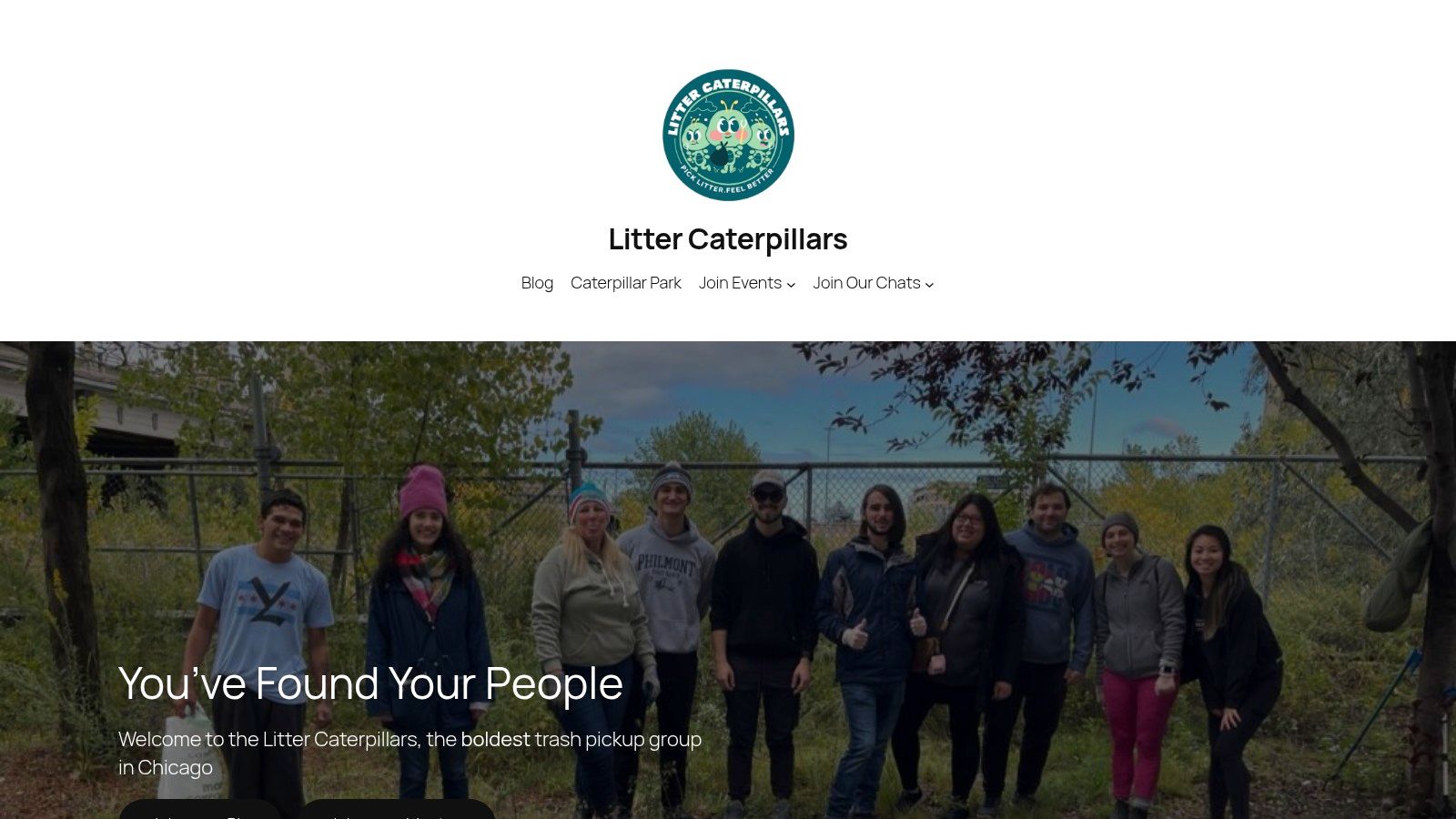
What volunteer-first looks like on the ground
While there is often no legal duty to insure volunteers in the same way you must insure employees, choosing to extend your liability coverage to them is a clear sign that you are a volunteer-first organization, as explained by the National Council for Voluntary Organisations on insurance and volunteers.
I agree with that. But I'd go further. A volunteer-first organization does four things every single time:
- It briefs people fast: Where are the hazards, where do we not go, who leads, and how do we stop if something feels off?
- It gives decent gear: Thick gloves, visible vests, bags that won't split, grabbers that are effective.
- It normalizes refusal: If a task feels sketchy, volunteers can say no without guilt.
- It keeps communication open: People can flag danger, confusion, or fatigue without feeling dramatic.
Kindness is a safety system
A lot of leaders think safety culture comes from authority. I think it comes from trust.
If your volunteers feel pressured to prove themselves, they'll make dumb choices. They'll step into traffic, overreach, lift too much, or ignore a bad gut feeling because they don't want to look weak. If they trust you, they'll speak up early.
That's why volunteer management matters as much as insurance language. Strong volunteer management best practices create the kind of group where people protect each other naturally.
The safest teams aren't fearless. They're honest.
My final take
Get the policy. Read it carefully. Ask annoying questions. Buy enough protection for the work you do.
Then remember that paper alone won't save your crew. The best defense is a group culture where bravery and caution live in the same room. You want volunteers who are eager, but not reckless. Generous, but not pressured. Kind, but clear-headed.
That's the kind of team I'd trust in a hail storm.
If you want to volunteer with a group that takes service, safety, and friendship seriously, check out Litter Caterpillars. We clean Chicago block by block, and we believe protecting volunteers is part of the work.