
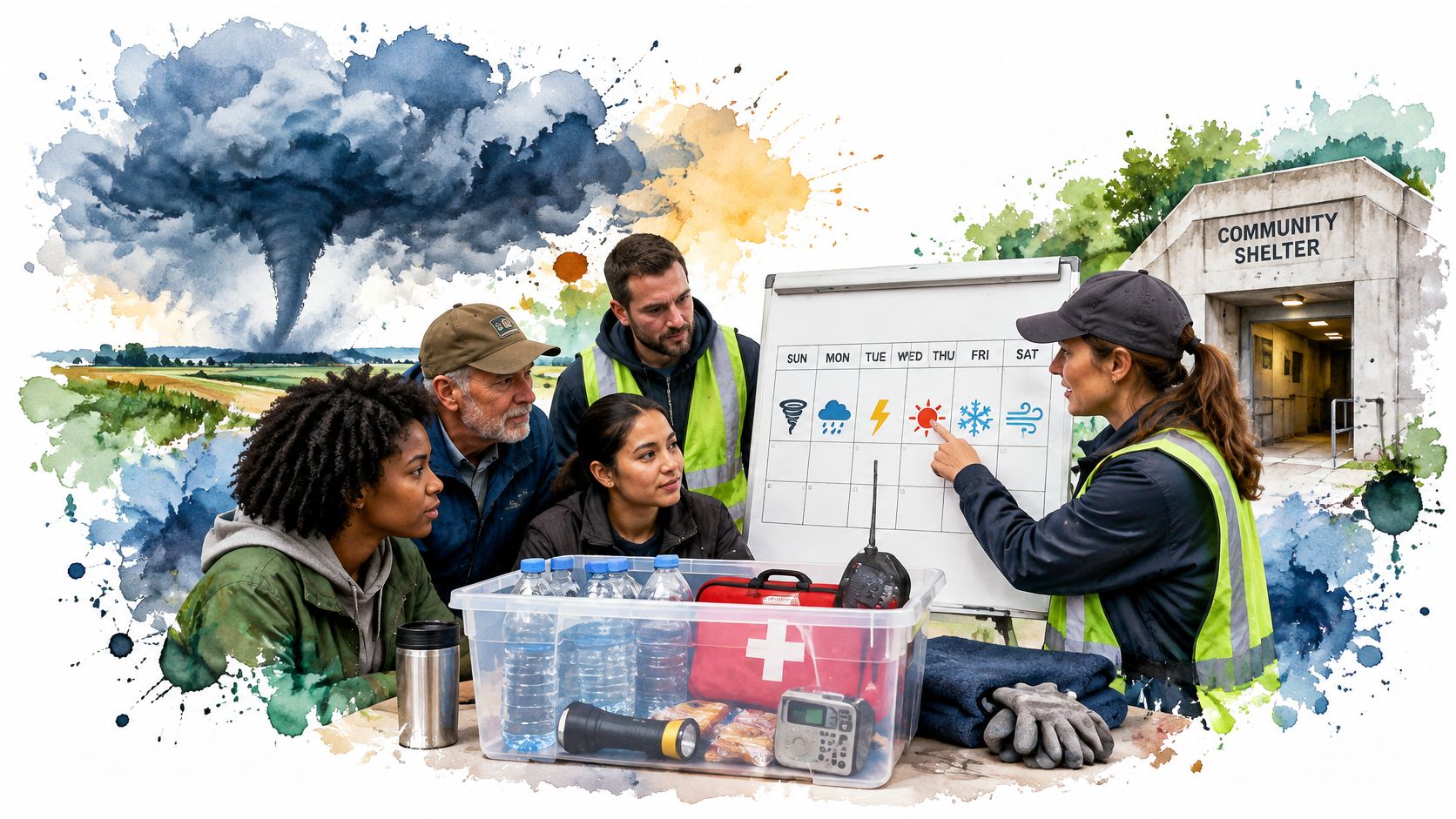
Say you drag a trash bag across a wet Chicago lot, hail stings your ears, and your ride app cancels for the third time. You don't need a pep talk in that minute. You need a call you made before you left home.
The 2026 Day Map I Copy First
Say a café owner is setting out chairs on a Saturday morning when the sky turns the color of a bruise. A good week map starts before that moment: it gives the group a clear go-or-no-go plan, and a reason to come back next Saturday if conditions say stop.
Severe Weather Preparedness Week gives you a prompt to organize the week around one hazard at a time. The National Weather Service says states generally schedule the week in late winter or spring, before their principal severe-weather season begins, and many hold a tornado drill during the campaign. You can build a realistic project timeline with a date, a task, and a clear finish line for each day.
The card on my fridge
The National Weather Service safety events calendar lists Illinois for March 2 to 6, 2026: Monday for a plan, Tuesday for lightning, Wednesday for tornadoes, Thursday for wind and hail, and Friday for flooding. It also lists a Required Weekly Test on Wednesday, March 4, at 11 a.m. Use that schedule as a local planning frame, not a reason to keep a route going when conditions turn unsafe.
| Place | 2026 dates | Day themes | Drill |
|---|---|---|---|
| Illinois | March 2 to 6 | Mon plan, Tue lightning, Wed tornadoes, Thu wind and hail, Fri flooding | Required Weekly Test, Wed March 4, 11 a.m. |
Give each day one small job. Write down who can call off a meetup. Mark a nearby building on the route map, and make sure the group knows where to gather if the plan changes. A phone note or a message in the group chat can keep the plan within reach for volunteers arriving by bus or on foot.
For the week's other tasks, check that your route avoids spots that collect water, and make sure loose items at the meetup point are secured. If the forecast or alerts make the route unsafe, call it off. A postponed cleanup protects the habit of showing up together; it also leaves room for people without a car, special gear, or spare hours to join when the weather allows.
My fridge rule: If you can't point to shelter on the map, you don't pick a meetup corner yet.
Use a severe weather safety kit as one part of your preparation, alongside a clear route and a shared plan.
The Call I Make Before Anyone Meets
Say a café owner is on the bus to our meetup when a storm watch arrives. The group needs one clear message: we meet, shorten the route, or stop. A quick call gives everyone the same answer before they leave home.
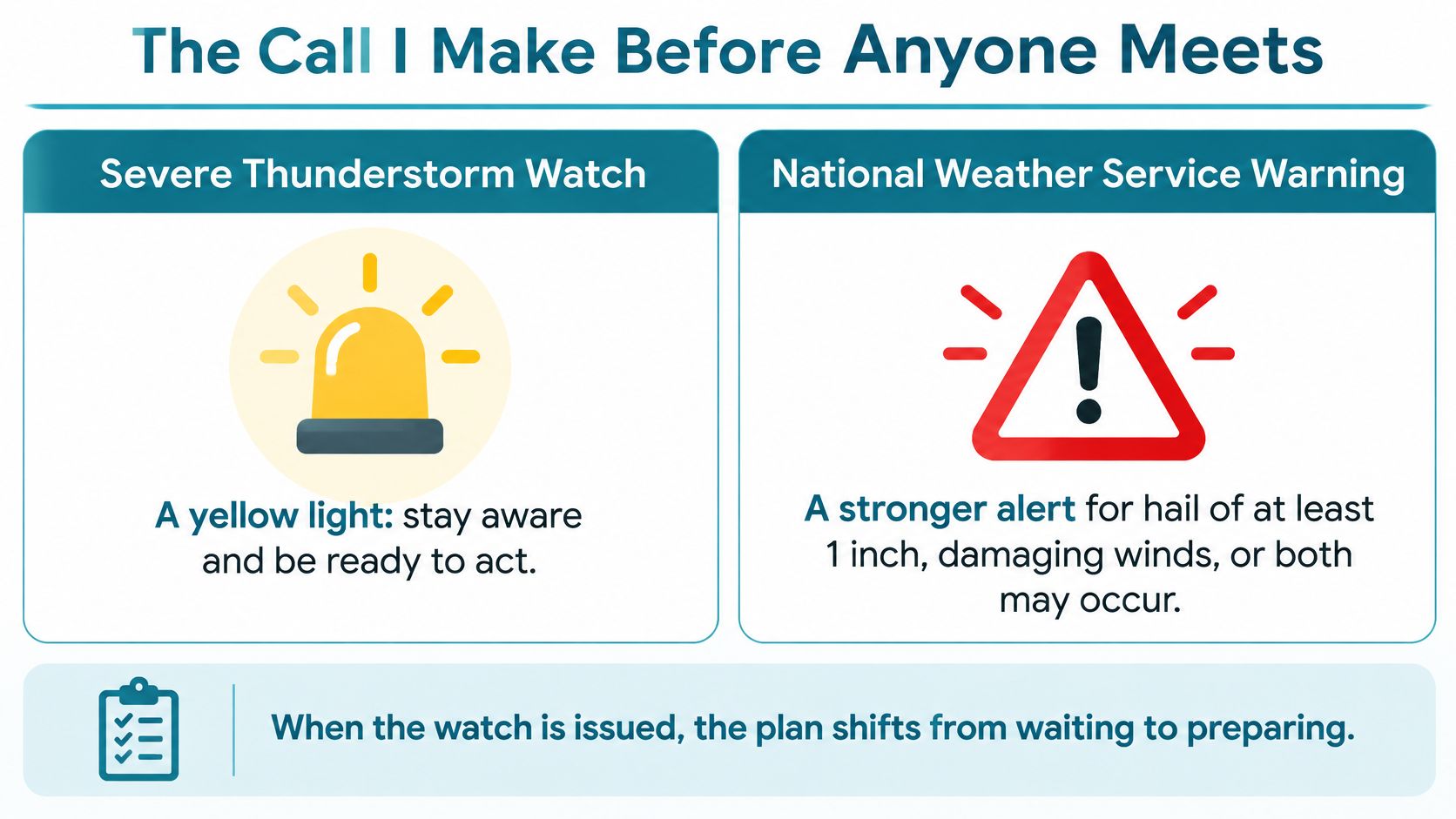
Yellow light means you get ready to move
A severe thunderstorm watch means hail at least one inch in diameter or damaging thunderstorm winds may occur in the area during a three-to-eight-hour period. Use that time to charge phones, identify a sturdy building, bring loose signs inside, and tell the group the route may be cut short.
A tornado watch means tornadoes are possible across a broad area. Review the plan, check supplies, and identify a safe room with the National Weather Service tornado watch and warning guide. Make sure everyone knows where to go and who will help keep the group together.
Red light means you move now
A tornado warning means take shelter in an interior room on the lowest floor of a sturdy building, away from windows. Drop the grabber and leave the trash. People come first. If you are in a car, mobile home, or open lot, get to the closest substantial shelter and protect your head from flying debris.
Lightning, heat, tornadoes, and flash floods cause deaths every year. When thunder is in the area, CDC lightning guidance says no outdoor location is safe. Seek a fully enclosed building or vehicle, and never shelter under a tree. A tree may shade you on a calm day, but it is no shelter from lightning.
| Signal | What it means | Move |
|---|---|---|
| Clear morning, no watch | Hazards are not expected during the meetup window | Meet, brief, start |
| Severe thunderstorm watch | Hail at least one inch in diameter or damaging winds may occur during a three-to-eight-hour window | Pause new blocks, name shelter, keep watching |
| Tornado watch | Tornadoes are possible across a wide area | Review the plan and identify the safe room |
| Severe thunderstorm or tornado warning | A threat is occurring or imminent in the area | Stop, leave open ground, shelter now |
| Lightning in the area | No outdoor location is safe during a thunderstorm | Go to a fully enclosed building or vehicle, never a tree |
| Flooded street or underpass | Water blocks the route | Reroute or cancel that block |
| Heat or cold people cannot safely tolerate | Conditions can overwhelm people before the work is done | Shorten, add breaks, or move the hour |
Before anyone arrives, name one weather lead to make the stop call. Check how each person can get home if the route ends early. A bus stop, a walking path, or a ride plan can make the difference between a safe cancellation and leaving someone stranded.
Say the sky looks clear at 8 a.m., then a watch arrives at 8:40. Shorten the route, stay within an easy walk of shelter, and stop opening new blocks. If thunder rolls at 9:10, end the discussion, go inside, and count heads. When conditions call for a stop, call it. Postponing protects the habit of coming back, and you do not need a car, special gear, or a free morning to take part another day.
How I Build the Week in Six Moves
Say a forecast threatens a Saturday cleanup. The group needs a clear plan for who makes the call, where people can shelter, and how the week's practice will work. I build that plan in six moves, with room to postpone so people can come back next Saturday.
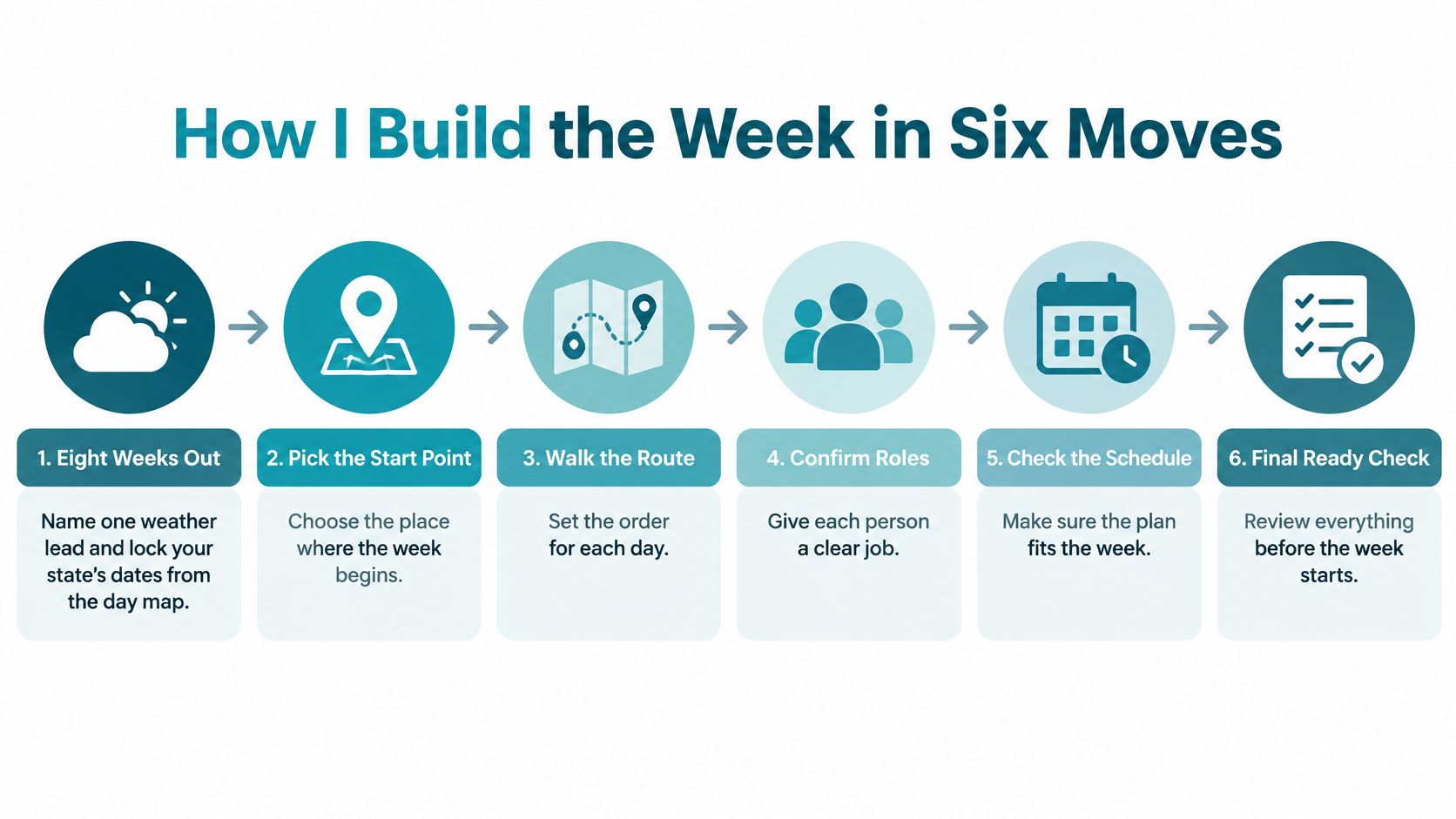
Moves one and two set the owner and the doors
Eight weeks out, name one weather lead and set the dates. That person owns the forecast check, the stop call, and the cancel message. Write the name beside the dates, then share them with two backups. A clear owner keeps the decision from getting lost in a busy group chat.
Six weeks out, write the go-or-no-go card and list indoor rooms near each meetup corner. Walk the route and check that the doors are accessible. A shelter listed on paper is no help if it is locked when hail starts. Set up a plain-text contact chain, too, in case the group app stops working. A volunteer event planning guide can help organize the practical details around a meetup.
Moves three and four fill the kit and the morning
Four weeks out, assemble a three-day kit and calculate the water. The FEMA disaster supplies checklist recommends one gallon of water per person per day for three days, along with nonperishable food and a manual can opener. Counting people makes the shopping list concrete.
| People | Water for three days |
|---|---|
| 1 person | 3 gallons |
| 2 people | 6 gallons |
| 4 people | 12 gallons |
| 6 people | 18 gallons |
Add medications, pet food, a phone battery, and supplies for a baby or someone who uses mobility equipment. Store the kit in a cool, dark place, and replace expired food before storm season. A manual can opener still works when the power is out.
Three weeks out, schedule meetups for weekend mornings. Litter Caterpillars holds its events on weekend mornings, a steady time for volunteers to show up and serve. Give new volunteers clear first-day jobs and safety instructions. VolunteerBadge's volunteer onboarding playbook offers ideas for setting up that welcome.
Moves five and six invite people and run the drill
Two weeks out, open signup and make it easy to opt out. Share the task, time, shelter, nearest bus stop, and any gear provided. Say plainly that people can skip this meetup and return another Saturday without explaining why. That keeps a difficult-weather decision from becoming a reason to disappear for good.
On drill day, practice a real alert response. For Illinois' Severe Weather Preparedness Week, use Wednesday, March 4, at 11 a.m. to check who receives an alert by phone or weather radio, then walk to the planned room. Time the walk and check the curb cuts. If someone misses the alert, address that gap with a radio or buddy text.
Before any morning activity that week, check the forecast before telling people to come. If conditions make the plan unsafe, postpone the practice and keep the next Saturday in reach.
Rules I Will Not Bend on Site
We pick up trash rain or shine, including on the coldest days of winter and the hottest days of summer. I say that with pride, and then I draw a hard line under it. A warning flips pride off. Lightning flips pride off. A faint volunteer flips pride off, and I don't negotiate with any of the three.
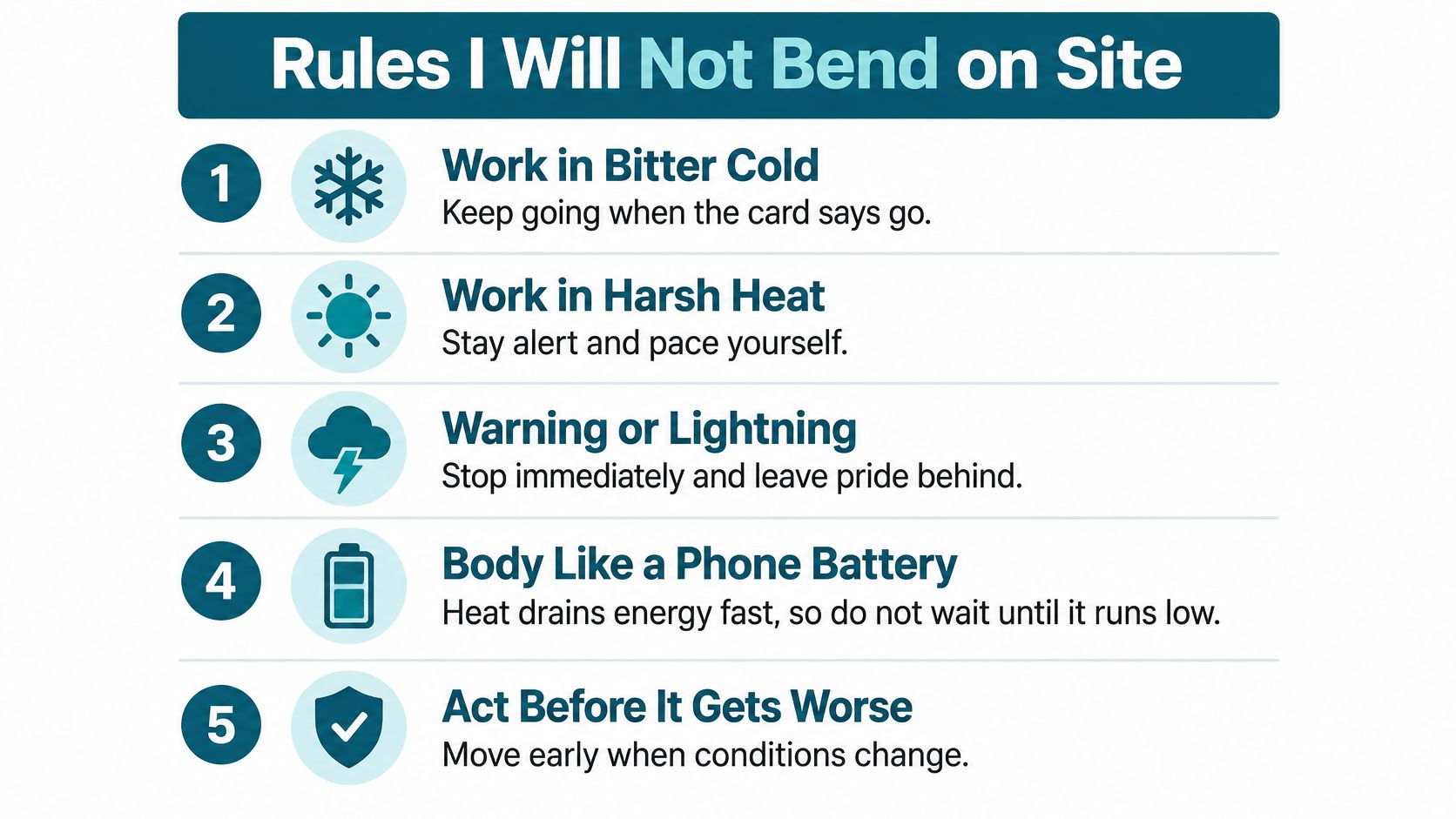
Think of your body like a phone battery in the sun. You don't wait for zero and then act surprised. You shade the phone, you plug in early, and you stop running heavy apps in a heat wave. I run people the same way, with kinder words and colder water.
Heat rules I say at the corner
Before we step off, I check the forecast, I point at shelter and the way an ambulance enters, and I confirm phones. I put hard work in the cooler part of the hour. I set water where hands reach it without a hike, and I break in shade or air conditioning before faces turn red and quiet.
The CDC page on heat and outdoor workers backs the habits I drill: acclimatization, hydration before thirst, earlier or later scheduling, cooling breaks, and buddy monitoring. I pair people up and I tell each buddy to watch for weakness, confusion, faintness, or abnormal behavior. New people get easier first days because a body learns heat the way legs learn a new route, in steps.
If you feel faint or weak, you stop and you move to a cool place. I don't let you finish one last bag to prove a point. If I suspect serious heat illness, I call for emergency care and I stay with you until help arrives. I keep our volunteer safety checklist in the lead bag so a tired brain can follow printed steps.
Drink before thirst. Sit before you wobble. Call before you hope.
Cold rules I score before we start
Cold lies to you in a different voice. It tells you the numb feeling means you adapted. Wet or tight layers steal heat, and a tired person stops noticing fingers and toes. Clothing alone gives you a thin promise, so I control time, turns, and warm breaks too.
The NIOSH cold stress page lays out controls I copy: move work to the warmest part of the day, shorten outdoor rotations, add relief volunteers, provide warm liquids and heated break areas, and use loose insulating layers plus waterproof, insulated footwear with cover for head, face, hands, and feet. I pack spare clothes, a blanket, a thermometer, and chemical heat packs in the first aid kit. I name an observer because self-reports arrive late when pride and numbness team up.
I score five controls before I open a single trash bag:
- Forecast read: I check wind, cold, and storm timing that morning.
- Warm shelter named: I point to a heated break spot we can enter.
- Timed breaks set: I set rotation times before hands go numb.
- Buddy checks live: I pair each person and I name the observer.
- Cold kit packed: I confirm spare layers, a blanket, and heat packs.
All five, or we don't deploy. My scoreboard counts process, and I write it down: 100% of volunteers briefed, 100% paired or accounted for, water and first aid out before start, and a written note for every pause or cancel call. That record teaches us more than a brag about a clean streak with no injuries, because the record shows the exact minute a rule saved a morning.
Notes and Events That Fill a Morning
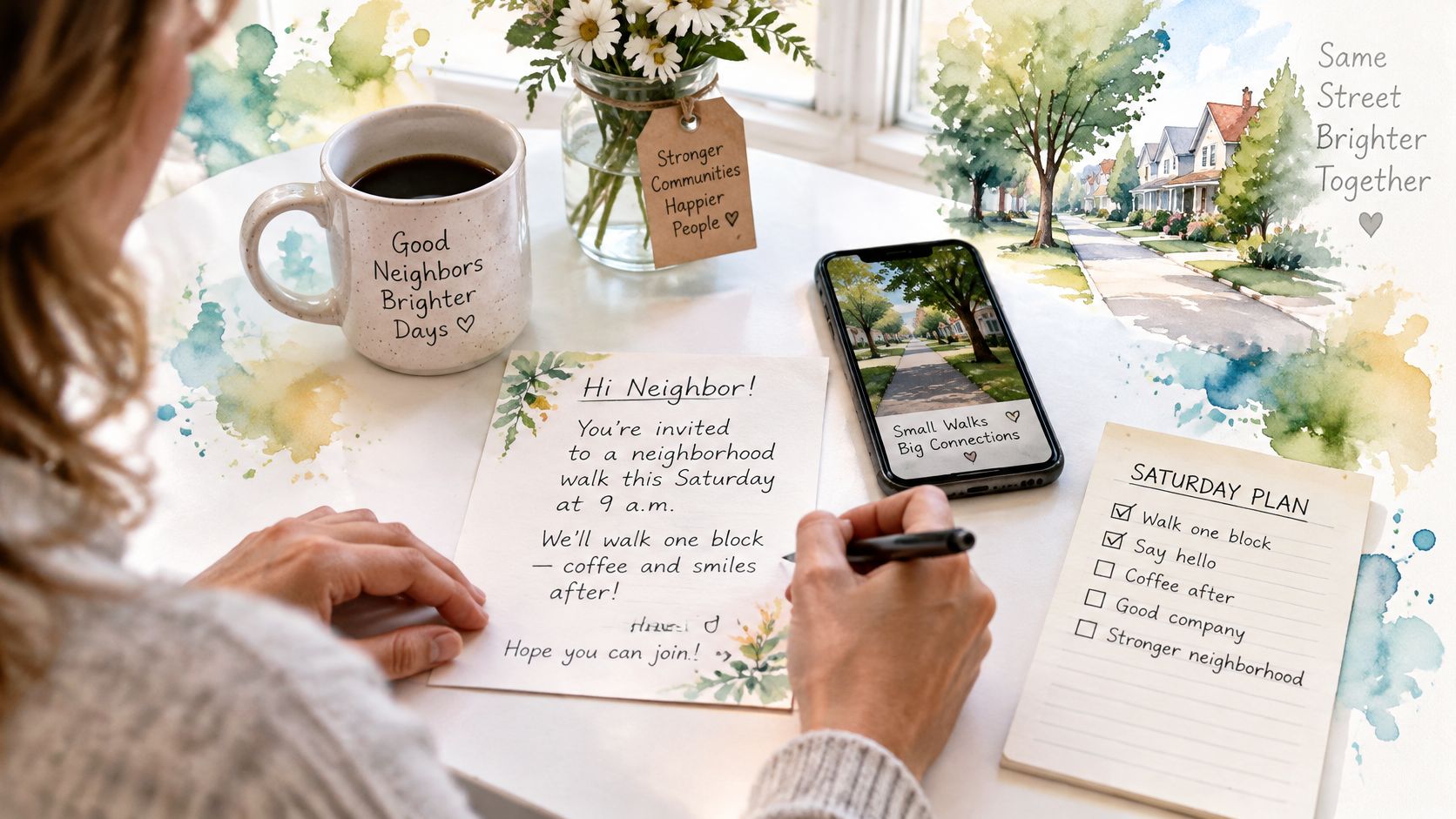
Say a café owner wants to join a Saturday cleanup but has no car and only an hour to spare. A useful invitation makes the plan clear: where to meet, how long the walk lasts, and how to leave early without explaining why. Litter Caterpillars holds events on weekend mornings, and a simple note can help neighbors decide whether one fits their day.
Three scripts I copy word for word
An invitation might read: “Saturday at 9 a.m., we'll walk one block. The bus stop is two minutes from the church door. Bring water, sunscreen, and gloves if you have them. Reply OUT if you need to skip.” Keep the route and time specific, and make the way home part of the plan.
A cancellation text should be just as direct: “Weather card is red. We won't meet outside. If you've already left home, use the church basement as shelter. I'll share a new morning when conditions allow.” Send it early, before someone spends time traveling to the meetup.
At the corner, say the route rules out loud. Buddies stay in sight. If someone feels weak, stop. If the call is to shelter, leave the bag and go inside. Ask a volunteer to repeat the shelter location so everyone knows where to head.
Five small rooms, five weekdays
Use short weekday sessions to practice decisions before a Saturday route. On Monday, write down a home plan and a meetup plan, including names, medications, and ways to get home. On Tuesday, walk from the corner to the doorway you would use during lightning. On Wednesday, practice the route to the lowest interior room. On Thursday, look for loose signs and talk through where to go during hail or high winds. On Friday, mark the block that floods, identify the underpass to avoid, and choose a dry street instead.
Give each person a small job: keep time, write names, or check the door. A clear task gives someone a way to join without needing to lead a discussion.
The NOAA National Centers for Environmental Information 2025 climate report says 2025 was the fourth-warmest year in the contiguous United States, 2.63°F above the twentieth-century average, and the preliminary tornado count reached 1,559, which is 127% of the 1991 to 2020 average. For an outdoor group, the practical lesson is to make a plan people can return to: know when to meet, when to shelter, and when to call off the route.
Before leaving home, check your own basics:
- Water and sunscreen: Bring what you may need for the time outdoors.
- Gloves: Pack a pair suitable for handling litter.
- Clothing: Dress for the forecast and the route.
- Getting home: Check your transit or other travel plan, including how you'll leave if the meetup ends early.
- Time: Set a clear point when you need to head out.
A one-hour cleanup can fit into a crowded day. The plan should make it easy to take part, and easy to choose another Saturday when the weather says no.
Score the Week and Pick the Next Saturday
When Friday ends, I don't count bags first. Bags tell me we worked. They don't tell me we learned. I score whether the week taught us to move, and I keep the score to three marks so I will do the math while my shoes still drip by the door.
Three marks on my notebook page
First, I count how many phones and radios catch the Wednesday drill. I write names under heard it and missed it, and I stare at the missed column until it embarrasses me into action. If half the chat misses the alert, I add a weather radio at the meetup and a plain text chain. A new poster won't fix a silent phone.
Second, I time the walk to shelter and I test that walk for real bodies. I ask a person with a cane to lead us once. I push a stroller over the same curb. If the walk runs long or a step blocks the door, I pick a closer room before spring thunder tests my choice for real. A shelter you can't reach in time is a story, not a shelter.
Third, I count how many of the same people come back on the next safe Saturday. That return count tells me the truth about my rules. People return to a group that feeds them water, spells out the out, and quits a route without shame. People drift away from a group that drains them and calls the drain character.
If people vanish after one cold morning, I ask what I failed to supply. Water? A vest? A bus plan? A real way out that spared them a speech? I write the answer down and I fix that one thing before I invite a single new face. Growth on top of a leak just gives me a bigger leak.
We have picked up trash every single week, and that streak only matters if the people inside it stay well enough to keep it alive. Litter Caterpillars is the first and only trash pickup group to clean up all 50 wards of Chicago, including the ones people were told to stay away from, and I hold that fact next to a harder one. No ward, no block, and no bag count pays for a volunteer in an ambulance.
So I pick the next Saturday with the card in my hand. I read the forecast, I name the lead, I text the invite with the shelter and the out, and I mean every word of both. If the card turns red, I cancel early and I protect the habit for the calm morning after. If the card stays green, we walk, we laugh, we fill bags, and we leave with the same energy we brought. That rhythm carried us through hail, heat, and bitter cold, and that rhythm will carry you too if you let the quit rule ride beside the work rule.
Bring a friend who has never walked your ward. Hand that friend a vest, point at the shelter door, and walk one block well. Then decide together if you want block two.
Come walk a Chicago block with us on the next weekend morning the weather card allows, learn the shelter on that corner, and leave the minute I call red. Visit Litter Caterpillars to find a meetup, grab a bag we supply, and build the habit of showing up for your neighbors in a way that sends everybody home safe.