
So, what is civic pride? Let me break it down for you. At its heart, it’s choosing to treat your neighborhood—your block, your city—like an extension of your own home. It’s that deep feeling of ownership and responsibility for the spaces we all share, not just what’s inside your four walls.
Finding Pride Beyond Your Front Door
For my whole life, I’ve had a secret struggle: I couldn't keep my own apartment clean. It was a mess. And as the clutter grew, my life felt messier, too. Every piece of trash told a story I couldn't let go of. A four-year-old jar of jam from a trip to Michigan. A bag of nuts from a failed health kick. Each item might as well have weighed 500 pounds because I felt paralyzed, unable to move it.
My own space was a mess, and honestly, so was my head.
It took hitting a personal rock bottom for me to stumble upon something wild. While I couldn't clean up my own life, I found this incredible surge of purpose cleaning up someone else's mess. This is what civic pride means to me. It's not some abstract, patriotic slogan you see on a billboard; it’s a hands-on, get-your-boots-dirty commitment to the world right outside your door.
The Shift from 'Me' to 'We'
That journey from personal chaos to collective action is where real civic pride is born. It's that click in your brain when you stop seeing a trashed-out park as "the city's problem" and start seeing it as our park. You start to believe, really believe, that your small actions can ripple outward, sparking a powerful change for everyone.
Civic pride is the radical belief that your individual effort matters to the collective whole. It’s the decision to show up for your community, even when no one is watching, because you feel a genuine stake in its success and well-being.
It all boils down to this:
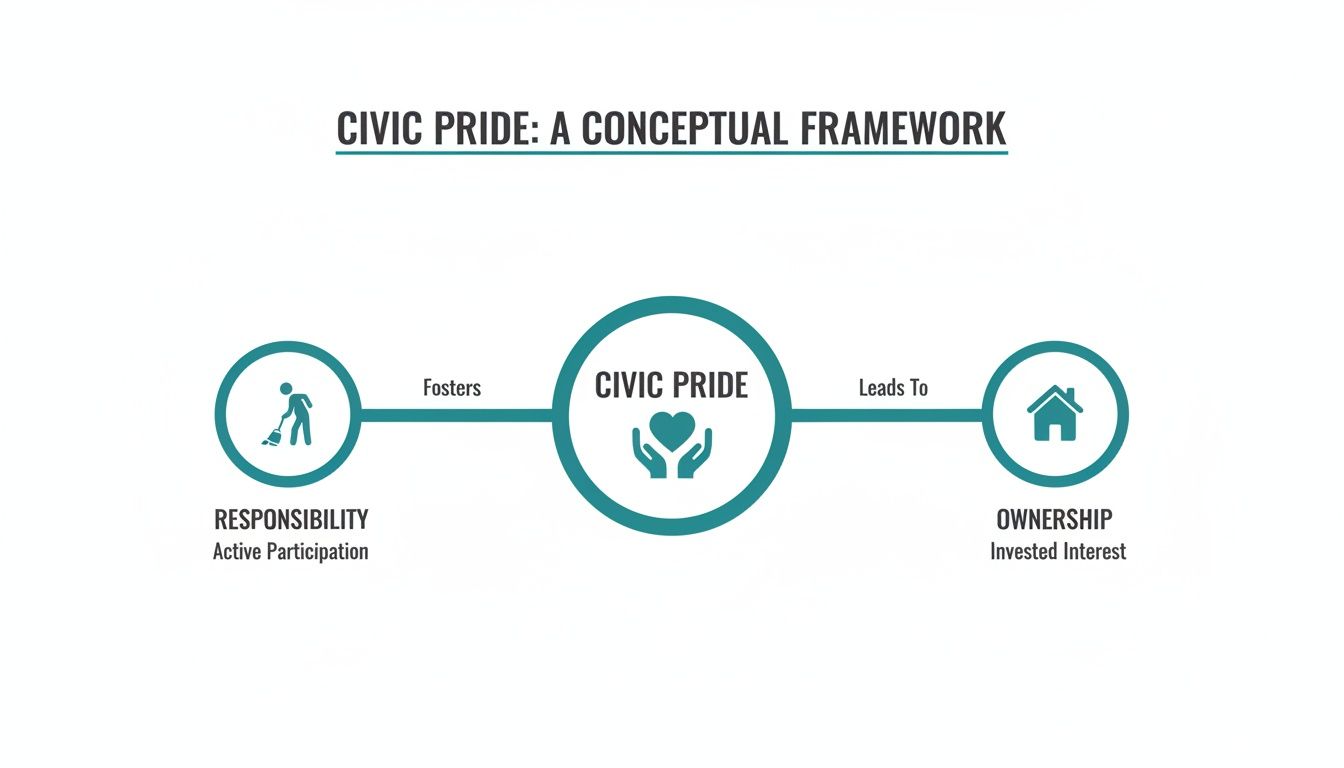
The idea is simple. When you take responsibility for the shared spaces around you, you naturally build a powerful sense of ownership. That feeling of ownership is the engine that drives true civic pride.
The Four Pillars of Civic Pride
You can build civic pride on four core actions—things anyone can do in their own community.
| Pillar | What It Looks Like in Action |
|---|---|
| Responsibility | You see a piece of trash on the sidewalk and you pick it up instead of walking past it. |
| Connection | You get to know your neighbors by name and actually check in on them. |
| Contribution | You volunteer for a local cleanup or join a community garden. |
| Celebration | You go to a neighborhood block party or cheer for a local sports team. |
These pillars aren't just concepts; they are tangible actions. When you practice them together, you create a strong, vibrant community spirit.
More Than Just a Feeling
Civic pride is something you do, not just something you feel. It's about actively building something better, together.
Imagine a sports team. Their success isn't just about raw talent. It's about players who feel a deep pride in their jersey, their city, and each other. They grind it out together because they share a common identity and a common goal. This is exactly what we’re building with projects like Litter Caterpillars all across Chicago.
This idea is closely related to a bigger concept. You can learn more about how all these individual actions add up in our article on what is civic engagement. It's the practical, real-world application of the pride we all feel for our home.
The Surprising Power of a Shared Mess
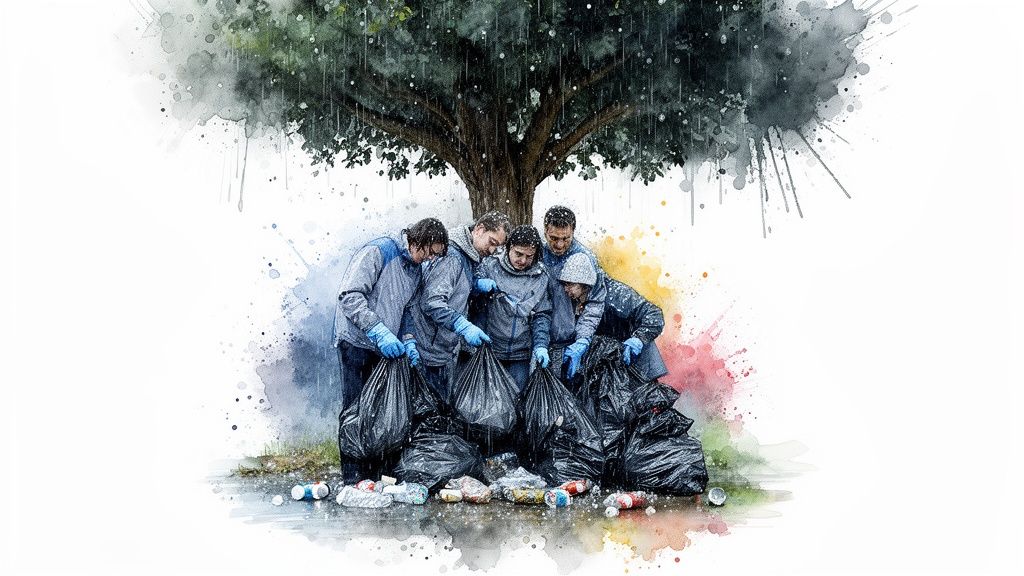
Let me tell you the story of how our group, Litter Caterpillars, was truly born. It wasn't in some sterile meeting room with a whiteboard. Nope. It was under a soggy tree during a freak Chicago hailstorm.
A few of us were out picking up trash when the sky just opened up and dumped on us. Ice pellets hammered down, forcing us to huddle together, shivering. I remember watching as Uber after Uber canceled, leaving us stranded, cold, clutching bags of strangers' garbage. Right there, in that moment of shared misery, something clicked.
There’s a strange kind of magic in cleaning up a mess that isn't yours. It's often way more satisfying than finally tackling the disaster in your own room. But facing that challenge together? That turns a chore into a real adventure. It adds a "flavor" to the story that makes you feel connected and alive.
From Chore to Adventure
This gets to the real psychology behind civic pride. It’s like a modern-day Tom Sawyer convincing his friends that painting a fence is the coolest adventure they could possibly have. He didn't just get a fence painted; he created an experience. He turned a punishment into a game, a solo job into a community event.
That's exactly what happens when we team up to tackle a shared problem. We aren't just picking up litter; we're writing a story of resilience together.
The shared struggle is a powerful glue. It forges bonds that simple, pleasant interactions never could. Overcoming a small bit of chaos together creates a profound sense of "us."
This collective effort taps into a deep human need to belong and to contribute to something bigger than ourselves. Study after study on group dynamics shows that teams who face and overcome obstacles together have way higher levels of trust and cohesion. Each piece of trash you pick up becomes a tiny victory, a visible trophy of your collective power. For more practical tips, check out our blog on cleaning up trash effectively.
Why Shared Suffering Builds Stronger Bonds
It might sound crazy, but that hailstorm was one of the best things to ever happen to our group. It bonded us in a way a sunny, easy day never could have. Facing that unexpected hardship created a unique, shared memory that’s now part of our origin story.
Psychologically, this makes total sense. Enduring a challenge with other people triggers a release of hormones linked to bonding and cooperation. It creates an instant camaraderie. You’ve been through something together.
You can see this principle everywhere in community efforts:
- Community Gardens: You aren't just planting vegetables; you're fighting off weeds, droughts, and pests as a unit.
- Neighborhood Watch: You're not just looking out a window; you're collectively standing against uncertainty to create a safer block for everyone.
- Barn Raising: The classic example where an entire community shows up to build something essential, knowing that many hands make light work of a huge task.
In every case, the effort is the point. The struggle becomes the story, and that story becomes the foundation of your shared pride. You look at what you’ve built, and you don’t just see a clean park or a new shed—you see the strength of your connection. You see what you can accomplish when you do it together.
Discovering the Real Benefits of Community Care
When you start to actually care for the spaces around you, something incredible happens. I’ve seen it time and again, from Rogers Park all the way to Englewood—picking up litter is never just about the trash. It’s about forging a community that’s more connected, more resilient, and way more beautiful for every single one of us.
The payoffs go so much deeper than just a clean street. They hit you personally and then spread through the whole neighborhood like wildfire.
The Psychological Boost of Visible Impact
You feel this powerful surge of self-respect when you see the immediate result of your work. You can literally stand back, look at a park that was just a mess of debris, and think, "I did that." This isn't just about feeling good for a moment; it's about proving to yourself that you have the power to make a real, positive change.
That feeling of purpose is a potent antidote to the helplessness we all feel sometimes. It's a tangible win. You're not just wishing for a better neighborhood; you're physically building it, one piece of trash at a time. This kind of direct action beefs up your sense of agency. And what is civic pride if not believing in your own power to make a difference?
Seeing the immediate impact of your work creates a positive feedback loop. The more you do, the more you believe you can do, which fuels even greater action and deeper community investment.
Forging Friendships Through Shared Action
The social side of this is just as huge. When you're working side-by-side with your neighbors, you stop being just acquaintances. You become teammates. You’ve got a common goal, you’re sweating together, and you're celebrating the wins together.
Honestly, I’ve met some of my best friends while hauling bags of junk. These aren't the kinds of bonds you form over small talk; they're forged over a shared commitment to our city. These relationships strengthen the very fabric of a neighborhood, turning a collection of houses into a real community where people actually look out for each other.
And this kind of engagement is happening everywhere. In fact, a recent study found 58% of LGBTQ young people got involved in at least one form of civic action last year, from community service to contacting officials. You can check out the full research on youth civic engagement from The Trevor Project.
Environmental Wins That Build Momentum
Of course, the environmental perks are obvious—cleaner parks, safer streets, and healthier local ecosystems. But the ripple effect is even bigger than that. A clean space sends a clear message: "This place is cared for."
This visibility alone discourages more littering and vandalism, sparking a cycle of positive reinforcement. When people see that a space is respected, they’re far more likely to respect it themselves. Your small act of picking up a few bottles can inspire an entire block to keep things tidy, leading to lasting environmental improvements that make your community a better place to live for everyone.
See How Civic Pride Transforms a Community
It’s one thing to talk about civic pride. It’s another thing entirely to watch it explode into reality. Let me tell you about Caterpillar Park—our biggest, boldest, and most heart-filling project yet. This is where you can see what civic pride looks like when it stops being a feeling and becomes a physical place you can stand in.
It all started with a forgotten, trash-filled lot in Englewood. You know the kind of space I'm talking about. The ones you walk past and try not to look at, a glaring symbol of neglect. But we saw something else. We saw potential.
So, we did something that felt a little crazy. A bunch of us dedicated volunteers pooled our energy, fought through the bureaucracy, and actually won that lot at a city auction. It was ours. Suddenly, this wasn't just another cleanup; this was about reclaiming a piece of our city for our city.
From Dirt to Determination
This project was never just about planting a few flowers or putting in a bench. It was an act of defiance against apathy. It was us, a group of ordinary Chicagoans, pouring our souls into a patch of dirt because we believed, truly believed, it could be beautiful.
We ran into every challenge you can imagine. Hauling away decades of illegally dumped junk. Dealing with skeptical looks from passersby. Figuring out how to turn hard, compacted soil into something that could actually grow life. There were days I thought we’d bitten off way more than we could chew.
Caterpillar Park is our proof. It's living evidence that when a community is brave enough to care, they can create something beautiful and lasting from nothing more than dirt and determination.
Small Wins and a Shared Vision
But the real magic wasn't in the big, dramatic moments. It was in the small victories that kept us going. The day the very first seedling poked through the soil. The afternoon a neighbor, who’d been watching us for weeks, finally came over with a cold bottle of water and stayed to help pull weeds. The sound of kids laughing on the grass where there had only been broken glass before.
Each tiny win fueled our energy. You could literally feel the shift on the block. The park became a magnet for positive connection, a rallying point for a vision we all started to share.
This transformation shows the true power of civic pride. It moves from an abstract idea into a tangible reality you can touch, see, and feel. It’s a place built by love.
Simple Ways to Cultivate Civic Pride Where You Live
So you’ve got that fire in your belly. Good. You don't need a huge, elaborate plan or a fully-funded nonprofit to start making a real difference. The truth is, the most powerful movements begin small. You already have everything you need to spark a change, right now, on your own block.
Civic pride isn’t born in a city council meeting. It’s grown in the soil of our neighborhoods through small, consistent acts of care. It’s about taking that abstract feeling of pride and making it something you can actually see and touch.
Make Your Care Visible
The first step is often the simplest: create visible signs that scream, "this place is loved." It could be as easy as putting a colorful planter on your porch or as bold as organizing a mural on a wall that's been a graffiti magnet for years. Visible care is contagious. When one person starts, others notice.
Think about these simple, but powerful, moves:
- Organize a Weekend Cleanup: Just pick a Saturday. Grab some trash bags and gloves, and text a few neighbors. You’ll be floored by what you can get done in just a couple of hours.
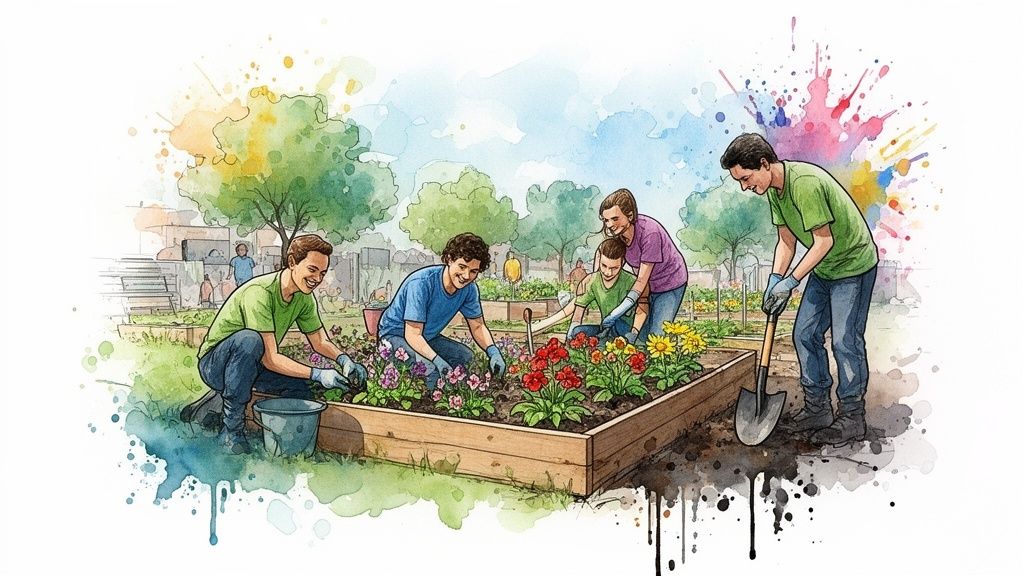
- Start a Community Garden: Find a forgotten patch of dirt, get permission, and plant something beautiful. A garden is a living, breathing symbol of shared investment and hope.
- Create Public Art: Even small art installations can completely shift the energy of a place. They can turn an overlooked corner into a spot that makes people stop, smile, and feel a little spark of pride.
These actions do way more than just make a space look nice. They send a powerful signal to every single person who walks by.
Turn Chores into Celebrations
Let’s be real: picking up trash isn't exactly glamorous. Here at Litter Caterpillars, we stumbled upon a secret early on: you have to turn it into an event. We transformed our cleanups into celebrations by creating little rituals that built a shared identity and a real connection between us.
It's an art form. We have theme songs. We give out badges for hitting milestones. Our weekly meetups have become a social gathering people actually look forward to. By layering in fun and ceremony, we took a chore and turned it into a ritual we all cherish. You can do this, too. Make a playlist for your cleanup day, have a potluck afterward, or design a simple t-shirt for your block’s "Green Team." You can check out more of our community engagement strategies that have worked for us.
The key is to inject the work with joy and a sense of shared mission. When people feel like they’re part of a team, their motivation goes through the roof.
Foster Visibility and Connection
Creating chances for people to feel seen and connected is the absolute core of building civic pride. This can look like a lot of different things—from a classic neighborhood block party to bigger initiatives that celebrate a community’s identity. Just look at Pride events globally. A recent report showed events were held in at least 101 out of 193 UN member states. These gatherings are powerful. They build awareness, connect people who might feel isolated, and send a clear message about a community's presence and strength. You can learn more about how Pride builds community worldwide in this awesome report.
The lesson here is huge: when you make your community’s spirit visible, you strengthen the bonds that hold it all together. You don't need a parade. You just need to create spaces where people can show up, be themselves, and feel like they’re part of something good.
Your Questions About Civic Pride Answered
I know what you're thinking. You're feeling that fire in your belly, but there's a little voice of doubt whispering in your ear. What if I'm the only one who cares? What if people are just negative? What if I burn out?
These are real questions. Let's tackle them head-on.
The fear of being the lone weirdo picking up trash while everyone else walks by is a big one. And yeah, sometimes that happens. You might even get a cynical comment or two.
But here’s the thing: you’re not doing it for them. You’re doing it because you know a better neighborhood is possible. Your actions, week after week, become a quiet, steady force. You’d be surprised how many people you inspire without ever knowing it.
Pride vs. Nationalism: This Is a Big One
It’s really important we get this straight. Healthy civic pride is not the same as blind nationalism. Not even close.
Think of it like this: True civic pride is like loving your family. You see their flaws, you want to help them grow, and you're committed to them, warts and all. Nationalism is like insisting your family is perfect and better than every other family, and refusing to see any problems.
Civic pride says, "I love this place, and I’m all in on making it better for everyone." Nationalism often says, "My place is the best, and I will ignore its problems to prove it." One builds community; the other builds walls.
Knowing the difference keeps your work pure. Your motivation comes from a place of genuine care, not ego.
Why Your Small Effort Is Actually Huge
Look, staying motivated is tough. I get it. The secret is to see how your small actions connect to a much bigger picture. We're all more connected than we think.
A global survey found that 1 in 2 adults knows someone who is gay or lesbian, and it showed huge generational shifts in how we see each other. You can read more about these community connections at Ipsos.
What does that have to do with picking up litter? Everything. It shows that individual lives and experiences ripple out and change the consciousness of the whole community. Your small act of care does the exact same thing. You’re part of a massive, unspoken network of people who believe in showing up. That’s why this work matters so much.
At Litter Caterpillars, we turn that belief into action every single week. If you're ready to stop wondering and start doing, join us. Find an event and see for yourself how good it feels to build a better Chicago, together. https://www.littercaterpillars.com