
Tag: community action

  • Noise Pollution Reduction: A Guide to Taking Back Quiet

    Noise Pollution Reduction: A Guide to Taking Back Quiet

    We were cleaning along a highway access road when the truck noise got so loud we had to shout from a few feet away. I remember looking at the trash bags in our hands and thinking that some messes sit on the ground, but some messes fill the air.

    The Noise We Do Not Have to Accept

    I got into noise pollution reduction the same way I got into cleanup work. I got tired of being told to treat ugly, stressful conditions like they were normal.

    One of our cleanups ran next to a road that typically only seen through a windshield. The litter was bad, but the sound was worse. Trucks growled, cars hissed over wet pavement, and every conversation felt like a small fight. By the end of that morning, I knew something simple. If a place is so loud that people can barely talk, that place is pushing people away.

    A man shouting in frustration beside a busy road with a large semi-truck driving by during rain.

    I found that in Chicago, noise levels are not evenly spread. They spike near roads and public transit, and they hit mid-to-low income neighborhoods harder, which is often where volunteers like us end up cleaning. When I measured a street during a bike-event shutdown we cleaned, the roar of idling cars hit 85 dBA, the threshold where hearing loss starts after 8 hours of exposure, based on the framing used in this Chicago noise and health research context.

    How you know your block is too loud

    You don't need a lab to notice trouble. Your body tells you first.

    Practical rule: If you're shouting at arm's length to hear someone, the noise around you is already in dangerous territory.

    That test changed how I look at ordinary places. A bus stop. A corner store near a major road. A cleanup route under the tracks. Places that look routine can sound punishing.

    A lot of people think quiet is a luxury, like a fancy park bench or a nice view. I don't buy that. Quiet is basic working equipment for a neighborhood. Kids need it to focus. Neighbors need it to sleep. Volunteers need it if they're going to stay out long enough to do good work.

    What recognition looks like on the ground

    When you start paying attention, you notice patterns fast:

    • Traffic surges make a block feel jumpy, even when nothing looks chaotic.
    • Idling vehicles create a steady wall of pressure that wears people down.
    • Transit corridors hit in pulses. Loud, brief, then loud again.
    • Cleanup work zones can pile on extra noise if you add engines, tools, and nearby traffic.

    That realization is part of why I believe in fixing your neighborhood without waiting for permission. You don't need to wait for a perfect city plan before you start naming the problem out loud.

    Noise is real. It is physical. It changes how long you want to stand on your own block. Once you notice that, you stop treating it like background scenery and start treating it like something you can fight.

    Why Noise Is More Than Just Annoying

    I think of sound like weather hitting the body. Soft sound is a light drizzle. A loud street all day feels more like standing in hard rain with no coat. You might stay upright, but you don't leave untouched.
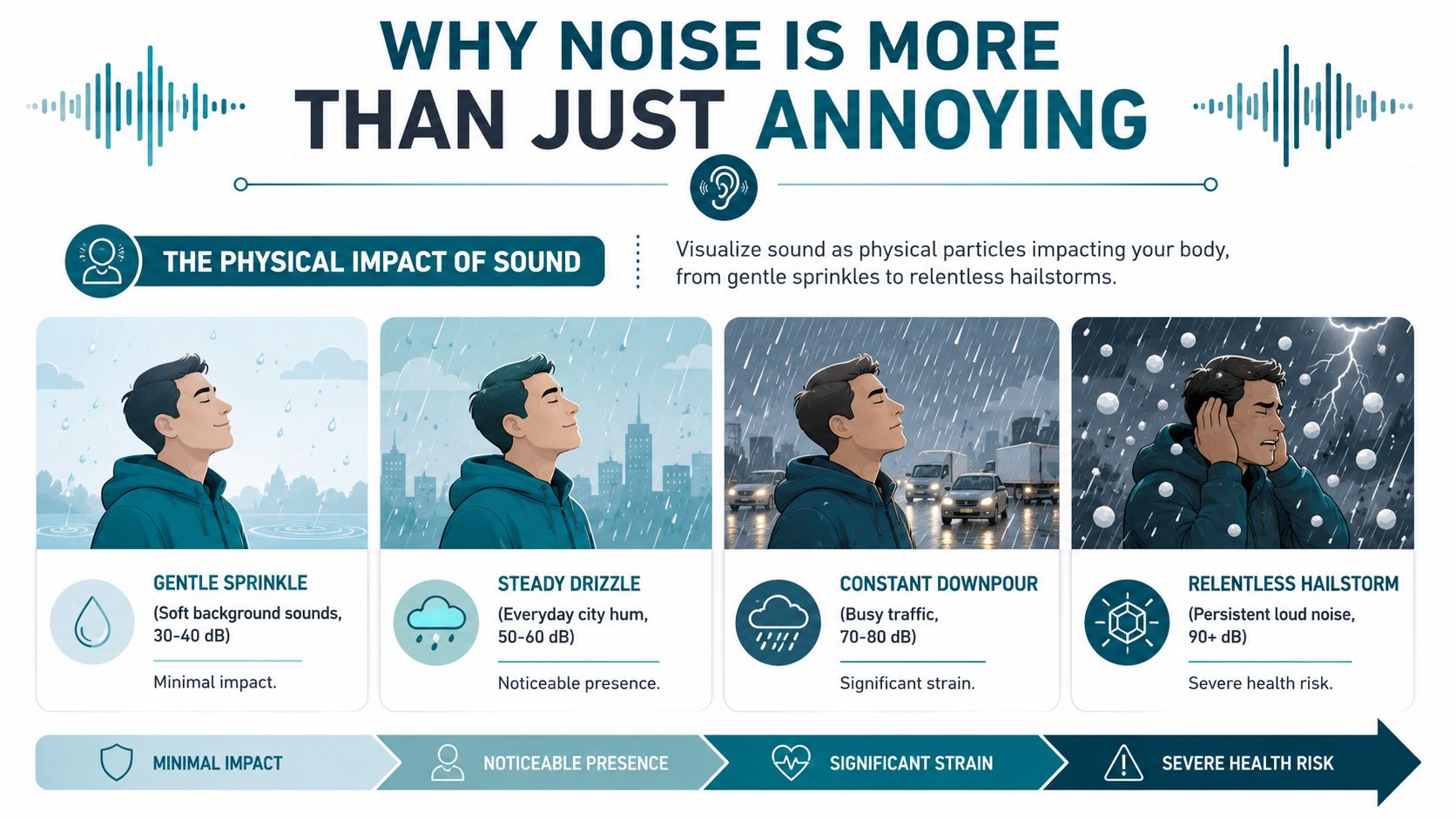
    An infographic visualizing how different levels of environmental noise affect human health using weather metaphors.

    Noise becomes pollution when it is unwanted, repeated, and hard to escape. That last part matters. A loud festival that ends is one thing. A roadway that leans on your apartment every morning and night is another.

    The body keeps score

    We talk about noise like it's only about annoyance because annoyance is easy to describe. But the harm goes deeper than irritation. According to the European Environment Agency's 2025 report on environmental noise in Europe, transport noise pollution causes 73,000 premature deaths annually across Europe, along with 49,000 new cases of cardiovascular disease and 23,000 new cases of type 2 diabetes. The same report says chronic exposure leads to the loss of 1.5 million healthy life years each year.

    That's a public health problem, not a personality problem. The issue isn't that people are too sensitive. The issue is that the sound load is too high.

    A simple way to think about decibels

    You don't need to memorize a chart to use decibels well. You only need a rough map in your head.

    Sound feel What it resembles What it means
    Gentle Soft indoor background sound Easy to ignore
    Noticeable Normal city hum Present, but manageable
    Heavy Busy traffic Mentally tiring
    Harsh Persistent loud street or tools Protective action matters

    The point of the number is not trivia. The point is comparison. If one street makes you tense and another lets your shoulders drop, your body is reading a real difference.

    Sound is invisible, so people argue with it more than they argue with smoke. Your heart and your sleep don't care whether you can see the source.

    A cheap sound meter or even a phone app won't replace formal measurement, but it can wake you up. It can help you stop saying, "Maybe I'm overreacting," and start saying, "No, this corner is rough every day around the same time."

    That shift matters in environmental justice work too. If a neighborhood already carries more traffic, more industrial pressure, and more stress, extra noise lands on a body that's already doing too much. If you want a practical frame for that, this piece on environmental justice and how regular people create change is a good place to start.

    Your First Steps to a Quieter Life

    You can't control the whole city from your couch. You can control more of your home than you think.

    When outside noise keeps barging in, I treat my home like a shelter I have to tune. The goal isn't perfect silence. The goal is relief. A room that lets your nervous system unclench is worth a lot.

    Start with the room that matters most

    Pick one room first. Usually that's the bedroom, or the room where you work, study, or recover.

    I always begin with the windows. If sound leaks through them, I use heavier curtains and make sure they cover the edges instead of just decorating the glass. Then I look at the room itself. Bare rooms bounce sound around. Soft rooms absorb it.

    A few changes help fast:

    • Move soft furniture to outside-facing walls. A bookshelf, couch, or padded chair won't solve street noise, but it can dull the hard echo inside.
    • Use rugs where footsteps and reflections feel sharp. A room with fabric on the floor usually feels calmer right away.
    • Seal obvious gaps. If you feel air around a window or door, sound is probably slipping through too.
    • Choose your sleep position wisely. If one side of the room faces the street, place the bed where the room itself gives you more buffer.

    Build a sound routine, not just a soundproof room

    People often look for one magic product. Most of the time, noise pollution reduction works better as a stack of small moves.

    Here's a home routine I like:

    1. Morning reset
      Open windows when the block is calm, then close them before traffic swells.

    2. Midday buffer
      Use a fan or white noise machine if outside sounds arrive in bursts. A steady indoor sound often feels easier on the brain than random revving and horns.

    3. Evening protection
      Keep the bedroom darker, softer, and less reflective. Noise and light often gang up on sleep together.

    4. Personal gear
      Keep earplugs in the same place every day. If you're tired, you won't go hunting for them.

    What works and what doesn't

    Some fixes help because they reduce pathways or soften reflections. Some fixes only make us feel busy.

    Usually worth trying

    • Heavy curtains when the room has hard surfaces and street-facing windows
    • Door sweeps and simple seals where gaps are obvious
    • White noise machines or fans if outside noise comes in unpredictable bursts
    • Furniture layout changes that put soft, dense objects between you and the loudest wall

    Usually overrated

    • Tiny decorative panels in the wrong place
    • One houseplant and a prayer
    • Moving things around without listening to the room before and after
    • Leaving windows cracked on a loud corridor and hoping for peace

    I like houseplants, but I don't pretend a fern can beat a bus route. Plants can help a room feel calmer. The bigger win often comes from the habits around them. You close the window at the right time. You create a corner where you can read without bracing for the next engine blast. You make the room act less like a drum.

    That matters because the fight outside is easier when you have somewhere to recover inside.

    Tackling Noise at the Neighborhood Level

    A home fix is personal. A block fix is political, even when it looks simple.

    The first time I convinced neighbors to care about noise, I didn't start with theory. I started with a walk. We stood at one corner, then another, then near a calmer side street. Nobody needed a lecture. The loud spots made their own argument.
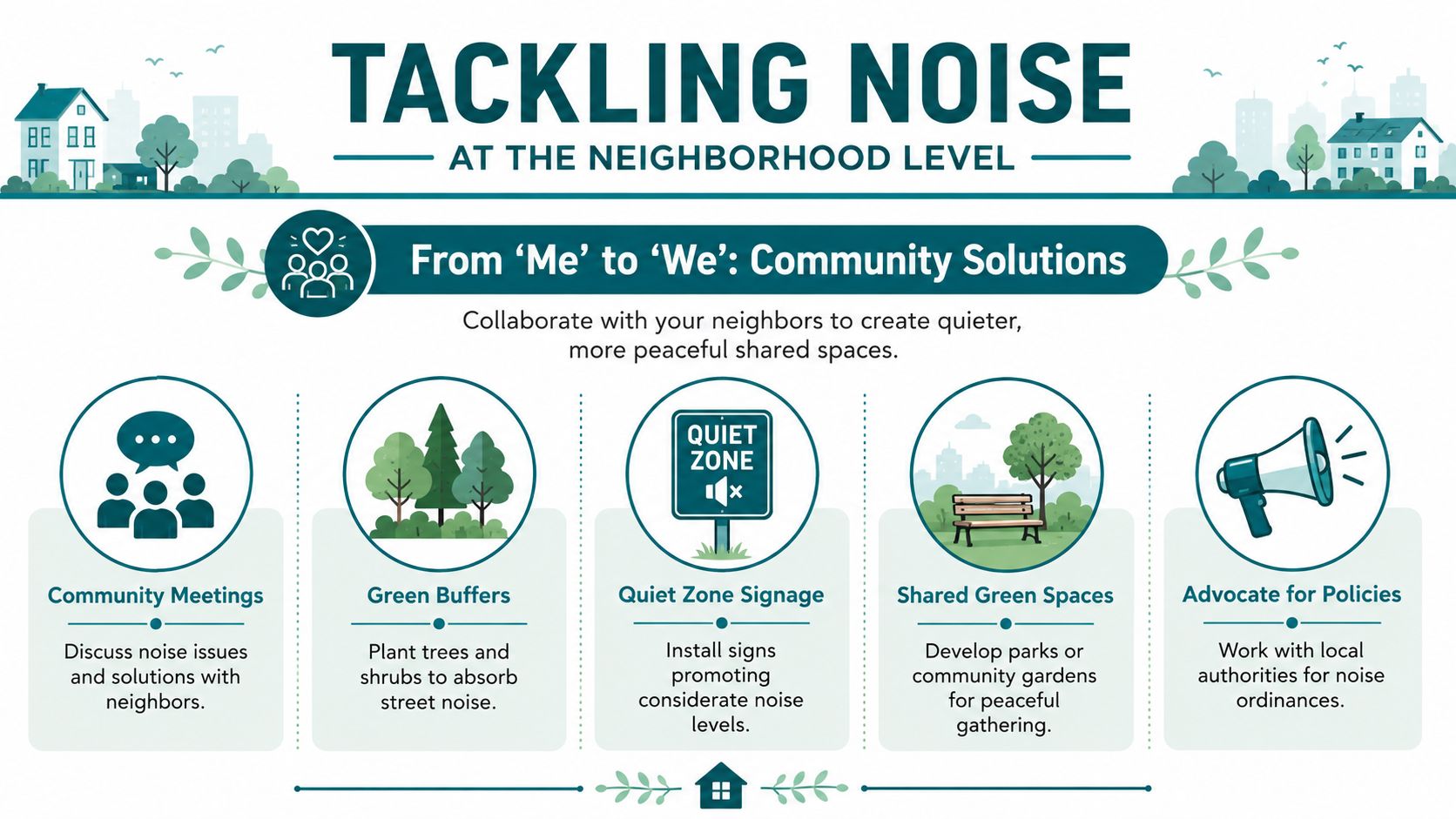
    An infographic titled Tackling Noise at the Neighborhood Level offering community-based solutions for reducing urban noise pollution.

    Run a neighborhood noise audit

    You can do this with a few people, phones, and a shared note.

    Walk the same route at different times. Mark where you have to raise your voice. Mark where kids wait for buses. Mark where traffic stacks up and idles. If a block has a school, a senior building, or homes close to a major road, pay extra attention there.

    A simple audit should answer four questions:

    • Where is it loudest
    • When is it worst
    • What is causing it
    • What nearby change might help first

    That last question keeps a group from drowning in complaints. You want handles, not just frustration.

    Pick fixes that match the block

    I like neighborhood noise work because you can see the trade-offs up close. A big wall may block sound, but it can also make a sidewalk feel dead or boxed in. Trees feel better, but they take time. New pavement can lower road noise, but only if the city is already planning work there.

    I installed noise barriers around our work zone during a downtown cleanup, and measurements showed levels drop from 80+ dBA to 70.09–79.11 dBA, a 10.67–13.95 dBA reduction, according to this study on barrier and porous concrete performance. The same source says porous concrete with crushed stone bases absorbs 0.8–5 dB more than regular concrete, and thicker porous layers boost absorption by 20–30%.

    That taught me a useful lesson. Noise work gets real when it touches materials, not just slogans.

    What I push for on a block-by-block basis

    Some neighborhood asks are more realistic than others. I like the ones that a small group can explain clearly in a meeting.

    • Green buffers
      Trees and shrubs won't erase a road, but they can soften the edge of it. They also make a street feel less exposed, which helps people use it.

    • Quieter surface choices
      If a street is already due for repair, ask what material is going down. Pavement texture changes what tires sound like.

    • Temporary barriers during work
      Construction and cleanup zones don't have to roar unchecked if crews plan for sound.

    • Better traffic flow
      A street with smoother movement often sounds different from a street full of stops, starts, and angry acceleration.

    If you want neighbors to join you, don't ask them to love policy first. Ask them to stand with you in the loudest place on the block for five minutes.

    That's how "me" turns into "we." One person hears a problem. A few people map it. Then the neighborhood starts asking for changes that fit the actual street instead of generic advice pulled from nowhere.

    How We Organize Our Community for Quiet

    Trash work taught me that volunteers stay engaged when the mission is clear and the next step is simple. Noise campaigns work the same way.

    When a group first notices a loud corner, people usually want to jump straight to outrage. I get it. But outrage burns hot and fast. Organizing needs a slower fire. We document. We compare times. We gather neighbors who live with it every day. Then we choose one ask that a city office or property owner can respond to.

    The first move is documentation

    I like a shared folder and a simple log. Date, time, location, what happened, how long it lasted, and whether it repeats. Video helps. Short notes help. A rough sound reading can help if you use it carefully and don't pretend it is more official than it is.

    Once you have a pattern, you can talk about the issue like an adult instead of like a person having a bad day.

    That matters with construction noise. Chicago's construction curfew bans noisy tools between 8 p.m. and 8 a.m., and if you violate it twice in a year, the penalty is $2,500–$5,000, according to this summary of Chicago construction noise rules. Rules like that give residents a clean opening. You're not asking for special treatment. You're asking for enforcement.

    The second move is a practical ask

    I never bring a complaint by itself if I can help it. I bring a complaint plus a fix.

    Here are the asks I trust most:

    • Adjust timing
      If a crew or business can shift the loudest activity out of the most painful hours, that is often the fastest win.

    • Plant screening where homes need it
      Vegetation between noise sources and homes can cut sound naturally. I've seen how trees create a better edge between traffic and people trying to live their lives.

    • Smooth the traffic pattern
      Changing traffic signals to improve flow can create a 5–10 dB drop, based on the same Chicago rule summary above. That kind of change matters on blocks where drivers race, brake, and lurch forward all day.

    Protect the volunteers

    Community groups make a mistake when they treat every willing person like unlimited fuel. Nobody is unlimited. If your campaign becomes all meetings and no joy, people vanish.

    So I keep a few rules:

    1. Small wins count
      One documented hotspot is progress. One resident who speaks up is progress.

    2. Safety comes first
      If a road is too exposed, the group doesn't prove courage by taking dumb risks.

    3. Roles should fit people
      One person logs data. Another talks to neighbors. Another takes photos. Another shows up at the meeting.

    4. Keep the social glue strong
      People stay when they like each other. That's true in cleanup work and noise work.

    A quiet campaign should feel like a neighborhood learning to defend itself without becoming harsh. Brave, yes. Mean, no. That's how you last long enough to win changes that don't disappear after one angry week.

    Our Story of Turning a Noisy Lot Quiet

    An empty lot near a busy street can feel like a mouth with a missing tooth. Wind moves through it. Trash collects in it. Noise slides right across it.

    That was the feeling with the lot that became a park in Englewood. It wasn't only ugly. It was exposed. The street had too much say over the space.
    Screenshot from https://www.littercaterpillars.com

    We didn't start with a grand theory. We started with irritation, effort, and repetition. People kept showing up to clean. We kept seeing the same truth. If you leave a space open to chaos, chaos keeps renting it for free.

    So we worked to turn that lot into something that could absorb care instead of neglect. A place with edges. A place with purpose. A place where people could stop, talk, and breathe without feeling pinned to the road. The story behind that effort lives in this account of the vacant lot transformation.

    What changed when the space changed

    Noise pollution reduction isn't always one giant intervention. Sometimes it is a chain of ordinary moves that finally start working together.

    We added green elements because living buffers change how a place feels. We thought about layout because open, hard, exposed space tends to throw sound around. We paid attention to how volunteers and neighbors moved through the area, because a quiet corner that nobody can use isn't much of a win.

    That work also changed how I think about "what's possible." During the COVID-19 lockdowns, seismic noise levels decreased by up to 50% worldwide, according to this research on global noise reduction and policy targets. The same source says the EU set a goal to reduce the number of people chronically disturbed by transport noise by 30% by 2030 compared with 2017 levels, while current outlooks project only about 19% without stronger measures. It also says about 45% reduction is technically achievable between 2017 and 2030.

    I take that to mean one thing. Big change is possible, but it doesn't happen from wishing.

    A short look at the spirit of that work helps more than any abstract pitch:

    Quiet is something you build

    I used to think of quiet as the absence of noise. Now I think of it more like a garden. You don't get it by demanding that the air behave. You get it by shaping the conditions.

    You slow what can be slowed.
    You buffer what can be buffered.
    You report what breaks the rules.
    You protect the people doing the work.
    You keep going.

    A noisy lot can become a gathering place. A harsh corner can become bearable. A group of volunteers can learn that cleanup is not only about what they remove, but also about what they restore.

    Quiet takes effort. So does every decent thing in a city. But once you've heard the difference between a place that batters you and a place that lets you stay, it's hard to go back to pretending noise is just part of the deal.


    If you want to build a cleaner, quieter Chicago with people who show up, join Litter Caterpillars. Bring gloves, bring courage, and bring a friend.
  • Littering on Beach: How One Act Sparked a Citywide Movement

    Littering on Beach: How One Act Sparked a Citywide Movement

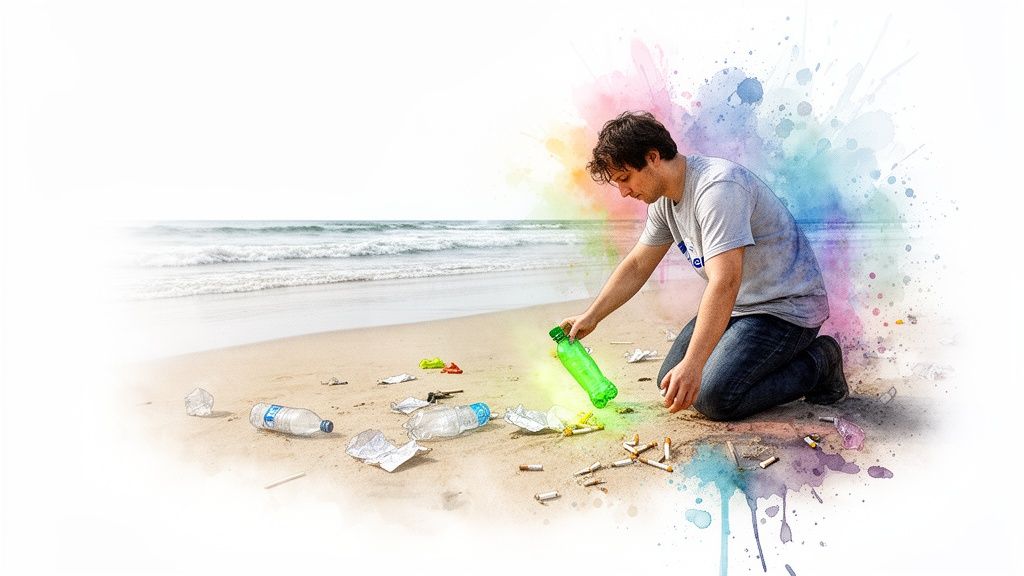
    You know that feeling, right? That dream of a perfect beach day—sun, sand, waves crashing. But you arrive, and the dream shatters. The shoreline is a graveyard of plastic bottles, soggy wrappers, and cigarette butts. It’s more than just an ugly sight. It’s a punch to the gut, and for me, it was a personal call to arms, a siren's song I couldn't ignore.

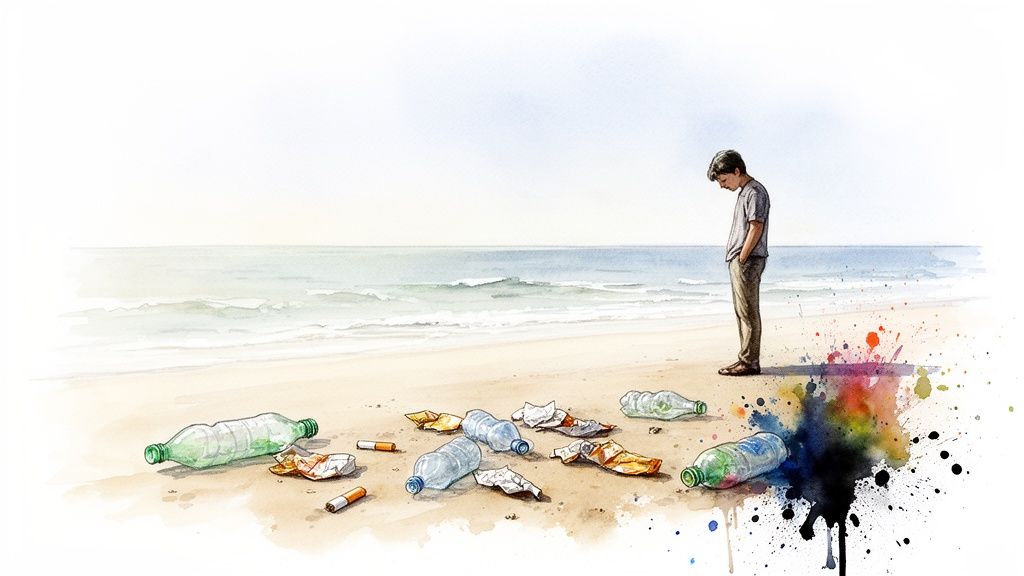
    A boy stands on a polluted beach, looking sadly at plastic bottles and trash near the ocean.

    Confronting the Reality of Littering on Beach

    I remember a time my apartment was its own kind of polluted shoreline. A chaotic mess. It was a mirror, reflecting the clutter storming inside my head. Every single object held a story I felt I couldn't part with, and the sheer weight of all that stuff left me paralyzed.

    Funnily enough, clarity didn't come from cleaning my own disaster. It struck me when I started cleaning up someone else’s—our public mess. That simple, repetitive act of picking up trash on a Chicago beach began to untangle the chaos inside me, too. This strange connection, the one between our inner worlds and our outer spaces, gets right to the heart of the problem with littering on beach.

    The True Scale of the Problem

    When you see a single plastic bottle lying on the sand, what do you really see? Is it just one piece of trash? I want you to see it for what it is: the tip of an enormous, deadly iceberg.

    Think about it like this. Imagine every person who visited a beach last year left behind just one small thing. A bottle cap. A stray straw. A chip bag. Now, multiply that by the millions upon millions of beachgoers across the globe. The number explodes into something so vast it’s hard to even imagine.

    We’re not just talking about an eyesore here. We are talking about a relentless tide of harmful stories washing ashore. Each fragment of plastic is a potential killer for marine life and a real, tangible risk to our own health.

    Why This Mess Is Deeper Than You Think

    This isn't just about a few careless tourists. A gigantic portion of the trash on our beaches is a long-distance traveler. It gets swept from inland cities, flowing through storm drains and rivers, embarking on a secret journey that ends on our coastlines. A plastic fork dropped in a city park can, without a doubt, become part of the littering on beach crisis a hundred miles from where it was forgotten.

    Think of our waterways as the planet's circulatory system. When you and I start clogging those arteries with our garbage, the whole system begins to fail. This hits us exactly where it hurts:

    • Marine Ecosystems: Animals mistake our plastic for food. They get tangled in our discarded junk. They die.
    • Human Health: I've seen sharp objects hiding in the sand, just waiting for a bare foot. And those tiny microplastics? They're getting into the very water you swim in.
    • Local Economies: Those beautiful coastal towns you love? The ones that depend on tourism? They lose big when their main attraction is buried under garbage.

    The mess on the sand is a physical symptom of a much bigger, systemic sickness. It’s the accumulated result of millions of individual choices and collective oversights, all piled up in one tragic monument.

    Once you look at it that way, everything changes. It stops being someone else’s problem. It becomes our shared story. It becomes our shared responsibility. It’s an invitation to stop looking away and start seeing the solution, right there at your feet.

    The Ghost Tsunami Clogging Our Shores

    You know that feeling? You step onto a beach, bracing for the sand and sun, and it’s just… a warzone of waste. It looks like some invisible, ghostly wave of trash slammed the coast overnight. You’re not entirely wrong, but that wave didn't start in the ocean. Its source is often miles and miles and miles from the nearest shoreline.

    Let me paint you a picture. I want you to imagine a plastic bottle, tossed from a car window onto a street in Chicago. It sits in the gutter, completely forgotten. Then the next big storm rolls in. That bottle gets washed into a storm drain, starting a secret, silent journey through the city's hidden arteries.

    This is the real story of beach litter. It's a whole system, a complex web, not just one person being careless on one day.

    The 80/20 Rule That Changes Everything

    There’s a concept in this field that completely flipped how I see the problem. It’s the idea that roughly 80% of all the trash in our oceans and lakes comes from land. Let that sink in for a moment. The overwhelming majority of the junk we pull off our beaches didn’t come from boats or even from people at the beach.

    It’s coming from places you’d never suspect:

    • City Storm Drains: Just like that bottle in Chicago, tons of trash gets flushed from our streets straight into rivers and lakes.
    • Inland Garbage Cans: I see it all the time. A windy day flips the lid on a full trash can in a park fifty miles from the coast, and that’s the beginning of the journey.
    • Your Washing Machine: This one is a real shocker for people. Tiny synthetic fibers—microplastics—from our clothes wash down the drain with every single load you do, eventually making their way into our water systems.

    This is why yelling at someone on the beach to "pick up your trash!" feels like I’m trying to bail out a sinking ship with a teaspoon. The real flood is starting way, way upstream. It’s a systemic problem flowing from the heart of our cities right to the shores we're trying so desperately to protect.

    Think of it like this: Our cities are constantly shedding a skin of plastic wrappers, cigarette butts, and coffee cups. Our storm drains and rivers act like veins, pumping that waste directly into the heart of our planet—the oceans and the Great Lakes.

    And this isn't some abstract theory I cooked up. A massive cleanup effort not long ago covered just over 53 miles of shoreline across 25 countries. Volunteers hauled away a staggering 47.4 tons of trash. You can’t imagine what they found—medical syringes in Tanzania, and the usual suspects like Marlboro and Coca-Cola products everywhere else. It’s a direct receipt showing how our daily habits on land are trashing our beaches. You can dig into the full global cleanup results and what they found.

    This ghost tsunami of trash is relentless, a silent monster made of a million tiny choices happening far from the water. Understanding that path—from a street in Chicago all the way to the shores of Lake Michigan—is the first, most critical step. It shows me, and it shows you, that to really stop the littering on beach hotspots, we have to look upstream and choke off the source. We have to fix the system, not just point fingers at the person by the sea.

    The Devastating Impacts of Beach Litter

    When you see trash on a beach, it’s easy to feel that quick, sharp pang of disappointment. But that feeling doesn't even begin to scratch the surface. The real damage runs deep, like an invisible infection spreading through an entire ecosystem. What we see—the plastic bottles and bags—is just the symptom. The disease of littering on a beach is actively poisoning our wildlife, our health, and even our bank accounts.

    The sheer scale of this is hard to wrap your head around. Picture this: a staggering 80% of all trash found polluting shorelines across the globe is plastic. Every single year, about 8 million tons of plastic waste floods into our oceans. And much of it doesn't just disappear; it washes right back up onto the very sand where you and I hope to relax and play. The data behind this is eye-opening, and you can dig into the specifics of beach litter's impact to see for yourself.

    A Death Trap for Wildlife

    Let me tell you a story I’ve seen play out in my mind a thousand times, because I know it happens every single day.

    A sea turtle, ancient and graceful, glides through the water. It spots what looks like a jellyfish—its favorite food—dancing in the current. But it's not a jellyfish. It's a plastic bag that someone, somewhere, left behind.

    The turtle swallows it. That one mistake becomes a death sentence. The plastic gets lodged in its gut, leading to a slow, agonizing starvation. This isn’t some freak accident; it’s a constant, heartbreaking tragedy I see in my nightmares.

    And it’s not just about what they eat. Think of a seabird, trying to find food for its young, getting its legs hopelessly tangled in a discarded fishing line. The more it struggles, the tighter the invisible trap becomes, until it can no longer fly, can no longer feed, can no longer escape.

    Every bottle cap, every plastic straw, every six-pack ring you see left on the sand is a potential weapon. It’s an indiscriminate killer that doesn't care if its victim is a curious dolphin, a soaring albatross, or a gentle sea turtle.

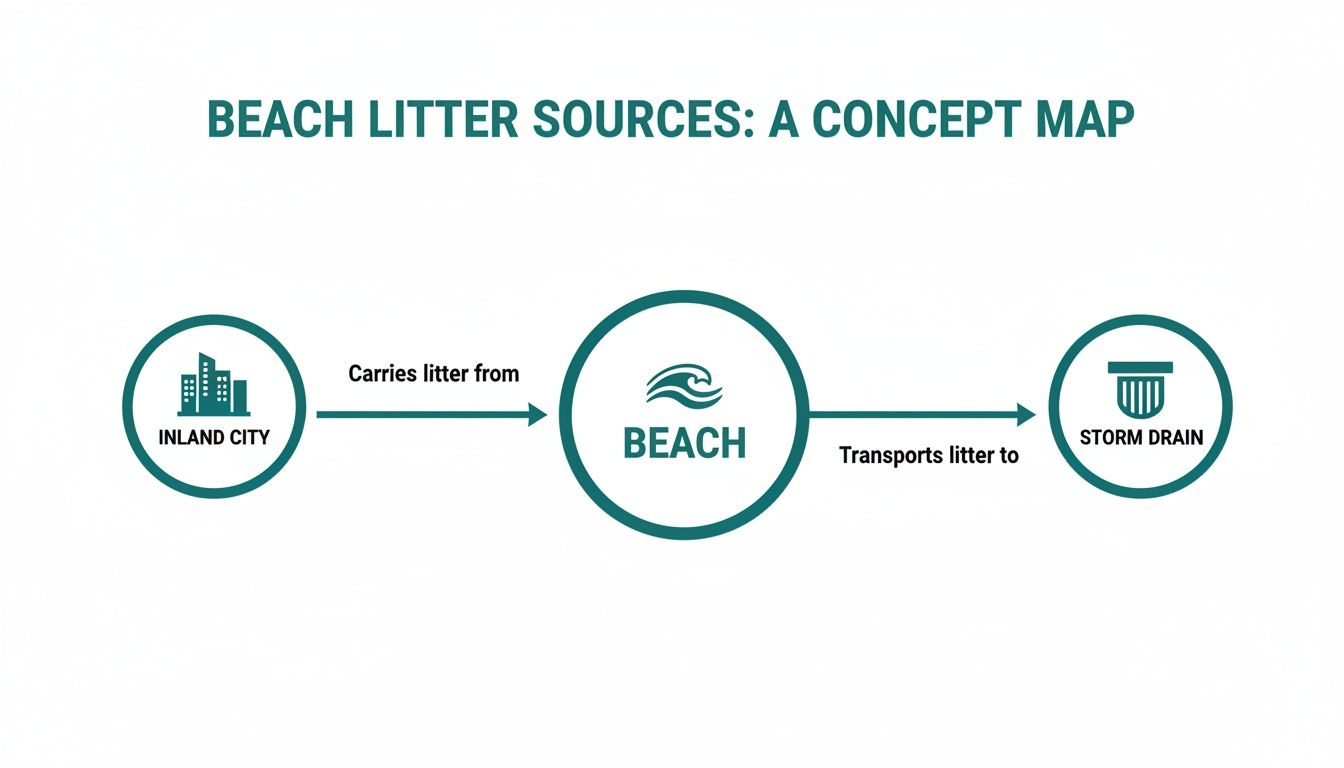
    A lot of this trash travels a long way to become a coastal threat. The problem often starts miles inland, as this visual makes painfully clear.

    Concept map illustrating beach litter sources, showing litter flowing from inland cities to the beach and then to storm drains.

    It’s a direct pipeline from our cities, down storm drains, and straight onto the beaches we cherish.

    The Hidden Costs of Littering on a Beach

    The mess on the sand is more than just an eyesore. It represents a web of consequences that ripple through our environment, our health, and our local economies. The table below breaks down these hidden costs, showing how a single piece of trash contributes to a much larger problem.

    Impact Area Description of Harm Real-World Example
    Environmental Wildlife can mistake plastic for food, leading to internal injuries and starvation. Animals also become entangled in discarded items like fishing nets and plastic rings, causing injury, drowning, or strangulation. A sea turtle ingesting a plastic bag it mistook for a jellyfish.
    Public Health Sharp objects like broken glass, rusted metal, and medical waste buried in the sand pose a direct physical threat. Over time, plastics break down into microplastics and leach toxic chemicals (like BPA) into the sand and water. A child stepping on a shard of glass hidden just beneath the sand, resulting in a deep cut and a trip to the emergency room.
    Economic Coastal communities spend millions on beach cleaning. Littered beaches deter tourists, which hurts local businesses like hotels, restaurants, and shops. Property values in areas with chronic litter problems can decline significantly. A small beach town sees its summer tourism revenue drop by 20% after images of its littered shoreline go viral online.

    Each piece of litter contributes to this cycle of harm. It's a heavy price to pay for a moment of carelessness.

    The Dangers to You and Your Family

    The impact of beach litter isn't just "out there" in the ocean; it's right here, directly affecting you and me.

    Imagine your kid running barefoot through the sand, laughing one second and screaming in pain the next. A buried piece of broken glass or a rusty can has just turned your perfect beach day into a nightmare. These are the booby traps left behind by others.

    But the danger is also invisible. Over time, all that plastic trash doesn't just go away. The sun and waves break it down into microscopic pieces—microplastics. At the same time, those plastics leach toxic chemicals like BPA and phthalates right into the sand where we build castles and the water where we swim. You and I are literally soaking in a chemical soup of our own making.

    The Crushing Economic Cost

    On top of the ecological and health crises, beach litter comes with a massive price tag. Coastal towns are forced to spend millions of dollars every year—your tax dollars—just to clean up the mess. That's money that could be going to our schools, our parks, or our roads.

    Think about a small town that lives and breathes on summer tourism. What happens when its number one asset, a beautiful beach, is consistently covered in garbage?

    • Tourists Stop Coming: Families choose to go elsewhere. The photos they might have shared of a beautiful sunset are replaced with pictures of trash.
    • Local Businesses Go Under: The hotels, cafes, and surf shops that depend on those visitors watch their income dry up.
    • Property Values Plummet: Who wants to buy a house with a view of a landfill?

    A trashed beach isn't just an environmental issue. It’s a community-killer. It’s a wake-up call showing us that the consequences are personal, painful, and incredibly expensive for every single one of us.

    How Personal Mess Became a Public Mission

    I have to be honest with you. I didn't start Litter Caterpillars from some grand, noble vision. I started it because my own life was a complete and utter mess. I mean that literally. My apartment felt just as trashed as a shoreline after a long holiday weekend—disorganized, chaotic, and totally overwhelming.

    Looking back, my place was a perfect physical metaphor for the chaos storming in my head. Every single object had a story. That jar of blueberry jam from a trip I took four years ago? It wasn't just jam; it was a memory I was afraid to lose. That bag of nuts from a failed health kick? A stinging reminder of good intentions gone wrong.

    Each item might have weighed less than a pound, but to me, it felt like it weighed 500 pounds. I was completely frozen, unable to clean up the trash in my own home. I was just… stuck. The real breaking point, the moment the dam finally burst, came after I ended a long, turbulent relationship that had mirrored the mess around me. I knew then I had to build a new life from the ground up, one centered on cleanliness, consistency, and a bravery I didn't think I had.

    The Spark in the Storm

    Here’s the crazy part: I found the solution not by tackling my own personal disaster, but by cleaning up someone else's. I discovered it was infinitely easier to clean up the public’s mess than my own. This strange little insight became the bedrock, the founding principle, of Litter Caterpillars.

    Our very first cleanup was a true Chicago welcome. There were just three of us, buzzing with a nervous, electric energy, ready to take on the littering on beach problem one piece at a time. Of course, the second we started, the sky just tore open. Not rain. A full-on springtime hailstorm.

    We found ourselves huddled under a tree, soaked and shivering, watching as every single Uber we tried to order canceled on us. But right there, in that moment of shared misery, something amazing happened. We started laughing. It was cold, it was uncomfortable, but it was also… fun.

    We realized that suffering together, facing a ridiculous challenge, adds a special kind of flavor to life. It advances the plot. In that freezing hailstorm, huddled together while picking up strangers' trash, the very soul of Litter Caterpillars was born.

    From Personal Struggle to Public Service

    That first day taught me something profound. Cleaning up a public space wasn't just about making a beach look nicer. For me, it was a way to practice the very things I was struggling with in my own life.

    • Cleanliness: By tidying a park, I was building the muscle for tidying my own life.
    • Consistency: Showing up every week, no matter what the weather threw at us, taught me the discipline I craved.
    • Bravery: Facing down a blizzard to pick up trash? That’s a crash course in courage you can't get anywhere else.

    This journey, from a messy room to a city-wide movement, is my proof that you can change your inner world by changing your outer one. It’s not about being perfect from day one. It’s about taking that first small, absurd step. It’s about finding a weird new form of "fun" in the struggle and discovering that helping others is one of the best ways to help yourself.

    That simple act of picking up trash became my mission. It’s grown from three people in a hailstorm to a community of hundreds who show up every single week, ready to build a better city and, in the process, better versions of ourselves. If this idea fires you up and you want to join us, you can learn more about how to volunteer and clean up beaches with us. It all starts with one small act.

    Making Beach Cleanups Fun and Meaningful

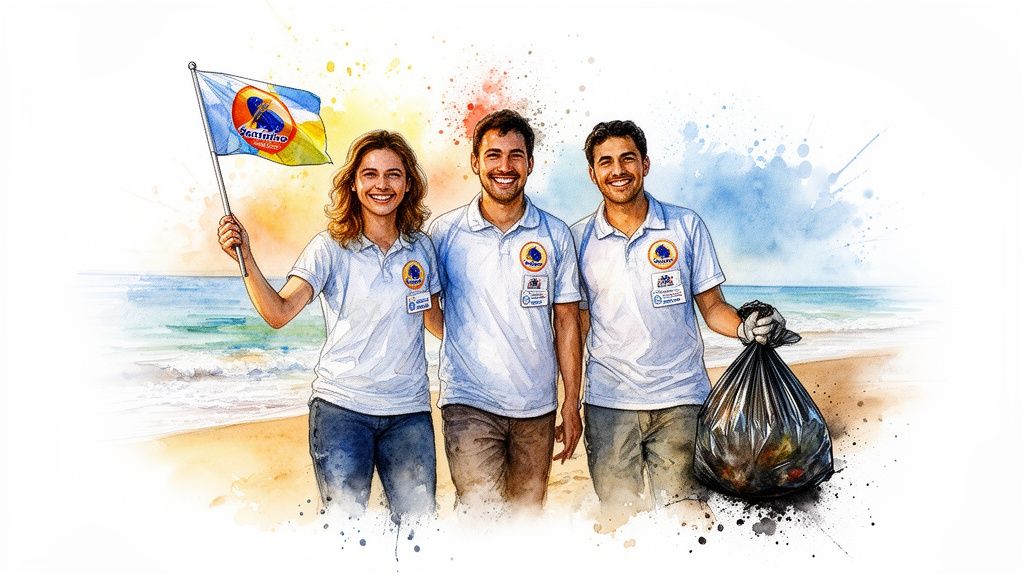
    Three smiling volunteers on a beach with a flag and trash bag, participating in a cleanup.

    How do you get people to give up their Saturday morning to pick up someone else's trash? It's simple. You don't ask them to do a chore. You invite them on an adventure. That’s the entire heart of what we do at Litter Caterpillars. It’s how I turn what sounds like a tedious duty into something you actually look forward to.

    I have this little philosophy I call the 'Tom Sawyer' approach. You remember the story, right? He was stuck painting a fence as a punishment. He didn’t complain. Instead, he made it look like the most incredible, fun thing in the entire world—so much so that his friends started paying him for the privilege of helping out.

    That's our entire playbook. Service isn't a burden; it's a privilege. It’s an opportunity to grow, to connect, and to build a type of resilience you can't find anywhere else. The moment you see it that way, everything shifts. It stops being about the littering on beach problem and starts being about our shared power to fix it.

    Our Three Core Values

    Everything we do is built on three simple, powerful ideas: Bravery, Kindness, and Unity. These aren't just empty words I stick on a website. They're how we operate, week in and week out.

    • Bravery: This just means showing up. It means you are willing to pick up trash in a Chicago blizzard or a scorching summer heatwave. When you face challenges together, even when it’s uncomfortable, you build a unique kind of strength.
    • Kindness: We have a volunteer-first rule. Your safety and your happiness come before anything else. It's not just about being nice; we intentionally create an environment where real friendships can actually grow while you work.
    • Unity: We bring people together from every walk of life. You’ve heard the old saying: "If you want to go fast, go alone. If you want to go far, go together." We’re in this for the long haul.

    The Power of Pride and Identity

    Have you ever noticed how sports teams use flags, songs, and uniforms to build this intense, powerful feeling of pride and belonging? Why should that power only belong to sports or nations? I believe it’s time for kind people to step into our power, too.

    That’s why we have flags. That’s why we award badges. That's why we even have our own theme song.

    These aren't gimmicks. They are tools. They transform a scattered group of individuals into a unified team with a shared mission. They give us an identity to be proud of, turning a simple cleanup into a bold statement of who we are and what we stand for.

    This gives you a sense of belonging that’s so hard to find these days. We aren't just cleaning a park; we are representing a movement. We are showing the world what it looks like when kind, brave people decide to take ownership of their community. It’s a powerful, incredible feeling.

    Turning a Chore into a Calling

    When you join one of our events, you’re not just some anonymous volunteer. You become part of a team, and that changes everything. You get to explore a new Chicago neighborhood, meet people who actually share your values, and see the immediate impact of your work with your own two eyes.

    We've found that this structure helps people build consistency and purpose in their own lives. If you want to see exactly how we use these principles to create powerful group experiences, you should check out our guide on inspiring volunteer team building activities. It’s a deep dive into our methods.

    By mixing a spirit of adventure with a strong sense of identity, we've turned the thankless job of cleaning up after others into a meaningful and joyful calling. This is an open invitation for you to join us, get your hands dirty, and discover just how good it feels to do good.

    Your Guide to Taking the First Step

    You feel that little spark, don't you? That quiet voice in the back of your head that says, "I should do something about this." I know that voice intimately. It's the same one that got me started.

    It's so easy to feel that fire and then, almost immediately, feel crushed by the sheer size of the problem. But I'm telling you, taking real, meaningful action is so much simpler than your brain wants you to believe.

    This is your map. It’s a practical, no-fluff guide to turning that good intention into a pile of filled trash bags. Let's take that first step together.

    How to Join a Cleanup

    If you’re in Chicago, finding us is easy. We always want new faces and new energy. The best way to link up with the Litter Caterpillars is through our main channels:

    1. Meetup: This is our home base for all event schedules. Every weekly cleanup gets posted here with the date, time, and exact spot we'll be.
    2. Instagram: Follow us for the play-by-play. You'll get real-time updates, see photos from our cleanups, and catch the vibe of our community.

    Seriously, just show up. That’s the only rule. You don't need special equipment or experience; I promise we have everything you'll need. All we ask from you is a willingness to help.

    The most important thing you can do is simply start. Pick up one piece of trash. Invite one friend. Every great journey begins not with a giant leap, but with a single, small, deliberate step forward.

    Starting Your Own Cleanup Crew

    What if you're not in Chicago? That's even better. It means you have the power to bring this same energy to your own community. This whole thing grows when people like you decide to start their own crew.

    It feels like a massive undertaking, I get it. But remember our origin story: just three people caught in a hailstorm. You don't need a 501(c)(3) or a flashy website to make a difference. You just need a starting point.

    Here's the blueprint, straight from my playbook:

    • Pick a Spot: Find a local park, a messy riverbank, or a specific public beach that could use some love. Starting small keeps it from feeling impossible. If you want to know why some areas, like the public beaches near Lake Michigan, need so much consistent help, we break it down here.
    • Set a Time: Choose a date and block out a two-hour window. Weekend mornings are magic for attracting the kindest, most dedicated people you'll ever meet.
    • Get the Word Out: Make a simple event on Facebook, Meetup, or just text a few friends. Your invite can be as simple as, "Hey, I'm cleaning up [Location] on Saturday at 10 a.m. Want to join?"
    • Gear Up (Simply): You only need two things to start: gloves and trash bags. That's it. I beg you, don't overthink it.
    • Create a Vibe: On the day of the cleanup, just be a welcoming human. Thank every single person for showing up. Remember, the goal isn't just to clean—it's to build connections. Make it feel like a get-together, not a chore.

    This process strips away all the excuses. It takes that huge, scary idea of "saving the world" and turns it into a simple plan you can launch this weekend.


    Your First Cleanup Action Plan

    Feeling ready? It’s normal to feel a little unsure of where to begin. This checklist is your simple, step-by-step guide to get you from "I want to help" to actually making it happen.

    Step Action Item Litter Caterpillars' Tip
    1. Find Your Spot Choose a park, beach, or street that needs attention. Start small! A single block or a small park is a perfect first mission.
    2. Pick a Date & Time Set a 2-hour window on a weekend morning. Saturday at 9 a.m. is our go-to. It attracts dedicated folks and leaves the rest of the day free.
    3. Rally Your Crew Invite friends via text, social media, or a Meetup event. Don't be shy! A simple, "Want to help me clean up our park?" is all it takes.
    4. Gather Supplies Get basic gloves and heavy-duty trash bags. Ask people to bring their own if they can. Many hands make light work.
    5. On Cleanup Day Greet everyone, do a quick intro, and get to work. The goal is connection as much as cleaning. Make it fun, not a chore.
    6. Share Your Impact Take a "before" and "after" photo. Celebrate your success! Post it online. Your small victory will inspire someone else to take their first step.

    Following these steps transforms a vague idea into a concrete plan. You've got this. Your community—and the planet—is waiting for you.


    Got Questions? I've Got Answers.

    I get it. When you look at the scale of the litter problem, it feels massive. It’s easy to feel overwhelmed, to think, what can one person even do? That hesitation is normal, but I've learned that clear answers are the best way to turn that doubt into action. Let's tackle some of the questions I hear all the time.

    What’s the Worst Stuff We Find Out There?

    It changes from place to place, but the villains are almost always the same: single-use plastics. We're talking bottle caps, food wrappers, and straws. But the number one thing we find, by sheer count, is cigarette butts. They look so small, but their plastic filters are like little poison sponges, leaching a nasty chemical cocktail straight into the sand and water.

    Think about it—these tiny, throwaway items are landmines for birds and fish that mistake them for a meal. And don't even get me started on discarded fishing gear. Those nets and lines are devastating, causing a slow, cruel death for anything that gets tangled. The convenience you and I crave for a few minutes creates a disaster that lasts for centuries.

    But I Don't Live Near a Beach. How Can I Help?

    This is my favorite question because it cuts right to the core of the problem. A huge chunk of ocean trash doesn't start at the coast. It starts on a street, in a park, or along a river hundreds of miles inland. Your actions right here in Chicago matter. Immensely.

    Start simple. Cut back on single-use plastics in your daily routine. And make sure your trash and recycling bins have lids that actually close tight. A strong gust of wind is all it takes to turn your garbage into street litter.

    Every river, every storm drain, every little creek eventually leads to the ocean. Cleaning up a riverbank in the Midwest is a direct blow to the litter piling up on a beach far away. It’s all connected.

    Does Picking Up Trash Really Make a Difference?

    Yes. A thousand times, yes. It makes a world of difference, and don’t let anyone tell you otherwise. Every single piece of trash you pick up is one less hazard for an animal. Every cleanup you join shows your neighbors that you care, sparking something in them, too.

    The numbers can be scary. Some studies say ocean plastic could double by 2030. But here’s another number for you: a recent Global Ocean Cleanup pulled 47.4 tons of trash out of the water across 25 countries. You can read more about these global plastic crisis insights and solutions.

    That’s what we do at Litter Caterpillars every single week. We’re part of that hopeful, worldwide movement. Your action isn't just a drop in the bucket; it's the start of a wave.


    At Litter Caterpillars, we turn that desire to help into real, muddy, satisfying action every week in Chicago. If you're ready to stop wondering and start doing, to build real friendships, and to be part of the solution, we're ready for you. Join our next cleanup and see for yourself how good it feels to do good. https://www.littercaterpillars.com

  • Discover what is environmental justice and how you create change

    Discover what is environmental justice and how you create change

    Forget the dry, academic stuff. I want to tell you what environmental justice really is. It’s a simple, ferocious idea: everyone, and I mean everyone, deserves to live in a healthy, clean place, no matter who you are, how much you make, or where you live.

    It's about fairness. It’s that simple.

    What Is Environmental Justice Really About?

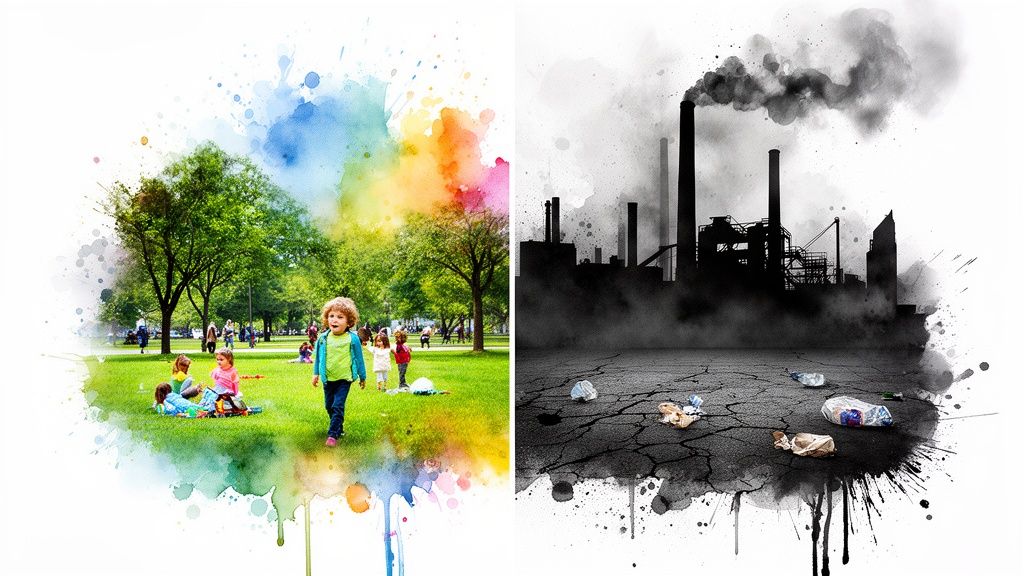
    Vibrant park with children playing contrasts with a dark, polluted industrial landscape.

    Have you ever driven across town and noticed how things just… change? In one part of town, you’ll find yourself surrounded by big, beautiful parks where kids laugh and the air feels crisp. But then, just a few miles away, the story is completely different. Maybe a factory looms over homes, spewing smoke, or the streets are littered with trash, and you wouldn't dream of letting your kids play outside.

    I promise you, that's not a coincidence. That’s injustice.

    Imagine your city is one giant house. For decades, all the trash, all the pollution, all the gross, unwanted stuff gets dumped into the same few rooms, over and over again. The people living in those rooms? They'd get sick. They couldn’t sleep. You’re telling them their health, their dignity, doesn’t matter. It’s fundamentally wrong.

    The fight for environmental justice is you standing up and shouting, "Enough. Everyone deserves a clean room." It's about demanding basic human dignity.

    The Four Pillars of This Fight

    At its core, this whole battle for environmental justice comes down to a few key ideas. These aren’t just words on a page; they're the roadmap I use to fight for a fairer world, and they explain why we do what we do at Litter Caterpillars.

    When you look at it this way, a huge, complicated problem suddenly becomes something you and I can actually tackle.

    The Four Pillars of Environmental Justice

    These core principles break down the environmental justice movement into clear, actionable ideas for building a fairer world.

    Principle What It Means for You and Me
    Distributive Justice This is all about where we put the bad stuff. It means one neighborhood shouldn't be the designated dumping ground for landfills, polluting factories, or highways just because of the race or income of the people who live there. You spread the burden fairly.
    Procedural Justice You get a seat at the table. This means you have a real, powerful voice in any decision that affects your environment—from where a new plant gets built to how your local parks are taken care of. No more backroom deals.
    Corrective Justice This is about cleaning up old messes. If your community has been choked by pollution for decades, you deserve to have that damage undone. We clean up the old sites and make things right for the people who have suffered.
    Recognitional Justice This means we see you, we hear you, and we respect you. It’s about finally admitting that different people and cultures have unique connections to the environment and that your knowledge and traditions are valuable.

    These principles show you that cleaning a street isn’t just cleaning a street. It’s a bold act of justice. It’s my way of showing up and fighting for your right to a healthy, safe home.

    This is what I’m all about at Litter Caterpillars. When we clean up a neglected lot or haul bags of junk off a forgotten street, we're not just picking up litter. We’re taking a stand. We're screaming, "This community matters. You matter."

    It connects directly to a much bigger picture, something you can read about in my guide on what is environmental activism. This whole fight isn't some distant political game; it’s about you and me showing up for each other, right here, and making our world better one piece of trash at a time.

    My Journey From Personal Mess to Public Mission

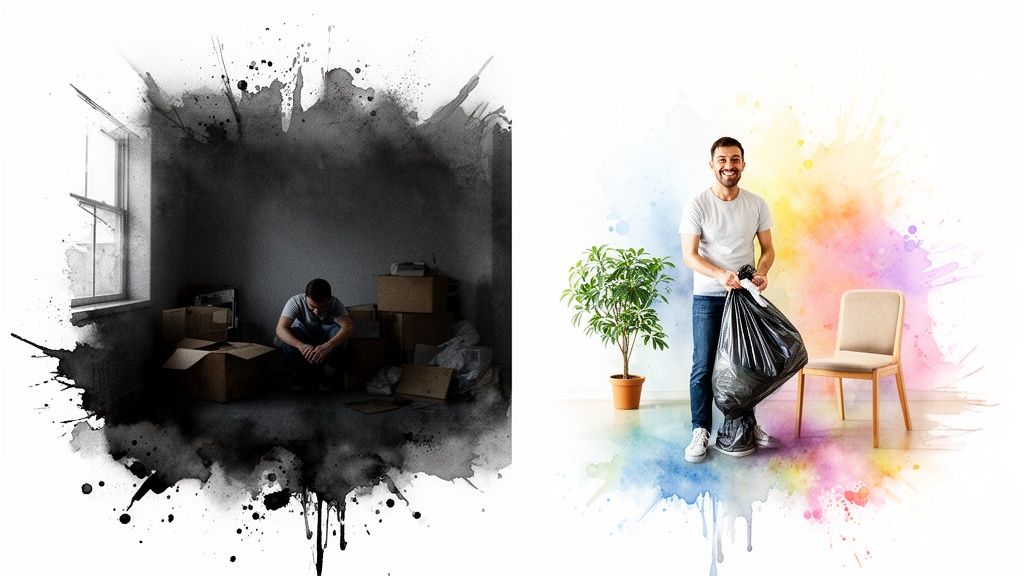
    Split image: a man in a dark, messy room contrasted with him smiling in a clean, colorful room, holding a trash bag.

    Long before I ever thought about big ideas like "environmental justice" for Chicago, I had to face the chaos in my own apartment. It was a disaster, buried under a mountain of stuff I couldn't let go of. Each old takeout box, every forgotten gadget, felt like a tiny anchor holding me down.

    That clutter was a mirror for my life. A long, turbulent relationship had just ended, and my world felt just as messy, just as stuck. I knew I needed a complete reset, not just a quick fix.

    I had to build a new life from the ground up, and I wanted it to be filled with kind, giving people. That meant I had to confront the things I was worst at: cleanliness, consistency, and bravery. That's the little seed from which Litter Caterpillars sprouted.

    From Personal Cleanup to Public Action

    My journey started with a selfish need to fix my own life. It’s strange, but cleaning up someone else’s mess felt so much easier than tackling my own. Picking up trash in a park didn't have the emotional weight of, say, finally tossing a four-year-old jar of jam from my own fridge.

    Doing something for you, for others, for a whole community… it was liberating. By showing up for a neighborhood, I was also, unexpectedly, showing up for myself. I was building that consistency and bravery I so desperately needed.

    The lesson hit me like a ton of bricks: Transforming your immediate world gives you the strength and vision to help transform the community around you. You find this incredible power in serving others, a power that helps you clean up your own life in the process.

    This is the bridge from your own struggle to a public mission. You start by cleaning your own room, so to speak, and before you know it, you’re looking at the whole city. That’s how a simple act of tidying up can blossom into an act of environmental justice.

    The Uncomfortable Truth About Environmental Injustice

    This idea of environmental justice didn't just appear out of nowhere. Its story is woven into the fabric of the Civil Rights movement of the 1960s. For decades, activists on the ground just knew something was deeply wrong. By the 1980s, they started connecting the dots with data, and the picture that emerged was horrifying.

    What they uncovered wasn't an accident. It was a brutal, intentional pattern.

    I saw how communities of color and low-income neighborhoods were systematically chosen to be the city’s dumping grounds. The landfills nobody wanted, the toxic waste sites, the factories spewing poison into the air—they all ended up in the same kinds of places. This wasn’t bad luck. It was policy.

    A Pattern Proven by Numbers

    The real bombshell dropped in 1987. A groundbreaking study, "Toxic Wastes and Race," exposed the entire rotten system. It proved, with cold, hard facts, that race was the single biggest factor in deciding where a hazardous waste facility was built. It mattered more than how much money you made, the value of your home, or anything else.

    And this isn't some ghost story from the past. I see it happening right now, in our own backyards. The numbers just punch you in the gut.

    The disparity is shocking: today, more than half of the people living within just one mile of America's most hazardous waste sites—the ones the EPA has targeted for cleanup—are people of color.

    This tells you everything you need to know. Environmental injustice isn’t a series of unfortunate events. It's a system. It's a machine built over generations that sorts people by the color of their skin and decides who gets clean air and who gets a toxic inheritance.

    From History to Action

    When you understand this history, it changes everything. It shows you that when we fight for a clean park or push back against a new polluting factory, we're not just talking about trees and trash. We are fighting for racial justice. We are trying to dismantle a system that has always treated certain lives as disposable.

    This is where the real work begins—right here, where you and I live. When we get together to clean up a street, we are directly defying that history of neglect. To see how you can turn this anger and understanding into real power, check out my guide on what is community organizing. It’s the next logical step after you see the problem: you do something about it.

    Bringing the Fight for Justice to Chicago's Backyards

    Environmental injustice isn't some abstract idea you read about. It's right here, in Chicago's own neighborhoods. You and I see it every single day. It's stitched into the very fabric of our city, a place where the air you breathe can change with your zip code.

    For years, people in our own communities have been fighting battles they shouldn't have to. I think about Little Village, a proud, majority-Latino neighborhood on the Southwest Side. For decades, the people there lived under the smokestacks of the Crawford and Fisk coal plants, fighting for every clean breath against a constant rain of soot that was making their families sick.

    They organized, they protested, they refused to give up. And they won. But then, the fight just changed its costume.

    New Battles, Old Wounds

    Soon after the plants shut down, a new giant moved in—a massive warehouse for Target. This brought endless fleets of diesel trucks rumbling down their residential streets, trading one kind of poison for another. This is exactly what environmental injustice feels like when you live it. It’s a suffocating cycle of having to fight for the basic right to be safe in your own home.

    Or I think about Englewood on the South Side. For years, you could look out your window there and see nothing but vacant lots and crumbling buildings. These aren't just ugly; they're open wounds, physical signs that say, "This place has been forgotten."

    But these aren't just stories of struggle. They're stories of unbelievable strength. When you stand up to a polluting company or fight to turn a derelict lot into a park, you are practicing environmental justice. It’s about looking at your home and refusing to let it be a sacrifice zone.

    This is the entire reason I started Litter Caterpillars. When we show up to clear a trash-filled lot in Englewood, we’re doing so much more than picking up garbage. We’re sending a message, loud and clear: this neighborhood is not forgotten. The people here deserve beauty, safety, and respect.

    A Small Park, A Big Victory

    I saw this power with my own eyes. A small group of us volunteers decided to bid on an empty, junk-filled lot at a city auction. We scraped together what little money we had and, honestly, against all odds, we won it. That little piece of land is now becoming Caterpillar Park—a green space for the community, built by the community.

    That one small act—taking back one forgotten lot—was a direct punch against the story of neglect. It was environmental justice in action, born from my simple idea of bringing something good to a place that deserved it. Our weekly cleanups are a continuation of that same fight. We show up, week after week, with our bags and gloves to prove that every single backyard in Chicago matters to me.

    How Picking Up Trash Becomes an Act of Justice

    You’re probably thinking, “It’s just litter. How is picking up a potato chip bag going to fix a massive, complicated problem?” I get it. I’ve thought it too. But the line from that chip bag to real justice is deeper than you can imagine. It's everything.

    Think about it with me. Which neighborhoods have the most trash blowing down the street? Where do you see dumpsters overflowing for weeks on end? It’s almost always the same communities already choked by industrial pollution and ignored for decades.

    Litter is the most in-your-face symptom of systemic neglect. It’s a daily, soul-crushing reminder that someone with power decided this place, and the people in it, weren't worth the effort to keep clean. When garbage piles up, it screams a message: this community is disposable.

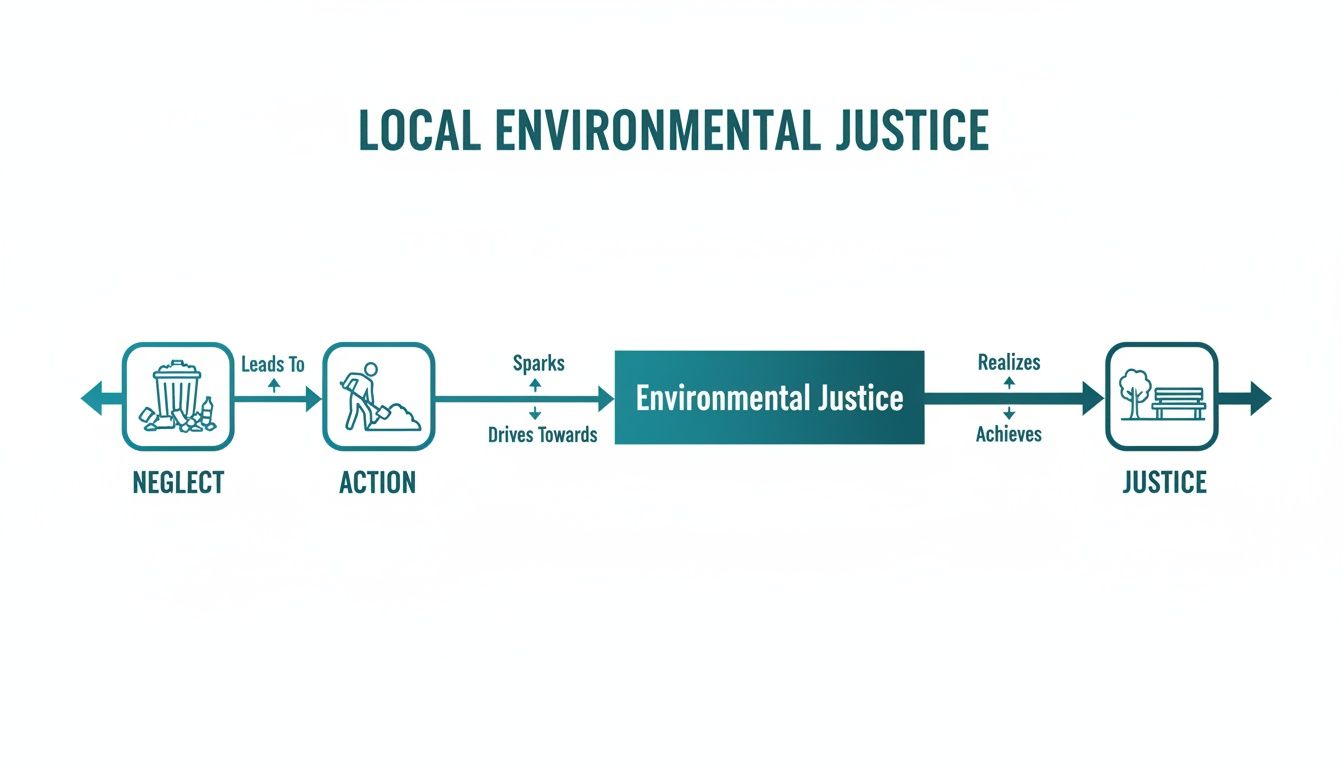
    From Neglect To Action

    So when we, the Litter Caterpillars, show up every single week—rain, shine, blizzard, or heatwave—we're screaming a different message. We are shouting from the sidewalks, "This neighborhood matters! You who live here matter!"

    Our work is an act of pure defiance. It’s my direct challenge to the quiet apathy that let the mess grow in the first place.

    This is the simple, powerful process we live by. We interrupt neglect and we transform it into real, tangible justice.

    A process diagram showing Neglect (trash) leading to Action (shoveling), which sparks Environmental Justice and achieves Justice (park bench).

    This image tells the whole story. A simple, direct action shatters the cycle of neglect. It’s the very first step toward justice and restoring a community’s spirit.

    Cleaning messes someone else made is how you and I give a place its dignity back. It’s an immediate, hands-on way to fight. We’re showing up with bravery and kindness, together. Every single bag of trash we haul away is a small victory, a piece of reclaimed pride for a neighborhood that deserves it.

    This is how we answer the big questions with our own two hands.

    It’s a powerful statement. We are physically mending the tears in our social fabric, one fast-food container at a time. We're not just cleaning a street; we are healing a small part of our city.

    And that’s the beautiful thing about this work. It isn’t some abstract idea. You can see the impact right away.

    If you feel that fire and want to take this kind of direct action yourself, check out my guide on how to start a volunteer trash pickup in your own neighborhood. It always starts with one person, you, deciding to show up.

    You Can Join This Movement Today

    Are you feeling that fire in your gut right now? That little spark that says, “This isn’t right, and I want to do something about it”? I know that feeling intimately. It’s what started this whole crazy journey for me, and I’m personally inviting you to join us.

    You don’t have to be a policy wizard or a seasoned activist to make a real, lasting difference. Real change starts small. It starts with the simplest and bravest step you can take: just show up.

    Your First Step Is Showing Up

    Every weekend morning, we gather to build a real community of givers. I’m not asking for your money; I’m asking for your time and your energy. We provide the gloves, the bags, the grabbers, and the great company—you just have to bring yourself.

    This is how we put the big ideas of environmental justice into action. For us Chicagoans, this is personal. Our weekly cleanups across all the city's wards, from highways to the future Caterpillar Park in Englewood, are my way of fighting back. We intentionally go to the neglected spaces where low-income and minority residents live surrounded by litter-choked streets, showing you that you are seen and valued. Read more about these climate inequality findings to see how this work makes equity visible.

    What to Expect at Your First Cleanup

    Throw away any idea you have about volunteering being a boring chore. This is different. Your first cleanup with us is more than just picking up trash; it’s an adventure. You’ll meet people from every walk of life, all connected by a shared desire to do something good.

    You’ll probably get a little sweaty, share some laughs, and feel an incredible sense of purpose. We make it fun with music, our iconic flags, and a genuine spirit of teamwork that’s hard to find anywhere else.

    The real magic isn't in the trash we take away; it's in the friendships we forge and the personal strength we discover. By investing your time to transform your city, you end up transforming yourself.

    This is how we fight back against the idea that some neighborhoods are disposable. We prove it wrong with our actions, our bravery in blizzards and heat waves, and our shared pride. Come find our next event, show up, and see for yourself how good it feels to be part of the solution.

    Your Questions Answered

    When you start digging into this stuff, questions pop up. That’s good. It means you’re paying attention. I get asked these all the time, so let me tell you what I think.

    Isn't Cleaning up Litter the City's Job?

    Yes. Of course it is. But have you ever noticed how some neighborhoods seem to be consistently skipped over? I see it all the time. Our work isn't about replacing city services; it's about forcing the issue.

    When we show up and clean a neglected block, we're planting a flag. We're saying, "This place matters. These people matter." It's our way of taking pride back into our own hands, and it puts friendly pressure on the city to spread its resources more fairly. You and I lead by example.

    I'm Just One Person. Can I Really Make a Difference?

    Yes. I'm going to say it again: yes. This whole group started with me, one person, feeling totally crushed by my own mess. Now, we're a community of hundreds, changing the face of Chicago.

    It’s all about momentum. One person picking up trash is a start. But 50 people showing up together, week after week, doesn't just clean a street—it transforms a neighborhood. You build a wave that's impossible to ignore. Your presence alone gives someone else the courage to join you.

    You are never just one person. When you show up, you are a symbol of hope and an invitation for others to join. You are the spark.

    What if I'm Not in Chicago? How Can I Help?

    Environmental justice isn't just a Chicago problem, so the solution can't be just in Chicago. If you're not here with me, I challenge you: find a group doing this work in your town. And if you can't find one? Start your own.

    Seriously, my model couldn't be simpler:

    1. Find a spot in your community that everyone else ignores.
    2. Grab a few friends who want to do some good.
    3. Start cleaning. And don't forget to have some fun with it—that part's crucial.

    Post what you're doing online. Tell people your story. That positive energy is what builds a community and gives you the power to push for real change. The Litter Caterpillars spirit can and should exist everywhere.

    Does This Work Actually Change Policy?

    It can, and it does. I’ve learned there's almost nothing more powerful than a community that consistently shows up. When we clean a forgotten alley and I share its story, we're not just picking up junk. We're creating public proof that a problem exists, and we're putting firm, friendly pressure on officials to act.

    My work has directly led to more city services in overlooked spots. I’ve seen community gardens pop up in lots that used to be filled with trash. I've seen residents find their voice and speak with confidence at local meetings. We clean with our hands, and we advocate with our voices. It’s a one-two punch for justice.


    Ready to stop asking and start doing? At Litter Caterpillars, I know that service changes us and our city. Come to our next cleanup. It’s time for you to show up, make some real friends, and be the change.

    Learn more and find your place with us at https://www.littercaterpillars.com.

  • Overcoming Fear of Failure: Real Strategies to Thrive

    Overcoming Fear of Failure: Real Strategies to Thrive

    Beating your fear of failure isn't some dramatic, life-altering leap of faith. It's more like a small, stubborn step forward. You've got to learn to take action even when that voice in your head screams about all the ways you could mess up. I want you to start seeing failure as just a part of the learning process, a way to build your confidence through small, low-risk challenges.

    Confronting the Inner Critic Holding You Back

    You know that voice. I know it. We all have it. It’s the one that whispers, "What if you fail?" the moment you stumble upon a brilliant new idea. I'm intimately familiar with that voice—it’s like a terrible roommate who delights in pointing out every single worst-case scenario, transforming a spark of excitement into a roaring fire of anxiety.

    For me, overcoming this fear wasn't about a grand career change or a terrifying public speaking gig. It started with the disaster zone that was my own apartment after a messy relationship finally imploded.

    A person kneels in despair amid crumpled papers, with a shadowy figure and a bright door symbolizing hope.

    When Your Own Mess Feels Unmovable

    Every single piece of trash felt like a monument to a past failure, a physical anchor holding me in place. An old jar of jam from a trip four years ago. A bag of nuts from a health kick I abandoned. Each item weighed almost nothing, but to me, they were 500-pound anchors of regret and inaction. I was completely paralyzed, trapped in a shame spiral that made even thinking about cleaning my own space feel like an impossible mountain to climb.

    This feeling is universal, even if your "mess" looks different. It's the exact same fear that holds you back from:

    • Finally applying for that dream job you’re almost qualified for.
    • Starting that creative project you've been daydreaming about for years.
    • Just showing up to a local volunteer group like ours where you don't know a single soul.

    That inner critic loves to make you feel isolated, convincing you that you’re the only one who feels this way. It tells you that even trying is a risk, because you might just confirm your deepest fear: that you’re not good enough.

    The Turning Point Is Outside Yourself

    I hit a breaking point that forced me to face the very things I was terrified of: consistency, action, and bravery. I couldn't handle my own mess, so I started with someone else's. I decided to go pick up litter in a public park. Imagine the stakes: they couldn't have been lower, but the act itself felt monumental. It was a physical, tangible way of moving forward—of cleaning up one small corner of the world when my own felt too chaotic to touch.

    That simple act changed everything. It quieted my inner critic because my focus was on something external. I wasn't trying to "fix my life." I was just picking up a bottle. I was learning, in real-time, that this is how real change happens: one simple action, repeated. Figuring out what drives you is a huge part of this journey, and you can learn more about intrinsic motivation in our guide.

    I realized something profound: cleaning other people's messes is way easier than cleaning up your own. It gives you a win when you desperately need one, building the momentum you can bring back into your own life.

    This is the very first step you can take to get over the fear of failure. It's not about shutting that critic up for good. It's about finding an action so simple, so external, that you can do it in spite of that voice. It’s about just showing up.

    Why 'Just Do It' Is the Worst Advice for Fear

    Have you ever been totally frozen by fear, only for some well-meaning person to chirp, “Just do it!”? It’s supposed to be a kick in the pants, but honestly, it lands more like a slap in the face.

    Telling someone you've paralyzed by the fear of failure to "just do it" is like telling someone caught in a Chicago blizzard to "just get warm." It's an instruction that completely misses the point, ignoring the crushing, invisible weight of the problem.

    This isn't some minor personality quirk you can just power through. It’s a massive, global barrier holding people back. In fact, this fear is so powerful it stops nearly half of all potential entrepreneurs before they even write a single line of a business plan.

    And it’s gotten worse. The Global Entrepreneurship Monitor Global Report found the percentage of people who won't start a business because they’re afraid of failing recently jumped from 44% to 49%. That's a huge spike, and it shows you just how much uncertainty has crept into our thinking. You can dig into more of these entrepreneurial trends at phys.org.

    Your Fear Is a Rational Response

    So, let's get one thing straight. Your fear isn't a flaw. It’s often a completely rational response when the stakes feel sky-high. You’ve poured your time, your hopes, and maybe your life's savings into a dream. Of course the thought of it all falling apart is terrifying.

    This is exactly why cleaning up someone else’s mess—like me picking up litter in a park—feels infinitely easier than tackling your own.

    The stakes are beautifully, wonderfully low. There's no emotional baggage. It’s just a simple, direct action with a tangible win. You show up, you fill a bag with trash, and you leave feeling better than when you arrived. It's a powerful way to detach the action from the outcome.

    A Hailstorm and a Huge Realization

    I learned this firsthand during our very first Litter Caterpillars cleanup. There were only three of us, and we got ambushed by a ridiculous Chicago hailstorm. I’m talking ice pellets coming down sideways. We were huddled under a flimsy tree, shivering, watching every single rideshare driver cancel on us. It was, by all objective measures, a miserable situation.

    But right there in that moment, something incredible happened.

    I realized that struggling together, even over something as small and absurd as a hailstorm during a trash pickup, was incredibly empowering. It became a shared experience. A story.

    It wasn't about succeeding or failing. It was about moving the story of my life forward. The cold, the hail, the frustration—it all just became another interesting page in the story. It advanced the plot.

    This mindset shift is everything. When you’re facing a big, scary challenge, stop thinking of failure as the end of the book. It’s not. It’s just an unexpected plot twist. It's the part that makes your journey compelling and teaches you something vital for the chapters still to come. It’s what makes your story worth telling.

    Finding Your Own 'Fence to Paint'

    You know the story of Tom Sawyer, right? His aunt saddles him with the world's most boring chore: painting a giant fence. But instead of moping, he flips the script. Tom turns this punishment into the hottest ticket in town, so much so that his friends actually pay him for the privilege of doing his work.

    That story holds a secret weapon for you to crush the fear of failure. You don't just muscle through a scary task. You completely change what it means.

    This is all about finding your own fence to paint. It's about taking something that feels like a drag—or is downright terrifying—and building a new, powerful story around it.

    Community volunteers joyfully paint a vibrant fence, symbolizing teamwork and positive change.

    Here at Litter Caterpillars, our "fence" is picking up trash. Let's be real, you and I both know nobody gets excited about grabbing soggy fast-food bags off the sidewalk. But we've intentionally reframed it. It’s not a chore; it’s a mission. We’ve turned it into a game of bravery and taking back our community.

    Building Your Narrative of Purpose

    So, how do you actually do this? You create little rituals and symbols that inject the action with meaning. For us, it’s things like flags, badges, and even our own theme song.

    When you’re marching down a street with a flag, you’re suddenly not just a person picking up litter. You're part of a movement. You're a team on an adventure, and that feeling changes everything.

    This isn't about pretending something isn't hard. It's about you wrapping your actions in a story of purpose. You're not just cleaning your junk drawer; you're creating order from chaos. You're not just signing up to volunteer; you're deciding to be someone who shows up.

    This works because fear is so often shaped by the stories we're told. It’s fascinating, actually—your fear of failure looks totally different around the world. A World Economic Forum analysis found that the European Union has the highest fear of failure rate at a whopping 40.7%, while the United States is much lower at 29.66%.

    By creating visible pride through symbols and just showing up, again and again, we prove that fear isn't your destiny. It's just an emotion you can reshape with others. You can dig into these cultural differences in fear of failure on weforum.org.

    The key is to find a task with low stakes and imbue it with high purpose. This flips the script on your fear, turning a potential failure into a noble effort.

    A Checklist to Find Your Fence

    Ready to find your own fence? The goal is for you to pick one low-stakes thing you've been putting off and give it a new story.

    • What's a small mess you can tackle? That pile of mail, the closet that exploded, the weeds taking over your garden bed.
    • What's a simple new skill you can try? Learning one song on the ukulele. Trying that one recipe you saved months ago.
    • What's a community act you can join? Signing up for one volunteer shift. Attending one local meeting.

    Choose one. That's it. This isn't your magnum opus; it's your training ground. It's your fence.

    Now, give it a new story. You’re not just “doing a chore.” You are practicing bravery.

    Building Your Low-Stakes Bravery Lab

    Here’s a secret I've learned: courage isn't something you’re born with. It's a muscle. And you don't build muscle by trying to bench-press 500 pounds on your first day at the gym, right? You start small. You get used to the feeling. You build strength in a safe space.

    Tackling a fear of failure works the exact same way. You need your own personal “Bravery Lab”—a low-risk space where you can practice doing things that make you a little uncomfortable.

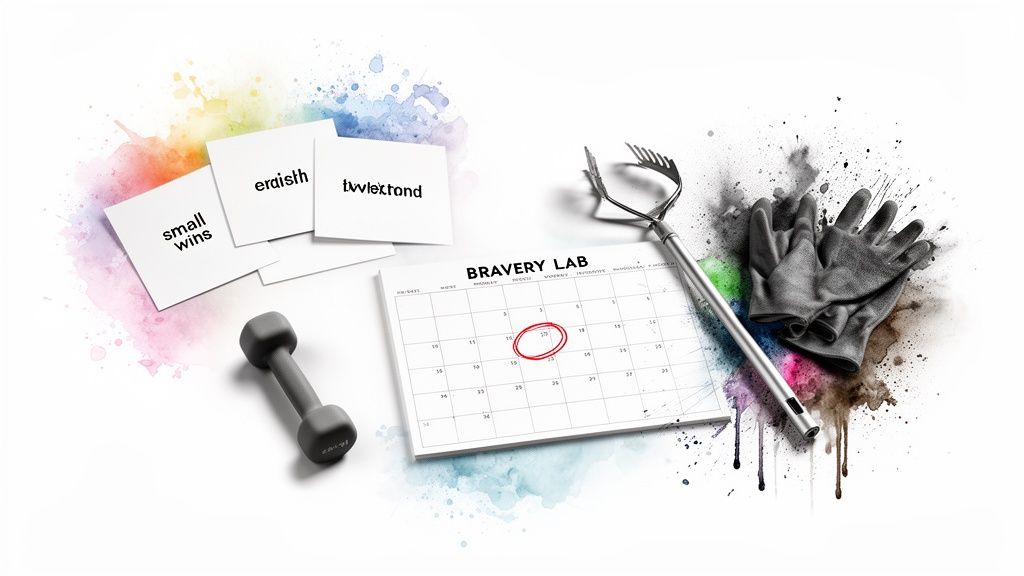
    A flat lay of objects symbolizing bravery and effort: cards, dumbbell, calendar, and gloves.

    For us at Litter Caterpillars, every weekend cleanup is a Bravery Lab. The stakes are beautifully, wonderfully low. If you show up and pick up just one single piece of trash, you’ve succeeded. If you get caught in a Chicago downpour and have to bail, you didn't fail—you just left with a great story to tell.

    This idea is so powerful because it separates your actions from some high-stakes outcome. Think about starting a business. The stakes are huge! Data from the U.S. Bureau of Labor Statistics shows a big chunk of new businesses don't make it past ten years, so that fear you might feel is totally rational. You can even read about how fear affects entrepreneurs at Harvard Business Review.

    But picking up a bag of litter? The stakes are nearly zero.

    Micro-Exposure Exercises to Rewire Your Brain

    The whole point of this lab is to rack up small wins for yourself. These little victories teach your brain a new, crucial lesson: failure isn't fatal. It’s just feedback.

    When our volunteers show up in negative wind chills, they're practicing the core skill that separates doers from dreamers: you take action even when it's uncomfortable.

    You can do this in your own life with what I call micro-exposure exercises. These are tiny, intentional actions designed to push the edges of your comfort zone without sending you into a full-blown panic.

    Let's break it down:

    • The Fear: You're terrified of networking and talking to new people.
    • The Big, Scary Action: Going to a massive industry conference all by yourself. (Yikes! Too much, too soon.)
    • The Micro-Action: Tomorrow morning, make eye contact with the barista at the coffee shop and say "good morning."

    That tiny action is your experiment. The risk is basically zero, but the psychological win is very real. You're collecting data that proves you can survive a moment of social risk. And you can.

    Your First Week in the Bravery Lab

    Ready to run a few experiments of your own? This is all about you taking small, manageable steps to build that courage muscle. Here’s a simple 5-day plan to get you started.

    Day Micro-Action Goal
    1 Make eye contact with a cashier and give a genuine "thank you, have a good day." Practice initiating a small, positive social interaction.
    2 Ask for a recommendation at a bookstore or coffee shop, even if you don't plan to buy it. Get comfortable asking for help or an opinion.
    3 Wear an item of clothing you like but are slightly self-conscious about. Survive a minor feeling of being "seen" and realize that nobody really noticed.
    4 Take a different route on your commute or walk, just to see what happens. Break a routine and embrace a tiny bit of the unknown.
    5 Send a text to a friend you haven't spoken to in a while just to say "thinking of you!" Overcome the small hesitation of reconnecting.

    Each action is a small rep. By the end of the week, you've completed a full workout and proven to yourself that you can handle these little moments of discomfort. You survived. You grew.

    Scenarios for Your Next Experiments

    Let's make this even more practical. Here are a few common fears and some lab-safe experiments you can try.

    • If you fear being judged: Post an opinion on a social media story where replies are private. Maybe it's about your favorite pizza topping or a new movie. You get to express yourself without the pressure of a public comment section.
    • If you fear rejection: Ask for a small thing that's easy to say "no" to. For example, ask a bookstore clerk if they have any spare promotional bookmarks. If they say no, you’ve just experienced a tiny, painless rejection. And look at that—you're perfectly fine.
    • If you fear looking incompetent: Try a brand-new, slightly complicated recipe for dinner, but just for yourself. If it's a complete disaster, who cares? No one ever has to know. You just learned what not to do next time.

    The victory isn't in the outcome; it's in the act of trying. Showing up is the win. This is how you build resilience.

    By celebrating the simple act of showing up, you build the mental muscle you need for the bigger challenges. It's the exact same philosophy we bring when we team up with awesome organizations like the Care for Real food pantry. It’s all about taking that one brave first step.

    How to Engineer Your Social Circle for Courage

    Have you ever noticed how your mood completely flips depending on who you're around? Walk into a room of complainers, and suddenly you're spotting problems everywhere. But step into a group of people who are genuinely trying—people who are out there doing the work—and you feel a little braver yourself.

    The people you spend time with are like the air you breathe; they shape your internal world, often without you even realizing it. I learned this the hard way. Years ago, I made a conscious choice to mindfully engineer my social circle to filter out selfish people, and it was a complete game-changer in my own journey. It’s about being intentional with your influences.

    You have the power to curate your own personal team of courageous people.

    Finding the Givers

    Think about your social circle. Is it full of takers who just drain your energy, or givers who lift you up? Takers see obstacles everywhere. Givers, on the other hand, see a challenge and ask, "How can we help?" They make being brave feel normal because it’s just what they do.

    This is exactly why we schedule Litter Caterpillars events on Saturday and Sunday mornings. It’s a natural filter. People who drag themselves out of bed on a weekend to clean up a stranger's neighborhood are, by their very nature, givers. They are the consistent, service-minded people who will support your growth, not hold you back.

    Surrounding yourself with people who act in spite of challenges is the fastest way you can learn how. Their courage becomes contagious.

    So, who are the givers in your life right now? Think about it. Who leaves you feeling more capable and optimistic after you talk to them? Those are your people. I want you to spend more time with them.

    Plugging into the Right Communities

    Finding these communities is easier than you think. You don't have to overhaul your entire life overnight. It’s about taking small, intentional steps to connect with people who align with the person you want to become.

    • Look for action-oriented groups. Find clubs or volunteer opportunities focused on a shared activity, not just talking. Working side-by-side on a real mission is an amazing way for you to build friendships that actually mean something.
    • Identify communities with strong values. Do they celebrate trying? Do they support each other through setbacks? Find a group whose core beliefs resonate with you. We believe failure and suffering are good because they lead to growth.
    • Just show up once. The biggest hurdle is always that first step. I want you to commit to attending one meeting or event. No pressure. No lifelong commitment. Just see how it feels.

    Building a support system that normalizes courage is one of the most powerful things you can do. When your friends are out there facing their own challenges, it makes your own fears seem much more manageable. If you're looking for ideas, you can even check out our guide on how to meet like-minded people in your city.

    Your circle defines your reality—choose one that makes you brave.

    Your First Step Starts This Weekend

    Reading about bravery is one thing. Practicing it is everything. We’ve talked a lot about mindset and small steps, but now comes the hard part. The real part.

    I want you to consider this a direct, personal invitation from me to you: stop thinking, and start doing.

    This weekend, you can take your first real step toward crushing that fear of failure by just showing up.

    Five diverse volunteers in blue shirts and gloves, holding tools, smiling and shaking hands.

    I know exactly what's going through your head right now because I hear the same questions from almost every single person before their first event.

    • "What if I don't know anyone?" Perfect. Nobody does at first. This isn't a networking event. The whole point is for you to work side-by-side on a shared mission. Friendships just happen when you're focused on a task together, not on trying to be cool.
    • "What should I wear?" Clothes you don’t mind getting a little dirty in. That’s literally it. We provide all the gear you need—gloves, pickers, and bags.
    • "What if it rains?" Then we get a little wet and have a better story to tell. We're out there rain or shine, because consistency is part of the practice. Suffering a little together is what makes it fun. It advances the plot.

    You Just Have to Show Up

    I’ll never forget one volunteer, Sarah. She told me she circled the block in her car three times before she finally got the courage to park and get out. She was that terrified.

    Fast forward a year, and now she’s leading her own cleanups.

    Her story isn't some magical, overnight success. It's about one small, messy, imperfect step. She chose action over anxiety. She chose sunlight and new friends over staying home and worrying.

    This isn't about being fearless. It's about you acting despite the fear. You don't have to be perfect to start. You just have to show up.

    The beautiful thing about this first step is that the stakes are incredibly low, but the potential for your growth is massive. You’ll leave with a real, tangible victory—a cleaner park, a satisfyingly heavy trash bag—and a feeling of accomplishment you can't get from reading an article.

    We’re out there every single weekend. Come find out what you're made of.

    Common Questions About Facing Your Fears

    But What if I'm Still Scared After I Try?

    Good! Feeling scared means you’re on the right track. Seriously.

    The point isn't to magically erase your fear forever. That's impossible. The goal is for you to learn to take action while you feel it. I always say, "Fear is good." It’s the compass telling you that you're stepping outside your comfort zone and into the growth zone.

    Just keep showing up. Keep practicing in your low-stakes bravery lab. Celebrate the fact that you tried at all. Pretty soon, you'll look back and realize that feeling of fear is still there, but it's no longer the one driving your car.

    How Can Picking Up Trash Possibly Help My Career?

    Think of it like this: it's mental cross-training for your life.

    When you choose to get up on a cold, rainy Saturday morning to clean up a park with a bunch of strangers, you're doing something hard. You're building muscles like consistency, resilience, and straight-up bravery.

    You are proving to yourself, through real-world action, that you are the kind of person who shows up and does difficult things. That quiet, earned confidence doesn't just stay on the sidewalk after the cleanup is over. You carry that with you into your next big work project, your relationships, and every other part of your life.


    Ready to see what you're made of? Come join Litter Caterpillars this weekend and take that first, real step.

    Find your next cleanup event here: https://www.littercaterpillars.com

  • What is social responsibility? Practical steps to make a difference today

    What is social responsibility? Practical steps to make a difference today

    I used to think social responsibility was a term reserved for corporate boardrooms, a phantom phrase haunting glossy annual reports. It felt colossal, impersonal, and a million miles away from my daily grind.

    Then my own world imploded. A relationship shattered, my apartment became a monument to chaos… I was submerged, drowning in my own life's clutter. Cleaning it up felt impossible. But a peculiar thought surfaced: what if, instead of tackling my own mess, I went out and cleaned up someone else's? The city's mess.

    The moment I stepped out that first day, litter picker in hand, it all clicked into place. Social responsibility isn't about having your own life flawlessly curated. It's about showing up for the world that exists beyond your front door.

    It’s this beautifully simple, profoundly powerful idea that we're all intricately woven together. Imagine society is a vast, sprawling quilt—you, me, every single person—we’re each a single thread. When you tug on one, even the tiniest one, the entire pattern ripples and shifts. That’s it. You’re making choices that fortify the entire fabric, not just your own little patch.

    The Three Layers of Making a Difference

    To really grasp what social responsibility is, you have to see its DNA expressed at different scales—from your own quiet decision to a multinational corporation's sweeping mission.

    This diagram unpacks it perfectly, illustrating how genuine change grows from the ground up, starting with you.

    A hierarchy diagram illustrating social responsibility at individual, community, and corporate levels with specific examples.

    This visual illuminates a crucial truth: real impact isn't a one-way street, trickling down from on high. It's a living feedback loop. Your personal choices ignite community action, and vibrant communities, in turn, compel corporations to elevate their game.

    Let me break down how this dynamic plays out in the real world.

    The Three Dimensions of Social Responsibility

    A straightforward look at how responsibility scales from a single person to a global corporation.

    Dimension Who It Involves Example in Action
    Individual You, me, every single person. You choose to bike to work instead of drive. I volunteer on a Saturday. We simply check in on an elderly neighbor.
    Community & Civic Neighborhood groups, local non-profits, city-wide initiatives. A group like Litter Caterpillars orchestrates weekly cleanups, or a community garden materializes, offering fresh produce for local families.
    Corporate (CSR) Small businesses and global corporations. A local coffee shop meticulously sources fair-trade beans, or a tech giant invests in renewable energy to power its sprawling data centers.

    As you can see, these layers aren't sealed off in silos. They're perpetually dancing with one another.

    One person’s unyielding dedication to recycling can spark a neighborhood-wide composting revolution. A community that passionately demands pristine parks can pressure local businesses to abandon single-use plastics. It all begins with the defiant belief that what you do actually, fundamentally matters.

    This mindset is a kindred spirit to another potent idea, which you can explore in our guide on what is environmental stewardship. Everything ignites the moment you decide to take that first small, powerful step.

    The Surprising Joy of Tackling a Shared Mess

    Three diverse people joyfully collecting trash under a tree in a watercolor painting, promoting environmental cleanup.

    You know that feeling? It's infinitely easier to help a friend conquer their chaotic garage than to confront your own overstuffed closet. A profound psychological truth hides in that sensation, and it's the secret ingredient that makes groups like ours thrive. Let me transport you back to our very first cleanup.

    We were a trio, armed with trash grabbers and only a hazy notion of our mission. Then, in a display of classic Chicago drama, a serene spring day erupted into violence. A freak hailstorm ambushed us, forcing us to huddle beneath a flimsy tree as ice pellets rained down like tiny hammers.

    And in that shared, shivering moment of misery, something profound clicked for me. Confronting a collective mess—the city's litter—felt strangely, wonderfully liberating.

    Detached from Personal Baggage

    This mess wasn't my mess. It carried none of the emotional gravity of my own to-do list, where each piece of clutter whispers a story of procrastination or past failure. The city's trash was just… trash.

    Tackling a problem that doesn't personally belong to you unleashes pure, unfiltered purpose. It vaporizes self-judgment, replacing it with a simple, achievable mission.

    This detachment is a superpower. It transforms a potentially demoralizing chore into an exhilarating adventure. You aren't fixing a personal shortcoming; you are contributing to a collective triumph.

    This is the very point where the idea of what is social responsibility sheds its heavy, obligatory skin and reveals itself as a wellspring of unexpected joy. It's about discovering your own strength by focusing on something orders of magnitude bigger than yourself. When you pivot your focus outward, you unearth a part of you that you never knew existed.

    Turning Struggle into a Story

    That hailstorm could have been the unceremonious end of our fledgling group. Instead, it became our origin story. Why? Because shared struggle forges bonds of steel.

    Facing a challenge together ignites a few spectacular things:

    • It builds resilience: Enduring a small, shared hardship like a sudden storm makes you feel like you can conquer mountains.
    • It creates instant community: Nothing connects people faster than a shared "can you believe this is happening?" moment.
    • It makes the work memorable: The struggle adds flavor, a narrative spice. It elevates a simple task into a story you’ll genuinely want to tell later.

    Suddenly, you’re not just picking up litter anymore. You're part of a crew that stared down a storm. You're a protagonist in a story of progress, where every filled trash bag is a victorious chapter. It’s in these moments that the true meaning of social responsibility reveals itself—not as a duty, but as a path to connection, growth, and even a bit of wild fun.

    How Big Companies and Local Groups Build Trust

    Watercolor image of a businessperson and a volunteer holding a green plant, symbolizing growth and collaboration.

    It's not just us out there, wielding trash grabbers on a brisk Chicago morning. The most gargantuan, powerful corporations on Earth are wrestling with the very same idea we are. They have a more polished name for it: Corporate Social Responsibility, or CSR. But strip away the acronyms, and it boils down to one elemental thing: trust.

    For decades, the gospel of business was brutally simple: a company's sole duty was to enrich its shareholders. The planet? The community? Someone else's problem. But something seismic has shifted in the landscape.

    Today, you, me, and millions of others are raising our voices, demanding more. We expect the brands we champion to be good neighbors. We want them to be accountable for their impact on the world, not just their profit margins. And you know what? They're listening.

    From Afterthought to Essential Strategy

    This isn't some ephemeral trend; it's a tectonic shift in the very mechanics of business. The proof is etched in the data.

    An astonishing 98% of S&P 500 companies now publish dedicated CSR or sustainability reports. Let that sink in. Just a few years ago, that figure was a negligible fraction. This explosive growth signals how social responsibility has morphed from a "nice-to-have" PR maneuver into a core tenet for survival.

    Why the sudden corporate enlightenment? Because they finally deciphered the code: doing good is good for business.

    Trust is the new currency of the modern economy. When a company invests in its community, it’s making a deposit. When it pollutes a river or ignores its workers, it’s making a catastrophic withdrawal.

    This new reality has birthed a playbook for how businesses earn that invaluable trust.

    The Two Sides of the Same Coin

    At first glance, a global behemoth cutting a multi-million dollar check for a climate initiative seems galaxies away from a small crew cleaning a neighborhood park. But I see them as two faces of the same coin. Both actions are grappling with one fundamental question: do you show up for your community?

    • Corporate Level: This is the macro-level stuff. A company might pour capital into renewable energy, enforce fair labor practices throughout its labyrinthine supply chain, or architect programs to diversify its workforce. These are the grand gestures that prove to customers and employees that the company’s values transcend the bottom line.
    • Community Level: This is where we live and breathe. When we show up every weekend, come rain or shine, we are making a tangible, visible promise to our neighbors. We are proving, block by block, that we care.

    Whether it’s a global titan or a handful of us armed with trash bags, the objective is identical. It’s about forging a reputation built on the bedrock of consistent, positive action. For us, the action is picking up litter. For a corporation, it might be an intricate sustainability program. Both are potent declarations saying, "We're here, and we're trying to help."

    We help businesses understand how to forge this connection at a local level—you can learn more about our corporate social responsibility programs. At the end of the day, building a better future begins with proving you can be counted on.

    The Values That Fuel Our Mission

    Three smiling friends in colorful raincoats and casual clothes walking, holding hands, with watercolor splashes.

    It’s one thing to comprehend what is social responsibility as an abstract concept. It’s a whole different beast to breathe life into it, week after grueling week, in the messy real world. That requires more than a solid plan; it demands a pulse. A heartbeat.

    You need a set of values that act as your North Star when the work gets hard, the weather turns hostile, and the siren song of staying home seems irresistible. For us, it all distills down to three core beliefs. These aren’t just words we splash on a website. They're the fuel. They're the reason we show up.

    Bravery to Begin

    First, let's talk about Bravery. I’m referring to the audacity to get uncomfortable. It’s showing up for a cleanup in a corner of the city you’ve never explored. It’s venturing out when the forecast screams rain, or worse. This is the fertile ground where real magic sprouts, because nobody ever grew by remaining cocooned in their comfort zone.

    Think about Tom Sawyer, condemned to the dreary punishment of whitewashing a fence. He could have sulked. He could have complained. Instead, he executed a brilliant psychological maneuver, reframing the chore as an exclusive, can’t-miss opportunity, convincing his friends they were lucky to even try. He made drudgery look like a privilege.

    That's the spirit. We unearth joy in the challenge. We lean into the tempestuous days because those are the ones that weave the best stories and forge the most unbreakable friendships. Real social responsibility ignites with the bravery to simply begin, especially when it’s inconvenient.

    Kindness as Our Compass

    Next up is Kindness. But perhaps not in the way you’re imagining. For us, kindness manifests as a fierce, unwavering protection of our volunteers' energy. Your time, your spirit, your well-being—that is the most precious resource we possess. It is the engine that powers this entire beautiful machine.

    This is precisely why I schedule our events on weekend mornings. It's a deliberate choice to convene a community of givers—people willing to launch their weekend with an act of service. It’s also why we will never, ever ask you for money.

    Your time and positive energy are the only currencies that hold value here. We believe that true service is a gift, not a transaction.

    By prioritizing our volunteers, we ensure this space always remains a sanctuary of joy and connection, not one of obligation. That’s my promise to you. Kindness is our compass, and it always points toward what’s best for the people who make all of this possible.

    Unity in Our Purpose

    Finally, there’s Unity. We are absolutely, unshakeably committed to bringing people together from all 50 wards of Chicago. This city can sometimes feel like an archipelago of disconnected islands, but we know its most profound strength lies in its connections.

    There’s an old proverb: "If you want to go fast, go alone. If you want to go far, go together." We are in this for the long haul.

    Every single cleanup is an act of bridge-building. It's living proof that we are stronger, happier, and exponentially more effective when we work side-by-side. Unity isn't just about showing up in different zip codes; it's about cultivating a shared sense of ownership for our entire city and proving that together, we can manifest the change we all yearn to see.

    So, You In? Here’s Your Personal Invitation

    Hopefully, by this point, you're feeling it—that little ember that starts to glow when you realize you can actually be part of something tangible, something bigger than yourself. If you are, consider this your official, personal invitation from me to you. Come join us.

    This is the exact moment where the concept of what is social responsibility ceases to be mere words on a screen and transforms into a real-life adventure. I've opened the door, and I want to show you just how exhilarating it is to step through it.

    Whether you're a newcomer to Chicago, searching for some of the most genuine, kind-hearted souls in this city, or you just crave the satisfaction of seeing the tangible, visible impact of your own two hands—you belong with us. I've got a spot saved just for you.

    How to Join the Adventure

    Getting involved is as simple as I could possibly make it. We've demolished all the usual barriers because I know the most vital thing you can bring is your own energy. I want you to feel excited, not burdened.

    Here’s the deal:

    • Find Us Easily: We post all our upcoming cleanups on Meetup and Instagram. Give us a follow, and you'll know precisely where we'll be next weekend. No ambiguity.
    • No Gear Needed: I mean it. Just show up. We bring everything—gloves, trash bags, those awesome litter grabber thingies. All you need to bring is yourself.
    • Your Happiness Is the Priority: This isn't about pressure. It’s about connection, fun, and doing something good. You'll discover that a cleaner city is an incredible side effect of forging real friendships.

    This journey isn’t merely about picking up trash. It's about personal metamorphosis. I’ve personally watched new volunteers arrive, shy and hesitant, and within a few months, they’re leading their own neighborhood cleanups, radiating a confidence they never knew they possessed. They discovered their own strength by showing up for others.

    A Community Built on Doing Stuff

    This isn't just my story. It’s a collective narrative we all write together every single weekend—a story penned by incredible people who choose to give their time. Deep friendships have been forged side-by-side, sharing laughs over the absurd things people discard and bolstering each other when the Chicago weather gets a little theatrical. This is where you find your people.

    Sure, corporate philanthropy is a juggernaut. US companies donate billions annually. But when policies shift or that support evaporates, the raw, undeniable power of people on the ground—of grassroots unity—shines through. It’s the untamed energy of volunteers that actually changes worlds.

    This is your chance to step into a story of bravery and kindness. It’s a chance to find the fun in service and see how it changes you from the inside out.

    We’ve seen firsthand how a small group with a shared purpose can ignite a massive, visible change. The only thing missing is you.

    If you’re ready to jump in but aren’t sure where to start, we've got your back. Check out our guide on how to find volunteer work that actually feels right for you.

    Your Questions Answered

    Jumping into something new, especially with a group of strangers, can feel a little strange. I get it. You probably have a few questions swirling in your mind. Let’s cut right to the chase and tackle those head-on.

    My goal is to give you the real answers, no fluff, so you can feel completely at ease about showing up.

    "My Schedule is Crazy. What's the Commitment?"

    Life is a whirlwind. Work is relentless. We know. That's precisely why we don't believe in commitments. Your time and energy are a gift, and we treat them as such.

    There is zero long-term commitment. I'm serious. Come once a year, once a month, or whenever you feel that magnetic pull to get out there and do something real. I post everything on platforms like Meetup so you can just pop in and RSVP when it aligns with your life. No pressure, no guilt. We’re just happy to have you, whenever that may be.

    "Do I Need to Buy a Bunch of Gear?"

    Nope! Not a single thing. We've got all the gear covered, so you don't have to worry about a thing.

    We provide everything you'll need to safely and effectively clean up our city:

    • Heavy-duty gloves to protect your hands.
    • Tough trash bags that won't give up.
    • Litter grabbers so you don't have to break your back.

    We have a 'volunteer-first' rule. That means we obliterate as many hurdles as possible. I want you to focus on the mission and the people you're with, not on remembering to bring a trash poker.

    Just show up. Wear some comfortable clothes and shoes you don’t mind getting a little dirty. That’s it.

    "Is It Safe? We're Going All Over the City."

    Your safety is our absolute, non-negotiable priority. Always. This isn't just rhetoric; it's woven into the very fabric of how we operate.

    The most crucial rule we have is that we always stick together. There’s a powerful safety in numbers, and we look out for each other like a family. When we venture into all 50 wards, we’re sending a profound message that every part of Chicago is worth caring for. We’re not just picking up trash—we’re showing up, building trust, and proving that unity makes us all stronger.


    At Litter Caterpillars, we believe that when you show up for your city, you start to transform yourself. We’re not just cleaning streets; we’re building a community of brave, kind people who are proud to make a real difference. Come find your people. https://www.littercaterpillars.com

  • Reducing Plastic Use One Small Action at a Time

    Reducing Plastic Use One Small Action at a Time

    Forget some massive, impossible lifestyle overhaul. Cutting back on plastic is just about taking one small step. Just one. The journey away from a world of single-use junk isn't a switch you flip overnight. Imagine it more like building a bridge, one plank at a time. It’s a whole series of tiny, empowering choices that you make, which stack up until you've created a whole new way to walk through the world.

    The Surprising Power of Starting Small

    A young man with a reusable bag stands in a doorway near a pile of plastic bottles, looking towards a park.

    I get it. Another lecture about plastic? No. Hear me out. This isn't about guilt. It's about you finding your own power. For me, this whole thing started in my own apartment, surrounded by my own junk. A mountain of it. Every old takeout container, every forgotten plastic bag, felt like a 500-pound weight pinning me to the floor, a physical anchor to a messy past I desperately wanted to leave behind.

    The real change didn’t come from a perfectly executed plan. It came from a simple, gut-level decision to just do something. Anything. And in that messy process, I stumbled upon a weird truth about myself that I bet you'll recognize, too.

    Why Is It Easier to Clean Someone Else's Mess?

    It's a strange quirk of our minds, but it's true: cleaning up a park, a street corner, a highway—somebody else’s mess—often feels way easier and more satisfying than tackling the clutter in our own homes. What is that about? I think it’s because it’s a pure act. A gift. You have no emotional baggage tied to a stranger’s discarded coffee cup.

    Picking it up is simple. Clear. A straightforward win. You do that over and over, and you start building this weird kind of momentum. It’s like a secret training ground for courage. You start by cleaning up a little patch of grass, and before you know it, you’ve found the strength to finally face the mess in your own life.

    This is the secret behind reducing plastic use that nobody ever talks about.

    This isn't just an environmental chore. It’s a path to reclaim your own space, to simplify your life, and to find a real connection with a community of people who actually care. You start by transforming the world outside your door, and somehow, that transforms you from the inside out.

    The Real Impact of One Small Action

    Your point isn't to become perfectly plastic-free tomorrow. The goal is just to start. Think of your current habits like a well-worn path in the woods. It's the easy trail, the one you can walk down without thinking. Choosing a reusable bag or turning down a plastic straw is like taking the first step off that path to carve out a new one.

    At first, it feels intentional. Maybe even a little awkward. But every single time you do it, that new trail gets clearer, more defined. Soon enough, it’s your new default route. Each time you make that conscious choice, you’re not just stopping one piece of plastic from hitting a landfill or floating in our lake. You're rewiring your own brain and sending a quiet but powerful message to the world. This is a huge part of what environmental stewardship is really about.

    • You reclaim your power. Businesses listen when money talks. Every time you say no to plastic, you're casting a vote for the kind of world you want to live in.
    • You simplify your life. Fewer disposable things means less clutter. Less stuff to manage. More headspace for what actually matters to you.
    • You inspire others without even trying. When you show up with your reusable coffee cup or produce bags, you make it look normal. People see you, and it makes it easier for them to start, too.

    This whole journey kicks off with a single, courageous step. Maybe it’s joining a local cleanup. Maybe it's buying a reusable water bottle. Maybe it's just saying "no thanks" to a plastic bag. That one action is the spark. It proves to you that change is possible and that you have the power to make it happen, right here, right now.

    Building Your Everyday Plastic-Free Toolkit

    Sustainable reusable products for reducing plastic waste: a water bottle, tote bag, straw set, and collapsible cup.

    Let's get real. Big, meaningful change doesn't happen in a flash. It's built from tiny, consistent habits—the kind you barely notice until one day you look back and realize everything is different. That’s how we have to tackle plastic. Forget the overwhelming, all-or-nothing guilt trip. We’re starting with simple swaps you can actually manage.

    Think of it like building a muscle. You don't walk into the gym for the first time and try to bench press a car. You start with something you can handle. You do it consistently. You get stronger. That's our game plan here.

    Start With The Big Four

    When I lead our Litter Caterpillars cleanups, I see the same four villains over and over again. Plastic bags, bottles, straws, and coffee cups. They’re scattered across every park and sidewalk in Chicago, and when you see them all piled up together, it cuts through the noise. It shows you exactly where to start your fight.

    Focusing on these "big four" is the smartest way to begin because they're absolutely everywhere. Taking them on first builds momentum and gives you the confidence to keep going.

    Your goal isn't perfection; it's preparation. The entire secret is just having your reusable alternative ready before you need it.

    This is where your toolkit comes in. It’s not about buying a bunch of fancy new gear. It's about putting together a simple "go-kit" that lives in your backpack, your car, or by your front door. You just grab it and go.

    Your First Four Plastic Swaps

    Ready to start? Don't overthink it. Kicking plastic to the curb begins with a few key swaps that have a surprisingly massive impact. Think of this table as your starting line.

    Single-Use Plastic Item Easy Reusable Swap Why It Matters
    Plastic Water Bottles A durable water bottle Saves you money and keeps thousands of bottles out of our parks and waterways.
    Plastic Grocery Bags A few tote bags They're stronger, hold more, and a single one can replace hundreds of flimsy plastic bags over its lifetime.
    Disposable Coffee Cups A travel mug or thermos Most paper cups are lined with plastic, making them unrecyclable. A travel mug is a simple fix.
    Plastic Straws & Utensils Reusable straw/utensil set Easy to carry and refuse the throwaway plastic that pollutes our environment for centuries.

    Nailing these four habits is a massive win. Once these become second nature for you, you'll find it's so much easier to tackle the next set of challenges.

    Assemble Your Simple Go-Kit

    Your kit needs to fit your life, but here's a basic setup that has worked for me and hundreds of our volunteers. It makes ditching plastic feel automatic.

    • Reusable Water Bottle: This is your foundation. Find one you actually like—stainless steel, glass, whatever—and make it your sidekick.
    • A Few Tote Bags: I keep foldable cloth bags everywhere. One in my backpack, a few in my car. They take up no space and save me from ever needing a plastic bag at the store.
    • Travel Mug: If you drink coffee or tea, this is a no-brainer. Lots of Chicago cafes even give you a small discount for bringing your own cup.
    • Simple Utensil Set: You can buy a bamboo set. Or you can just grab a fork and spoon from your kitchen, wrap them in a napkin, and call it a day. It’s that easy.

    Having this kit ready removes the friction. Thirsty? You have your bottle. An unplanned stop at the store? You have your bags. You’ve already made the right choice before you even had to think about it.

    The scale of this problem can feel paralyzing, I know. But your actions really do matter. Projections show that by 2040, plastic pollution could swell to 280 million metric tons a year. Packaging is the main driver, and that’s exactly where our simple swaps hit them where it hurts. You can dig into these global plastic trends to see why every little bit you do helps.

    Make It a Habit

    Once your kit is ready, the real work begins. You need to turn its use into a reflex. I used to forget my tote bags all the time. My fix was stupidly simple—I started hanging them on the doorknob right next to my keys. I couldn’t leave the house without seeing them.

    Find your own tricks. Set a phone reminder. Put a sticky note on your dashboard. Whatever it takes for you. Make your reusable kit as essential as your wallet or phone, and soon enough, you won’t have to think about it at all. It'll just be what you do.

    How to Navigate the Grocery Store Plastic Minefield

    You ever walk into a grocery store, ready to do the right thing, and just get completely overwhelmed? I have. It feels like an impossible maze of plastic. A minefield. Every single step feels like a compromise when you see a cucumber shrink-wrapped for no reason.

    But we can get through it together. This isn't about making shopping some miserable chore. It's about learning to see the store differently—making smarter choices that actually feel good. It’s about turning that frustration into a personal win.

    The amount of packaging we face is insane. By 2025, the world will be drowning in 225 million tonnes of plastic waste, and packaging is the main villain, making up 33% of all plastic produced. You can read more about this global plastic waste challenge to see why what we put in our carts really matters.

    Master the Produce Aisle

    Let’s start where the fight is most obvious: the produce section. This is your first, best chance to make a huge dent in your plastic habit. It’s where I started my own journey.

    My strategy is dead simple. I always choose the naked option. If there’s a loose apple next to a plastic-bagged one, the choice is easy. I bring my own mesh produce bags for stuff like green beans or mushrooms to dodge those flimsy plastic bags on a roll. It’s a tiny action, I know, but man, it feels like a victory every single time.

    Seek Out the Bulk Bins

    The bulk bin section is your secret weapon. For years, I walked right past it. I thought it was too complicated. But it's incredibly simple and one of the best ways to absolutely slash your packaging waste. You get exactly what you need—no more, no less—without any of the plastic baggage.

    Here’s how you can make it work:

    • Bring your own containers. I keep a few lightweight glass jars and cloth bags in my main grocery tote. Just get them weighed by a cashier before you fill them up so you're not paying for the weight of the jar.
    • Start easy. Don't try to go all-in on day one. Start with things like oats, rice, nuts, or dried fruit.
    • Embrace the freedom. This is the best part. You can buy the exact amount you need. Just need one cup of quinoa for a new recipe? No problem. You cut down on food waste and plastic waste in one go.

    This isn't just about avoiding plastic; it's a fundamental shift in how you shop. You go from being a passive consumer grabbing pre-packaged stuff to an active participant, choosing exactly what you want and how you want it.

    Become a Packaging Detective

    Once you get past produce and bulk, you have to become a bit of a detective. For everything else on your list, from pasta sauce to yogurt, you need to train your eye to spot the non-plastic options.

    I have a mental checklist I run through for every item:

    1. Can I get this in glass? (Think sauces, pickles, jams)
    2. Is there an option in a metal can? (Beans, tomatoes, soups)
    3. Is it available in paper or cardboard? (Pasta, crackers, eggs)

    Choosing glass, metal, and paper is a power move. These materials have way higher recycling rates than plastic and can actually be repurposed. It’s a simple hierarchy that guides your hand toward better choices without making your shopping trip take forever.

    And finally, don't forget the power of your own voice. The checkout line is your last stand. A simple, "No bag, thanks, I've got my own," is easy. But you can go further. At the deli counter, I’ll ask, "Can you wrap that cheese in paper instead of plastic?" Sometimes they say no, but a lot of the time, they’re happy to do it. You're not just cutting your own plastic use; you’re planting a seed. You're showing the store that its customers want better options.

    From Personal Action to Community Movement

    Changing your own habits is a huge first step. It proves to you, more than anyone else, that this stuff is actually possible. But the real change—the kind that shifts a whole neighborhood—starts when we connect with each other. It’s when your one action inspires two more people, and their actions inspire ten more. That’s how a real movement catches fire.

    I’ve seen it with my own eyes. Litter Caterpillars wasn’t born from some big strategic plan or a fancy grant. It started with just three of us huddled under a tree, shivering through a freak Chicago hailstorm, wondering if we were completely nuts. We felt so tiny. But that moment of shared suffering and purpose lit something inside us. It proved that even a small, crazy crew could make a difference.

    You don't need to be a nonprofit to do this. You just need an idea and the guts to ask your neighbors to join you.

    Plant the Seeds of a Repair Culture

    We live in a throwaway world. The story goes: if it breaks, toss it and buy a new one—usually wrapped in a ton of plastic. We can push back on that. You and I can create spaces where things get a second chance at life.

    Ever thought about hosting a "Repair Cafe"? It’s way simpler than it sounds. Just pick a date. Find a spot like your garage or a park district room. Then you just put the word out for people to bring their broken stuff. A wobbly chair. A toaster that won't toast. A jacket with a torn pocket.

    Then, you find the fixers. Every neighborhood has them. The retiree who can fix any gadget. The person who’s a wizard with a sewing machine. The bike nerd who can true a wheel in five minutes flat. You bring these two groups together. Suddenly, you're not just fixing stuff. You're weaving a community together, sharing skills, and directly fighting the need for more new, plastic-wrapped junk.

    Make Swapping the New Shopping

    Here’s another powerful move: the "Swap Meet." It’s basically a party with a purpose. Instead of buying new things, we just trade the good stuff we already have. This is a direct hit against the mountains of plastic packaging that comes with every new t-shirt, toy, or gadget.

    A simple blueprint for you to start:

    • Pick a theme. A kids' clothing and toy swap is always a winner. Or try a book or plant exchange.
    • Set some ground rules. Keep it simple. Something like, "Bring 5-10 quality items, take home the same number."
    • Make it fun. Crank up some music. Turn it into a social event, not just a transaction.

    These swaps build a culture that values using what we have and connecting with our neighbors more than just clicking "buy now." It’s a powerful reminder that we already have everything we need, right here.

    This flowchart shows how even a routine chore like grocery shopping can become a powerful act against plastic waste.

    It’s all about those small, intentional shifts—like you choosing loose produce over pre-packaged or hitting the bulk bins—that add up to make a huge difference.

    Turn Volunteering Into a Celebration

    When we started Litter Caterpillars, I knew one thing: this couldn't feel like a chore. People are busy. If you want them to show up on a Saturday morning, you have to offer more than just a garbage bag. You have to offer an experience. You have to offer joy.

    This is our secret: We make service feel like a party. We lean into pride and identity because doing good should feel good. We’re not just cleaning a street; we’re reclaiming it for our community.

    We bring flags. We have a theme song. We hand out badges. Sounds silly, right? But it works. It turns a bunch of strangers into a team. A crew. That shared identity makes people want to come back. That's why we invite everyone to find out how to join a volunteer trash pickup and see it for themselves.

    You don’t need anything fancy to get your own crew together. A post in a neighborhood Facebook group, an event on Meetup, a few stories on Instagram—that’s all it takes to get the ball rolling. Start small. Invite five friends to clean up one block. Celebrate it like you just won the championship. Then you do it again. That’s how you go from one person’s idea to a neighborhood’s movement.

    Finding Your Zero Waste Community in Chicago

    Trying to make a big change all by yourself can feel like shouting into the wind. I’ve been there. The good news? You don’t have to go it alone. Chicago is humming with incredible people and places ready to back you up on this journey. You just have to know where to look.

    This isn’t just about finding stores; it’s about finding your people. Think of this as your personal map to the local sustainability scene, a guide to plugging into the energy that’s already here.

    Where to Find Your Supplies and Your Tribe

    Your first step is often the most practical one: where can you go to shop in a way that feels good? Chicago has some gems that make avoiding plastic not just possible, but genuinely enjoyable. These aren't just stores; they're community hubs.

    • Zero-Waste Refill Shops: Places like these are total game-changers. You bring your own containers—jars, bottles, bags, whatever you've got—and fill them up with everything from laundry detergent and shampoo to spices and olive oil. It’s such a simple concept that directly attacks the problem of single-use packaging.

    • Community Gardens: Joining a local garden is a powerful move. You get to grow your own food, which means zero food miles and absolutely no plastic packaging. Better yet, you get your hands in the dirt alongside neighbors who share your values.

    • Specialized Recycling Centers: Let's be real, recycling can get confusing. Knowing where to take those specific items that can’t go in the blue bin is a huge relief. We put together a guide on where to find Chicago's specialized recycling centers to make sense of it all.

    The scale of the plastic problem is insane. Global production hit 436 million metric tons in 2023 alone. Since the 1950s, we’ve made 8.3 billion tonnes of the stuff, and a staggering 79% of it has ended up in landfills or nature. That’s why finding local solutions and support is so crucial; it turns a global crisis into a manageable, local fight for you and me.

    Join Us on the Front Lines

    If you’re ready to turn that feeling of "I should do something" into real action, I want to personally invite you to join us. At Litter Caterpillars, we're not just picking up trash; we're building a community of givers, doers, and friends, block by block. Showing up for a cleanup is the most direct way I know to see your impact in real-time.

    You can feel the difference you make with your own two hands. It’s an incredible feeling.

    The joy of service is a real and powerful thing. It’s the antidote to feeling helpless. When you work alongside others for a shared cause, you build a connection that goes deeper than just a shared interest—you build hope.

    We meet every single week, no matter the weather. From the North Side all the way to Englewood, where we’re building Caterpillar Park on a lot we won at auction, we are present in our city.

    How to Get Involved with Litter Caterpillars

    Getting started is simple. We've made it as easy as possible for you to plug in and find your place with us.

    1. Find an Event: Check out our schedule on Meetup or Instagram. We post all our weekly cleanups there with details on where and when we'll be.
    2. Just Show Up: That’s it. Seriously. You don’t need to bring anything but yourself and a willingness to help. We provide the bags, gloves, and the good vibes.
    3. Become Part of the Crew: After your first event, you’ll see what I mean. The energy is contagious. You’ll meet amazing people from every corner of Chicago who, just like you, decided it was time to do something.

    This is your invitation. Come experience the joy of service firsthand. Let’s make our city cleaner and our community stronger, together.

    Common Questions About Reducing Plastic Use

    Over the years, I've heard so many great questions from our volunteers and community members. We all start this journey with a bit of uncertainty. We wonder if we're doing it right. If it's even worth the effort. My hope is that sharing my answers to these common hurdles helps light the path for you, too.

    Isn't a Low-Plastic Lifestyle Expensive?

    This is a massive misconception. I'm so glad you asked. It's easy to look at some fancy, branded "eco" products and think this whole thing is for people with money to burn. But the real heart of reducing plastic is actually about saving money, not spending more.

    It’s a shift in your mindset. You go from buying more to using what you already have. You stop spending your hard-earned cash on things you don’t actually need, like endless bottles of water or disposable coffee cups. It pushes you to be resourceful. Shopping the bulk bins, for example, is almost always cheaper per ounce than buying pre-packaged stuff.

    At Litter Caterpillars, our whole vibe is built on resourcefulness, not expensive gadgets. Your most powerful tools are a reusable bag you probably already own and the simple habit of asking yourself, "Do I really need this?" Both of those are completely free.

    What If My Friends and Family Don't Get It?

    I feel this one on a personal level. It can be isolating, and frustrating, when you feel like you're the only one trying, especially around people you love. When I first started this journey, I definitely got some strange looks.

    My best advice? Lead with inspiration, not judgment. Nobody responds well to a lecture. Instead, just live your values. Show up to the picnic with your cool reusable water bottle and your own utensils. When someone asks you why, share your personal story. Tell them about the fun you had at a community cleanup or how good it feels to have a less cluttered life.

    Remember the story of Tom Sawyer? He made the boring chore of painting a fence look like the most exclusive, exciting activity in the world. Frame your choices with joy and positivity. People are drawn to that energy far more than they are to guilt.

    Make your sustainable choices look appealing and easy, and people will naturally get curious. That curiosity is the door to a real conversation.

    Can My Small Actions Really Make a Difference?

    Yes. A thousand times, yes. I know how it feels to stand in front of a huge problem and feel completely powerless. I felt that exact same way when I was staring at the overwhelming mess in my own apartment—it felt impossible.

    But then I cleaned one small corner. Just one. And suddenly, tackling the next corner felt a little bit easier. That is the entire philosophy behind Litter Caterpillars. We don't try to clean the whole city in one day; we clean one block, and we celebrate that victory.

    Every single piece of trash you refuse sends a tiny but clear message to businesses that you, the customer, demand better options. When you join a group, your one action gets multiplied by ten, then a hundred. It creates a ripple of change you can see and feel. Your "small" action is not small at all. It's everything. It's the spark that starts a new habit for you, proves you have power, and changes things right where you are.


    Ready to turn that spark into a flame? Join Litter Caterpillars this weekend and see for yourself how good it feels to make a difference. Find your next cleanup event and your new crew at https://www.littercaterpillars.com.

  • What Is Environmental Stewardship: A Practical Guide to Caring for Our Planet

    What Is Environmental Stewardship: A Practical Guide to Caring for Our Planet

    Let me tell you what environmental stewardship really is. It’s about taking care of this place we all call home. It’s a simple, yet wildly powerful idea: you and I have a personal responsibility to look after our natural world. We do this through smart, sustainable choices, ensuring this planet stays healthy and vibrant for the people who come after us.

    What Is Environmental Stewardship, Really?

    I used to hear the term "environmental stewardship" and, I'll be honest, my mind would conjure images of scientists in sterile lab coats or maybe activists chaining themselves to ancient trees. It felt… distant. Definitely not for an everyday person like me.

    But the real meaning hits much closer to home. Imagine you’re a good neighbor. Now, imagine your neighborhood is the entire planet. See? It’s not about grand, impossible gestures that feel out of reach. It starts with a single, quiet decision you make to take ownership of your small corner of the world.

    This feeling of ownership can start anywhere. Maybe for you, it's finally decluttering that one chaotic drawer in your kitchen or figuring out, once and for all, what actually goes in the blue recycling bin. For me, it started with cleaning up my own wildly messy apartment. That small act of bringing order to my personal space somehow, almost magically, spilled out onto the streets of Chicago.

    Stewardship is a mindset that grows. It’s a seed. It starts small and transforms you from the inside out.

    The Three Levels of Stewardship

    This journey of care isn't just one big, monolithic thing; it unfolds in layers, like an onion. It starts with you, expands to your community, and ultimately impacts the entire planet.

    As you can see, huge planetary change isn't a top-down mandate. It’s built on a foundation of your choices and our collective community action. It all starts with you.

    This mindset isn’t about following a rigid set of rules someone else made up. I want you to ask yourself one simple question in everything you do: "Am I leaving this place better than I found it?"

    This applies to everything—from a picnic spot in Lincoln Park to the global climate crisis. Your answer to that question, followed by your action, is the very soul of environmental stewardship.

    Stewardship is the active expression of responsibility. It’s turning that passive, nagging feeling of “someone should do something” into the active decision, “I will do something.”

    This active decision is where the magic happens. It's where you discover that strange, surprising joy that comes from service. For a lot of us, the simple act of cleaning up trash is the perfect first step. It's visible. It's immediate. It connects you directly to your environment, showing you the real, tangible difference one person can make.

    Finding Purpose in a Hailstorm

    My journey into this whole environmental stewardship thing didn’t kick off with some grand, planet-saving vision. It actually started with my messy apartment. My life was chaotic, and my living space was a perfect mirror—every forgotten takeout container and pile of clothes a monument to my own indecision.

    It took a pretty brutal breakup to finally jolt me awake. I looked at the life I had and knew I had to build something new, something centered around giving instead of just taking. It was time for me to finally face the things that terrified me: cleanliness, consistency, and just showing up for something bigger than myself.

    So, I started small. I decided to try cleaning up a public space.

    The First Cleanup

    Our very first cleanup was… not glamorous. At all. There were only three of us. We met on a spring day in Chicago that decided to turn on us, unleashing a freak hailstorm that felt more like a blizzard than a spring shower. The sky went dark. Ice pellets hammered down on us.

    We huddled under a tree, totally soaked, shivering, watching as every single Uber we called canceled on us. In that miserable, freezing moment, something just clicked. An epiphany hit me as hard as the hail.

    Cleaning up someone else’s mess is surprisingly more joyful than facing your own. It pulls you out of your head and plugs you into a tangible, immediate purpose.

    That shared struggle forged an unbreakable bond between the three of us. It gave our little mission a soul. We weren’t just picking up trash anymore; we were weathering a storm together, both literally and figuratively.

    From Personal Chaos to Collective Action

    That hailstorm taught me what environmental stewardship really feels like. It’s not about being perfect or having all the answers. It’s about showing up, especially when it’s hard, and finding a weird kind of fun in the suffering. It adds a little flavor to the story, you know?

    That one experience completely shifted my perspective. Creating order in a public park was a direct extension of the order I was trying to create in my own life. It proved that my own personal transformation could spark change in the community. By facing my own fears—of mess, of inconsistency—I stumbled into a mission that was more rewarding than I ever could have imagined.

    Your journey can start the same way. It doesn’t begin with a global plan. It begins with the simple, brave decision to clean up the space right in front of you.

    How One Small Act Can Ignite a Movement

    Do you ever wonder if picking up one piece of trash actually makes a difference? I’m here to tell you it’s the only thing that ever has. That one small, repeated act is the seed of every great movement. It’s the spark. The tiny little flame that ignites a wildfire of change.

    Three smiling people in the rain clean up litter with rakes and trash bags under a tree.

    For three years, we've shown up every single week at Litter Caterpillars. Every. Single. Week. We’ve picked up trash through Chicago blizzards, suffocating heatwaves, and pouring rain. That kind of consistency creates a visible ripple effect, and you can feel it spreading through a neighborhood. It shows people someone cares, which gives them permission to care, too.

    The Tom Sawyer Effect

    You know the story of Tom Sawyer, right? It’s a simple but powerful analogy from Mark Twain's classic. When Tom had to whitewash a fence as punishment, he didn’t mope. He attacked the chore with so much infectious joy and pride that his friends started begging—they even paid him—for a chance to help.

    That’s exactly what we do. We bring that same energy to our cleanups. We treat the work like an adventure, not a chore.

    When you treat service like a privilege instead of a punishment, people can't help but want to join in. Joy is contagious, and a shared purpose is one of the most powerful forces on Earth.

    This is the heart of our approach to environmental stewardship. We aren't just cleaning streets; we're building a community around the joyful act of giving back. My whole mission is to make service so appealing that it becomes irresistible.

    Building a Team for Change

    We use bright yellow flags, a theme song, and team badges. It’s not just me being silly—it’s about building a real identity around service. When you feel like you belong to something bigger than yourself, when you're part of a team, the work completely transforms. It stops being about picking up litter and becomes a shared mission. A quest.

    This isn’t just about making our streets look better for a day. It’s about so much more:

    • Reclaiming our public spaces and sending a loud, clear message that these places are loved and protected.
    • Forging real friendships built on shared effort and a common goal, not just casual chit-chat.
    • Proving that a handful of determined people can absolutely spark a city-wide transformation.

    Every piece of trash you pick up is a vote for the kind of world you want to live in. It's a small act of defiance against apathy and a testament to the power of just showing up. One person, one bag, one block at a time—that's how we change the world.

    A Global Chorus Demanding Change

    When we're out on Chicago’s streets, picking up litter one piece at a time, it's easy to feel small. You might look at the bag in your hand and wonder if you're just a drop in an ocean of problems. I'm here to tell you that your small act is actually a local verse in a massive global song—a chorus of voices demanding a better world.

    If you feel that deep, unshakable desire for a healthier planet, you are not alone. You are part of an overwhelming, powerful majority.

    A group of cheerful volunteers cleans up litter, holding a flag and trash bags, in a vibrant watercolor style.

    A Unified Global Voice

    Let's be real, sometimes it can feel like apathy or greed are winning. But the data tells a very different, much more hopeful story. People everywhere are waking up.

    A groundbreaking study, the Global Green Attitudes Survey, found something stunning: an incredible 84% of people worldwide would choose stronger environmental protections, even if it meant slower economic growth. Think about that. This isn't just a sentiment in wealthy countries. The passion for action is actually strongest in developing nations, with huge numbers of people in places like India (82%), China (79%), and Nigeria (79%) saying they're taking more personal action now than they did last year. You can read the full research about these powerful global attitudes.

    This isn't just a trend; it's a fundamental shift in human values. People are sending a clear, unambiguous message to our leaders: environmental stewardship is no longer a niche hobby for a few. It is a non-negotiable demand from the citizens of Earth.

    Your choice to act locally—whether you join a cleanup, plant a garden, or simply consume more mindfully—is an echo of this powerful, worldwide chorus. You aren’t just one person; you are a vital voice in a global movement calling for a better future.

    Your Action Is Your Voice

    This global perspective reframes everything. When you pick up that discarded coffee cup on your block, you aren’t just cleaning a sidewalk in Chicago. You are standing in solidarity with a farmer in Nigeria planting trees and a student in India choosing to recycle.

    Your actions are your vote for the future you want. They're a tangible expression of a shared human value that transcends borders, cultures, and languages. The desire to care for our home, to be a good steward, is a fundamental part of who we are.

    So, the next time you feel small, remember this global chorus. You are part of something immense. Your individual effort is what gives this global movement its power, proving that the answer to "what is environmental stewardship?" is found in the collective heartbeat of humanity demanding change.

    Stewardship from the Streets to the Boardroom

    That little decision you make to just own your space and pick up some trash? It’s not just happening on street corners anymore. The same spirit that gets us out there on a Saturday morning is finally starting to echo in the world’s biggest corporate boardrooms.

    It’s the same core idea, whether you’re cleaning a park or running a Fortune 500 company: you have to take responsibility for your impact.

    For a long time, it felt like a battle between everyday people like you and me and these giant, faceless corporations. But the tide is turning. That grassroots mindset is scaling up, and companies are finally starting to listen. This isn't just fluffy PR, either.

    The biggest companies in the world are setting real carbon targets, hiring VPs of sustainability, and even tying executive bonuses to hitting green goals. Investors are now pouring trillions of dollars into businesses that can actually prove they're serious about this stuff.

    The Proof Is in the Numbers

    The demand for corporate transparency is massive, and it’s not going away. A recent report found that an incredible 95% of the world's 250 largest companies now publish their carbon targets. On top of that, over 22,100 companies—representing half the world's market cap—are sharing their environmental data through platforms like CDP. You can see for yourself just how widespread this movement is and dig into the numbers.

    This shift isn't happening in a bubble. It lines up with the same accountability frameworks used by global groups like the United Nations to track our progress toward a healthier planet. It’s a powerful validation of the work you and I do every single weekend.

    The core principle is the same everywhere: we are all responsible for the mark we leave on this world. The spirit of stewardship connects a neighborhood cleanup directly to a corporate sustainability report.

    This link proves that what you do locally is perfectly aligned with a global movement. When a company adopts greener practices, it's following the lead set by people like you. You can learn more about how businesses are stepping up by exploring different corporate social responsibility programs that are making a real difference.

    Your time spent volunteering is part of a much bigger story—one that’s reshaping our world from the ground up.

    How to Start Your Stewardship Journey Today

    Feeling that spark? Good. Let's turn that inspiration into action, right now.

    You don't need a special degree, a bunch of free time, or any expensive gear to become an environmental steward. You just need to show up.

    This is your personal invitation. It’s your no-fluff, practical guide to getting involved with Litter Caterpillars this weekend. We host events every single Saturday and Sunday, hitting all of Chicago's 50 wards. There's always a place for you.

    What to Expect at Your First Cleanup

    Joining us is simple. I know the first step is always the hardest, but I promise it's worth it. When you come to an event, you’ll find a group of the kindest, most welcoming people you’ve ever met. We bring everything you need—gloves, bags, and trash grabbers.

    Our entire philosophy is "volunteer-first." Your safety and your happiness are my only real priorities. We're not here to hit you up for money or pressure you into anything. We’re here to build a genuine community of givers who find real joy in service.

    Showing up is the most powerful thing you can do. It’s a vote for the world you want to live in—a world where people care for their spaces and for each other.

    Our meetups are designed to let you find your own rhythm. You might be the quiet type who puts on headphones and gets in the zone. You might be the social butterfly making new friends. Both are perfect.

    This is your chance to make a visible difference right where you live, connect with some amazing people, and discover that strange, wonderful joy that comes from leaving a place better than you found it.

    You can see our upcoming events and easily sign up to volunteer for a trash pickup on our website. It’s the easiest, most rewarding decision you'll make all week. I can't wait to meet you.

    Common Questions About Getting Started

    Watercolor illustration of smiling volunteers with cleaning supplies, ready for an environmental clean-up.

    You’ve got questions, and that’s a fantastic sign. It means you're already thinking like a steward, ready to take that next step. Here are a few things people like you often ask me before jumping in.

    Do I Need Any Special Gear?

    Nope, not a thing! We live by a "volunteer-first" philosophy, which means I make sure we provide everything you need to make an impact: gloves, bags, and trash grabbers.

    Your only job is to show up with a good attitude, ready to meet some amazing people. We handle all the logistics so you can focus on the community and the pure joy of service.

    What If I Can't Make It Every Weekend?

    That is completely okay! We're here to create opportunities, not obligations.

    We show up every single weekend so you can join us whenever it fits your life—whether that’s once a week or once a season. Every single hour you put in makes a visible difference you can actually see and feel.

    The strength of our community comes from our collective consistency, not from placing heavy demands on any one person. Your presence is always a gift.

    Is Stewardship Only About Picking Up Litter?

    Picking up litter is a powerful and visible start, but trust me, it’s just the beginning. True environmental stewardship is a mindset you carry into every part of your life.

    It’s about consuming less, conserving resources, and advocating for a healthier world for everyone. Our cleanups are the gateway—the first step to building habits of service and awareness that will empower you to make a positive impact everywhere you go.


    Ready to turn inspiration into action? Join the Litter Caterpillars community and discover the joy of making a real difference, one block at a time. Find your next cleanup event here!

  • How to Reduce Plastic Use A Guide to Fearless Change

    How to Reduce Plastic Use A Guide to Fearless Change

    Figuring out how to use less plastic can feel totally overwhelming, like being asked to clean up an entire city by yourself. But the real magic isn't in some huge, heroic act. It's in the small, brave choice to clean up your own corner of the world—and in doing so, cleaning up your own life. This is about decluttering your space to make room for something better inside you.

    Your Mess Is Your Superpower

    This whole thing didn’t start with a grand plan to save the planet. It started with my own personal mess. For years, I just couldn't get my own space organized. My apartment was a mess, and frankly, so was my life.

    Every little piece of trash, every forgotten item, felt like it weighed a thousand pounds. That old jar of jam in the back of the fridge wasn't just jam; it was a memory from a trip, a piece of the past I just couldn't seem to let go of.

    My life felt stuck, bogged down by all the physical and emotional junk I'd collected. After getting out of a chaotic relationship, I knew I had to make a change. I decided to finally face the things that had always felt impossible for me: consistency, bravery, and cleanliness.

    One day, I was looking at the litter on the streets of Chicago, and it hit me. It was a perfect reflection of the chaos I felt inside. A wild idea popped into my head: what if cleaning up someone else's mess was actually easier than cleaning up my own? What if that one simple act could be the key to unlocking everything else?

    It’s a crazy truth, but we discovered that service isn't just about helping other people. It's one of the most powerful forms of self-care there is. It's how you prove to yourself that you can show up, that you can make a real difference, and that you're stronger than your own mess.

    Born in a Hailstorm

    The origin story of Litter Caterpillars is perfectly, beautifully chaotic. Our very first cleanup was just three of us. We were out there, bravely picking up trash, when a classic Chicago spring storm decided to show up—a bizarre mix of freezing rain and hail. We ended up huddled under a tree, shivering, as one ride-share after another canceled on us.

    In that freezing, slightly miserable moment, it all clicked. Suffering together for a good cause wasn't just bearable; it was fun. It was an adventure. It advanced the plot of our lives.

    And that's the heart of what we do. We show up. No matter what.

    Reducing your plastic use isn't about sacrifice or trying to be perfect. It’s an act of self-respect. It's about taking pride in your choices and building the life you actually want, one small, brave step at a time. The goal is to build habits that serve both you and your community.

    This journey will help you find consistency and, more importantly, find your people. If you're looking for where to begin, learning more about how to find volunteer work can be a powerful first step in that transformation.

    Your Personal Plastic Purge Is a Brave First Step

    You can’t change the world overnight. But you can change what’s on your kitchen counter. This is where the real work begins—not with some overwhelming wave of guilt, but with a simple, brave first step.

    Think of it like a treasure hunt in your own home. The goal isn't to judge yourself for what you find. It's to see. To become aware of what's actually there. That awareness is the starting line for any real transformation.

    You’re just taking inventory. What plastic are you really using every day? Where is it hiding? This isn't a test; it's just getting curious.

    The Home Plastic Audit: A Gentle Investigation

    Forget complicated spreadsheets or weighing your trash. Just grab a notepad or open a new note on your phone. For one week, just pay attention.

    Wander through your home and, without any judgment, jot down the single-use plastic you see.

    Your mission is to find your personal "Big Four" plastic culprits. For most of us, they hide in plain sight:

    • Bottles: Water bottles, soda, juice, cleaning sprays, shampoo.
    • Bags: Grocery bags, produce bags, sandwich baggies, snack wrappers.
    • Cups: Coffee cups (yep, those paper-looking ones are lined with plastic!), takeout drink cups.
    • Containers: Takeout clamshells, yogurt tubs, berry containers, microwave meal trays.

    One of our volunteers, Sarah, told us her "aha!" moment came from looking at her own recycling bin. She thought she was doing great, but when she really looked, it was overflowing with the exact same plastic iced coffee cups and salad containers every single week. It wasn't a moment of failure. It was a moment of clarity. She finally saw her pattern.

    That’s what this audit is for. It gives you a pattern, a starting point. It turns a vague, scary problem—"the plastic crisis"—into something you can actually tackle: "my yogurt container habit." Now that is a problem you can solve.

    Your First Four High-Impact Swaps

    Once you’ve spotted your own Big Four, the fun begins. This is where you start taking your power back. You don't have to become a zero-waste guru overnight. Just pick one. Then another.

    Start with these simple, high-impact swaps to kickstart your plastic reduction journey. These changes are easy to implement and address the most common single-use items.

    The Plastic Villain Your Hero Swap Why It's a Win
    Single-Use Water Bottles A reusable water bottle you love This is the easiest win. You save money, cut waste instantly, and stay hydrated. Find one that feels like an extension of you!
    Plastic Grocery Bags A set of sturdy reusable bags Keep them in your car or by the door. This one habit stops hundreds of flimsy bags from becoming litter each year.
    Disposable Coffee Cups A reusable coffee mug or travel tumbler Many cafes even give you a discount for bringing your own. Your coffee tastes better and stays warmer. Win-win.
    Plastic Produce Bags Reusable mesh produce bags They're lightweight, washable, and let the cashier see what’s inside. A simple swap that gets rid of those annoying, impossible-to-recycle bags.

    These small changes are about more than just switching products; they’re about building a new muscle.

    The point isn't perfection. It's progress. It’s about building the habit of choosing durability over disposability. Each swap is a vote for the world you want to live in.

    This journey of reducing plastic isn't just about the environment; it's a powerful form of self-care rooted in consistency, community, and connection.

    A self-care framework diagram detailing summary, consistency, community, and connection for well-being.

    When you show up for your own goals consistently, you naturally find others on the same path. It builds a powerful sense of belonging and reminds us that we’re not in this alone.

    Why We Must Target Packaging First

    If you want to make the biggest dent in the plastic problem, you have to go after the biggest villain in the story. It’s not the durable plastic in your car or your computer. It’s the stuff we use for a few minutes and then toss without a second thought.

    It’s the packaging.

    Imagine the plastic crisis is a river overflowing its banks. You could spend all your energy scooping water out downstream, or you could be brave and go straight to the source where the floodgates are wide open. Packaging is those floodgates. It's the wrapper on your granola bar, the clamshell holding your salad, and the bottle your soda came in.

    These things have an incredibly short life with us, but an eternal one in our environment. Going after them is the most powerful and direct way to turn down the flow.

    The Numbers Behind the Story

    This isn’t just a feeling; it’s a cold, hard fact. A massive chunk of the plastic problem comes from these fleeting encounters. Around 40% of all global plastic production is for packaging alone, and it makes up a similar slice of the waste overwhelming our planet.

    The scariest part? Global plastic production is set to soar, but our ability to manage the waste is barely inching forward. This means if we don't change course, even more of this packaging will end up littering our streets, parks, and oceans.

    Stepping in here is powerful because you’re tackling the largest and fastest-moving part of the problem. You can dig into the full scale of this challenge in the Breaking the Plastic Wave assessment.

    When we, as a community, make a conscious choice to refuse single-use packaging, we're not just making a small personal statement. We're sending a powerful economic signal.

    Your Choices Are Your Voice

    Every time you shop, you're on the front lines. Your choices at the grocery store, the coffee shop, and the local farmers market are a direct vote for the kind of world you want.

    It’s a quiet, kind rebellion against the throwaway status quo.

    • At the Grocery Store: Choosing loose produce instead of the pre-packaged stuff. Hitting up the bulk bins with your own containers. Picking the glass jar of pasta sauce over the plastic one.
    • At the Coffee Shop: The simple act of saying, "I have my own cup."
    • For Takeout: Politely refusing the plastic cutlery and straw. Some brave folks even bring their own containers for their food.

    These actions might feel small, but they create ripples. When a business owner sees more and more customers bringing their own bags or cups, they notice. It starts a conversation. It plants a seed that maybe, just maybe, there's a better way to do business.

    Choosing to reduce packaging isn’t about deprivation. It's about intentionality. It's about choosing to own fewer, better things and honoring the resources used to create them. You're not losing convenience; you're gaining control.

    Community Is the Game Changer

    This is where individual action blossoms into a community movement. At Litter Caterpillars, we see this magic happen every single weekend. When we talk to local shop owners about reducing their plastic footprint, it’s not an attack; it’s an invitation to partner with us.

    Supporting a local business that offers refills for soap or olive oil is a powerful way to show there's a real demand for a different system. Organizing a local swap meet for household goods means fewer new things need to be bought, packaged, and shipped.

    It’s about building a new culture, one where durability is valued over disposability. Targeting packaging is the most strategic, high-impact place to start. It’s where your personal choices and community actions can create the most visible and immediate change, turning the tide one coffee cup, one grocery bag, one brave conversation at a time.

    The Truth About Recycling and Why Reuse Is Our Superpower

    Various reusable containers, a community swap crate with produce, and hands holding a jar of food waste on a wooden table.

    Time for some real talk. We need to have a fearless, honest conversation about recycling.

    For decades, we’ve been fed this comforting story: just toss your plastic in the blue bin, and it'll magically get a second life. It’s a nice thought. The problem is, it’s mostly a fairytale.

    Recycling isn't the solution to our plastic crisis. It's a last-ditch effort, and the system itself is completely overwhelmed and broken. Thinking we can recycle our way out of this mess is like trying to bail out a sinking ship with a teaspoon. Sure, it feels like you're doing something, but the water is still rising.

    The hard truth is that only a tiny fraction of the plastic we dutifully sort ever gets recycled. The numbers are, frankly, shocking.

    The Myth of the Blue Bin

    Let’s be brave and look at the actual data. Globally, the amount of plastic waste that gets recycled is depressingly low—somewhere around 9-15%. Meanwhile, most new plastic is made from virgin materials, not our old bottles and containers.

    This isn’t some accident. The system is rigged to favor making new plastic because it's often cheaper and easier than collecting, sorting, and processing used stuff. This means even with our best intentions, recycling can’t possibly keep up.

    Improving our recycling systems is important, don't get me wrong. But it’s not enough. To dig into the data behind this gap, you can read the full breakdown of plastic waste statistics.

    Understanding this isn't about feeling hopeless. It's about channeling our energy where it actually makes a difference. If you want a practical first step, get to know your local system. Our guide to Chicago recycling centers can show you what’s really possible right here in our community.

    Once we accept that recycling can’t save us, we can finally embrace our true superpower: reuse.

    Unleashing Your Superpower of Reuse

    This is where the story gets exciting. This is where we take our power back.

    Reuse isn’t about buying a bunch of fancy new "zero-waste" gear. It’s a mindset shift—from disposable to durable, from temporary to treasured. It’s about seeing the value in what we already own and building systems in our neighborhoods that make reuse fun, easy, and social.

    At Litter Caterpillars, we see this superpower in action every single week. It’s not some grand, complicated strategy. It's just a series of small, kind, and brave actions that add up to something huge.

    • Neighborhood Swap Events: We’ve seen people organize simple swaps for everything from books and clothes to kids' toys and kitchen gadgets. It’s basically a party with a purpose, keeping perfectly good stuff in circulation and out of the landfill.
    • Mug-Sharing Programs: A few of our volunteers bravely walked into their local coffee shops. They started a simple conversation: "What if we helped you start a mug library?" Now, a couple of local cafes have a shelf of donated mugs for customers to borrow and bring back. It’s a small act of trust that builds incredible community bonds.
    • Refill Partnerships: Supporting businesses that offer refills is one of the most powerful things you can do. It creates a real market for reuse and shows business owners that we are hungry for a different way of doing things.

    Reuse is an act of rebellion. It’s a quiet, powerful declaration that we value our resources, our communities, and our planet more than the fleeting convenience of a throwaway culture.

    This isn't about being perfect. It's about being intentional. It's about choosing the library book over the new paperback, the hand-me-down jacket over the fast-fashion trend, and the refillable jar of oats over the plastic-wrapped box.

    Each act of reuse is a vote for a more resilient and connected world. It's a skill we build, a muscle we strengthen, and a superpower we can all unleash together.

    Go Far Together by Uniting Your Community

    A diverse group of smiling people holding buckets and a bag full of plastic bottles, promoting recycling.

    Trying to tackle the plastic problem alone feels like an impossible, lonely chore. It’s like trying to paint a giant mural with a tiny little brush. Sure, you'll make a mark, but you'll never bring the whole picture to life by yourself.

    But doing it with friends? That turns the chore into an adventure.

    This is the entire soul of Litter Caterpillars. We live by the old wisdom: "If you want to go fast, go alone. If you want to go far, go together." We are living proof that small actions, when multiplied by a community, create a force that's way bigger than any one of us.

    Here’s how you can turn that quiet desire for change into a powerful, joyful community movement. It's easier and a lot more fun than you might think.

    Start a Conversation, Not a Crusade

    Your first move isn't organizing some massive event; it's just starting a small conversation. We've found that the people running our favorite local spots—the coffee shops, taco stands, and grocery stores—are often just as worried about waste as we are. They're just crazy busy running their businesses.

    So instead of showing up with demands, approach them with kindness and genuine curiosity.

    A simple, friendly opener can work wonders:

    • "I absolutely love your coffee! Just wondering, have you ever thought about offering a little discount for people who bring their own mugs?"
    • "Your tacos are the best in the neighborhood! We're trying to cut down on plastic at home. Would you mind if we brought our own container for takeout next time?"

    See? It's not a confrontation. It's an invitation to team up. You're not just some random customer; you're a neighbor who gives a damn. You’d be amazed how many small business owners are thrilled to have a customer who wants to find solutions with them.

    Create an Event That Serves Others

    Ready for the next step? Host an event. But here’s our secret sauce: frame it around giving, not just taking away trash. This is exactly why we schedule our cleanups on weekend mornings. It acts as a filter for kindness. The people who show up are the givers—the ones ready to serve their community before anything else.

    And your event doesn't have to be a litter cleanup. It can be whatever your neighborhood really needs.

    • A Repair Cafe: Get a few handy neighbors together in a garage or community center. People can bring their broken toasters, ripped jeans, and wobbly chairs to get fixed up for free. This directly fights our throwaway culture and builds incredible skills and friendships along the way.
    • A Neighborhood Swap Meet: Pick a theme—kids' toys, books, clothes, or kitchen stuff. Everyone brings their gently used items and "shops" for free. It’s basically a party that keeps perfectly good things out of the landfill and helps everyone save some cash.
    • Organize a Community Cleanup: If you want to dive right in, this is our bread and butter. It's simple, the results are immediate, and it's incredibly satisfying.

    The key is to set small, achievable goals. Your first goal isn't to clean the whole city. It's to get five neighbors to show up and clean one block. Success builds momentum like nothing else.

    The Math of Making a Real Impact

    Sometimes, the sheer scale of global plastic production—somewhere around 436–450 million tonnes annually—can feel completely paralyzing. But community action has a powerful, measurable effect that you can actually see.

    Small, repeated changes, when multiplied across a whole neighborhood or city, add up to real reductions in waste. For example, if every person in a city the size of Chicago cut their single-use plastic by just 5 kg a year through these kinds of community efforts, it would prevent 13,500 tonnes of plastic waste annually. That’s the weight of over 1,000 city buses.

    This is why we set practical, numerical goals at Litter Caterpillars. If we organize 52 weekend events where 200 people each pledge to skip just 10 single-use items that week, that’s 104,000 fewer items in the waste stream. That's a real, countable number. It's proof that what we do together actually matters.

    This is your invitation. Find your people. Start small. Be brave. Your collective impact is the real superpower, and it’s just waiting for you to unleash it.

    Answering Your Questions About Ditching Plastic

    Starting out, you're going to have questions. That's a good thing. It means you're paying attention and you're brave enough to question the way things have always been done. Here are a few we hear all the time, answered with the honesty you'd get from a friend.
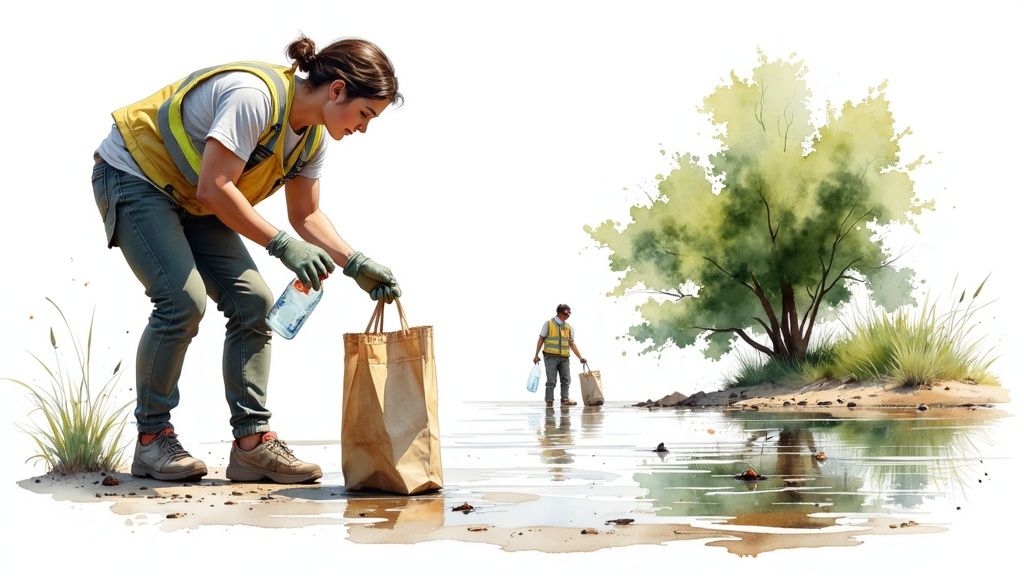
    Isn't It Expensive to Live with Less Plastic?

    This is the biggest myth out there, and we need to smash it right now. Sure, some of those fancy "zero-waste" stores can feel a little pricey, but the real point of cutting out plastic is simple: buy less stuff. And buying less always saves you money.

    Think about it. Your single-use plastic habit is like a subscription you never even signed up for, draining your bank account every week. A reusable water bottle might cost a few bucks once, but bottled water can set you back hundreds of dollars a year. Buying oats from a bulk bin is almost always cheaper per ounce than buying them in a plastic canister.

    Yeah, there's a small upfront cost for a few good reusables—a solid water bottle, some cloth bags, a travel mug—but they pay for themselves in weeks. The most expensive habit you have is the disposable one.

    This isn't about buying expensive eco-gadgets. It’s about getting back to a simpler, smarter way of living. We focus on what works for real people with real budgets, because this has to be a movement for everyone.

    What If My Family or Roommates Just Don't Get It?

    This one is so real. It’s where your bravery and kindness really get put to the test. You can't force people to change, and trying to will just make everyone miserable. The most powerful tool you have is leading by a joyful example.

    Don't lecture. Just do.

    Rock your reusable grocery bags. Talk with real excitement about the cool local shop you found that does olive oil refills. Cook an amazing dinner with all the plastic-free stuff you got at the farmers market.

    People are inspired by action and joy, not guilt trips. Start by creating your own "zone of influence." Maybe it's just your shelf in the pantry or your corner of the fridge. Focus on your own journey. A lot of the time, when people see how easy and rewarding it is for you, their curiosity gets the best of them. Be patient, be kind, and own your path.

    I'm So Overwhelmed. Where Do I Even Start?

    You start right here. Right now. Don't try to become some zero-waste guru overnight. That's a surefire way to burn out.

    Pick one thing. Just one.

    The easiest, most powerful first step for almost anyone is this: get a reusable water bottle you actually like and promise yourself you'll use it every single day for a month. That's it. That's your only job. This one small habit builds the "muscle memory" you need until grabbing your reusables is as automatic as grabbing your keys.

    Once that feels totally normal, pick your next one thing. Maybe it's always bringing your own bags to the store. The goal isn't perfection; it's progress. Small wins build momentum. Remember what we learned in that hailstorm: every big change starts with one small, brave step.


    Ready to turn that personal fire into community action? Litter Caterpillars is where you find your people, get your hands dirty, and make a difference you can actually see. Join us for a weekend cleanup—we bring the gear, you bring the heart. Find your next adventure at https://www.littercaterpillars.com.

  • Cleaning Up a River: Your Guide to Making a Real Difference

    Cleaning Up a River: Your Guide to Making a Real Difference

    It all starts with one person and one trash bag.

    Seriously. That’s it. That’s the secret to sparking massive, positive change in your community. Forget needing some grand, complicated plan or a massive team. You just have to be brave enough to start.

    The Unbelievable Power of a Single Trash Bag

    Man in a cap and shirt carrying a bag walks along a serene riverbank at golden hour.

    You know that feeling, right? You're walking along the river, and you see plastic bottles and old bags tangled in the reeds. Your heart sinks. It's that familiar pang of sadness mixed with a heavy dose of helplessness, the sense that the problem is just too big for one person to tackle.

    We're here to tell you that’s a lie. The real magic isn't in some massive, top-down initiative. It's in the simple, brave act of just starting.

    This whole guide is built on one core belief: you have the power to create incredible change.

    We’ve seen it happen. I remember a few friends who were just fed up with seeing the same stretch of their local river choked with trash. One Saturday, armed with nothing more than gloves, trash bags, and a shared feeling of "enough is enough," they just started cleaning. That one small act of bravery snowballed into a community-wide movement that made the whole town proud.

    From Helpless to Hopeful

    This isn't about being some credentialed environmental expert. It's about being a neighbor who gives a damn. We want to help you shift your mindset from "someone should really do something about this" to "I can actually do something amazing."

    The journey of cleaning up a river isn't just about the impact—it's deeply rewarding and, believe it or not, a ton of fun. You meet people who care as much as you do. You get to see the direct result of your work. It's pure, simple, and good.

    Sure, the scale of the problem can feel overwhelming. Globally, it’s estimated that 1.95 million metric tonnes of plastic flows down our rivers every single year. But that number isn’t a reason for despair; it's a call to action. Small, dedicated groups are already making a huge dent in it, one kind act at a time.

    "Think of a river cleanup like Tom Sawyer painting the fence. He didn't see it as a chore; he made it an adventure so compelling that his friends literally paid him for the chance to help. That’s the spirit we’re channeling here—turning service into something joyful and magnetic."

    This guide is your playbook for turning that spark of inspiration into a real, tangible, and fun event. It’s as much about your personal growth as it is about community service. You'll find that the tools you need for both are way simpler than you think. In fact, you can apply these same principles anywhere—you might even check out our guide on cleaning up trash in your neighborhood.

    Let's get one thing straight: it’s a LOT easier to make an impact than you think. Let's show you how.

    How to Plan Your First Cleanup Adventure

    That little spark you're feeling? Let's turn it into a full-blown bonfire. This is where your good intentions start growing legs, where your kindness gets an action plan. But hold off on the complicated spreadsheets and dry logistics for now. The real adventure of cleaning up a river starts with something much simpler: a walk.

    The very first step is just about getting out there and being a curious explorer in your own backyard. Lace up some comfy shoes and go scout a stretch of your local river. What do you actually see? Is it a minefield of plastic bottles tangled in tree branches? A sad graveyard of old tires half-sunk in the mud? Or is it maybe just a light dusting of everyday trash that feels totally doable for a small crew?

    I'll never forget a story I heard about a group out in the Midwest. They were scouting a park that looked pretty clean on the surface. But one person, with a bit of a brave streak, spotted a faint trail of old construction debris leading into the woods. They followed it. Not even 50 yards off the main path, they discovered a massive illegal dumping site, completely hidden from sight. That one curious walk turned their small litter pickup into a major restoration project. That’s the power of looking a little closer.

    Become a River Detective

    Think of this first walk as a recon mission. You’re gathering intel. You're not just spotting trash; you're getting a feel for the terrain, understanding the challenges, and seeing the opportunities. It's like mapping out a hiking trail before you lead a group on it. A little prep work here builds a ton of confidence for the main event.

    Before you start planning anything, you need to know what you're up against. Your initial scouting trip is all about gathering the on-the-ground facts that will shape your entire event.

    Use this checklist as your guide when you first walk the site. It’ll help you spot the critical details that make the difference between a chaotic day and a smooth, successful cleanup.

    Your Initial River Scouting Checklist

    Area to Assess What to Look For (Examples) Why It Matters
    Volunteer Access Are there official parking lots? Paved or unpaved trails? Public boat ramps or easy-to-walk-down banks? You need safe, clear entry points for your crew. Kindness means not making people scramble down a treacherous, muddy hill to help out.
    Trash Hotspots Look for eddies where trash collects, areas under bridges, or sections near storm drains. This helps you focus your energy. You can direct teams to the highest-impact zones right away instead of having them wander aimlessly.
    Safety Hazards Steep, slippery banks? Patches of poison ivy? Areas with fast-moving water or hidden drop-offs? Volunteer safety is everything. Identifying hazards beforehand lets you warn everyone and mark off any no-go zones on the day of the event. Being brave doesn't mean being reckless.
    The "Big Stuff" Discarded furniture, shopping carts, tires, appliances, or anything that looks like it might contain chemicals. These items often require special equipment, more people, or specific disposal methods. You need to know about them early to plan properly.

    This scouting trip does more than just give you data; it gives you a story. It transforms your mission from a vague "let's clean the river" into a powerful, concrete goal: "We're going to clear that huge pile of styrofoam from under the old bridge." That’s something people can rally behind.

    Starting the Conversation with Your City

    Alright, now for the part that sometimes makes people nervous: talking to local officials. Let's reframe this. This isn't some bureaucratic chore; it's a conversation with a potential partner. You're the one bravely stepping up to improve a public space—most city and park departments will be thrilled to have your help.

    Your first call should probably be to your local Parks and Recreation Department. When you connect, be direct, friendly, and fearless.

    Instead of asking, "Am I allowed to do this?" try framing it this way: "Hi! I'm leading a group of neighbors who are excited to help clean up the riverbank at Lincoln Park. What’s the best way we can coordinate with you to make sure our event is safe and successful?"

    That small shift in language changes the entire dynamic. You’re not a kid asking for permission; you’re an organized leader asking for a partnership. It shows you’re serious and that you respect the process.

    This one conversation can be a goldmine. They can give you crucial info on waste disposal, flag any sensitive wildlife areas to avoid, and sometimes even provide supplies like bags and gloves. Building this relationship from the start makes your event solid, safe, and way more impactful.

    How to Rally Your Crew of River Champions

    A river cleanup is a team sport. Its magic doesn’t come from a perfectly executed plan; it comes from people showing up for each other and for a piece of earth they care about. This is where we gather your crew, but let’s throw out the idea of a boring, formal volunteer call.

    Think of this as inviting friends to a party with a purpose. Your passion is the real invitation.

    This isn’t about begging for help. It’s about sharing an opportunity to do something that feels good, something that connects us to our community and to each other. It’s a chance to spend a few hours outside, get our hands a little dirty, and see a tangible, beautiful result at the end of it.

    The real power of cleaning up a river is that it’s a shared victory.

    Finding Your First Believers

    Forget mass emails and generic flyers, at least for now. Your first champions are probably already in your life.

    Start with the people who get you. The friend you go hiking with, the person you grab coffee with every week, the neighbor who also complains about the trash in the park. Your invitation can be as simple as: “Hey, I’m putting together a small group to clean up that messy spot by the old bridge next Saturday morning. Want to join me? We’ll grab pizza after.”

    That’s it. It’s personal, it’s kind, and it’s brave. You’re stepping up and inviting others into your vision.

    The goal isn't to recruit an army overnight. It's to find your first few "yeses." Those first few people are like the kindling for a campfire; their energy and belief will attract others and help the movement grow.

    From there, the circle widens. Think about the natural gathering spots in your community. Where do people who care about local spaces already hang out?

    • Local Coffee Shops: Chat with the owner or manager. Ask if you can leave a small, story-driven postcard at the counter.
    • Outdoor & Hobby Groups: Connect with local hiking clubs, bird-watching societies, or even book groups. Their members already value community and the outdoors.
    • Neighborhood Social Media Pages: Craft a post that tells a story, not just a call for volunteers. Instead of "Volunteers Needed," try something like, "Felt heartbroken seeing all the plastic along our river this morning. I’m going out with a few friends on Saturday at 10 AM to do something about it. Anyone want to be a hero with us?"

    Telling a simple, authentic story connects with people on an emotional level. It transforms a task into a mission. And if you’re looking for more creative ways to spread the word, our guide on how to find volunteers offers even more ideas for building your team.

    The Gentle Art of Asking for Help

    Now let’s talk about partnerships. Asking a local business for support can feel intimidating, but it’s just another conversation. You’re not asking for a handout; you’re offering them a chance to be a hero in their own community story.

    People want to help—they often just need a clear and kind invitation. When you walk into that local hardware store or pizzeria, go in with a smile and a simple, direct request.

    Scenario: Asking a Hardware Store for Supplies

    • Don't say: "Can you donate something to my event?"
    • Do say: "Hi, I’m Sarah. A few of us neighbors are cleaning up the riverbank behind the library this weekend. We're so excited, but we're short on work gloves for everyone. Would you be willing to help us out by donating a few pairs? We’d be sure to give your store a huge thank you on our social media page."

    Scenario: Asking a Pizzeria for Post-Cleanup Food

    • Don't say: "We need food for our volunteers."
    • Do say: "Hi, I’m Mike. Our community group is spending Saturday morning cleaning up trash along Miller Creek. We’re expecting about 20 people to come out. We’d love to celebrate their hard work afterward and were wondering if you might be able to help us with a couple of pizzas? It would mean the world to our crew."

    This approach is kind, specific, and honors their contribution. You are inviting them to be part of the celebration.

    Building these small, local partnerships is how a one-day event starts to feel like a true community movement. You’re not just cleaning up a river; you’re weaving a stronger, more connected neighborhood, one brave and kind conversation at a time.

    Your Game Plan for a Safe and Unforgettable Cleanup Day

    The big day is finally here. This is the moment it all pays off. What follows is your playbook for turning a great idea into a lasting memory—an event that’s not just effective, but safe, fun, and genuinely empowering for every single person who shows up.

    Forget the dry, boring safety manuals. Today, you're not just an organizer; you're an expedition leader. Your job is to make safety feel like empowerment, not a list of restrictive rules. It’s about creating an atmosphere where everyone feels looked after, confident, and ready to make a real difference.

    Crafting a Safety Briefing That Actually Connects

    Think of the pre-cleanup huddle as a campfire gathering, not a lecture. This is your chance to set the tone for the whole day. Get everyone in a circle, make eye contact, and speak from the heart. This is where a group of strangers becomes a unified, caring team.

    A good briefing is the foundation of a safe event. Keep it engaging, clear, and kind.

    • Talk About the Hazards Honestly: Be upfront about the real risks. Mention slippery banks, poison ivy, and the potential for sharp objects. You're not trying to scare people; you're equipping them. Frame it like, "We're going to be brave and smart out there today, and that means looking out for each other."
    • Show, Don't Just Tell: Demonstrate how to do things right. The most important one? Show everyone the proper way to lift a heavy bag—bend with your knees, not your back. It’s a simple move that prevents a world of hurt.
    • Make the Buddy System Mandatory: This one is non-negotiable. Pair people up and tell them their main job is to keep an eye on their partner. This instantly builds camaraderie and creates a web of safety across the entire group.

    The story of the Citarum River in Indonesia really puts this in perspective. Cleanup crews there pulled a staggering 3,200 tons of waste from the river in a single year. That same river has mercury levels 100 times above safety standards. It’s a stark reminder of why safety has to be number one—you never know what’s lurking in the water.

    Your Essential Gear Checklist

    Having the right equipment is an act of care for your volunteers. It tells them you’ve thought about their well-being from the start. You don't need a warehouse full of gear, just the smart essentials.

    Here’s a simple, can't-skip list:

    • Puncture-Proof Gloves: This is your #1 priority. Hands need to be protected from glass, metal, and whatever else is hiding in the mud.
    • Sturdy Trash Bags: Get the heavy-duty kind. The last thing you want are bags ripping open when they're full of wet, jagged debris.
    • A Well-Stocked First-Aid Kit: Make sure it's easy to find and at least one other person knows where it is. Stock it with bandages, antiseptic wipes, pain relievers, and anything else you might need.
    • Hand Sanitizer and Wipes: An absolute must for a quick clean-up before grabbing a snack or after handling particularly grimy trash.
    • Buckets or Tubs: These are surprisingly useful for carrying smaller bits of trash or consolidating half-full bags, which makes the whole process way more efficient.

    These principles for a safe event apply everywhere, from riverbanks to city squares. For more tips on group safety and logistics, check out our guide on how to clean up a park.

    Building Your Base Camp and Logistics Flow

    Every great expedition needs a base camp. For your cleanup, this is the heart of the operation—a central spot where people check in, grab supplies, take a break, and connect. It doesn't have to be fancy. A pop-up tent or a couple of folding tables under a shady tree works perfectly.

    This graphic shows the simple journey that got you and your team to this point.

    A graphic illustrating a team building journey with three steps: Inspire, Partner, and Gather.

    Each step—inspiring others, partnering with your community, and gathering your crew—is what makes a successful and safe cleanup day possible.

    "A well-organized base camp is a message to your volunteers: 'You are valued here. Your comfort and safety matter.' It turns a tough job into a supported mission."

    Set up clear stations for water, snacks, and sorting the trash. A simple system—one pile for recycling, one for general trash—makes the final disposal so much easier. This central hub ensures nobody gets lost, everyone stays hydrated, and the day runs like a well-oiled machine. Make sure you've coordinated your waste pickup ahead of time so the fruits of your labor don't just become a new eyesore.

    Finally, designate a photographer. Capturing the smiles, the teamwork, and the triumphant moments will tell the story of your success long after the last bag is gone.

    How to Turn One Great Day into a Lasting Movement

    Six diverse volunteers celebrate a successful outdoor cleanup, displaying a '2,000lb removed' sign.

    The last bag of trash is tied off, and that quiet sense of victory settles over your crew. This feeling right here? This is the most important part of your entire river cleanup. It's the spark that can ignite a lasting movement, but only if you tend to it.

    Don't let this incredible energy just fizzle out as people head home. The work isn't truly over until you’ve honored the effort. This is your victory lap, and it's where a one-day event transforms into a real community of river champions.

    Celebrate Your Champions

    Think of your cleanup as a championship game. You wouldn't win the Super Bowl and then just quietly walk off the field, right? You celebrate! Your volunteers are the MVPs, and they absolutely deserve to feel like it.

    A celebration doesn't need to be fancy or expensive. Its only job is to be genuine.

    • Host an immediate after-party. This could be as simple as pizzas and sodas at a nearby park or moving the crew to a local cafe that offered you a discount. The goal is to give everyone a chance to connect as friends, not just as fellow workers.
    • Give a heartfelt thank you speech. Before everyone scatters, get them together. Look them in the eye and tell them what their effort means. Share a specific, memorable moment from the day—maybe someone pulling a particularly gnarly tire from the mud.
    • Share the glory. Get photos up on your social media pages within 24 hours. Tag anyone you can, and shower praise on your team and community partners. Make your volunteers the heroes of the story, because they are.

    This simple act of celebration tells every single person that their time and sweat were seen, valued, and deeply appreciated. That feeling is what brings them back.

    The Power of Cold, Hard Data

    Now, let's give all that hard work a voice that can speak to city councils, potential sponsors, and future volunteers. The most powerful way to do that is with data. Numbers tell a story that's impossible to ignore.

    Before the trash is hauled away, take a few minutes for this crucial step: weigh the collected trash. A simple bathroom scale or a luggage scale can do the trick. Tally up the total weight and count the number of bags you filled.

    Imagine telling your town, "Today, our team of 50 neighbors removed 2,000 pounds of plastic, tires, and debris from our river in just three hours." That’s not just a feel-good story; it’s a headline that demands attention and inspires action.

    This data becomes your proof of impact. It’s the evidence you can use in grant applications, partnership proposals, and media outreach. It quantifies your effort and turns a day of cleaning up into a measurable community achievement.

    Keeping the Campfire Burning

    Your event created a powerful burst of positive energy. The final piece of the puzzle is to capture that energy and keep it glowing. Don't let the community you just built fade away.

    This is about creating a real legacy for your river.

    1. Follow Up Fast: Send a thank-you email to all participants within 48 hours. Share the final stats (pounds of trash collected!), include a link to the photo gallery, and give a shout-out to your partners.
    2. Create a Hub: Start a simple Facebook group or an email newsletter. This gives your river champions a place to stay connected, share ideas, and hear about future events. It’s their community space.
    3. Plant the Seed for Next Time: In your follow-up, mention that you're already thinking about the next cleanup. This simple act turns a single event into the beginning of a sustained effort.

    This data-driven approach is critical on a global scale, too. We know that ten major rivers are responsible for an astonishing 90% of all plastic that flows into the world's oceans. Reporting your local data contributes to a bigger picture, showing how targeted cleanups can make a massive difference. You can read more about these global pollution statistics and discover why every piece of data matters.

    By celebrating your people, measuring your impact, and building a community, you turn one great day into an unstoppable force for good. You’ve shown everyone just how easy—and fun—it is to make a real difference.

    Your Questions About River Cleanups Answered

    So, you feel that pull. You're ready to do something brave and kind for your river. But then the questions start creeping in, the little "what ifs" that can stop you cold if you let them.

    Let's drag those questions out into the sunlight and tackle them head-on. These aren't roadblocks; they're just the last few turns you need to figure out before the real adventure begins. We've been there, and we've got the answers to help you lead with confidence.

    What If I Can't Get Official Permission?

    This is a classic fear, but don't let it kill your momentum. It's almost never a hard "no." It's usually just a matter of finding the right person to talk to.

    Your first stop should be your local parks and recreation department. When you call, don't frame it as asking for permission. Frame it as offering a gift. You're a community leader bringing a team of passionate people to beautify a public space they're in charge of—for free.

    If that’s a dead end, look up a local environmental nonprofit. These folks often have relationships with city officials already baked in. They might partner with you or just give you the right name to call.

    "Sometimes, the kindest path is the simplest one. Grab a few friends for a 'plogging' walk—jogging and picking up litter. This small, brave act often requires no permits and shows you're serious. It builds the foundation for something much bigger."

    How Do We Handle Large or Hazardous Items?

    Your crew's safety is everything. This is where your kindness as a leader has to be fierce. Their job is the everyday stuff—plastic bottles, foam cups, chip bags. For anything else, the rule is simple and absolute.

    If you come across big items like tires or furniture, or anything that looks sketchy like sealed drums or chemical containers, the rule is: Do Not Touch.

    In this situation, your team's job is to become expert witnesses.

    • Flag it: Have volunteers mark the spot so it's easy to find again.
    • Document it: Snap a quick photo on a phone.
    • Report it: Mark the location on a map and call it in to the right people, like your city’s public works or environmental protection agency.

    You're their eyes on the ground. Reporting these bigger problems is a huge part of the mission. It’s an act of bravery that protects your people and the river.

    How Can I Keep Volunteers Motivated for Future Events?

    The trick to turning first-timers into a loyal crew isn't complicated: make them feel seen, valued, and part of a team that wins. You’re not just filling a roster; you're building a community.

    It all starts on cleanup day. Be organized. Be positive. Thank everyone, out loud, for their hard work. Let them stand back and see the massive pile of trash they collected together. Let them feel their impact.

    Then, follow up within 48 hours. Send an email celebrating what you all accomplished. Use the numbers: “Together, we pulled 800 pounds of trash out of our river!” Fill it with pictures of people smiling, working, and looking proud.

    The real magic, though, is giving that energy a home. Start a simple Facebook group or an email list to share updates and celebrate the wins. When you focus on the shared passion, the cleanup stops being a one-time chore and becomes a joyful, ongoing movement they can't wait to join again.


    At Litter Caterpillars, we believe in showing up for our city and each other, one piece of trash at a time. If you’re in Chicago and ready to find friendship and purpose through service, join our next adventure. Learn more about our mission and find an event at https://www.littercaterpillars.com.