Tag: chicago parks

  • Harrison Smith Park: A Guide for Chicago Volunteers

    Harrison Smith Park: A Guide for Chicago Volunteers

    I once watched somebody show up to a cleanup in Chicago thinking they were headed to a park with a pool in Ohio. We laughed, handed them gloves, and by the end of the morning they said they were glad they got lost.

    Which Harrison Smith Park Are You Looking For

    You probably typed Harrison Smith Park because the name feels clear enough. It isn't. That name sends people in a few different directions, and I get why.

    One path takes you to Harrison Smith Park in Upper Sandusky, Ohio, at 525 E Wyandot Ave, Upper Sandusky, OH 43351, and it has a public swimming pool as its primary amenity according to the Harrison Smith Park listing in Upper Sandusky. If you wanted flip-flops, summer chlorine, and a pool deck, that's your place.

    The Chicago mix-up

    Then Chicago enters the chat and makes everything messier.

    Some people mean Harrison Park in Pilsen. Some mean Smith Park on the West Side. Some mash the names together and search for Harrison Smith Park as if the city fused them overnight. I like that confusion. It feels human. We do this with places the same way we do it with memories. We blur names, but we remember the feeling.

    If you're trying to sort out the Chicago side of this, start with this guide to Harrison Park in Pilsen. It helps if you're looking for the park by the museum, the courts, the fields, the neighborhood rhythm.

    A park name matters less than what your hands do when you get there.

    Why the confusion matters less than you think

    I care about this mix-up for a simple reason. Searchers aren't really searching for a noun. They're searching for a place to go, something to do, and maybe a reason to get out of their own head for a few hours.

    I've seen that search look a hundred different ways. One person wants a calm walk. One wants a place to volunteer. One wants to feel useful after a rough week. One just wants to be around decent people without needing to explain their whole life story first.

    So yes, there is a real Ohio park with a pool. Yes, there is a Harrison Park in Chicago. Yes, there is a Smith Park in Chicago that gets mixed into this too.

    Here's the simple version:

    Search phrase What you may mean What it has
    Harrison Smith Park Upper Sandusky, Ohio Public swimming pool
    Harrison Park Pilsen, Chicago Fields, courts, playground, garden
    Smith Park West Side, Chicago Historic park on former quarry and landfill land

    If you're in Chicago and you're looking for a park with grit in its story, dirt under its fingernails, and the kind of energy that makes you want to do more than stare at grass, you're probably looking for one of the Chicago parks. That's where this story really starts.

    A Chicago Park's Surprising History

    I love places with ugly beginnings. Maybe because I trust them more.

    Smith Park didn't begin as the kind of place where you'd toss a ball around or sit on a bench with a coffee. Smith (Joseph Higgins) Park in Chicago was founded in 1929 after a former quarry and landfill was filled to the brim by the mid-1940s, with the site transferred to the Bureau of Parks and Recreation in 1929, as described in this history of Chicago's West Side quarries.

    From hole to home ground

    Start there for a second. A quarry is a wound in the ground. People cut stone out of it. They take and take until the land looks like a giant missing tooth. Then people start dumping into it. Layer by layer, the city hides its mess in the same place it once carved for material.

    That story hits me hard because it feels familiar. I know what it's like to look at a mess and think, this thing is too old, too tangled, too embarrassing to fix. I know what it's like when every piece of junk has a memory attached to it, and moving one tiny thing feels like lifting a refrigerator with your bare hands.

    Then you look at a place like Smith Park and realize land can recover enough to become useful again. Not magically. Not cleanly. But well enough that kids run around there and neighbors gather there and life keeps happening on top of old damage.
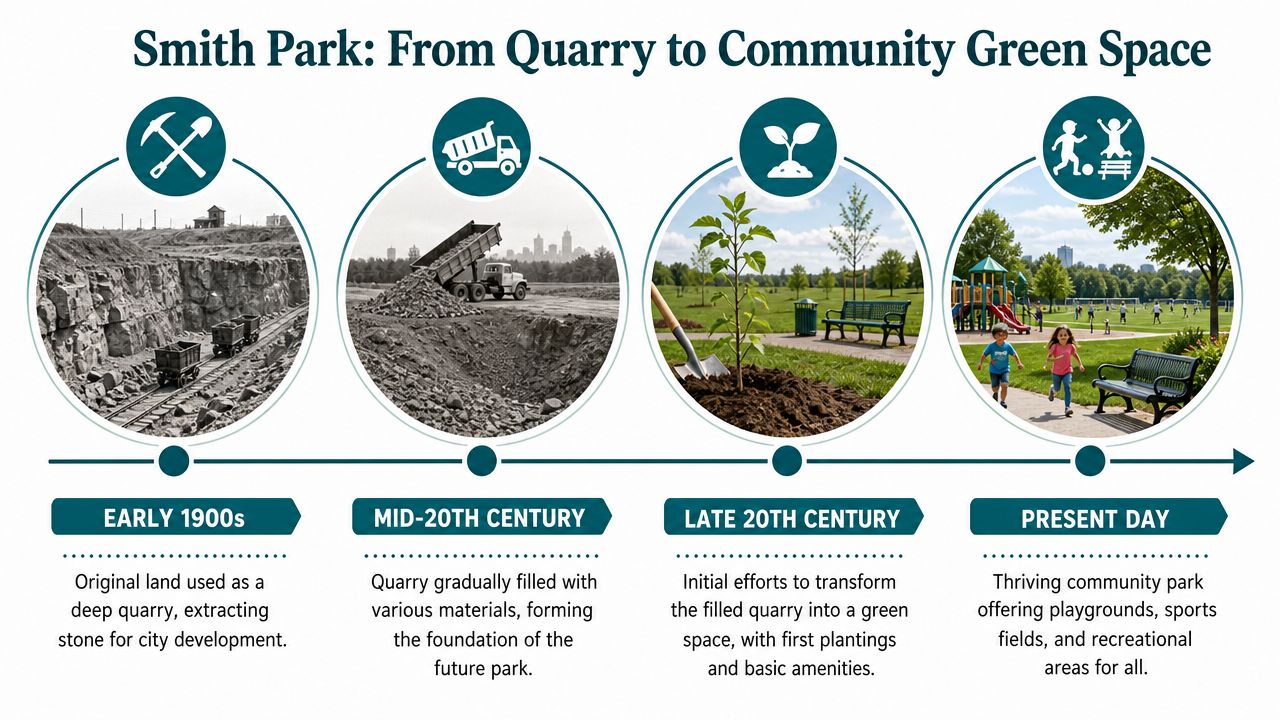
    A timeline graphic showing the transformation of Smith Park from a stone quarry to a community park.

    Why I can't stop thinking about that story

    A lot of us carry quarry years. Then landfill years. Then maybe, if we're stubborn, we build something decent over the top.

    That doesn't erase what came first. It just means the old mess doesn't get the final word.

    Some places make sense only after you know what used to sit under your feet.

    When I walk through a park with that kind of past, I don't feel discouraged. I feel challenged. If a city can take a scar in the earth and turn it into a place where people meet, play, and breathe for a while, then you and I can probably face our own pile of wreckage too.

    Smith Park's history is earthy and blunt. That's why I like it. No fake perfection. Just dirt, trash, labor, time, and another chance.

    Exploring Chicago's Community Green Spaces

    If you want the practical version, here it is. Chicago gives you different flavors of public space, and the two parks tangled up in the Harrison Smith Park search each pull people in for different reasons.
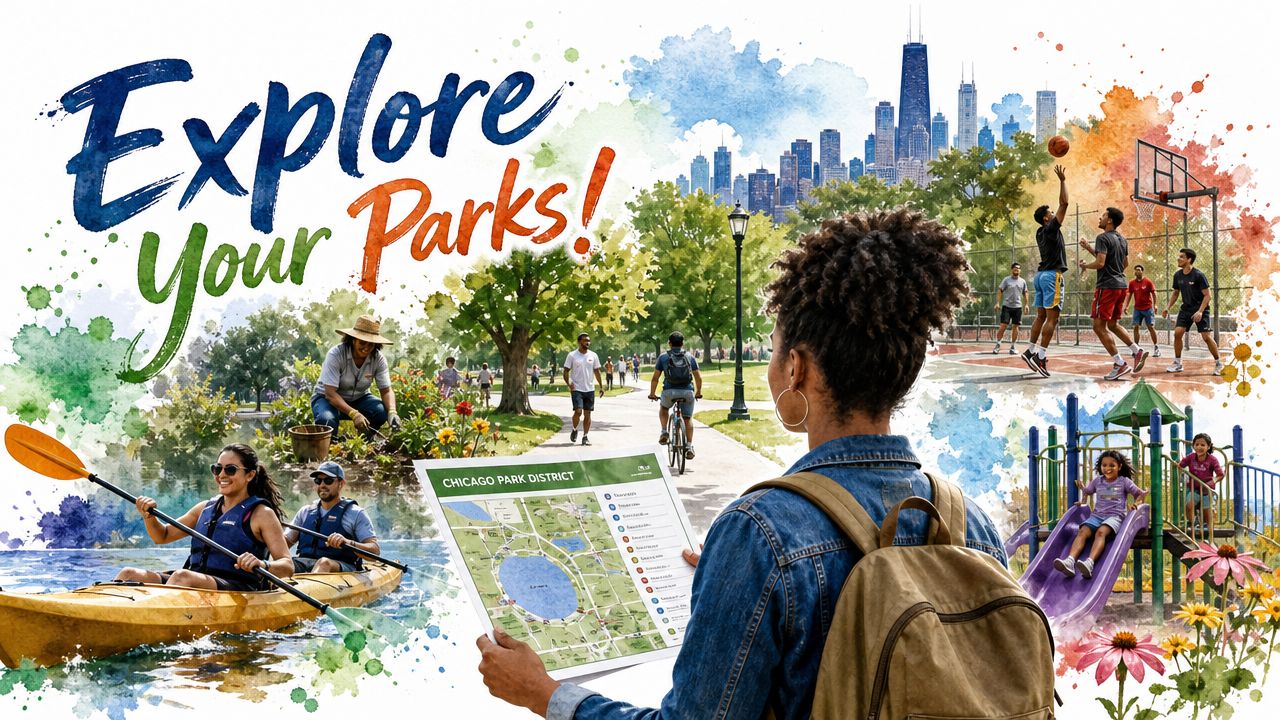
    A vibrant illustration of people enjoying various outdoor activities in Chicago parks, including kayaking, basketball, and gardening.

    Harrison Park in Pilsen

    Harrison Park is the one many Chicago searchers want. You can find it at 1824 S Wood St, Chicago, IL 60608, right next to the National Museum of Mexican Art in Pilsen, according to the Harrison Park page on Tripadvisor.

    And the park itself gives you room to move. Harrison Park's nearly 18 acres include tennis courts, basketball courts, baseball fields, athletic fields for football or soccer, plus a playground and community garden, as noted in Time Out's Harrison Park overview.

    That list matters because it tells you how to use the place.

    • If you want motion: Hit the courts or fields. This is the park for people who don't want to sit still.
    • If you want family time: The playground gives kids something immediate to do while adults breathe for a minute.
    • If you want neighborhood texture: Walk by the garden, circle the edges, and look at who's using the place.

    I like parks more when they have jobs. Harrison Park has jobs. It hosts games, walks, rest, noise, waiting, and small daily rituals.

    Smith Park on the West Side

    Smith Park feels different. The history changes the way I move through it. I pay more attention to edges, low spots, and the way built structures sit in relation to the ground.

    Here's a little street-level look before you go further.

    How to use these parks like a local

    Locals don't overcomplicate it. They pick a reason and go.

    Your mood Better fit Why
    You want activity all around you Harrison Park Courts, fields, and steady movement
    You want to think about place differently Smith Park The ground itself has a story
    You want to explore Pilsen on foot Harrison Park It's next to the museum and easy to pair with a neighborhood walk

    Practical rule: Don't arrive asking, "What's the perfect park?" Ask, "What kind of day am I trying to have?"

    That's a better question. It gets you out the door faster.

    How We Safely Clean Our Parks

    Good intentions aren't enough when you're cleaning ground with a complicated past. You need judgment. You need discipline. You need to know when a trash grabber and a bag are enough, and when they aren't.

    One hard truth sits underneath this work. Parks built on historic landfills in Chicago can have 3–5x higher concentrations of legacy contaminants such as lead, asbestos, and hydrocarbons than naturally formed parks, and that risk can be higher in zones like drainage ditches, as noted in this post about landfill-built park risks in Chicago.

    Brave doesn't mean reckless

    I hate the fake version of courage. The version where somebody acts fearless because they don't know enough to be careful. That's not courage. That's ego wearing work boots.

    Real courage looks more boring. It looks like gloves. It looks like long pants. It looks like stopping to assess a weird material instead of poking it with your hand. It looks like telling a volunteer, "Leave that one. We're not touching it today."
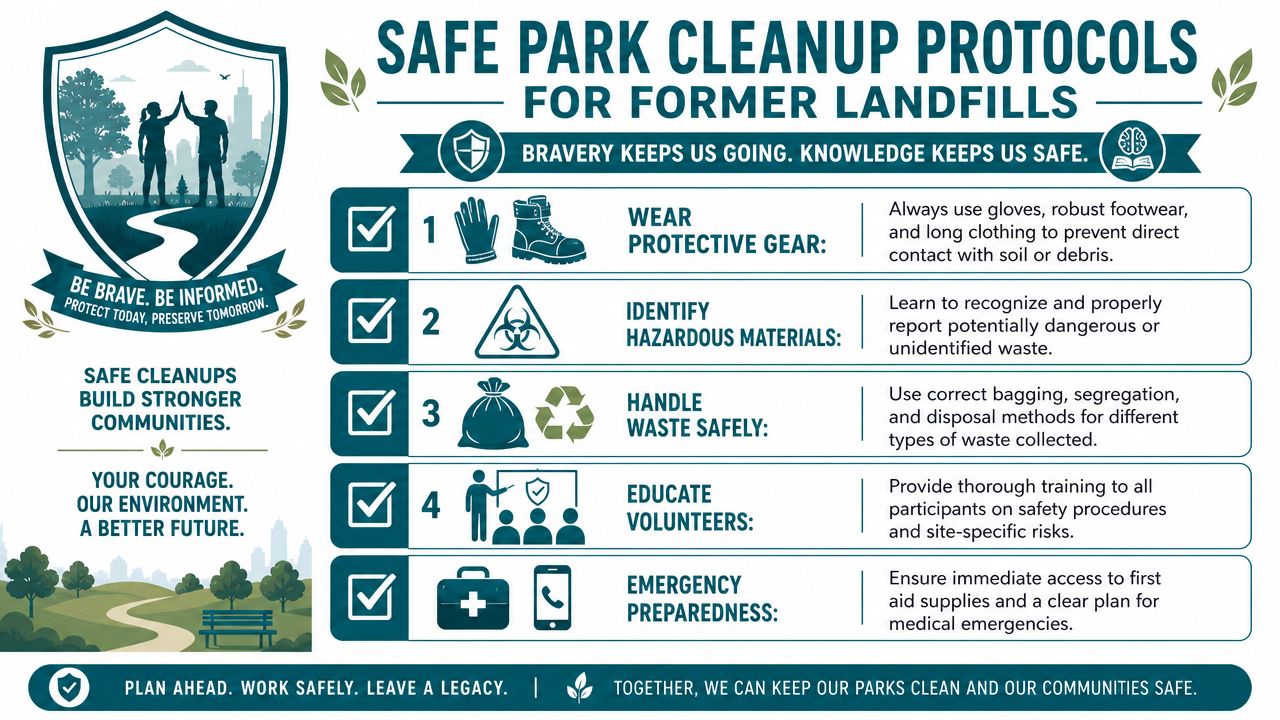
    An infographic detailing safety protocols for volunteers cleaning up former landfill sites to ensure community safety.

    The method I trust

    When I clean a park with old industrial or landfill history, I keep the approach simple and strict.

    • Dress for contact: Wear protective gear that covers skin and keeps your footing steady.
    • Respect the weird stuff: If an item looks sharp, chemical, dusty, sealed, or unfamiliar, don't improvise.
    • Watch the edges: Drainage paths, fence lines, and ditch areas collect trash and can collect risk too.
    • Train before heroics: A volunteer who knows what not to touch is more useful than a volunteer trying to prove something.
    • Have backup plans: First aid, communication, and clear roles matter before the first bag gets filled.

    A lot of volunteer groups skip this because safety sounds less exciting than action shots. I think that's backwards. Safety is what lets good people keep showing up week after week instead of getting burned out, hurt, or scared off.

    If you want to think through the legal and planning side before you organize your own effort, read up on volunteer liability insurance for community cleanups. It helps you understand why structure protects generosity.

    If a park has a rough history, your cleanup plan needs a backbone.

    That isn't fear talking. That's respect.

    Join Us for a Weekend Cleanup

    Weekend mornings have a special energy. The city is quieter, the air feels less chewed up, and the people who show up that early for unpaid work usually have something good inside them.

    I think about Tom Sawyer a lot. He got stuck painting a fence and turned the punishment into an invitation. That's part of the fun here. Work changes shape when you stop treating it like humiliation and start treating it like a dare.

    What your first cleanup feels like

    You arrive a little unsure. Maybe you wonder if everyone already knows each other. Maybe you worry you'll be awkward, underdressed, too quiet, too late, too soft for the job.

    Then somebody hands you a bag.

    That moment matters. Holding a trash bag in a park is strangely clarifying. You stop performing. You stop trying to look interesting. You just start scanning the ground, picking targets, moving forward. Cup. Wrapper. Bottle cap. Broken toy. Fast-food bag snagged under a bush like it was trying to disappear.

    And the weird thing is, your brain starts to quiet down.

    Why the work feels good

    Smith Park got major upgrades in the late 1930s, including a field house with a gymnasium and meeting rooms, according to the Chicago Park District's Smith Park page. I love that detail because it reminds me that parks aren't abstract ideas. They are places where bodies gather, sweat, talk, rest, and return.

    That's why cleanups matter in a practical way. You're not cleaning some symbol. You're clearing a path for an actual person. A kid running near a field. A neighbor walking past. Somebody heading toward a meeting room. Somebody trying to have one decent hour outside.

    If you want a way in, check out weekend volunteer opportunities near you.

    What to expect when you say yes

    Your first cleanup usually includes a few things:

    1. A small moment of hesitation when you realize you're doing real physical work.
    2. A rhythm shift once your hands get busy and conversation starts to happen naturally.
    3. A quiet hit of satisfaction when the pile of full bags grows and a messy patch looks human again.

    Hard work with good people is one of the cleanest pleasures left.

    That's the pitch. No fake glamour. Just a better Saturday morning than doomscrolling.

    Building Friendships One Bag of Trash at a Time

    The first time I went out with a tiny cleanup crew, Chicago threw hail at us like the city was testing our sincerity. We huddled under a tree, freezing, phones out, watching ride after ride cancel. It should have been miserable.

    It was miserable. And it was funny.

    That combination changes people. When you shiver through something dumb and difficult with strangers, they stop feeling like strangers way faster than they would at a bar or a networking event or some polished little mixer where everybody is trying to seem effortless.

    Shared discomfort is glue

    I learned something that day. Cleaning somebody else's mess is often easier than cleaning your own. Maybe because there isn't any shame in it. The ground doesn't judge you. The bottle in the weeds doesn't ask why your apartment is a mess or why your last relationship blew up or why you've been avoiding your own life.

    You just pick it up.

    And when somebody next to you is doing the same thing in cold rain or sharp wind, you trust them a little. They've already shown you one thing that matters. They came.
    Screenshot from https://www.littercaterpillars.com/

    Why people keep coming back

    Friendship doesn't always begin with deep conversation. Sometimes it begins with shared labor, an inside joke, and that look people exchange when a heavy bag finally gets tied shut.

    A cleanup group becomes social in sideways ways:

    • You earn trust fast: People see whether you help, drift off, complain, or stay steady.
    • You get stories immediately: Rain, weird finds, busted grabbers, lost gloves, surprise laughter.
    • You build identity through repetition: Same mission, different block, same people returning.

    I also think service scrubs away a lot of fake hierarchy. Out there, nobody cares who has the best resume. The wind doesn't care either. Trash equalizes people. That's one reason this kind of friendship feels less brittle.

    "We suffered a little together" is a stronger beginning than most small talk.

    If you've been lonely in a crowded city, this matters. You don't need a brilliant opening line. You need a reason to stand next to other people while doing something honest.

    Your Questions About Park Cleanups Answered

    People usually ask the practical stuff first. Good. Practical questions keep everybody safer and calmer.

    Is it actually safe to clean a park with a rough past

    It can be, if you respect the site and don't freeload on optimism. Use protective gear, avoid suspicious material, and treat certain areas with extra caution. If something looks off, leave it and report it through the right channel instead of trying to be a hero.

    What should you bring

    Keep it plain.

    • Wear sturdy clothes: Closed-toe shoes, long pants, and gloves are the baseline.
    • Bring water: Even short cleanups can sneak up on you.
    • Pack light: You don't need a whole expedition setup. You need mobility and common sense.

    Can you come alone

    Yes. A lot of people do. In fact, coming alone is often easier than dragging a half-interested friend who wants credit for almost showing up.

    The work gives you something to do with your hands right away, which takes pressure off conversation. That helps shy people more than they expect.

    What if you're nervous about not knowing anyone

    Then you're normal.

    It's common to feel that way before the first cleanup. The trick is to let the task carry the social weight for a while. You don't need to charm anybody. You just need to participate.

    Can you organize your own cleanup somewhere else

    Yes, including in a place like the Ohio park that comes up in the Harrison Smith Park search. Start small. Learn the site. Ask what risks are unique to that area. Keep your plan tighter than your ambition on day one.

    A simple checklist helps:

    Question Why it matters
    What kind of site is this Park history changes cleanup risk
    Who is coming Group size changes supervision needs
    What will you avoid Boundaries keep volunteers safe
    What happens if something looks hazardous You need a clear answer before you begin

    What mindset should you bring

    Bring humility. Bring energy. Bring a willingness to do unglamorous work.

    Don't bring the fantasy that one cleanup fixes everything. It won't. But one cleanup can fix one morning, one patch of ground, one conversation, one corner of your own drifting life. That's plenty.


    If you want a group that cleans Chicago with courage, humor, and actual care for the people doing the work, visit Litter Caterpillars. You'll find a crew that shows up on weekend mornings, takes safety seriously, and turns trash pickup into friendship, purpose, and a pretty wild kind of fun.
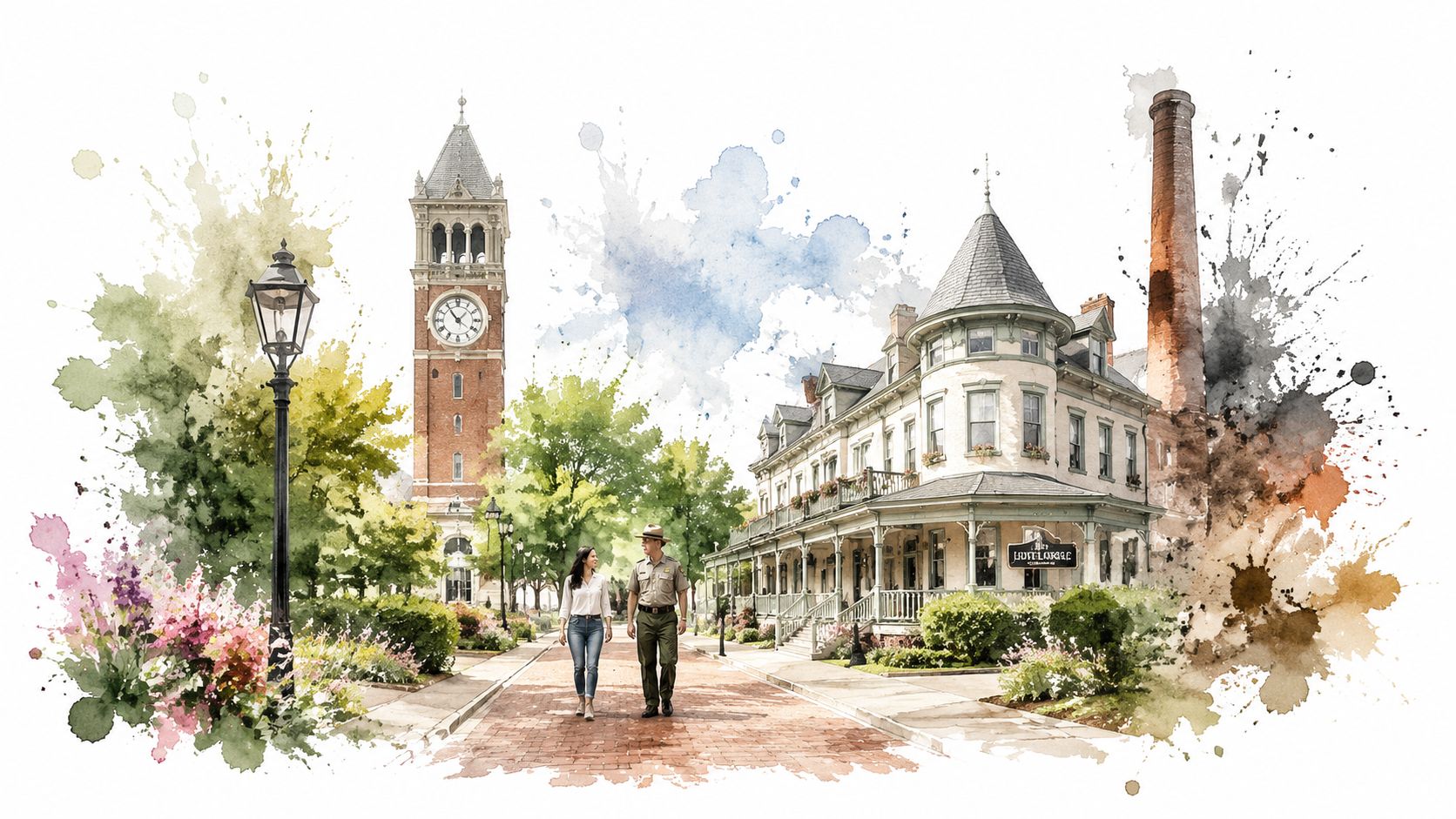
  • Pullman National Historical Park: A Visitor’s Guide

    Pullman National Historical Park: A Visitor’s Guide

    I turned a corner near 111th Street and felt that strange Chicago feeling where a block starts talking back to you. Brick rows, old factory bones, and quiet streets made me slow down and pay attention.

    More Than a Monument It Is a Chicago Story

    A few Saturdays ago, I watched a first-time visitor stop in the middle of Pullman and go quiet. Kids were riding bikes past red-brick homes. A neighbor was sweeping a front walk. The old industrial buildings stood in the background like they still had something to say. That mix is what gets me every time. Pullman does not sit in Chicago like a relic under glass. It lives as a neighborhood where history keeps bumping into ordinary life.

    That is why Pullman grabbed me so hard the first time I came through with a coffee in one hand and cleanup gloves in the other. The National Park Service recognizes it as Chicago's national historical park, but the title only gets you so far. The full story shows up on the street, in the preserved architecture, in the homes that are still occupied, and in the long shadow of work, power, and organizing that shaped this part of the South Side.

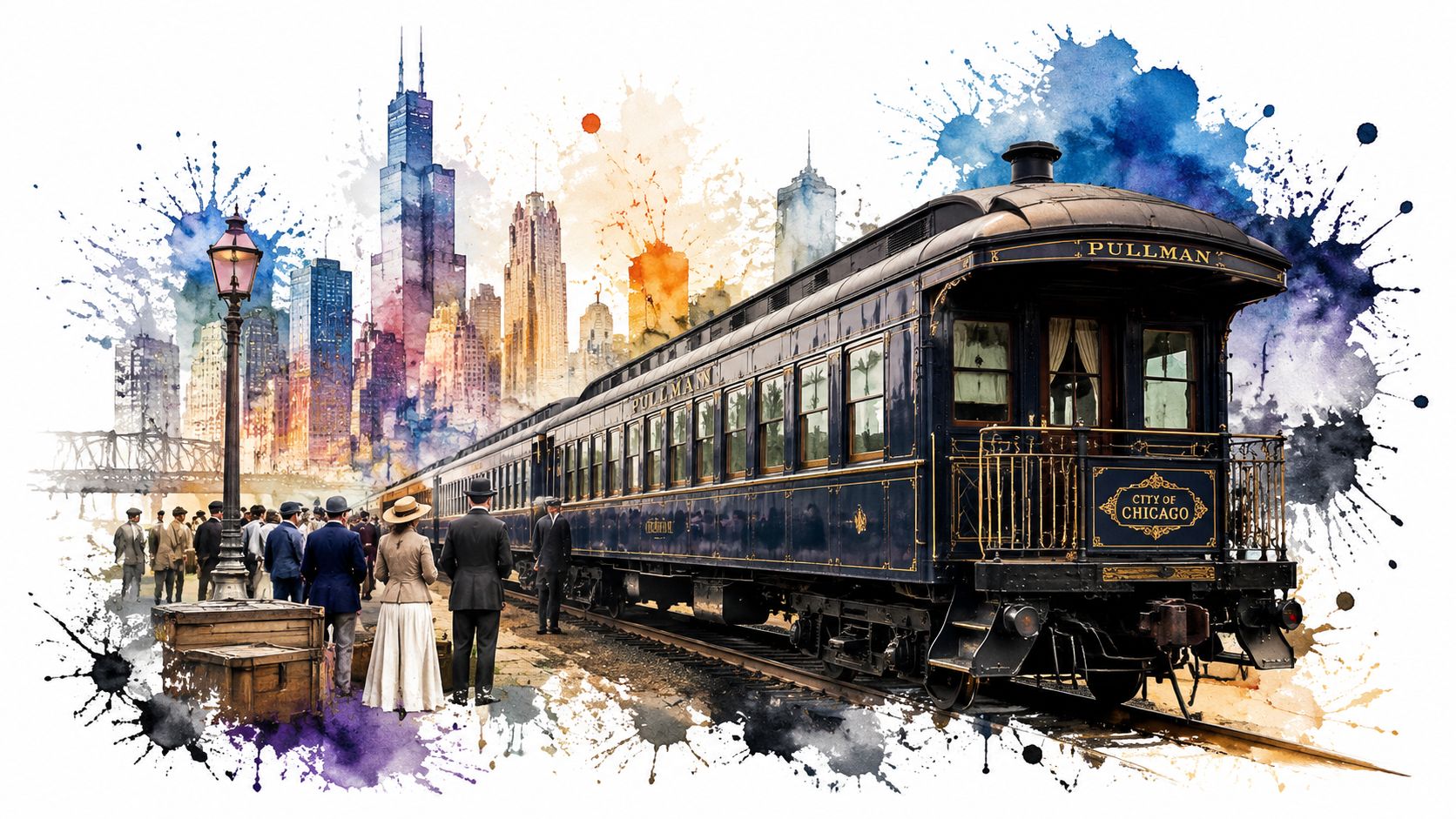
    A vintage Pullman passenger train sits at a station with a stylized watercolor Chicago city skyline backdrop.

    I run a volunteer group that spends time in places people too often pass by. We pick up litter, talk to neighbors, and learn a block by walking it slowly. Pullman fits that ethic perfectly. You can come for the history and leave with a sharper sense of what community care looks like when real people keep showing up for a place.

    That is what makes this park feel personal to me. The streets raise questions Chicago has been asking for generations.

    • Who gets to shape a neighborhood
    • What happens when too much control sits with too few people
    • How a community protects its story while still living its daily life

    I often tell friends to pair Pullman with other Chicago neighborhoods to explore, because the comparison teaches you something. In one part of the city, the story sits in a mural or a corner store. In Pullman, it sits in the bricks, the rail legacy, the worker housing, and the community memory that still holds the whole place together.

    Pullman changed the way I think about public history. A monument asks for your attention. This neighborhood asks for your participation. Walk it, listen well, and you start to see that the lesson is not only about the past. It is about what kind of city we want to care for right now.

    The Story of the Town Pullman Built

    The first time I walked these blocks with the company-town history in mind, one detail stayed with me. The homes are handsome. The streets feel orderly. You can still sense why a working family in the late 1800s might have looked around and thought, at least on day one, that this place offered dignity.

    Then you learn who held the reins.

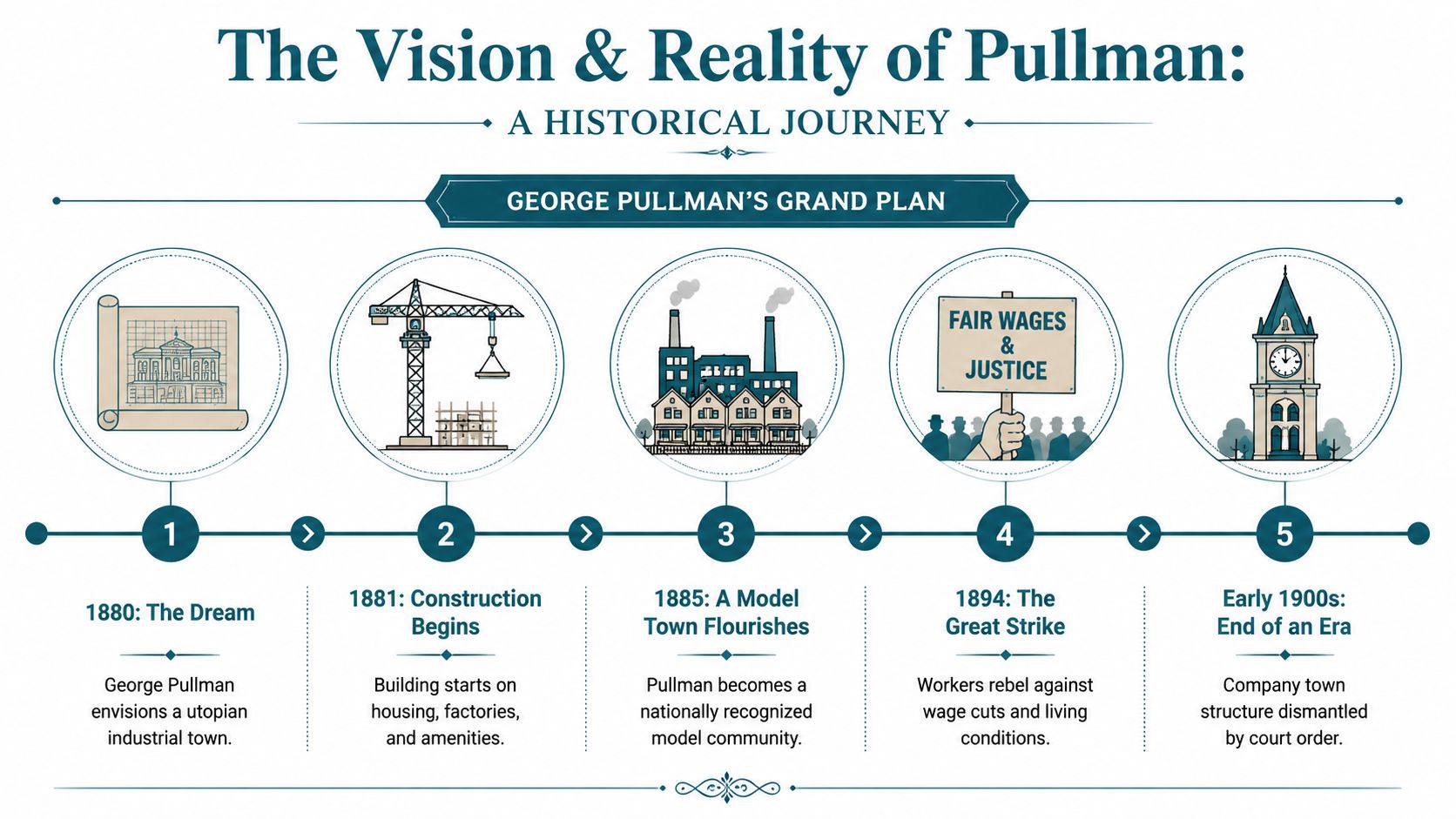
    A timeline infographic illustrating the historical rise and fall of the industrial company town of Pullman.

    George Pullman built the neighborhood around his railcar business with a clear vision of how workers should live. Brick row houses, shared green space, civic buildings, and factory life were tied together in one planned community. From the outside, it could look generous, even enlightened compared with the rougher industrial districts of its time.

    On the ground, the story gets more complicated.

    A beautiful block does not automatically mean a fair one. Workers lived in a town shaped by company priorities, company rules, and company power. The same design that made Pullman feel orderly also limited how much control residents had over daily life. That tension is part of what makes a walk here feel alive. You are not just looking at architecture. You are standing inside a debate about work, housing, and who gets to decide what a good community looks like.

    I often picture an ordinary evening here. Someone comes home tired from the factory, steps onto a clean street, then sits at the table to make hard choices about rent, food, and family needs. That is the part of Pullman that stays with me. History is not only in the grand plans of industrialists. It is in the private math of households trying to hold themselves together.

    The conflict that followed gave Pullman its sharpest lesson. Workers resisted the imbalance built into the system, and the Pullman strike turned this neighborhood into one of the defining labor stories in the country. When I stand near the old industrial spaces, I do not think first about dates in a textbook. I think about people gathering, arguing, risking income, and asking for a measure of dignity that the town's design could not provide on its own.

    That is why Pullman matters as more than a preserved historic district. It shows how a neighborhood can be carefully built and still fail its people if power only runs one way.

    It also shows something hopeful. Residents, preservationists, organizers, and neighbors kept this story from being flattened into a neat company legend. They protected the buildings, yes, but they also protected the harder questions. That part means a lot to me as someone who believes places improve when regular people care for them together, the same spirit that drives groups like Litter Caterpillars to treat streets and public spaces as shared responsibilities.

    Three questions from Pullman still feel close to home:

    Question raised here Why it still matters
    Who has power at work People still fight for fair pay, stability, and respect on the job
    What makes housing just Neighborhood change still tests who gets security and who gets pushed aside
    How do neighbors act together Communities still rely on solidarity when formal systems fall short

    Pullman stays with you because it never resolves into a simple moral. It is a story about vision, control, resistance, and community memory, all on the same set of blocks. Walk slowly enough, and the lesson becomes clear. A neighborhood is not defined only by what gets built. It is defined by whether people who live there can shape its future together.

    Your First Visit to Pullman National Historical Park

    The best way to start is simple. Go to the visitor center at 610 E. 111th Street, Chicago, IL 60628, which is open daily from 9:00 a.m. to 5:00 p.m., according to the Pullman visitor center listing.

    I like starting there because a neighborhood park can feel confusing at first. If you expect one big gate and one obvious route, Pullman may throw you off. The visitor center helps you get your footing.

    What to do when you arrive

    Walk in, slow down, and let yourself orient. You don't need a perfect plan before you step through the door. That's the whole point of beginning here.

    A first visit works well when you do these things:

    1. Check the exhibits first. They help you connect the buildings outside to the people who lived and worked here.
    2. Ask for self-guided materials. That gives you a path once you step back outside.
    3. Look at the district as a neighborhood, not a single attraction. You're not done when you leave the building. You're just ready to start.

    How I'd handle a first hour

    If I brought you with me for your first visit, I wouldn't rush. I'd spend a little time inside, get the basic story straight, then head back outdoors with a loose plan. Pullman works best when you mix orientation with wandering.

    Practical rule: Start indoors so the streets make sense later.

    You don't need to memorize every detail. You just need enough context that the brick row houses, factory remains, and nearby institutions stop being anonymous. Once that clicks, the whole district opens up.

    A good first-timer mindset

    Treat your visit like meeting a person for coffee, not like cramming for an exam. Stay curious. Let a few buildings pull your attention. Read some signs. Skip others. Sit for a minute if you need to.

    Here's the part many guides miss. You're not just visiting a building with historic objects inside. You're entering a public place where the story spreads across streets, corners, and everyday life. That shift matters. Once you understand it, Pullman gets much easier and much more rewarding.

    Planning Your Trip Itineraries and Tips

    One thing I like about Pullman is that you can shape the day around your energy. If you have a short window, you can still get a real feel for the place. If you have a relaxed afternoon, the neighborhood gives you room to wander.

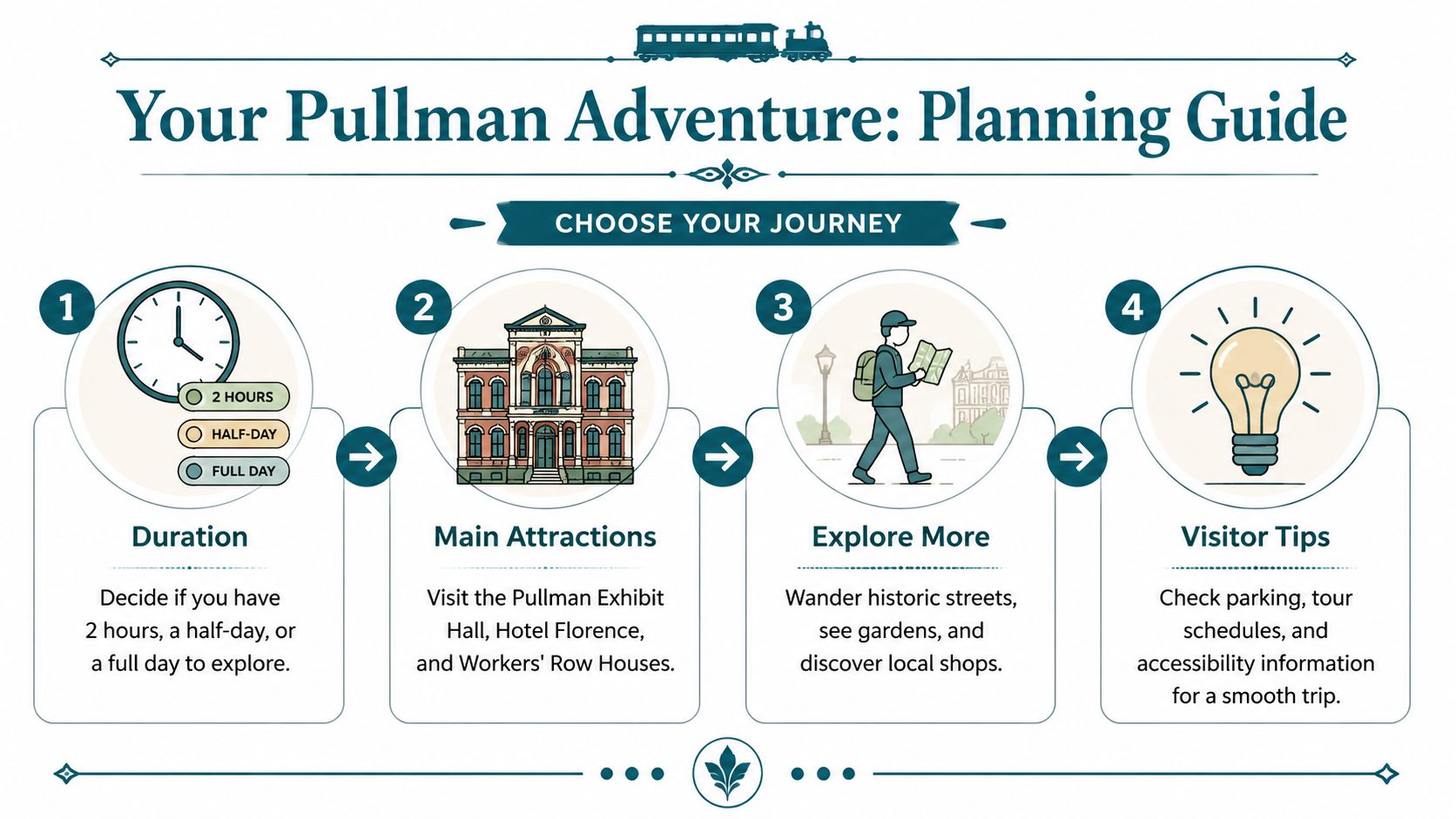
    The park grounds are open dawn to dusk, which means you can explore the historic area as public space even outside visitor center hours, according to the National Park Foundation park page. That changes how I plan a trip. I don't think of Pullman as a single timed attraction. I think of it as a walkable field trip.

    A planning guide infographic for Pullman National Historical Park showing four numbered steps to design your visit.

    If you only have a short visit

    A shorter outing works well if you want a clean, focused experience.

    • Start at the visitor center. Ground yourself before you roam.
    • Walk a few nearby blocks. Let the neighborhood scale sink in.
    • Pick two or three stops, not everything. Pullman gets better when you move slowly enough to notice details.

    I've found that a compressed visit still feels satisfying if you avoid checklist mode. This isn't the kind of place where speed makes you feel accomplished. Speed makes you miss the point.

    If you have a half day

    A half day is my favorite rhythm for Pullman. You can settle in without turning it into a marathon.

    Here's a simple way to do it:

    Time shape What I'd do
    Early part Begin at the visitor center and get oriented
    Middle stretch Walk the historic streets and stop at the major sites that catch your eye
    Final stretch Sit, reflect, grab food nearby, and take one more pass through the neighborhood

    If you enjoy city walking, you might also like these self-guided Chicago walking tours. Pullman fits that style well because the streets themselves carry so much of the experience.

    Local mindset for getting there

    I like using transit when I can because it changes the pace of the day. You arrive on the city's terms, not in a sealed bubble. But driving can make sense too, especially if you're visiting with family or anyone who wants fewer transitions.

    A few practical tips help:

    • Wear walking shoes. The best part of Pullman happens on foot.
    • Bring water. Historic curiosity doesn't cancel out basic comfort.
    • Plan food loosely. I'd rather leave space to notice a local option than lock myself into a rigid schedule.

    Pullman rewards the visitor who leaves room for one extra block, one extra corner, one extra pause.

    That's how I'd do it. Give yourself structure, then let the place interrupt you a little.

    Walk Through History Key Sites to See

    The visitor center gives you the map. The streets give you the feeling. Pullman's essence comes to life.

    I always tell friends to stop trying to “cover” Pullman and instead let each site act like a chapter. Some chapters are about work. Some are about class. Some are about Black labor history. Together they make the district feel layered, not flat.

    The factory grounds and the clock tower

    The factory area hits me first because it makes labor feel physical. You don't have to stretch your imagination very far. You can almost hear the churn of production and the movement of workers coming and going.

    The clock tower pulls your eye because clocks always do that in old industrial places. They remind you that work once ruled the day down to the minute. I stand there and think about how different time feels depending on who controls it. For an owner, time can look like efficiency. For a worker, time can feel like pressure.

    Hotel Florence

    Hotel Florence tells a different kind of story. This building lets you think about status, taste, and the social rules of the town. I like places like this because they show that power isn't only in the factory. It's also in the spaces where respectability gets performed.

    Walk around it and you can feel that Pullman wasn't built only to produce railcars. It was built to project an idea of order. That idea reached into daily life. It touched how people lived, where they gathered, and what kind of behavior fit the town's image.

    Some buildings tell you what happened. Others tell you what people wanted the world to look like.

    Hotel Florence does both.

    The A. Philip Randolph Museum

    Then there's the A. Philip Randolph Museum, which changes the emotional temperature of the visit. If the factory grounds make you think about labor under pressure, this site makes you think about labor organizing, dignity, and Black workers refusing to stay invisible.

    I always slow down here.

    The museum adds a chapter that many first-time visitors need. Pullman is not only about one strike in one year. It's also about the lives of Black railroad workers and the push for fair treatment. That part of the story gives the neighborhood a different voice. More determined. More personal.

    How I'd walk it

    If you want a simple field route, I'd do it this way:

    • Begin with the clock tower area so the scale of the industrial site clicks.
    • Move to the residential streets and pay attention to repetition, design, and how the homes sit together.
    • Pause at Hotel Florence and think about who the town was meant to impress.
    • End with the A. Philip Randolph Museum when you're ready for the labor story to deepen.

    That order works for me because it moves from structure to people. From the company's view of the town to the people who had to live and work inside it.

    From History to Action Get Involved in the Community

    The thing I love most about Pullman is that it doesn't leave me in spectator mode for very long. After a while, standing around and admiring old brick starts to feel incomplete. A place with this much history pushes me toward a simple question. What am I going to do for the neighborhoods I care about now?

    Screenshot from https://www.littercaterpillars.com

    That's where service comes in. Pullman is still a lived-in area. Since becoming a national park, the area has seen hundreds of millions of dollars in investment, according to a Pullman House Project video about the neighborhood today. I don't hear that and think, great, problem solved. I think, then this is exactly when ordinary people need to stay involved.

    Small acts change how a place feels

    If you care about Pullman, you don't need to arrive with a grand theory. Start small and stay consistent.

    • Join a cleanup if one is happening nearby. A public place feels different when people care for it with their hands.
    • Support preservation-minded community work. Attention matters. Presence matters.
    • Walk respectfully and spend locally when you visit. Neighborhood care isn't abstract.

    I believe service is one of the best ways to understand a place. You can read about labor solidarity all day, but picking up litter with other people teaches a related lesson fast. Shared effort changes strangers into teammates.

    One option is to look at community engagement strategies that turn good intentions into regular action. Another is to join a local volunteer event when one is scheduled. For example, Litter Caterpillars has done cleanup activity at the Pullman National Historical Park Visitor Center with the National Park Service's Trash Trekkers program.

    Care is a way of reading the city

    I want to show you a piece of that spirit in motion.

    When people sweep, plant, pick up trash, or help maintain public space, they aren't doing side work beneath the “real” story. They are writing the current chapter. That matters in Pullman because the neighborhood has always been about how people live together under shared conditions.

    My rule for any historic district: leave it a little better than you found it, even if all you can give is attention, respect, and one hour of work.

    That's the bridge for me. History becomes action when you stop asking only what happened here and start asking what care looks like here now.

    Your City Is Waiting for You

    Pullman stays with me because it asks for more than curiosity. It asks for honesty. When you walk those streets, you start thinking about work, fairness, housing, memory, and what neighbors owe each other. Then you leave and those questions follow you home.

    I think that's a gift.

    You don't need to become a historian to feel something at Pullman National Historical Park. You just need to show up ready to notice. Notice the brickwork. Notice the scale of the old company town. Notice how a neighborhood can carry conflict and care at the same time. Then notice your own block with that same level of attention.

    Chicago gets better when more of us do that.

    I've learned this through cleanup mornings, long walks, and conversations with people who love their neighborhoods in practical ways. The city opens up when you stop waiting for polished invitations. You pick a place. You go. You listen. Maybe you help. Then you come back different.

    Pullman is a good place to begin that habit.

    Go for the history if that's what pulls you in. Go for the architecture. Go because you want a thoughtful afternoon on the South Side. But once you're there, let the visit push you one step further. Join something. Care for something. Learn one neighborhood thoroughly enough that it stops being “somewhere else.”

    Your city isn't finished. That's the exciting part. It still needs hands, eyes, patience, and people who are willing to love it in public.


    If you want a hands-on way to explore Chicago while caring for it, take a look at Litter Caterpillars. It's a volunteer group that organizes neighborhood cleanups across the city and gives people a simple way to show up, meet others, and do real work together.

  • Amundsen Park Chicago: Your Complete Guide

    Amundsen Park Chicago: Your Complete Guide

    I remember the first time I stopped at Amundsen Park with a grabber in one hand and a trash bag in the other. A basketball rolled across the court, a kid shouted from the playground, and I thought, this is how a neighborhood tells you whether people still care.

    Discovering Your Neighborhood Anchor

    Some places don't look dramatic when you first pull up. They look ordinary. A fieldhouse. A few courts. A playground. A patch of city life doing its job.

    Then you stand there for a minute, and the place starts talking.

    Amundsen Park is a Chicago Park District facility at 6200 W. Bloomingdale Ave. in the Austin/Galewood area. That's the official description. Fine. Useful. But it doesn't tell you what it feels like to watch people drift in from surrounding blocks with strollers, gym shoes, grocery bags, and that tired-but-still-trying look most Chicagoans know by heart.

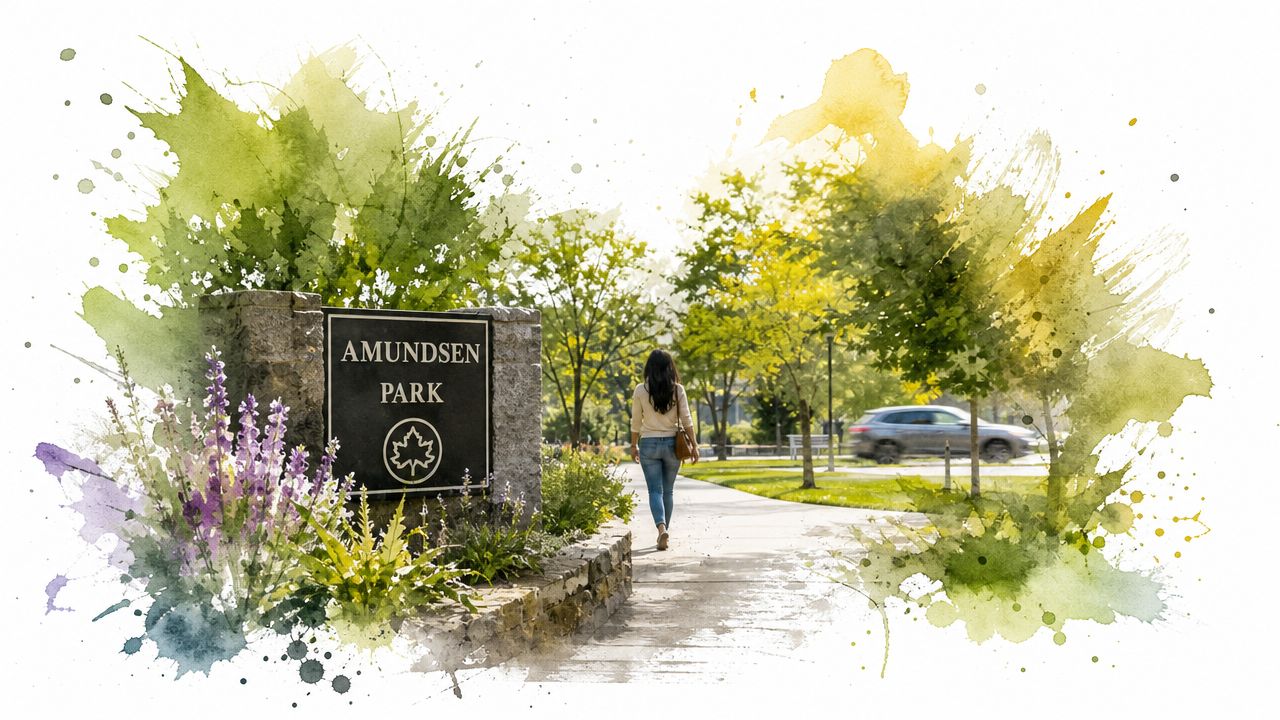
    A woman walking away on a pathway toward Amundsen Park with a stone park sign in the foreground.

    The moment a park stops being background

    I drive past a lot of parks in this city. It's a common urban experience. You catch a fence line out of the corner of your eye, maybe a baseball backstop, and you keep moving. Amundsen Park Chicago can be that kind of place if you let it. Background. Scenery. Something for other people.

    I don't think that's good enough.

    A neighborhood park is where you prove to yourself that you still know how to show up. You go outside. You meet somebody. You carry something heavier than your phone. You do one useful thing before noon, and your whole day changes shape.

    If you want to get a feel for parks across the city, I like browsing Chicago park guides from Litter Caterpillars before I head out. It helps me read a place better once I'm on the ground.

    A park looks simple until you ask who depends on it.

    Why this one gets under your skin

    Amundsen Park has a fieldhouse, and that matters more than people think. A fieldhouse means the park isn't only for nice weather. It means activity doesn't disappear the second Chicago acts like Chicago. Cold day, windy day, gray day, wet day. People still have somewhere to go.

    I care about that because I've seen what happens when public spaces feel neglected. People pull back. They stop trusting the place. They stop expecting much from each other. Trash starts to feel normal, and normal is dangerous.

    I tell new volunteers when we walk into a park like this:

    • Look at the entrances first. That's where people form their first opinion.
    • Watch where people slow down. Benches, courts, gates, corners. That's where litter piles up.
    • Notice who is here. Kids, parents, seniors, ballplayers, people cutting through. A park has a rhythm if you're paying attention.

    Amundsen Park isn't just grass and equipment. It's one of those places where you can restart your mood, your habits, even your social circle if you've been drifting too long.

    The Story Behind the Name

    I like names that make you earn them.

    When I first heard "Amundsen," I didn't think about a park sign. I thought about ice, maps, risk, and a guy stubborn enough to venture where others wouldn't. That's Roald Amundsen, the Norwegian explorer who lived from 1872 to 1928, and Chicago attached his name to public life fast. Amundsen High School opened in 1929, one year after his death.

    That detail sticks with me because cities don't name things by accident. Somebody decided the name meant action. Somebody wanted that word on a building where young people would walk in every day.

    Exploration isn't only snow and flags

    I don't care much for fake inspiration. You know the kind. Big words, no dirt on the shoes. But I do like the idea that exploration can shrink down to city size and still stay real.

    You don't need a ship frozen into polar ice. You need curiosity and a little nerve.

    For me, urban exploring looks like this:

    • Turn off the autopilot. Walk into a park you've ignored for years.
    • Learn the ground. Figure out where people gather, where they play, where they retreat.
    • Do something useful once you arrive. Pick up litter. Ask a question. Say good morning.

    Street rule: Exploration counts more when you come back with your hands dirty.

    Why the name fits the work

    Amundsen Park Chicago isn't the North Pole. Good. Most of us don't need a fantasy. We need a mission we can complete.

    A neighborhood cleanup has its own kind of expedition energy. You scan the terrain. You move as a team. You solve small problems fast. You deal with weather, awkward moments, and the occasional weird surprise near a fence line. Then you leave the place better than you found it.

    That's enough adventure for a Saturday morning. And unlike a lot of modern life, it's real.

    What You Will Find at Amundsen Park

    The first time I walked Amundsen with cleanup eyes on, I saw a kid cutting across the open grass with a soccer ball under one arm, two guys already shooting on the court, and a grandmother easing a stroller toward the playground. Three different reasons to be there. One park holding all of it together.

    That is what you need to notice before you pick up a single piece of trash.

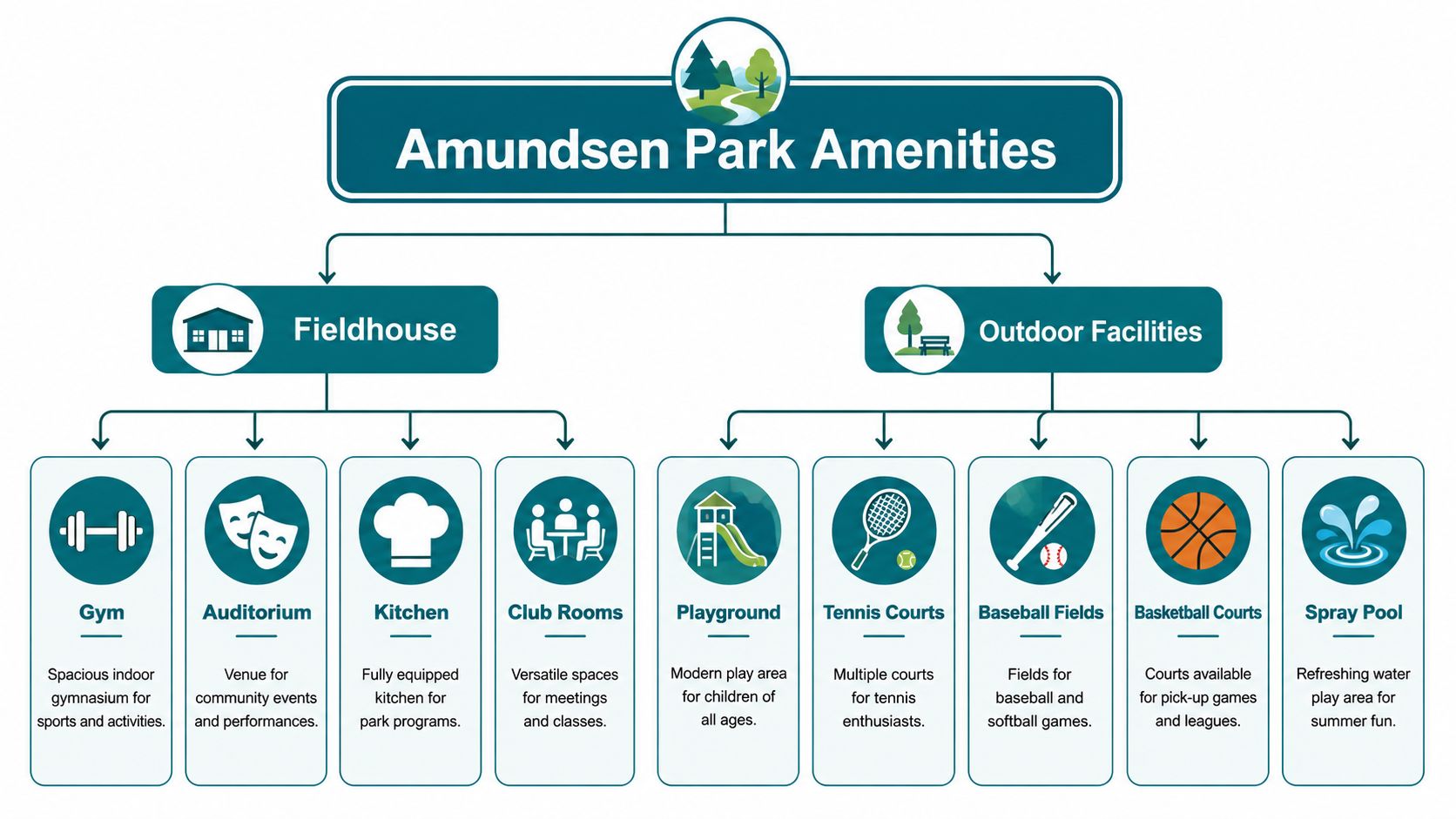
    Amundsen Park covers 16.24 acres, and the park packs in a fieldhouse with a gymnasium, fitness center, and club rooms, plus baseball and softball fields, a football and soccer field, volleyball and basketball courts, and a playground, according to the Chicago Park District's Amundsen Park listing.

    An organizational chart showing the various indoor and outdoor amenities available at Amundsen Park.

    The fieldhouse sets the tone

    A fieldhouse changes a park. It gives people a reason to come in when the sky looks mean, when school is out, when they need a place to move, meet, or catch their breath.

    I pay attention to that because indoor space creates loyalty. Regulars start recognizing each other. Parents swap names. Teens find a place to burn off energy without getting hassled. Neighbors who would never call themselves volunteers still start acting like stewards because they use the place enough to care what happens to it.

    That is how a park becomes a neighborhood anchor instead of just a patch of city land.

    Outside, every area tells a different story

    You can read the whole park by watching where people stop.

    Courts collect fast traffic and fast mess. Ball fields spread people out, but the edges catch the leftovers. Playground areas need slower, more careful attention because little hands touch everything. Open grass looks clean from a distance and fools rookies every time. Walk the fence line after a windy day and you learn fast.

    Here is how we read it during a Litter Caterpillars pass:

    Area What happens there What we watch for
    Courts Pickup games, waiting around, spectators talking trash and laughing Drink bottles, snack wrappers, litter tucked against fencing
    Ball fields Practices, games, parents watching from the side Seed bags, cups near benches, debris along the perimeter
    Playground Families circulating, kids dropping things without noticing Small trash near benches, curbs, equipment bases
    Open field areas Running drills, crossing through, casual play Windblown paper, plastic caught in corners and fence lines

    That table came from work, not theory.

    One Saturday, a new volunteer wanted to start in the middle because it looked bigger and more important. I sent him to the court fence instead. Ten minutes later he came back with an armful of bottles and wrappers and a different look on his face. He had figured out what every cleanup crew learns. Parks do not wear down evenly. The pressure lands where people gather, wait, eat, and watch.

    If I were walking you through it

    I would tell you to slow down and stop acting like bigger means better.

    Start at the entrances and sidewalks. Those spots tell visitors whether anybody cares. Then hit the courts for a quick win. After that, work the field edges and bleacher areas, where trash drifts and settles. Save the playground for last so you have enough patience left to do it right.

    That order matters. Early wins keep people engaged. Careful zones demand more focus.

    And there is something else here people miss. A park like Amundsen gives you more than places to play. It gives you chances to serve without making a speech about service. You pick up a wrapper near the bench, a parent notices, a kid asks what you are doing, and suddenly you are not just passing through. You are part of the place.

    That is the good stuff. Friendship starts there. Pride starts there. So does the habit of showing up again.

    A Park for Everyone All Year Round

    Last winter, one of our volunteers showed up with a trash grabber in one hand and a cup of gas-station coffee in the other. The wind was sharp enough to make your eyes water. The playground was still quiet, but the park was not dead. A couple of seniors were heading toward the building. A parent was steering one kid away from a puddle and another toward the swings. That morning made the point better than any city brochure ever could. A neighborhood park has to work in bad weather, tired weather, ordinary weather.

    Amundsen Park holds up because people can use it in different ways across the year, and because the design choices matter to real bodies. The playground is accessible and has a rubberized surface. I care about that for a simple reason. It changes who gets to join in, who feels welcome staying longer, and what kind of cleanup work protects the space.

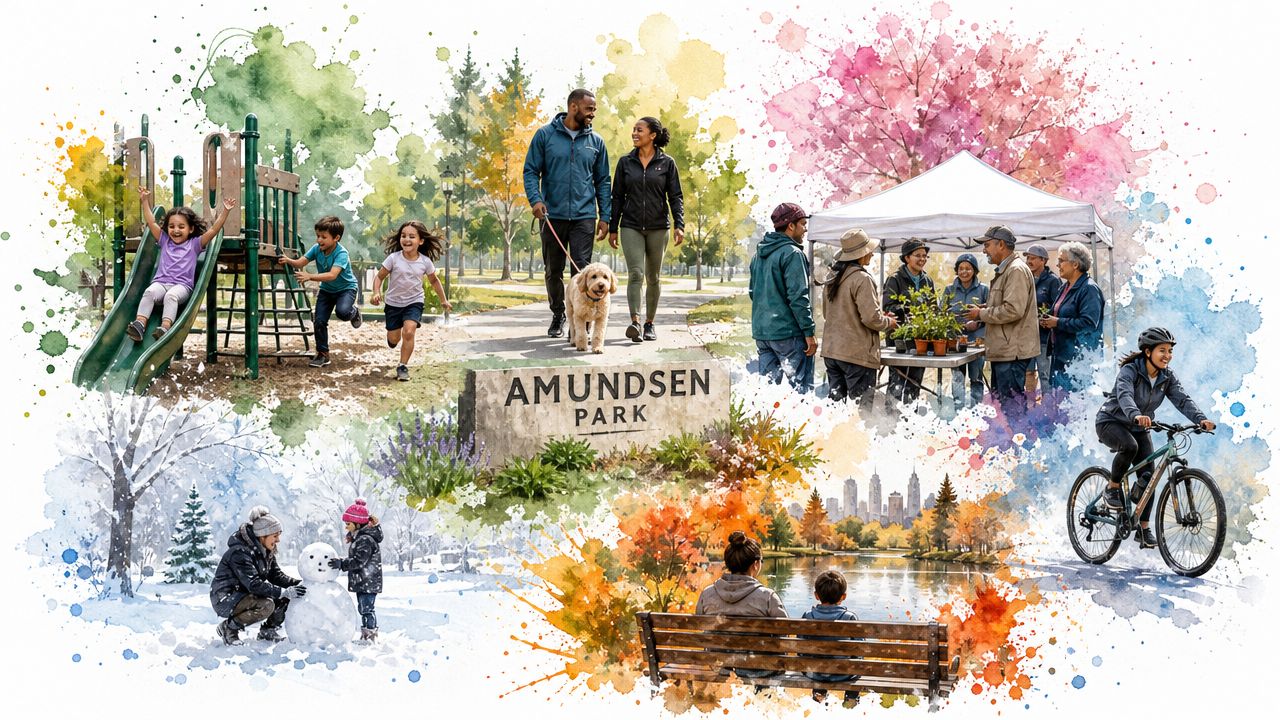
    A watercolor-style illustration showcasing various seasonal outdoor activities and community events at Amundsen Park in Chicago.

    What the ground teaches you

    Rubber surfacing looks easy until you kneel down and see what gets trapped there. Juice straw wrappers flatten out. Wet leaves glue small bits of plastic to the edge. Cigarette waste hides where the surface meets the curb or the base of the equipment.

    So the job changes.

    You do the obvious pass with grabbers. Then you slow down and work the seams with gloves on. If you rush that part, you leave behind the sharp stuff and the sticky stuff, which means the next family gets a park that only looks clean from ten feet away.

    That lesson carries beyond litter. Service gets personal fast in a place like this. A smooth surface helps a child move with more confidence. A careful cleanup keeps that same child from meeting broken glass first. That is not abstract community talk. That is Tuesday afternoon in a neighborhood park.

    Why all-season use changes people

    Summer has its own noise. Spray, sneakers, basketballs, somebody calling a kid's name for the third time. Cold months shift the rhythm, but they do not erase it. Indoor activity keeps people coming back, and that matters more than park planners and armchair critics usually admit.

    Routine builds attachment. Attachment builds responsibility.

    When people return to the same park in July, in October, in February, they start recognizing each other. They hold doors. They ask if a cleanup is happening next weekend. They bring a friend. That is how a park turns from public property into shared ground, and it is a big part of what we believe in with the Litter Caterpillars. You do not just use the park. You help carry it.

    Here is a closer look at the place in motion:

    I also push people to make the trip part of the habit. If you can get there without turning the outing into a production, you are more likely to come back and help again. That is why I like these eco-friendly transportation tips for getting around Chicago for park days and cleanup runs.

    What happens when a park's rhythm gets broken

    Residents felt it when regular use of the fieldhouse was disrupted. You could hear it in the way people talked about missed classes, changed routines, and one more neighborhood place feeling unstable for a while. Programming returning mattered because routine matters.

    That is the part I never want cleaned-up civic language to hide. A park is friendship with a location. It is kids burning energy, adults catching their breath, neighbors learning each other's names, and volunteers finding out they are tougher than they thought. Amundsen Park does that all year, if enough of us keep showing up for it.

    How to Get to Amundsen Park

    The first time someone joined one of our cleanup mornings at Amundsen Park, she texted me from her car: wrong entrance, low battery, already annoyed. Ten minutes later she found us, grabbed a spare bag, and by the end of the hour she was laughing with two neighbors she had never met. The park did its job. So did a decent set of directions.

    Use 6200 W. Bloomingdale Ave. as your starting point. Then give yourself a minute to arrive like a human being, not a package being dropped at a pin. Walk one side of the park before you choose where to settle in. You will spot the rhythm fast. A family heading toward the playground. Someone cutting across to the courts. A volunteer noticing the corners where trash likes to collect after a busy day.

    Getting there should be easy enough that you will come back.

    If you take transit, check the route before you leave. If you drive, build in a little time so parking does not put you in a bad mood before you even touch the grass. If you bike or want a lower-waste way to make the trip, I like these eco-friendly transportation tips for getting around Chicago because they help turn one park visit into a repeat habit.

    A few things make the visit better:

    • Carry less than you think you need. Water, gloves for cleanup, and one extra layer usually does it.
    • Wear shoes that can handle the whole park. Pavement, grass, rubber surface, and a muddy edge after rain are all part of the deal.
    • Know your main reason for going. Hoops, a walk, family time, or service. Pick one and let the rest happen naturally.

    That last part matters more than people think. A rough first visit is usually not the park's fault. It is being rushed, hungry, underdressed, or showing up with no plan and expecting the place to rescue your mood.

    If you are heading to the fieldhouse for a class or scheduled activity, check current programming before you leave home. As noted earlier, regular use has been returning, and the schedule can shift because this is a real neighborhood space, not a museum piece. Show up ready to adapt a little. That is community life.

    And if you see a few of us with grabbers and buckets, come say hello. Plenty of good days at Amundsen Park start with somebody asking a simple question: "Need a hand?"

    Help Us Build a Better Chicago

    I'll say something a little rude. A lot of people love the idea of community more than they love doing community.

    They like the word. They like the vibe. They like posting about it. But when it's cold, or early, or slightly inconvenient, they disappear. That's fine. I don't build around that type of person anymore.

    I built my life differently because I had to. Cleaning my own mess used to feel impossible. Other people's trash felt easier. Strange, but true. Once I learned that, I leaned into it. I started cleaning outside, and outside started cleaning me back.

    Why service changes a person

    When you pick up litter in a park, you get immediate proof that your effort matters. The bag gets heavier. The ground gets cleaner. A stranger nods at you. A kid notices. Your brain stops spinning in circles because your hands are busy doing one honest thing.

    That's part of why I believe in weekend morning service. It filters for people who are ready to give. Not perfect people. Ready people.

    The values I care about are simple:

    • Bravery. You go out when it's awkward, cold, or unfashionable.
    • Kindness. You improve a place that belongs to everybody.
    • Unity. You work beside people you might never have met otherwise.

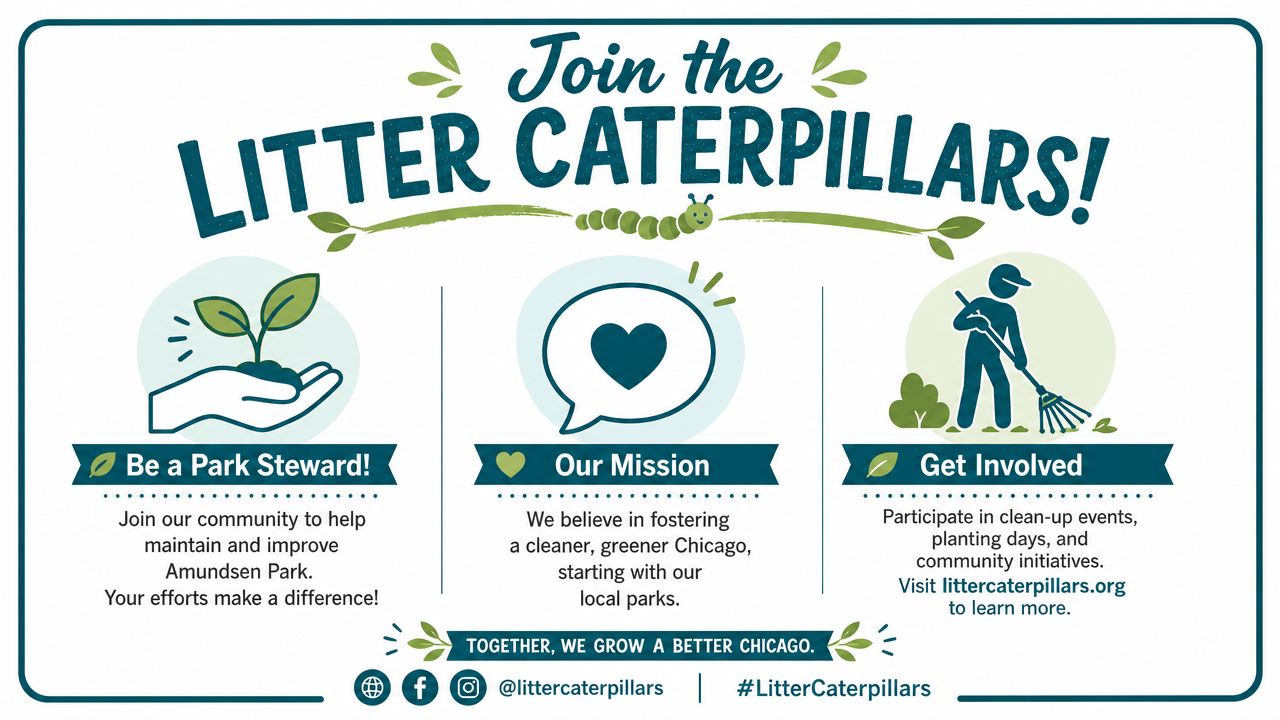
    A poster inviting community members to volunteer for Amundsen Park with the Litter Caterpillars group in Chicago.

    What helping actually looks like

    You don't need a grand plan. You need a morning, decent shoes, and enough humility to do work that isn't glamorous.

    If you want a practical way in, park cleanup volunteering in Chicago is one path. It gives people a direct way to spend time outdoors and remove litter from public spaces.

    Here are the people who usually end up loving this work:

    Person What they get
    New to the city A low-pressure way to meet solid people
    Burned out by screens A task with a visible finish line
    Students and young professionals A weekend habit that feels real
    Longtime residents A chance to protect a place they already care about

    Cleaning up other people's messes can teach you how to face your own life with less fear.

    Why I want you there

    Because parks don't stay clean by accident. Because friendship grows faster when people carry a shared burden. Because a lot of us are starving for a reason to get out of bed and do something decent before the day gets hijacked.

    Amundsen Park Chicago isn't asking you for perfection. It is asking for presence.

    Show up once and you'll understand. Show up again and you'll start to trust yourself more. Keep going, and one day you'll look around and realize the city feels less anonymous than it used to.


    If you want that kind of Saturday, join Litter Caterpillars. We pick up trash, meet good people, and turn service into a habit you can keep.

  • Harrison Park in Pilsen: A Guide to Your Next Adventure

    Harrison Park in Pilsen: A Guide to Your Next Adventure

    I remember one cold morning when my gloves were already damp before breakfast. I cut through Pilsen, stepped into Harrison Park, and felt that weird reset you only get when a neighborhood gives you a little room to breathe.

    Finding A New Kind of Fun in Pilsen

    The first time I really paid attention to harrison park in pilsen, I wasn't looking for beauty. I was looking for a place to sit down for five minutes after hauling bags of trash and trying to get my heartbeat back under control.

    I watched a kid race toward the playground like he had somewhere urgent to be. A man moved slowly along the path with his coffee. On the courts, you could hear the ball before you saw the game. That mix hit me hard. Sweat, noise, grass, concrete, laughter. It felt honest.

    Parks tell on us. If people care, you can see it. If people stop caring, you can see that too.

    What I notice when I walk in

    Harrison Park doesn't feel like an escape from the city. It feels like the city taking a full breath. That's why I keep coming back to it in my mind. You don't come here to pretend Chicago disappeared. You come here to remember that people can still make room for each other inside all the pressure.

    A simple morning at the park can turn into a whole emotional weather report:

    • On the basketball side, the energy is sharp and loud. You feel competition, rhythm, and habit.
    • Near the open fields, things loosen up. Families spread out. Kids drift. People stop checking their phones.
    • Around the fieldhouse, you get that public-building feeling I love. Real use. Real wear. Real life.

    What hooked me: I didn't need Harrison Park to impress me. I needed it to feel lived in. It did.

    If you're the kind of person who likes exploring green spaces with purpose, this Chicago parks guide from Litter Caterpillars is a good companion. I like tools that get people out the door instead of trapping them in research mode.

    Why this place sticks with me

    Some fun is flashy. This kind isn't.

    This is the fun of showing up early. The fun of hearing a ball bounce off blacktop. The fun of seeing a public place that people use, and knowing that use is fragile. One rough season, one stretch of neglect, one wave of people deciding "someone else will deal with it," and a park starts to feel different.

    That's why I don't look at Harrison Park like a pin on a map. I look at it like a test. Will we keep this place alive with our presence, our respect, and our effort, or will we just consume it and leave?

    That question follows me every time I walk through the gate.

    The Surprising Story of Harrison Park

    The first time I learned what this ground used to be, I stopped walking.

    A teenager was cutting across the grass with cleats in one hand. A grandfather was posted up on a bench like he'd earned that seat through twenty Chicago winters. Kids were shouting near the path. Then I found out this park began as a limestone quarry, a deep industrial cut in the earth before it became a place where neighbors could breathe.

    That hit me hard.

    Before Harrison Park held pickup games and family routines, this site was worked for dolomite at the old Chicago Union Lime Works. Later, public officials turned the land into park space on the Lower West Side. The park dates back to the early 1900s and became part of the Chicago Park District during the 1930s. I am leaving the official park page for the next section, where it helps more with the on-the-ground details.

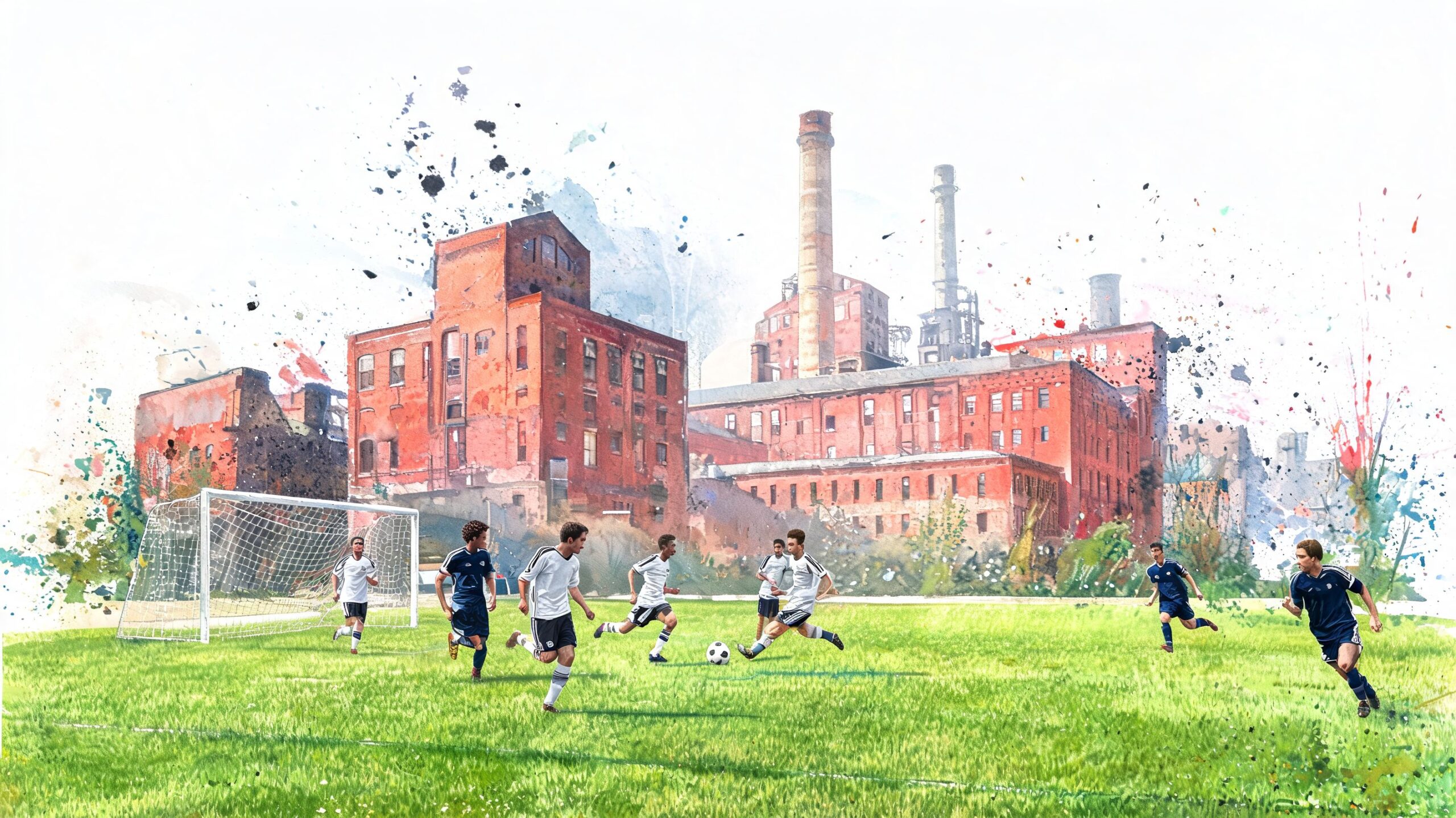
    A watercolor illustration of soccer players competing on a grassy field in front of industrial brick buildings.

    From quarry floor to neighborhood ground

    Our volunteer crew talks a lot about cleanup, repairs, turnout, showing up. We do not talk enough about conversion. Harrison Park is a conversion story.

    Men once blasted and hauled stone here. Then a neighborhood that needed open space got a park instead of a permanent wound in the ground. Somebody had to look at damaged land and say, no, children should run here. Families should gather here. A community should get something back.

    I trust places built from that kind of decision.

    You can feel the older layers if you pay attention. The park carries industry under its grass and public effort over it. Pilsen has always had people making something out of pressure, and this park fits that pattern. It was not handed down clean and easy. It was reshaped.

    That matters to me because I have seen the same thing in people. I have watched volunteers come in late, angry, distracted, burned out, then steady themselves with simple work. Fill bags. Sweep glass. Haul mulch. Check on a neighbor. A rough beginning does not disqualify a place. It does not disqualify a person either.

    Why the history changes the visit

    Once you know the ground was remade, you stop treating the park like background scenery.

    You notice the labor under the ordinary stuff. A path is no longer just a path. A field is proof that a city chose public life over abandonment. Even a worn patch near a busy corner starts to read differently. People kept working on this land until it could hold daily life.

    That is the part of Harrison Park I carry with me. It is not only a park in Pilsen. It is a piece of local stubbornness made visible.

    And around here, stubbornness can become love.

    What You Can Actually Do at the Park

    One Saturday, one of our younger volunteers showed up carrying too much. Bad week. Tight jaw. Would not say much. We handed him a trash grabber, cleaned a stretch near the walkway, and ended up staying for a pickup game after the work was done. An hour later he was laughing, drenched in sweat, arguing about a missed call like the world had given him a little room back.

    That is a real use for Harrison Park.

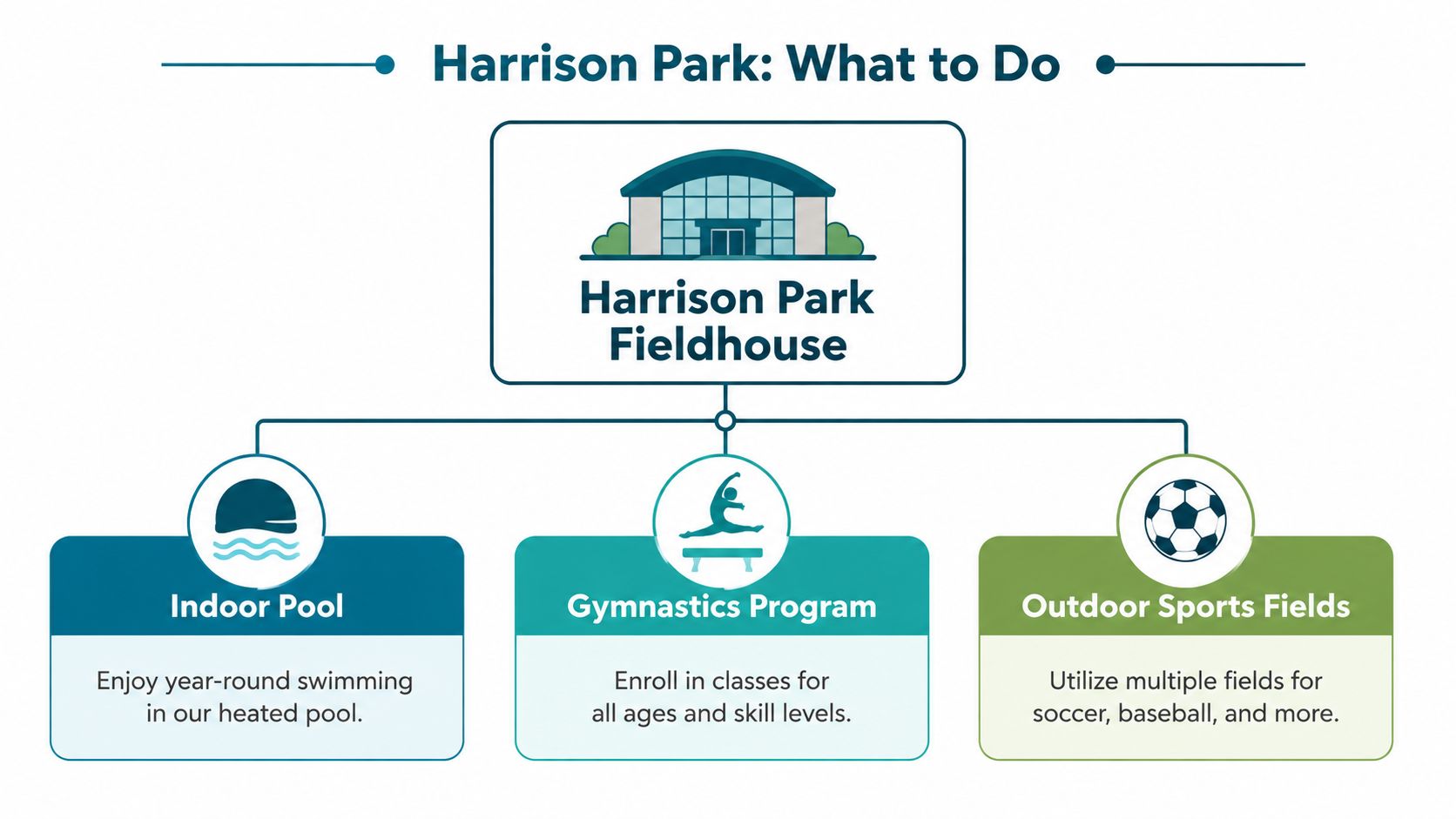
    A diagram outlining amenities at Harrison Park Fieldhouse, including an indoor pool, gymnastics program, and sports fields.

    A park like this earns its keep in small recoveries. Kids burn off chaos on the playground. Neighbors catch up by the courts. Somebody swims laps inside, somebody else sits still long enough to breathe right again. Harrison Park gives you a lot of ways to enter the day, depending on what you need and what you can carry.

    Start with the fieldhouse

    The fieldhouse is the practical center. If you are meeting people, make that your landmark. If the weather turns rude, it keeps the day alive. As noted earlier, it includes an indoor pool, a gymnasium, meeting rooms, a gymnastics center, and a reception rotunda that honors Emiliano Zapata.

    That mix matters. You can come here for organized activity, for a class, for a swim, or just to get oriented before heading outside. I have watched families use it like a base camp, one kid pulled toward the pool, another toward the gym, a parent trying to keep the whole operation from drifting apart.

    Here's a visual overview that helps if you're trying to picture the layout before you go.

    Pick the part of the park that fits your day

    Outside, the park spreads the pressure out. Courts pull in the loud energy first. Fields give people room. The playground keeps its own rhythm, all motion and quick course corrections. If you need structure, go where the games already have rules. If you need air, head for the edges and keep walking until your thoughts stop crowding each other.

    The outdoor setup includes courts, ball fields, a turf field, and a playground, as noted earlier. You do not need a perfect plan to use any of it well.

    Area What happens there Best for
    Courts Fast talk, fast feet, people testing each other Basketball, tennis, meeting up with active friends
    Open field space Room to spread out Soccer, tossing a ball, walking with kids
    Fieldhouse interior More structure, less weather drama Swimming, classes, scheduled activities
    Playground area Constant movement and quick attention shifts Families, short visits, after-school energy

    A better way to spend an afternoon here

    I tell first-timers to stop trying to conquer the whole park.

    Pick one thing that gets your body involved. Shoot for ten minutes. Walk a lap. Stretch near the field. Join a game if somebody waves you in. Then change gears before you wear yourself thin.

    Sit where you can still hear life happening. Near the court fence works. So does a bench with a view of the playground or the field. Let the park do some of the work on you.

    Then end with something small and deliberate. A phone call you have been putting off. A slow walk out. A check-in with the person you came with. We spend a lot of time in this neighborhood teaching people to show up for each other. Parks help when you use them that way.

    Practical rule: Pick one corner and stay with it long enough to notice people, patterns, and your own mood changing.

    What I tell people before their first visit

    If you have kids, start at the playground and stay loose. Children do not care about your itinerary.

    If you want noise and momentum, head toward the courts and see if the energy feels right.

    If you need to clear your head, do not march straight into the busiest section. Walk the perimeter first. Let your nervous system catch up.

    That is the version of Harrison Park I trust most. Not as a checklist of amenities, but as a public place where a rough day can turn into a decent one, and a decent one can turn into a day you remember.

    How to Get Here and Find Your Way

    Getting to a park shouldn't feel like solving a riddle. In Pilsen, it helps to keep your expectations plain. Streets are active, parking can get annoying, and your best move is usually the one that keeps the trip simple.

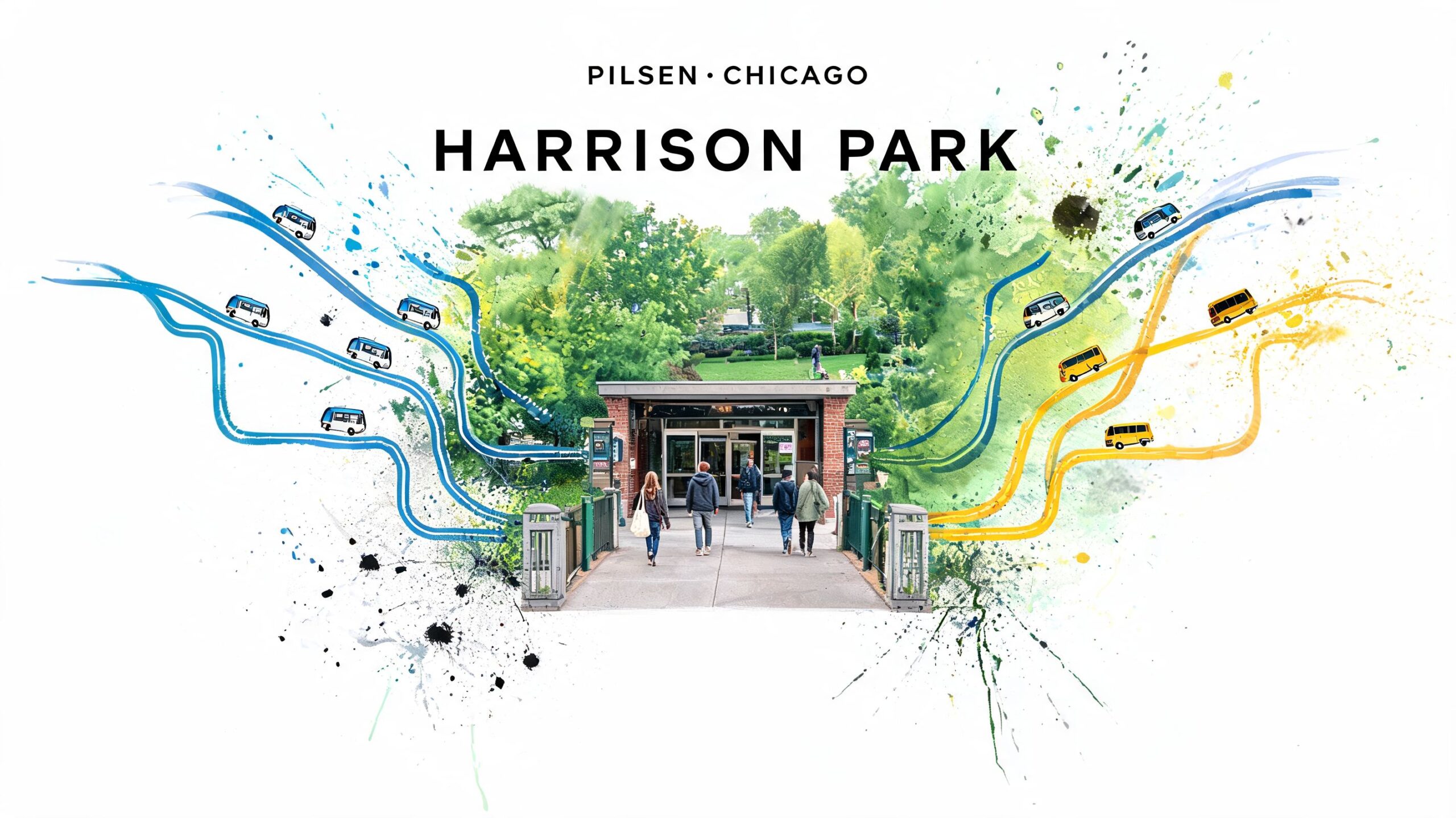
    A creative illustration blending a photo of Harrison Park in Chicago with colorful painted bus transit lines.

    Keep the arrival low drama

    If you're taking transit, I suggest checking your route before you leave and aiming for a short final walk. I won't pretend every trip across Chicago is elegant. Build in a little buffer, wear shoes you don't mind walking in, and don't cut things too close if you're meeting people.

    If you're driving, get there earlier than you think you need to. That's the honest advice. Neighborhood parking can turn a relaxed park visit into a cranky loop around the block if you arrive at the same time as everybody else.

    Once you're there

    The easiest way to orient yourself is to use the fieldhouse as your home base. From there, you can branch outward depending on what you're doing that day. If you're with friends, pick a meeting point before anyone arrives. If you're with kids, identify the bathroom situation and the nearest seating before anyone starts running.

    A few habits make the whole thing smoother:

    • Choose a meetup spot early. "By the fieldhouse" is better than a text thread full of guesswork.
    • Pack for a change in pace. Bring water, a layer, and something to sit on if you like lingering.
    • Walk the edges first. A slow loop gives you a read on the courts, fields, and quieter corners.

    Show up with a loose plan, not a military campaign. Parks are better that way.

    Accessibility and comfort

    I always look for the path of least friction. Paved routes and clear entrances matter, especially if someone in your group has mobility concerns or just doesn't want a chaotic approach. Public places feel friendlier when you can understand them fast.

    That's another thing I like about Harrison Park in Pilsen. Once you enter, the place reads clearly. You don't waste your whole visit trying to decode where life is happening.

    A Smarter Way to Care for Our Park

    One often sees litter and thinks the answer is simple. Grab a bag. Pick it up. Done. I respect that instinct, but Harrison Park asks for a little more brainpower.

    Its past matters to the cleanup. The park's history as a quarry and its location in an industrial area mean cleanup efforts must be strategic. Post-precipitation debris can collect near old drainage systems, and knowing the site's industrial past helps you tell the difference between surface litter and deeper soil issues. The park's governance under the Chicago Park District since 1934 also gives community groups a way to coordinate with official maintenance cycles, according to the Harrison Park assessment PDF from the Chicago Park District.

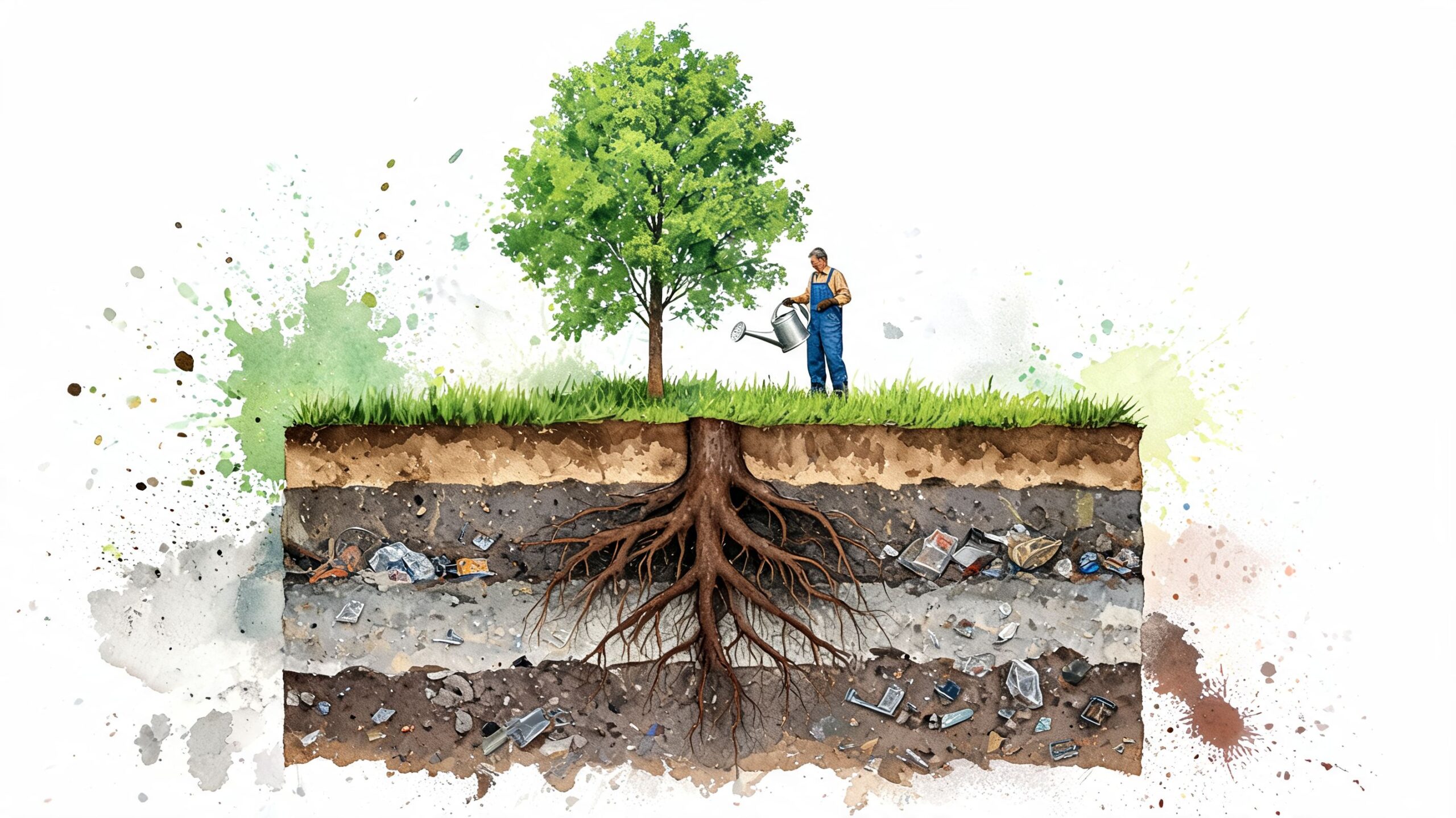
    A man waters a tree growing in ground filled with buried plastic waste and trash underground.

    What smart cleanup looks like

    This changes how I think about service in a place like Harrison Park. You don't attack every mess the same way.

    If a storm pushes cups, wrappers, and bottles toward drainage areas, that's a surface-litter job. If you see something in the ground that looks off, or an area that feels more like a soil problem than a trash problem, that's when regular volunteers need to stop pretending they're a remediation crew. Discipline is part of care.

    I like this because it keeps people safe and useful at the same time.

    A simple field mindset

    When I think about park cleanup, I use a rough filter:

    • Surface litter means cans, bottles, food packaging, and loose trash you can remove safely.
    • Drainage choke points deserve extra attention after rain because debris tends to gather there.
    • Ground concerns need caution. If it feels deeper than a pickup job, don't freelance it.

    That last part matters. Pride can make volunteers reckless. I don't admire reckless.

    Field note: The strongest volunteer is the one who knows where the line is.

    If you want a practical framework for organizing your own effort, this guide on how to clean up a park is useful because it keeps the work grounded in planning instead of hero fantasies.

    Why strategy beats intensity

    I've seen people come in hot, grabbers swinging, trying to "win" against trash in an hour. That energy burns out fast. A smart cleanup works more like chess than like a sprint.

    You watch where debris gathers. You protect volunteers. You respect the site. You work with the people who manage the park instead of pretending you can outmuscle history with one Saturday morning.

    That approach isn't less passionate. It's more mature.

    And for a place with layered ground and a long industrial memory, mature beats dramatic every time.

    Become Part of the Park's Next Chapter

    Every park asks a simple question. Are you just passing through, or are you willing to leave the place a little better than you found it?

    Harrison Park gets that question out of me fast because its whole existence came from change. Hard ground became play space. A worked-over site became somewhere people gather, swim, hoop, talk, watch, recover, and start over. When I spend time there, I don't feel pressure to be perfect. I feel pressure to participate.

    Start small and make it real

    You don't need a speech. You need one act.

    Pick up one piece of trash on your way out. Straighten a bench area if you brought food and made a mess. Bring a friend next time instead of always treating public space like a private convenience. That's how care becomes habit.

    A few good entry points:

    • Visit with intention. Don't only consume the park. Pay attention to it.
    • Learn its rhythm. Go in the morning once, then later in the day another time.
    • Join hands with other people. Community work gets lighter when more people carry it.

    The change goes both ways

    This is the strange thing I keep learning. When you take care of a place, the place starts taking care of you back.

    You become less numb. You notice more. You build a better relationship with your own word because you said you'd show up, and then you did. If you want a concrete next step, check out these Chicago volunteer opportunities.

    I think that's the adventure in harrison park in pilsen. It isn't only the courts, the fieldhouse, or the grass under your shoes. It's the chance to practice being the kind of person who doesn't look away.


    If this kind of service calls to you, take the next step with Litter Caterpillars. Join a cleanup, meet people who come out, and turn one Saturday morning into a better story for you and for Chicago.

  • 10 Transformative Adventures at a Forest Preserve in IL You Can’t Miss in 2026

    10 Transformative Adventures at a Forest Preserve in IL You Can’t Miss in 2026

    I know what it’s like to feel stuck. Imagine your life is a refrigerator full of old jam and bags from failed health kicks. That was me. Each piece of trash felt like a 500-pound weight, a story I couldn't move past. I had to end a bad relationship to finally see it. I realized I needed to face the things that terrified me: cleanliness, consistency, and being brave enough to start over.

    So, I started picking up trash. It's a strange hobby, I know. But cleaning up other people's messes felt so much easier than tackling my own. And you know what? I found a weird kind of fun in it, especially when things got tough. I remember my very first cleanup, huddled under a tree with two friends during a freak Chicago hailstorm. We were shivering. Ubers were canceling. But in that moment, I realized something powerful. Suffering together adds flavor to the story. It moves the plot forward.

    That’s how I started Litter Caterpillars. We believe in showing up—for our city, for our parks, and for ourselves. The spaces in this guide, from a sprawling forest preserve in IL to a dense city park, are not just land. Think of them as canvases for your own transformation. Let me show you 10 places where you can find that for yourself.

    1. Schiller Woods Forest Preserve: A Gateway to the Des Plaines River Trail

    You step into Schiller Woods and feel it instantly. The city's hum fades away, replaced by the rustle of ancient oak trees. This classic forest preserve in IL is more than just green space; it's a living portal, a doorway to the vast Des Plaines River Trail. For me and my crew, it’s a frontline where we protect a vital waterway.

    Cleaning along the riverbanks here feels incredibly direct. It’s like being a goalie for the environment. I remember one Saturday morning, we were pulling out forgotten fishing lines, picnic leftovers, and all the usual city debris from the water's edge. Each piece I grabbed was one less item that could float downstream and pollute the river. It's a powerful act of interception.

    Why You Should Go

    Schiller Woods is a perfect spot whether you're new to this or a seasoned pro. The trails are mostly flat and easy, so you can cover a lot of ground. Plus, its connection to the Des Plaines River means your work sends ripples of positive change through an entire ecosystem.

    "When you tackle the litter here, you feel like you're healing a small part of something much larger. You watch the river flow on, relentless and steady, and you know you helped it stay clean."

    Get Involved:

    • Your Mission: Focus on the riverbanks. That's where trash gets stuck before the water can sweep it away.
    • Actionable Tip: You should bring waders or waterproof boots. This lets you safely grab the litter tangled just offshore that other people can't reach.
    • Learn More: Find details on parking and trail maps on the Forest Preserves of Cook County website.

    2. The Chicago Botanic Garden (Glencoe)

    When you walk into the Chicago Botanic Garden, you don't feel like you're in a typical forest preserve. It's more like a perfectly curated masterpiece of nature. This 385-acre living museum isn’t just for looking at beautiful flowers; it’s a powerhouse for restoring native habitats. For us, it offers a unique chance to protect delicate ecosystems where manicured gardens and wild nature meet.

    I once volunteered during a prairie cleanup here, working right alongside their expert staff. We weren't just picking up stray wrappers. No. We were learning to identify and remove invasive plants that were choking out the native grasses. Pulling each invasive thistle felt like a direct action, a way to help the local ecosystem flourish. It was a hands-on lesson in ecological stewardship.

    Why You Should Go

    The Garden is an amazing place if you want a deeper, more educational cleanup experience. The work here is about precision and care, like a surgeon protecting sensitive plant life while removing litter. Your effort supports the conservation of rare and beautiful native Illinois flora in a truly world-class setting.

    "Working here is like being a surgeon for the prairie. You’re not just clearing debris; you are making careful, intentional moves to help a beautiful, complex system heal and thrive."

    Get Involved:

    • Your Mission: You should focus on the edges of the naturalized areas, like the Skokie River Corridor and the Dixon Prairie. That’s where litter and invasive species often sneak in.
    • Actionable Tip: Partner up with the Garden’s volunteer coordinator. They can align our cleanup efforts with their seasonal needs, like seed collecting or invasive species removal days.
    • Learn More: Discover volunteer opportunities and plan your visit on the Chicago Botanic Garden website.

    3. Lincoln Park: Urban Oasis, Crucial Cleanup Zone

    You might not think of Lincoln Park when you hear “forest preserve in IL,” but don't be fooled. This sprawling urban oasis is a critical ecosystem on the front lines of our city. It stretches for miles along Lake Michigan, a mosaic of beaches, gardens, and wooded paths right in the heart of Chicago. For us, its high visibility and heavy foot traffic make it a top priority for litter interception.

    I remember leading a cleanup at North Avenue Beach right after a big storm. The sheer amount of plastic debris washed ashore was jarring. It was a plastic graveyard. But as my group and I worked, clearing section by section, we saw the immediate difference. We weren't just cleaning sand; we were stopping that pollution from going back into the lake, protecting a vital source of fresh water for millions of people.

    Why You Should Go

    Lincoln Park's incredible diversity makes it an ideal spot for any kind of cleanup. You can tackle high-traffic picnic areas one day and feel like you're in a remote nature sanctuary the next. Its location makes it super accessible, letting you organize focused, neighborhood-based efforts that have a massive impact.

    "Cleaning Lincoln Park is a direct act of service to the city itself. You’re protecting a shared space that brings joy to so many, and you can see the immediate, positive result of your work right before your eyes."

    Get Involved:

    • Your Mission: Focus on areas right after big events or storms. That's when debris is most concentrated, especially along the lakefront.
    • Actionable Tip: You should divide and conquer. Split the park's six-mile stretch into zones and assign a team to each. This systematic approach ensures no area gets missed.
    • Learn More: Connect with the Lincoln Park Conservancy for resources and to coordinate your cleanup efforts with their ongoing work.

    4. Humboldt Park: Urban Preservation and Community Power

    Humboldt Park stands as a testament to the power of a community green space. This 207-acre park on Chicago's West Side isn't just a bunch of trees and fields; it's the vibrant, breathing heart of its neighborhoods. It’s an urban forest preserve in IL where our mission goes beyond just picking up litter and into building real, human connections.

    I’ll never forget a cleanup we organized around the lagoon. We partnered with a local neighborhood group, and what I thought would be a small event blossomed into a full-on community gathering. We shared stories, we shared donuts, and we shared a common goal. Removing bags of storm debris and picnic trash from the water's edge felt like we were restoring a community landmark, not just cleaning a park.

    Why You Should Go

    Humboldt Park is where our work feels most connected to people. It's the perfect spot if you want to see your efforts build community pride. The mix of manicured parkland, natural wooded areas, and the iconic lagoon presents a unique set of challenges and incredibly rewarding moments.

    "Cleaning here is about more than the environment; it’s about showing love for a neighborhood. You can see the 'before and after' in the landscape and in the smiles of the people who call this park their own."

    Get Involved:

    • Your Mission: You should concentrate on the lagoon edges and the natural wooded sections where trash often gets hidden from view.
    • Actionable Tip: Schedule cleanups for early weekend mornings, between 8 and 10 AM. This is a sweet spot for safety and attracting the most community volunteers before the park gets too busy.
    • Learn More: Discover more about this historic park on the Chicago Park District website.

    5. Grant Park: Restoring Chicago's Iconic Front Yard

    While it's not a traditional forest preserve in IL, Grant Park is Chicago's public heart. It's our sprawling front yard along Lake Michigan. For us, cleaning here is an act of pure civic pride, a high-visibility effort that shows thousands of people what community care looks like in action. It’s about protecting the city's most iconic gathering space.

    I’ll never forget a post-festival cleanup we organized. The sheer volume of discarded items was overwhelming. It looked like a party had exploded. But as we worked, dozens of passersby stopped to thank us, and a few even jumped in to help. We weren't just picking up trash; we were inspiring a sense of collective ownership over this incredible public asset.

    Why You Should Go

    Grant Park is the ultimate stage for showing what we do. The high foot traffic means your efforts are seen by everyone, creating a powerful recruiting opportunity. By partnering with the Grant Park Conservancy or joining post-event cleanups, you can directly support Chicago’s cultural backbone and keep its most famous park beautiful.

    "Cleaning in Grant Park feels different. You’re not hidden away in the woods; you are on full display, restoring a space that belongs to everyone. Each piece of litter you grab is a direct contribution to the city's spirit."

    Get Involved:

    • Your Mission: Focus on the less-maintained borders of Millennium Park and Museum Campus, where trash often piles up.
    • Actionable Tip: You can schedule your cleanup to coincide with a major cultural event. You’ll find more volunteers and create opportunities to partner with event organizers.
    • Learn More: Connect with the Grant Park Conservancy to find official volunteer events and coordinate your own group cleanup.

    6. Busse Woods Forest Preserve (Rolling Meadows/Des Plaines)

    Busse Woods feels like you've stepped into a completely different world. With over 3,000 acres, it’s a vast expanse of woodlands and wetlands that shows what a dedicated forest preserve in IL can truly protect. This isn't just a park; it's a genuine ecosystem where our work feels less like tidying up and more like real habitat restoration.

    A person in a high-visibility vest cleans a forest path beside a lake, with two deer in the misty background.

    Our first volunteer day trip here was an eye-opener for me. We partnered with the Forest Preserve District and focused on a section of trail near the elk pasture. Instead of just picking up wrappers, we were learning to identify and remove invasive garlic mustard. It felt like we were giving the native wildflowers a fighting chance, directly contributing to the health of the entire forest understory.

    Why You Should Go

    Busse Woods is perfect for you if you want to go deeper than just a surface-level cleanup. It’s an opportunity to learn about habitat restoration and see the direct impact of removing invasive species. The sheer scale of the preserve means our efforts are crucial for maintaining its wild character for both wildlife and visitors.

    "Working in Busse Woods is like being a gardener for a giant, wild forest. You're not just picking up trash; you're helping native plants thrive and protecting the homes of countless animals. It’s a powerful feeling."

    Get Involved:

    • Your Mission: Focus on trail edges and undergrowth for invasive species removal and accumulated litter. Its immense size means there's always a new area to restore.
    • Actionable Tip: You should organize a carpool day trip. Since it’s a bit of a drive from the city, making it a group event with shared transport builds community and makes it easier for everyone to participate.
    • Learn More: Explore volunteer opportunities and preserve details on the Forest Preserves of Cook County website.

    7. Garfield Park (Douglas Park Historic District): A Partnership in Urban Renewal

    Garfield Park isn't just a park; it's the heart of a community. Spanning 185 acres on the West Side, its historic lagoons, formal gardens, and the stunning Garfield Park Conservatory act as a vital green haven. For us, this isn't a typical forest preserve in IL; it's a chance to build deep community partnerships and restore a piece of Chicago's legacy.

    I'll never forget a cleanup we did near the lagoon. We worked alongside a neighborhood group that had been caring for the park for years. We weren’t just picking up litter. No, we were sharing stories, learning about the area’s history, and becoming part of a local movement. It showed me that our work here is about more than just trash; it's about solidarity.

    Why You Should Go

    Garfield Park is where you can make a profound, visible impact. The need is significant, but the potential for collaboration with groups like the Garfield Park Conservancy is even greater. This is a place to invest your energy where it will be seen, felt, and celebrated by the people who call this park their home.

    "Cleaning up here is an act of respect. You're showing the community that you see their efforts and want to stand with them. It’s about building trust, one piece of litter at a time."

    Get Involved:

    • Your Mission: Your first goal should be to build relationships. You need to connect with local organizations before you even plan a cleanup.
    • Actionable Tip: Schedule early morning cleanups (7-9 AM) with clear safety protocols. This respects the park's daily rhythm and ensures your volunteers feel comfortable.
    • Learn More: Discover the incredible community work happening and see how you can join in by exploring our guide to Garfield Park.

    8. Navy Pier Lakefront & Easternmost Edge

    While not a traditional forest preserve in IL, the public lakefront surrounding Navy Pier offers a unique and vital urban cleanup frontier. The pier itself is private, but the surrounding pedestrian paths and shoreline are where the city’s energy meets Lake Michigan’s vastness. This intersection creates a high-impact zone for our cleanup efforts, protecting a world-renowned waterfront.

    I’ll never forget an early morning cleanup we organized here. The city was just waking up, and we patrolled the eastern edge, collecting countless plastic bottles, food wrappers, and windblown debris. With the iconic skyline behind us, every bag we filled felt like a direct gift back to the city and the lake. It was like giving Chicago a thank-you note.

    Why You Should Go

    The Navy Pier lakefront is an incredible spot to show the power of community action in a highly visible area. The constant foot traffic means there is always work to be done, and the urban setting allows us to engage with tourists and locals alike, spreading awareness about litter prevention.

    "Cleaning here is a powerful statement. You’re standing at the edge of one of the world's great cities, physically stopping pollution from entering one of the world's great lakes."

    Get Involved:

    • Your Mission: You need to target the water’s edge and the rocky revetments along the easternmost point where trash gets trapped by the waves.
    • Actionable Tip: Schedule your cleanups for early mornings or weekdays to avoid the largest crowds. This gives you better access and makes the work much more efficient.
    • Learn More: Coordinate with the Navy Pier sustainability team for access and to see how your efforts can support their larger environmental initiatives.

    9. Des Plaines River Corridor & Restoration Areas

    The Des Plaines River isn't just one forest preserve in IL; it's a vital artery flowing through dozens of them. It snakes over 80 miles, a long, winding corridor connecting communities and ecosystems. For us, this isn't a single site but a massive, linear opportunity to defend an entire watershed from pollution.

    A man in a green shirt cleans up litter by a winding river with reeds in watercolor.

    I think of the river as a story that we can help rewrite. We've worked at access points from the Salt Creek confluence all the way north, and the mission is always the same: stop trash before it travels. A single plastic bottle you remove here won't end up miles downstream, and that’s a victory you can see and feel in real-time.

    Why You Should Go

    The Des Plaines River Corridor is perfect for you if you want to see your impact scale up. Cleaning just one section contributes to the health of the entire river system. It’s an ideal setting for ongoing projects, where you can "adopt" an access point and witness its transformation week after week.

    "Working along the river feels like you're part of a relay race for conservation. Every cleanup event passes the baton of a cleaner waterway to the next community downstream."

    Get Involved:

    • Your Mission: You should focus on the riparian zone—that critical area where land meets water. This is where litter gets snagged in reeds and roots.
    • Actionable Tip: You can partner with a group like the Des Plaines River Watershed Group for larger, coordinated cleanups that will amplify your impact.
    • Learn More: Discover more about the many access points by exploring our guide to the Des Plaines River Trail.

    10. Cantigny Park & Neighboring Woods (Wheaton/DuPage): A Fusion of History and Habitat

    Cantigny Park offers something different. It’s a beautifully curated estate where manicured gardens meet authentic woodland habitat. While not a traditional forest preserve in IL, its 500 acres in Wheaton represent a significant commitment to preserving natural spaces. For us, it’s an opportunity to blend our cleanup mission with history, education, and community partnership.

    I think of it as a destination cleanup. We once organized a day-trip here. We started the morning by clearing debris from the edges of the woodland trails, where nature meets the more formal park areas. After our work, we explored the museums and gardens. It turned a simple cleanup into a rich, rewarding experience for everyone, showing that stewardship can be part of a larger, wonderful day out.

    Why You Should Go

    Cantigny is ideal for a more structured volunteer event. The park is well-maintained, but the borders between the wilder sections and curated landscapes are prime spots for stray litter. It’s a perfect place to introduce new volunteers to our work in a setting that feels safe, inspiring, and full of other activities.

    "Cleaning up at Cantigny feels like you’re protecting a living museum. You’re not just picking up trash; you’re helping preserve a piece of Illinois history and its natural legacy for families and visitors."

    Get Involved:

    • Your Mission: Focus on the woodland trail edges and the borders of the native plant gardens. These transitional zones are where litter often gets overlooked.
    • Actionable Tip: You must contact the park’s volunteer office beforehand to coordinate your group's visit. This can open doors for partnerships and ensure you’re helping in the most impactful way.
    • Learn More: Plan your trip and explore partnership opportunities on the Cantigny Park website.

    Top 10 Illinois Forest Preserves & Parks Comparison

    Site 🔄 Implementation Complexity ⚡ Resource Requirements 📊 Expected Outcomes (⭐) 💡 Ideal Use Cases ⭐ Key Advantages
    Millennium Park & AT&T Plaza High — permit coordination & crowd management Medium — volunteer teams, early-morning staffing, park coordination ⭐⭐⭐⭐ — immediate visible improvement & media attention Urban volunteer recruitment; high-visibility campaigns Partnerships with city/cultural institutions; strong media appeal
    Chicago Botanic Garden (Glencoe) Medium — sensitive habitats require coordination with staff Medium — trained volunteers, transport for urban groups, educational materials ⭐⭐⭐⭐ — habitat restoration & volunteer retention Ecology-focused cleanups and educational workshops Established volunteer network; strong education potential
    Lincoln Park High — large geographic scope and multi-agency logistics High — many volunteers, equipment, ongoing scheduling ⭐⭐⭐⭐ — sustained lakefront and neighborhood impact Rotating weekly zones; large-group lake/beach cleanups Diverse ecosystems for varied volunteer experiences; strong recruitment
    Humboldt Park Medium — safety planning and community trust-building Medium — consistent volunteer commitment, local partnerships ⭐⭐⭐⭐ — neighborhood pride and meaningful environmental justice impact Building community relationships in underserved areas Strong local engagement; visible neighborhood benefits
    Grant Park High — event schedules, permits, dense crowds High — large volunteer drives, coordination with institutions ⭐⭐⭐⭐⭐ — maximum visibility and media/social reach Media-focused recruitment; post-event cleanups Iconic location; high volunteer influx and partnership potential
    Busse Woods Forest Preserve Medium — transportation logistics to suburban site Medium — trail tools, day-trip coordination, fewer volunteers needed ⭐⭐⭐⭐ — strong habitat and trail preservation outcomes Authentic forest preservation and trail maintenance trips True natural preserve experience; safer, less-crowded work
    Garfield Park (Douglas Park Historic District) Medium–High — community engagement and safety protocols Medium — regular volunteer cadence, conservatory coordination ⭐⭐⭐⭐ — deep community impact and restoration gains Long-term neighborhood partnership projects Conservatory partnerships; multigenerational volunteer potential
    Navy Pier Lakefront & Easternmost Edge High — intense crowds, commercial coordination, water safety High — strict timing, safety gear, coordination with Navy Pier ⭐⭐⭐⭐⭐ — high social-media impact and visible litter removal Tourist engagement; photo-driven volunteer recruitment Iconic skyline/backdrop; exceptional social visibility
    Des Plaines River Corridor & Restoration Areas Medium — dispersed sites require transport planning Medium — trail/river gear, partner coordination, variable access ⭐⭐⭐⭐ — measurable watershed and riparian habitat benefits Sequential ward-by-ward or watershed restoration campaigns Linear coverage enables consistent weekly presence; educational value
    Cantigny Park & Neighboring Woods Low–Medium — coordinate with institutional staff, smaller scale Medium — transport, small-group tools, museum coordination ⭐⭐⭐⭐ — combined preservation and educational outcomes Day-trip volunteer experiences blending history and ecology Strong educational partnerships; intimate woodland stewardship

    Your Story Is Waiting in the Woods

    We’ve walked together, virtually, through ten incredible green spaces. From the sculpted gardens of the Chicago Botanic Garden to the wild, sprawling trails of the Des Plaines River Corridor, each place offers you more than just scenery. They are invitations. They are blank pages waiting for your story.

    I remember my first real cleanup. It was a cold, drizzly Saturday at Busse Woods. Honestly, I didn't want to go. I was tired, feeling a little lost in my own life, and the idea of picking up soggy fast-food wrappers felt anything but inspiring. But I showed up. And within an hour, something inside me shifted. Working alongside strangers, sharing a thermos of hot coffee, and watching a patch of woodland slowly return to its natural state changed me. It wasn't about the trash. It was about the shared effort. It was about taking a small, messy corner of the world and making it whole again.

    That simple act became my lifeline. I found that every piece of litter I picked up felt like I was clearing away a piece of my own internal clutter. Every restored prairie I saw was a metaphor for my own potential to grow. These places, these beautiful examples of a forest preserve in IL, are not just for you to look at. They are dynamic arenas for action and connection.

    You don't need a grand plan to start. Your journey can begin with a single step onto a trail at Cantigny Park or a quiet moment watching the birds in Humboldt Park. Let the peace of the woods settle your mind.

    But if you feel a deeper calling, a pull to do more, then that’s where the real story begins.

    • Your Next Step: You should choose one location from this list that speaks to you. Don't overthink it. Just pick one and make a plan to visit within the next week.
    • Your First Action: Go for a walk. That's it. No pressure. Just observe. Notice the light filtering through the trees, the sound of your own footsteps, the feel of the air. See what feelings come up for you.
    • Your Community: If you feel that spark, that desire to protect these spaces, then you know where to find us. You know there’s a community waiting for you with open arms, a trash bag, and a shared purpose.

    This is your story. It might start with a simple walk in a park, but it can lead you to discover your own strength, find your people, and realize you have the power to create real, tangible change. Your transformation is waiting for you. It might just be under a piece of litter in a forest preserve in IL.


    Ready to turn your inspiration into action? Join Litter Caterpillars and become part of a community dedicated to restoring the beauty of our local parks and preserves. We provide the gear and the camaraderie; you provide the heart. Find your next cleanup event and start your story with us at Litter Caterpillars.

  • Mary Bartelme Park: Your Guide to Chicago’s West Loop Oasis

    Mary Bartelme Park: Your Guide to Chicago’s West Loop Oasis

    I remember walking through the West Loop when it was all grit and noise. The energy was electric, sure, but frantic. Then you step into Mary Bartelme Park, and it’s like the whole city exhales. This isn't just a patch of grass; it’s a story. This place is the neighborhood's backyard, a living, breathing testament to what happens when you decide to fight for something better.

    The Heart of the West Loop

    Volunteers cleaning a vibrant urban park with green grass, trees, and city skyline.

    For a group like us at Litter Caterpillars, a park like this is everything. It’s physical proof of our mission. It shouts from the rooftops that when you care enough to get your hands dirty, real change happens. The journey of this park, from a forgotten industrial wasteland to the soul of the community, is our story written on a much larger scale.

    From Rubble to Oasis

    Not so long ago, I saw the West Loop as all warehouses and steel. As people and families started calling it home, they felt a void. They needed a place to breathe, to play, to just be. So they raised their voices. And they didn't stop until the city listened.

    This park is the answer. It cost $3.1 million and rose from the ashes of an old infirmary. We watched them transform what was a contaminated brownfield into a 2.3-acre green space by August 2010. They even salvaged terracotta from the original building, embedding it in the new walls—a beautiful nod to the past. It’s a story of total metamorphosis, like a butterfly emerging.

    The design here wasn't some cold, top-down plan. I see it as a direct answer to a neighborhood that was starving for a backyard. It proves what's possible when we actually band together.

    A Community's Living Room

    Spend any time here, and you'll see what I mean. I watch families spread out on blankets, their kids screaming with pure joy. I see dog owners laughing and catching up at the sunken dog park. You find people stealing a quiet moment in the seating garden. There's even a little six-foot-tall hill that, believe it or not, gives you a killer view of the skyline. It’s a tiny mountain with a giant reward.

    This is the kind of place we at Litter Caterpillars dream about creating all over Chicago. It’s what happens when you invest in your shared spaces. If you want to see what that kind of community spirit feels like, I recommend exploring more amazing Chicago neighborhoods. Mary Bartelme Park is all the proof you need that even the most forgotten corners of our city can be brought back to life.

    Meet 'Suitcase Mary': The Park's Fearless Namesake

    Two women, one older and one younger, exchange a vintage brown suitcase with watercolor accents.

    When you walk through Mary Bartelme Park, you're on turf named for a woman who was our kind of person—a true Chicago trailblazer with a ton of heart. Her story fires me up. It’s a perfect example of seeing something broken and deciding, "Nope, I'm going to fix this."

    Mary Bartelme wasn't just some historical figure; she was a force. As Illinois' first female judge, she shattered barriers in a world totally dominated by men. But she didn't just sit back and bang a gavel. She got her hands dirty, fighting for the city’s most overlooked kids and young women.

    A Legacy of Dignity

    Picture this: a young woman, fresh out of the court system, completely alone with nothing. Mary Bartelme didn't see a case number; she saw a human being who needed someone in her corner. That's how she got the incredible nickname that stuck: 'Suitcase Mary.'

    She literally gave them suitcases. But this wasn't just an empty gesture. I imagine her filling each one with clothes, toiletries, and basics—everything a person needs to start over with their head held high. It was a simple, powerful message: "You matter. You deserve respect."

    For me, her story is a powerful reminder that real change doesn't always come from grand, sweeping laws. Sometimes, it comes from a single, consistent act of showing up for those who are overlooked.

    More Than Just a Judge

    The sheer scale of what she did blows my mind. In just one decade, she heard over 50,000 cases, a staggering number that cemented her reputation as the single most important figure in the first 25 years of the Cook County Juvenile Court.

    But she went even further. She started 'Mary's Club' group homes—one specifically for African-American girls—to give them a safe place to land and learn real-life skills, instead of just being thrown into the system. You can explore more about her groundbreaking career and see how she fought to build dignity into a system that often lacked it.

    This is the spirit baked into the DNA of Mary Bartelme Park. It’s the same energy that fuels me and my Litter Caterpillars crew every single weekend. She’s the blueprint for civic courage—someone who showed up, didn't flinch, and proved that one person’s brave, kind effort can change thousands of lives.

    A Guided Tour Through The Park's Best Features

    Let's walk through Mary Bartelme Park together. I want to show you why this place feels so special to me. It’s not just a patch of grass—the designers were smart. They built it like a good house, with different rooms for different moods, where every space has a purpose.

    When you first walk up, you can't miss the five giant, stainless steel arches. They curve up towards the sky like massive sculptures, and they're probably the park's most famous feature. But they have a secret. On a blistering Chicago summer day, they suddenly erupt in a cool mist. Watching the kids (and let's be honest, me too) run laughing through the spray is pure joy. It’s art, but it’s also just plain fun.

    The Playground and Dog Park

    Once you’re past the fountains, you'll hit the kids' playground. This isn’t the rusty slide and gravel pit I remember from being a kid. It’s a modern play zone with a bouncy, rubberized floor that softens every trip and fall. The equipment is creative, with unique climbers and little interactive spots that get kids' brains working. I’ve seen so many little ones get this look of total victory after finally figuring out a tricky route to the top.

    Right next door is maybe the most-loved spot in the whole park: the sunken dog park. This is the social club for every four-legged resident in the West Loop. Because it’s built down below ground level, it feels like a secret world, keeping all the barking and happy chaos contained. It’s a little haven of its own where I see owners chat while their pups go wild.

    What I love most is how they separated these zones. It’s brilliant. You can have total, joyful chaos happening in one corner while someone is finding total peace just a few steps away.

    A Quiet Escape and a Skyline View

    If you’re looking for that peace, I suggest you head to the enclosed seating garden. It’s tucked away and surrounded by all these beautiful native plants and flowers, feeling almost like a private little hideaway. It’s my go-to spot to read a book, finish my coffee, or just sit for a minute and watch the world go by.

    Last, we’ll head to the park's highest point—a gentle, grassy hill that only rises about six feet off the ground. It doesn't sound like much, but trust me. When you get to the top, you’re rewarded with this incredible, perfectly clear view of the Chicago skyline. It’s the best seat in the house for watching the sun go down behind the skyscrapers.

    If you're hungry to explore more of the city's amazing green spaces, be sure to check out our guide to other fantastic Chicago parks worth your time.

    Before we move on, I made a quick rundown of what makes this park tick. It’s a great way for you to see all the key features in one place and figure out where you'll want to spend your time.

    Mary Bartelme Park at a Glance

    Feature Best For My Pro Tip
    Misting Archways Families with kids, hot days The mist is on a timer—stick around, and you'll catch it!
    Playground Toddlers & young children The rubber surface is a lifesaver for parents of clumsy climbers.
    Sunken Dog Park Dog owners, social pups I'd go during "yappy hour" (around 5 PM) to meet other dog people.
    Seating Garden Solo visitors, readers Grab a corner bench for the most privacy and quiet.
    Grassy Hill Photographers, sunset watchers The view is best on clear evenings just before sunset.

    These are the highlights, but the real magic is just finding your own little corner of the park and making it yours.

    When you look at a park, what do you really see? Most people just see grass, maybe a playground. I see something totally different. I see a neighborhood's secret weapon. It’s not an expense on a city budget; it's an investment that pumps life back into the streets, the local shops, and the people who live there. It’s like an engine.

    If you don't believe me, just go look at Mary Bartelme Park. It's the perfect proof.

    It all started with a simple, almost radical idea in a concrete-heavy part of the city: give people a beautiful green space to just be. That one move set off a chain reaction. Suddenly, the area wasn't just a grid of streets you pass through; it became a place you go to. I watched people show up for the park, and then they'd stick around for a coffee, grab dinner, or pop into a shop. The park didn't just grow grass; it grew a whole local economy.

    And this isn't just some feel-good story; the numbers don't lie. Homes just a couple blocks from the park now sell for 50% more than the area average. That's a massive deal, proving that green space is basically gold for property values. The park even pulls in its own money, with over $7,500 a year coming from things like event permits and fitness classes. You can dig into all the data on the park's economic boost and see for yourself how this stuff pays off.

    A Community Asset That Shines

    This is the kind of transformation that gets me fired up. When we're out there cleaning a park, we're doing more than just picking up trash. We're polishing a community gem, making it shine so it can make our city a better, more valuable place for everyone. The success of Mary Bartelme Park shows exactly what happens when you care for a space—it becomes a source of pride and a magnet for prosperity.

    It creates this amazing feedback loop. A beautiful park brings you in. You spend money at local businesses. Thriving businesses and higher home values make the neighborhood more desirable. And that success creates more motivation and resources to keep the park beautiful. It just keeps getting better.

    This infographic gives you a quick look at the features that make it all work.

    Infographic detailing park features: 70 kids play areas, 40 dog parks, 30 skyline viewpoints.

    Each one of those areas—the playground, the dog run, that awesome skyline view—is like its own little magnet. They pull in different people all day long, and every one of them adds to the neighborhood's energy. This isn't just pretty landscaping; it’s a brilliant strategy for building community and commerce, side-by-side.

    Planning Your Visit to Mary Bartelme Park

    Watercolor painting of a person using a tablet in Mary Bartelme Park with a bike and bench.

    Alright, so you're ready to check out Mary Bartelme Park. Good call. I've spent more time here than I can count, so let me give you the real story, the kind of stuff that makes you feel like a regular on your first go. Let's get you there.

    First things first, you'll find the gates open every single day from 6 AM to 11 PM. That's a huge stretch of time, perfect for catching a quiet sunrise or just chilling under the archways after dark. You'll find it at 115 S Sangamon Street, smack in the middle of the West Loop.

    Getting There and Insider Tips

    Getting to the park is easy, which is a big part of why people love it so much. If you're coming by public transit, you've got a couple of solid choices that'll get you close.

    • CTA 'L' Lines: I usually hop on the Green or Pink Lines to the Morgan station, or take the Blue Line to UIC-Halsted. Either way, you're looking at a nice, easy 10-minute walk.
    • Bus Routes: The #8 Halsted and the #20 Madison buses are your friends here. They'll drop you off just a stone's throw from the park entrance.

    Now, if you're thinking about driving… let's talk. Parking in the West Loop can feel like a contact sport. Sure, there’s street parking on Sangamon and the side streets, but finding a spot, especially on a beautiful weekend? It’s a challenge. My honest advice: if you have to drive, get there early in the morning or just be ready to play the circling game for a bit.

    Here's a little secret from me to you: the best time to go is on a weekday morning. The park is practically empty. It's the perfect time to grab a coffee from a nearby spot, claim a bench, and just have the whole place to yourself before the city really gets going.

    Bringing your dog? You're in luck. The sunken dog park has this unofficial "yappy hour" that I see happen around 5 PM. It's when all the neighborhood pups and their people show up. The vibe is super friendly and chaotic in the best way. Just be a good neighbor—keep an eye on your dog and clean up after them. It keeps the space great for everyone.

    No matter how you make your way to Mary Bartelme Park, I promise you, it's worth it. You're not just visiting some patch of grass; you're stepping into the West Loop's living room.

    How You Can Make a Difference in Your Community

    Have you ever walked through a beautiful park like Mary Bartelme and felt a little voice in your head say, "I want to be part of making something like this"? You absolutely can. This is your invitation to step into that power.

    I know how hard it can be to start. For years, just cleaning my own room felt impossible. Every piece of trash had a story, and I was stuck. But then I found a weird trick: cleaning up a public space with other people? That felt fun. It felt like I was actually accomplishing something.

    Join the Litter Caterpillars

    That discovery is what led me to create Litter Caterpillars. Every single weekend, we get together to take care of our city's parks. We get our hands dirty, we make real friends, and we see the difference we’re making right away.

    It’s not about being perfect. It's about the brave and simple act of showing up. It's about deciding you want to be part of the solution, not just wishing for one.

    This is your chance to stop wanting a cleaner Chicago and start building it yourself. We intentionally meet on weekend mornings to filter out the selfishness and bring together people who are givers.

    We practice bravery, find joy in the hard work, and prove every week that a few people who care can make a massive impact. If you're ready to see how it feels to transform a space—and maybe transform yourself a little, too—you can find out how to clean up a park with us. We’d love to see you out there.

    Your Questions, Answered

    People are always asking me about the little things at Mary Bartelme Park. After all the time I've spent here, I've got the real-deal answers, not the generic stuff you find on a city website. Let me get straight to it for you.

    Are There Public Restrooms?

    Yes, and thank God. There's a field house right by the playground with public restrooms. If you're out with kids, you know this is a game-changer.

    The hours can get a little weird depending on the season, but you'll almost always find them open when the park is busy. Just don't push it. My rule of thumb is to assume they lock up a bit before the park itself closes at 11 PM.

    Can I Throw a Party or Host an Event Here?

    I see it all the time—birthday parties, little community meetups, you name it. To do it right and claim your spot, you need a permit from the Chicago Park District.

    It’s not a huge hassle, but my advice is to get on it early, especially if you’re looking at a prime summer weekend. A permit means you won't have to fight for space, which is the last thing you want to deal with.

    When Do They Turn the Fountains On?

    Ah, the misting gateways. On a hot Chicago day, they're pure magic. They are definitely a seasonal thing, though.

    You can usually count on them starting up around Memorial Day weekend. They run all summer and then get shut down sometime after Labor Day once things start to cool off.

    Is It Safe at Night?

    This is the big one you all ask, and my honest answer is yes, it feels very safe. I've noticed the park has good lighting along the paths and under those big metal arches.

    It’s surrounded by homes, so there are always people around, walking dogs or just hanging out, even late into the evening. Of course, it’s still a big city, so you always need to be smart and aware of who's around you. But the vibe here is calm. It’s a park that feels looked after, and that makes all the difference to me.


    Feeling inspired by a park that feels cared for? At Litter Caterpillars, we believe in the power of showing up and making our own neighborhoods shine. Come join us for a cleanup and see the difference you can make with your own two hands.

  • Fulton River Park Chicago: A Downtown Oasis – fulton river park chicago

    Fulton River Park Chicago: A Downtown Oasis – fulton river park chicago

    Picture this. You're walking down a loud, busy city street. Then you turn a corner. Suddenly, quiet. You're in a little pocket of green. That’s the feeling of Fulton River Park Chicago. It’s this incredible community spot, a secret tucked between the soaring high-rises and the old, winding Chicago River. The first time I ever organized a cleanup here with the Litter Caterpillars, a thought hit me like a ton of bricks: for so many people living in those towers, this little park is their backyard. Their only backyard.

    A Shared Living Room for the City

    A vibrant watercolor-style image of a city park with people and a dog enjoying a sunny day.

    Before I break down all the details, I want you to feel the vibe of this place. This is not just some random patch of grass. No way. It's more like the city’s shared living room. A big, comfy couch where all the small, beautiful, unscripted moments of life happen. You'll see office workers escaping their cubicles to eat a sandwich in the sun. You’ll see neighbors you recognize, walking dogs that are practically local celebrities. You'll hear the unmistakable sound of kids laughing on the playground, a sound that cuts through any city noise.

    It's a lung for the neighborhood. Think of the park as a pause button for your day. A little slice of nature that just beautifully crashes the party of concrete and steel all around you.

    Why This Park Matters

    I believe, with my whole heart, that parks like this are the lifeblood of a community. They're the common ground. The place where our separate paths finally cross, where you actually meet the people you live next to. Fulton River Park is a champion at this because it's a chameleon; it becomes whatever you need it to be. For you, it might be:

    • That quiet corner to cradle a warm coffee on a cool morning.
    • The perfect sun-drenched spot for an impromptu picnic.
    • The starting line for a long, winding walk along the river.

    This park is a canvas. It’s not just a list of features; it's a place for your life to happen, and proof that no matter how high we build our towers, we humans will always crave open space and each other. It’s one of many incredible places, and you can see more in my guide to other Chicago neighborhoods to explore.

    In this guide, I'm going to walk you through it all. My personal take on what makes Fulton River Park so special and everything you need to know to make your first visit feel like coming home.

    From Gritty Rails to Green Space

    Watercolor illustration of a city park with a skyline, rusty train tracks, and two people walking.

    Every single inch of Chicago has a story buried under it, and let me tell you, Fulton River Park is no exception. When you stand on this grass, you’re standing on history. Layers of it. You’re on ground that was once the city’s roaring, clanking engine room.

    Close your eyes for a second. I do this sometimes. You can almost hear it. The deep, earth-shaking rumble of trains on the tracks. The clatter of iron-rimmed wagon wheels on the cobblestones of Randolph Street’s old produce market. The sheer, unapologetic grit of an industrial machine that refused to sleep. This wasn't just a part of the city; this was its heart, pumping with commerce, ambition, and sweat.

    The Bones of Old Chicago

    The Fulton River District is where Chicago's story was written. Scrawled in lumber, grain, and steel. It was raw. It was loud. It was bursting with the kind of energy that pulls a city right out of the mud.

    This neighborhood was the center. The very beginning. The city’s original 1830 plat map was centered right here at Wolf Point, setting the grid that would define Chicago forever. For more than a hundred years, this was a place of relentless work—lumber and grain poured in from the plains, the city’s first railroad terminal at Kinzie and Canal roared to life in 1848, and huge moments like the Haymarket Square riots happened just steps from here. You have to dive deeper into this local history; I really recommend you learn about the district’s foundational role.

    That industrial soul is the park’s secret ingredient. It gives the green space a weight, a depth. A feeling that this peace was earned.

    The park isn't just a park. It’s a living monument to Chicago's superpower: reinvention. It's the story of a city that can look at a noisy, dirty, industrial artery and see a peaceful place for families to live.

    I think about this all the time when my Litter Caterpillars crew is out here cleaning. We're not just picking up somebody's forgotten coffee cup. We're tending to history. We're polishing a piece of the city's story, honoring its journey from gritty rails to green space. You can still feel the echoes of the past, but now they’re softened by the sound of kids playing and neighbors saying hello. It's a beautiful, powerful thing to be a part of.

    Exploring the Park's Layout and Amenities

    Watercolor illustration of Fulton River Park with winding paths, trees, playground, and people enjoying the space.

    So, when you first walk into Fulton River Park, what's the deal? Let me be your guide. Imagine a little urban getaway, cleverly designed with a few different zones that each have their own personality. It’s simple. And that’s what I love about it.

    You've got these wide-open fields of grass. They’re like green carpets rolled out just for you, practically screaming at you to throw down a blanket and finally finish that book you’ve been reading for six months. These are the park’s lungs—the perfect spot to tilt your face to the sun or just lie on your back and watch the clouds morph into weird shapes.

    Then you have the paths. They snake and wind through the trees. I love these. They feel like an invitation to just slow down. Take a real walk. Unplug from the city’s relentless pace. They aren't just for getting from point A to point B. They’re for the journey.

    The Heartbeat of the Park

    The real heartbeat, though? You can hear it from a hundred feet away. It’s the playground. This is where the soundtrack of pure joy takes over. Kids shrieking with laughter. Parents catching up. It’s a modern, safe space where children can unleash all that boundless energy. It’s a magnet for families, a place where you always see new friendships forming while the little ones conquer the slide.

    To give you the lay of the land, here’s what you’ll find.

    Fulton River Park at a Glance

    Amenity What to Expect Best For
    Open Lawns Spacious, well-kept grassy fields perfect for spreading out. Picnics, sunbathing, frisbee, or just relaxing with a book.
    Winding Paths Paved walkways that loop through the park's trees and gardens. Leisurely walks, jogging, or a peaceful stroll with a stroller.
    Playground A modern, fenced-in play structure with slides and climbing equipment. Kids ages 2-12 looking to run, climb, and make new friends.
    Benches & Seating Plenty of benches strategically placed along paths and near the playground. Taking a quiet break, watching the kids play, or people-watching.

    This simple design is why the park feels so intuitive. You’re not hunting for things. Whether you need a quiet bench with a view or a place for your kids to go bananas, you'll find it instantly. It’s just a smart, welcoming design that works.

    Making the Most of Your Park Visit

    A park is just grass and trees. Until you show up. You are the magic ingredient. **Fulton River Park** is a blank canvas, just waiting for you to come and paint your own experience on it—to create those little, perfect moments that stick with you.

    I've seen so many stories unfold on these lawns. I remember watching a group of new parents meet by the playground, a little club of sleeplessness and joy, swapping tips while their toddlers explored the world. I’ve seen friends spread out a blanket and share a pizza, catching up for hours as the city lights started to twinkle. People come here to connect.

    Your Park Your Way

    So, what do you need from this space today? What is your story? Are you looking for a quiet escape, just you, a good book, and a thermos of coffee? You can find a perfect, hidden-away bench for that. Or maybe you need to get your blood pumping with a quick jog? The paths are calling your name.

    • For a Quiet Moment: Grab a spot on the grass furthest from the playground.
    • For a Family Picnic: The big open lawns give you plenty of space to spread out.
    • For a Quick Workout: The paved loops are just right for a few laps.

    It’s about more than just a list of things to do. It’s about creating memories. This small patch of green is a simple, powerful tool for happiness and community.

    Think of this as your permission slip. How are you going to use this great public space to add a little more good to your day? Your visit is what gives the park its pulse, and if you ever feel like giving a little back, you can always look for a volunteer trash pickup near you.

    Becoming a Guardian of Our Green Space

    Four smiling volunteers in a watercolor park illustration are collecting litter into trash bags and a recycling bin.

    Okay, now we're getting personal. A park doesn’t just stay beautiful. It's not magic. It stays that way because we decide it will. Because people like you and me show up and care for it. This is where the story of Litter Caterpillars and Fulton River Park Chicago smash into each other. I started this group because I believe in the raw, messy power of service, friendship, and looking a problem right in the eye and doing something about it.

    Cleaning up a park like this? It's not a chore. I promise you. It's an act of love for our city. It's about showing up, even when it's a little cold, and discovering this weird, unexpected joy in doing something good with other people.

    It’s More Than Just Picking Up Trash

    So, I am personally inviting you to join us. The work itself is simple, but the feeling you get when you’re done is gigantic. There's this incredible hit of accomplishment when you look at a patch of grass that was cluttered and now it's clean. Because of you.

    But it’s even deeper than that. You build real friendships when you're working next to someone. You swap stories. You laugh. You complain about the weather together. You get through it.

    This neighborhood is exploding. With the tech boom, especially after Google moved in back in 2015, the local population skyrocketed by 52% between 2010 and 2020. This transformation from old meatpacking grit to a shiny high-rise community is exactly why our work here is so vital—we're helping care for a neighborhood that’s bursting at the seams with new life. You can read all about this impressive neighborhood growth on century21sgr.com.

    For me and my crew, this is prime territory for our weekend cleanups. It’s where we build our own resilience and make a difference we can literally touch, one block at a time.

    This isn't about picking up litter. It's about transforming ourselves while we transform our city. It's about becoming part of a community that believes kindness is a verb, that showing up matters, that you can make a real, tangible difference.

    You’ll discover how to join our next event and become part of a group that actually shows up. If you're feeling that little spark of inspiration, I would be so thrilled if you would learn more about how to clean up a park with us.

    Your Park Questions Answered

    You've got questions. I've got answers. After spending so many hours here—both chilling out and cleaning up with my fellow Litter Caterpillars—I've heard it all. These are the same things that pop up again and again from people visiting for the first time or new volunteers trying to get the lay of the land. Think of me as your inside source for Fulton River Park Chicago, getting all the boring little details out of the way so you can just go and enjoy this gem.

    Let's dive in.

    Getting Around and Park Logistics

    What's the best way to get to Fulton River Park using public transit?

    Honestly, just take the 'L'. It's a total no-brainer. The Clinton station, for the Green and Pink Lines, is an incredibly short walk away—it practically spits you out right at the park's doorstep. If you're coming in from the suburbs, the Ogilvie Transportation Center, a huge Metra hub, is right there too. I always tell my friends, just take the train. Hunting for parking around here is a classic Chicago nightmare you can completely avoid.

    Are there public restrooms available at the park?

    Ah, the million-dollar question, especially if you're bringing kids along! Fulton River Park is what I’d call a true neighborhood green space, which means it doesn't have its own dedicated public bathrooms. But don't you dare let that stop you. You are surrounded by civilization! There are tons of coffee shops and little restaurants on nearby streets like Clinton where you can pop in as a customer. Just have a game plan, especially if you’re with little ones who have tiny bladders.

    Park Rules and Community Life

    Is Fulton River Park dog friendly?

    Oh, absolutely! It’s like a daily dog party here. You’ll see so many happy pups sniffing around and making friends. It’s a fantastic spot for a walk. All I ask is that you follow the two golden rules of city dog ownership: always, always keep your dog on a leash, and even more importantly, always clean up after them. A massive part of what we do at Litter Caterpillars is keeping these spaces beautiful for everyone, and let me tell you, responsible pet owners are our number one allies in that fight.

    Every single time I see an owner bend down to bag waste, it feels like a small victory. A little act of kindness for the entire neighborhood. It's such a simple thing, but it makes a huge difference. It keeps the park clean for the next person, the next kid, the next dog.

    How can I find out about Litter Caterpillars cleanup events at the park?

    I'm so glad you asked! The best way to keep up with us is to follow our Instagram or join our group on the Meetup app. That’s where I post all our events—the details, the times, where we're meeting, everything. We often hit up amazing spots like Fulton River Park. All you have to bring is yourself and a good attitude; I provide all the gear. It is a seriously fun, zero-pressure way to meet some really cool people and make an impact you can see with your own eyes.


    At Litter Caterpillars, I believe transforming our city starts with showing up for it, one piece of trash at a time. Join our next cleanup event and become part of a community that’s building friendships and a cleaner Chicago.