
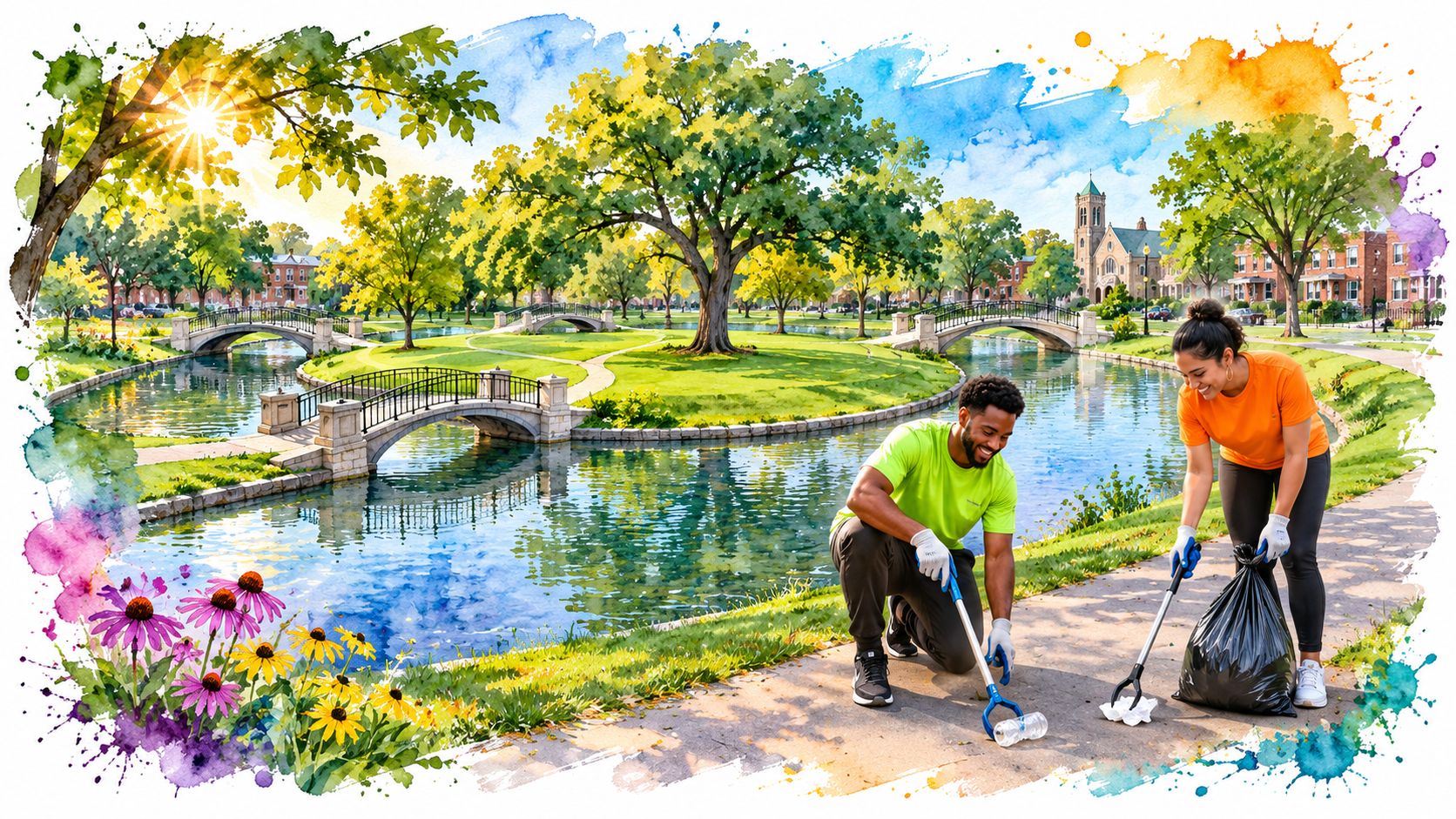
You've got a group chat with eleven names in it, a box of contractor bags in the trunk, and a Saturday morning that's supposed to mean something. Somebody typed "let's clean up Sherman Park" at 11 pm on Thursday. Now it's Friday night, and nobody in the thread knows where to park, which side of the lagoon to start on, or whether those four little bridges on the map lead anywhere a volunteer is allowed to walk.
I've stood at that same fork in the road. So I'd treat the park as a handful of separate work zones instead of one big green blob, pick one zone for the morning, and finish it before anybody wanders.
That's the walk I want to take you on. Lagoon edge first, then the bridges, then the island meadow in the middle, then the open ground. Along the way you'll learn which habitat to leave alone entirely and whether your gathering needs a permit before a single bag gets opened.
Sherman Park at a Glance and How It Was Built
Stand where the path bends around the water on a Saturday morning and the whole shape of the place shows up at once: a long lagoon looping back on itself, a meadow island in the middle with athletic fields on it, and four small bridges reaching across to carry you there. That's Sherman Park. The moment you see the loop, you stop thinking of it as one big park and start thinking of it as a set of places you can walk in order.
The ground under that path was wet and low. The South Park District bought the land in 1903, and the park opened to the public in 1905 as one of 10 neighborhood parks the Olmsted Brothers designed to bring recreation, social services and open space into dense immigrant and working-class neighborhoods, as the National Park Service entry for Sherman Park records. John Charles Olmsted drew the plan for the grounds. D.H. Burnham & Company designed the formal buildings. The name comes from John B. Sherman, a founder of the Union Stock Yards who sat on the South Park Commission for nearly 25 years.
Why the lagoon decides your route for you
Picture opening day. The park was dedicated on October 21, 1905, in front of more than 1,000 people, and the neighborhood went at it hard right away: during October 1905, before the swimming pool opened, 2,906 men and 855 women used the park's showers. People showed up for water, shade and company, and a century later they still do.
That lagoon is a closed loop that follows much of the park's rectangular perimeter and covers roughly two-thirds of the parkland. It wraps around an island meadow where the ball fields sit. Four pedestrian bridges connect the island to the rest of the park. For a cleanup crew, that geometry is a gift. The water pulls litter into a line you can walk, and the bridges give you a dry way into the middle without stepping onto a muddy bank.
A park with a loop in it is easier to clean than a park with no edges. Follow the water, cross at a bridge, finish one side before you start the next.
| Detail | What the park has |
|---|---|
| Location | New City community, Chicago's South Side |
| Size | 57.70 acres |
| Land acquired | 1903 by the South Park District |
| Opened to the public | 1905 |
| Designed by | Olmsted Brothers, with John Charles Olmsted leading the plan for the grounds |
| Formal buildings | D.H. Burnham & Company |
| Named for | John B. Sherman, a founder of the Union Stock Yards |
| Lagoon | Closed loop covering roughly two-thirds of the parkland |
| Pedestrian bridges to the island | Four |
| Natural area habitat | More than 17 acres of savanna, wet prairie, wetland and aquatic habitat |
Older descriptions put the park at about 60 acres. Plan with 57.70 acres, the figure the Chicago Park District publishes, because that's the size your bags, your grabbers and your crew hours have to cover.
One more thing worth knowing before you load the car: the water isn't decoration. It's the spine of the whole site, and every decision you make on Saturday, from which shoes you wear to where you stack full bags, comes back to how close you are to it.
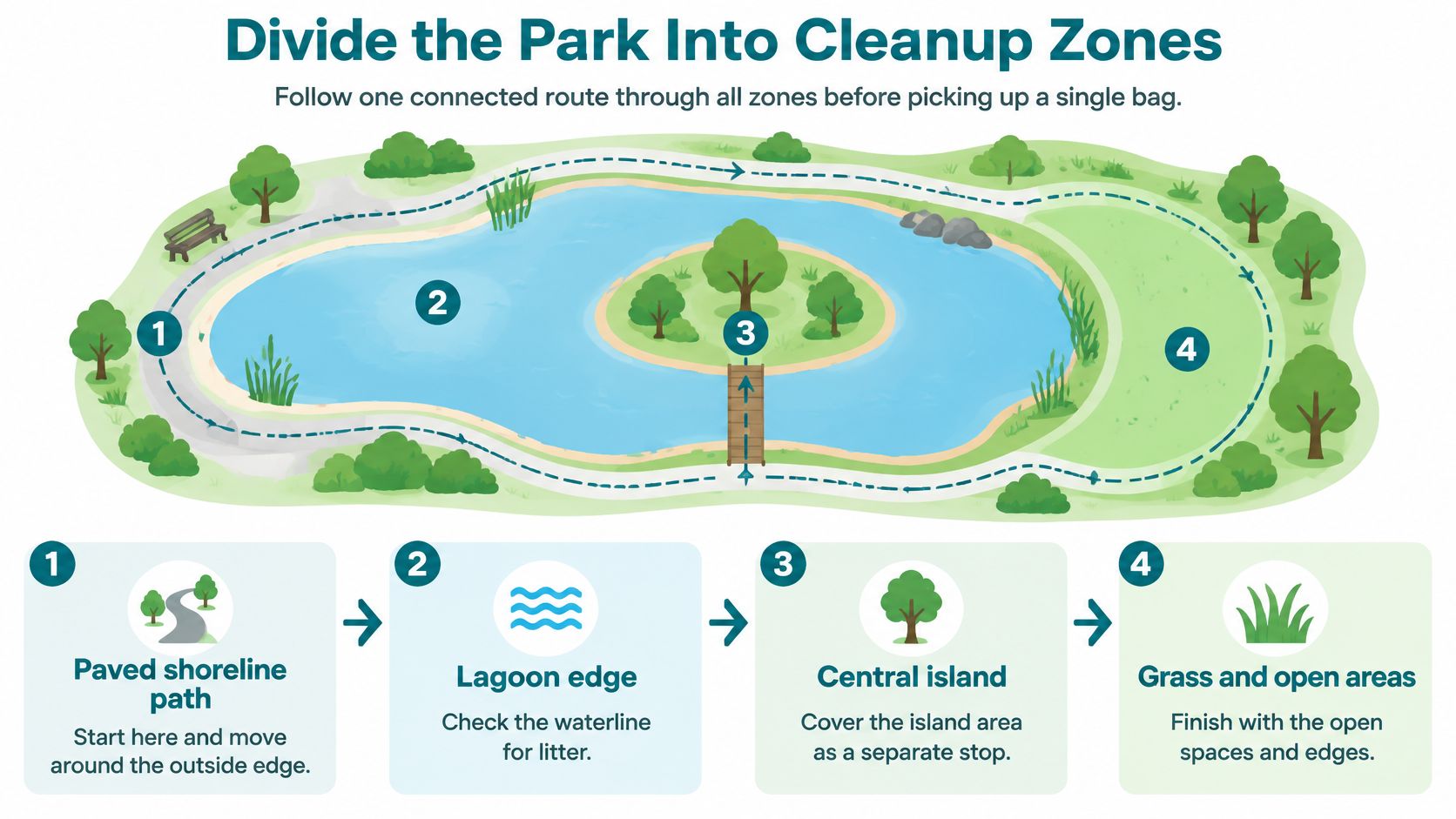
Divide the Park Into Cleanup Zones
Say a café owner, a Sunday running club and a family of four all show up ready to help. Give each group one piece of Sherman Park, and the morning feels manageable. Send them in every direction at once, and you get scattered bags, missed corners and a crew tired before the job is done.
The Chicago Park District describes Sherman Park as a 57.70-acre site whose low, wet ground the Olmsted Brothers reshaped around a meandering, closed-loop lagoon running parallel to the rectangular boundaries. The water covers roughly two-thirds of the parkland, per the Chicago Park District park page. That shape gives a cleanup crew clear zones: the lagoon, the bridges, the island, the athletic fields and the vehicular loop. Treat each one as its own small act of care for the city.
Walk the zones in the order a crew reaches them
Start at the lagoon from the paved shoreline path. It is the easiest ground and the quickest visible win. Walk the outside edge, pick up cans, bottles and wrappers, then stack full bags well back from the water. Keep the lagoon itself separate in your mind from the path beside it. The shoreline is where bags go. The waterline is where you reach carefully with a grabber and leave unstable banks alone.
Move next to the bridges. The four pedestrian crossings give you dry access to the island, and litter often gathers at approaches, railings and steps. Brush debris off stone and decking rather than scraping at historic surfaces. Keep your body and your bags away from the water edge while you work.
On the island, use the soft trails ringing the meadow as your boundary. The athletic fields sit inside, so give active play room and collect only what your zone covers. Treat the island as a full stop, not a shortcut back to the mainland. Once a crew steps onto it, the same path should carry them through the work and back out.
Finish with the vehicular loop, where the litter line follows traffic rather than water. Work from the edge, keep clear of lanes and let one person watch for cars while the rest collect bottles, cups and food wrappers. This zone asks for patience. A full bag beside a moving lane is a small hazard, so choose a staging spot before the first wrapper goes in.
Read the ground rules aloud with the group before the shift, then point to the zone map and confirm where bags will sit. A crew that knows the lagoon, bridges and island as separate places will waste less time deciding where to step and more time lifting litter. Read the volunteer safety checklist together before anyone spreads out, so the rules are spoken plainly rather than assumed.
| Zone | Usual litter | Access rule |
|---|---|---|
| Paved shoreline path | Cans, bottles, wrappers | Collect from the path and keep full bags away from the water |
| Four pedestrian bridges | Cups, bags, small litter | Work from the approaches and stay off the water edge |
| Island trails and athletic fields | Bottles, cans, bagged trash | Stay on designated trails and keep clear of active play |
| Vehicular loop | Bottles, cups, food wrappers | Work from the edge and keep clear of traffic lanes |
| Natural area | Plastics, fishing line, cans | Follow the habitat rules in the next section |
Give each crew one zone per shift and let them finish it. A finished lagoon edge, bridge approach or island trail gives the next group a clean place to begin. Four half-cleared zones leave everyone carrying the same job into another week.
Protect the Natural Area While You Pick Up
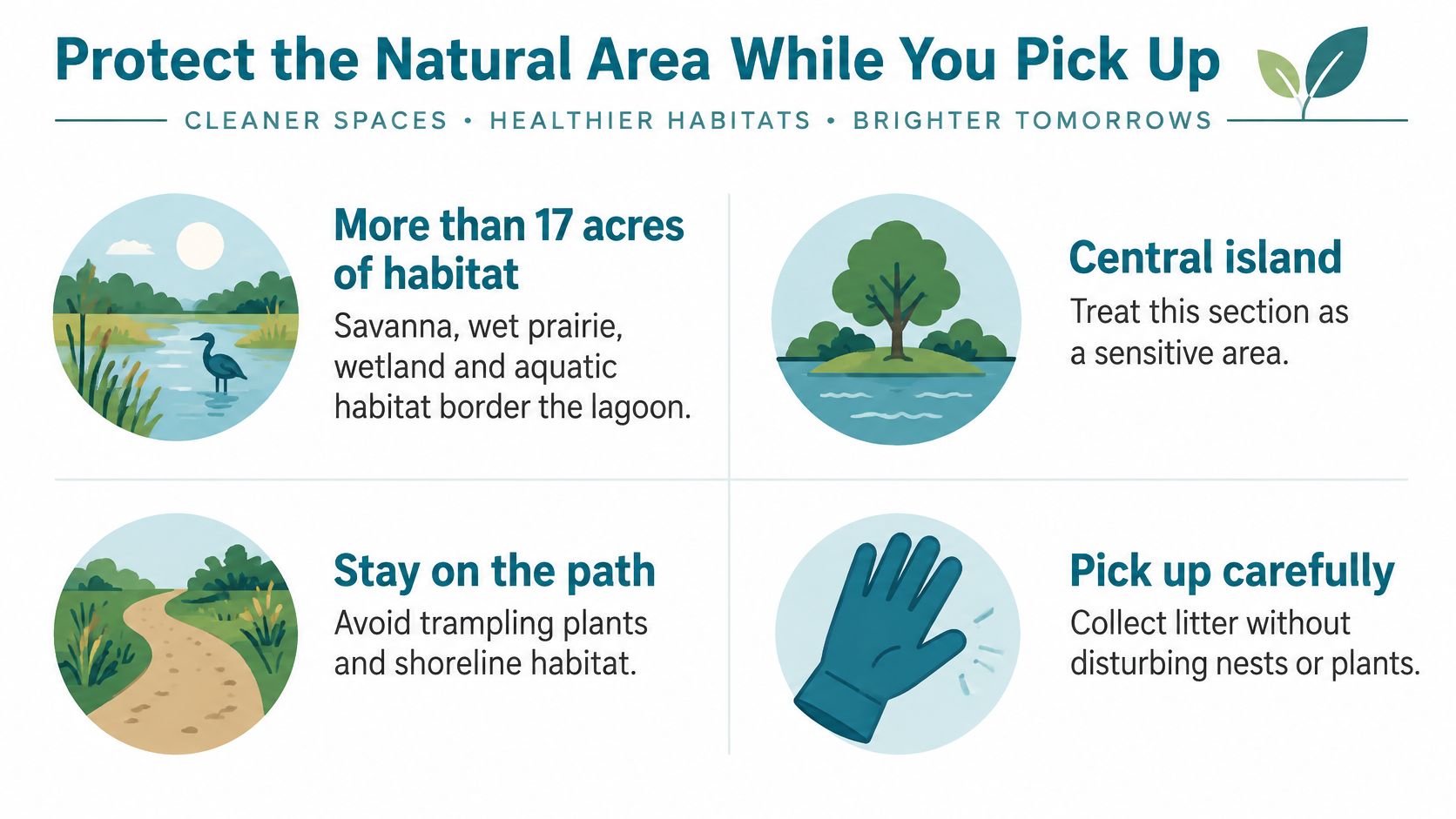
Walk to the island's edge and look down. That tangle in the grass is fishing line, and it's the reason the natural area gets its own set of rules. The Sherman Park Natural Area holds more than 17 acres of savanna, wet prairie, wetland and aquatic habitat bordering the lagoon, including a large section on the central island, per the Chicago Park District natural area page. A paved path runs around the exterior shoreline, soft trails ring the island, and the four bridges carry you in.
That mix changes the order of work. Plastics, fishing line and cans come out first, before they can break into fragments or trap wildlife. Everything else waits.
Seven rules, each with the reason behind it
- Wear puncture-resistant gloves. Thin cotton lets a broken bottle edge straight through to your palm.
- Stay on designated paths. Wet prairie and savanna plants don't bounce back from foot traffic, and a shortcut costs more than it saves.
- Use long-handled tools near water. Skip the lagoon and unstable banks entirely; a grabber reaches what your arm shouldn't.
- Separate sharp objects and anything questionable. Keep them in their own container so the person tying the bag isn't surprised.
- Report unusual dumping instead of touching it. Photograph it, note the spot, and hand it to park authorities.
- Leave the plants and nests alone. No pulling vegetation, no stepping into nesting areas.
- Keep full bags off the waterline. Wind and runoff will put your work right back in the lagoon.
Rule that saves a whole bag: if you can't reach it from stable ground, it stays where it is and goes on the report list.
Before every shift, run a gear check out loud: gloves, grabber, bags, closed-toe shoes, water bottle, phone for photos. If you want to go further than one Saturday, these practical tips to cut plastic waste tackle the litter upstream of the bag, and this guide to managing what you collect explains where the bags go once they leave your hands.
When a Cleanup Needs a Permit
Think of the Chicago Park District permit rule as a gate with two handles. Group size turns one handle. Equipment turns the other. Either one opens it.
The Chicago Park District permit rules require a Special Event Permit for an outdoor activity involving 50 or more people. The same requirement lands on smaller events that add amplified sound, tents or canopies, stages, generators, animals, merchandise sales, food distribution, exercise classes, drones, or a guaranteed reservation of space. An ordinary gathering of 49 or fewer can use an outdoor facility nobody has rented, but only when it skips every item on that list.
Three crews, three answers
Say your group chat turns into 30 people and someone offers to bring a portable loudspeaker for the safety briefing. That speaker is amplified sound, so the crew needs a Special Event Permit even at 30.
Change the scenario. 45 volunteers show up, no speaker, no vendors, but August in Chicago means somebody brings a shade canopy. A tent opens the gate too, so that crew needs a permit as well.
Now the third version. 40 people, gloves, bags and a clipboard for sign-in. Nothing on the list, nobody has rented the space, and the crew doesn't need an application at all.
Check before you post: count heads, list the gear, read the table. A permit question is cheap to settle on Wednesday and miserable to settle at 9 am on Saturday with thirty people already standing there.
| Group size or setup | Required approval | Who issues it |
|---|---|---|
| 49 or fewer, no listed items, unreserved space | No application needed | None |
| 50 or more people, any outdoor activity | Special Event Permit | Chicago Park District |
| Under 50 with any listed item | Special Event Permit | Chicago Park District |
| Under 50 reserving a Park District facility | Written application | Park or playground supervisor |
Two numbers do most of the work here: 50 people and 49 people. Count once, count again, and post the honest number in your meetup listing. If your planning lives on an events page, the community cleanup events playbook covers how to write a listing people can follow, headcount and all.
Reserve Space and Plan Bigger Gatherings
An open field isn't yours just because your crew got there first. Chicago's park code sends anyone who wants a Park District facility for fewer than 50 people, with none of the special features, into a separate written process, per the Chicago Park District permit application form. You apply in writing to the park or playground supervisor at that location, on the form and timeline that supervisor sets.
The practical version looks like this:
- Lock down your headcount and write out every piece of equipment you plan to bring.
- Call the park or playground supervisor at Sherman Park and ask what they need from you.
- Submit the written application on the required form.
- Wait for the timeline the supervisor gives you before you advertise a fixed meeting spot.
Do the fourth step before the second post goes out. A volunteer group that announces "we'll be at the north field at 9" and then learns the field is spoken for has to unwind the whole message.
The big-event track and its separate approvals
Scale up and the requirements change shape. Any event with 10,000 or more people attending per day needs added community-engagement steps and approval from the Park District Board, according to the Chicago Park District event application. Equipment carries its own approvals: drones must follow Federal Aviation Administration Part 107 rules and be flown by a licensed, certified FAA pilot, tents or canopies larger than 400 square feet need a permit from Chicago's Department of Buildings, and portable toilets must sit on a hard surface such as asphalt, concrete or plywood, appear on the site map, and get Park District approval before delivery.
Notice what those three items have in common. Shade, sanitation and aerial footage all turn into their own approval tracks, separate from the headcount question. Sort them early.
Pick Your First Cleanup Day at Sherman Park
Say you have a free Saturday morning, three friends and a pair of gloves each. This is the version of the guide you can act on tonight.
Pick one zone and one date. Pull up the cleanup zone table, choose the paved shoreline path if this is your first shift, and put a Saturday on the calendar. The path gives you the shortest walk back to your car and the clearest view of where the litter is.
Count your people and your gear. If you are organizing your own crew, run your headcount against the permit table before you post anything. That one check keeps a good morning from turning into a conversation with a park supervisor.
Find a pickup and sign up. Litter Caterpillars runs volunteer trash pickups across the city and posts upcoming events and sign-up details on its site and in its group chats. Walking a route with people who have done it in a blizzard teaches a first-timer more in one morning than a checklist can.
Litter Caterpillars is the boldest trash pickup group in Chicago, and the first and only trash pickup group to clean up all 50 wards, including the ones people were told to stay away from. The group is also building Caterpillar Park in Englewood on an empty lot it won at auction.
Bring the right kit. Gloves, bags, a long-handled grabber and closed-toe shoes. Leave the water's edge to the grabber, and leave anything you cannot reach from stable ground on the report list.
If your crew grows past a dozen and you want everyone visible in the same shirt, this guide to bulk tee ordering for event staff covers sizes, timelines and the details that trip up a last-minute order.
Finish the zone. One shift cleans one zone. Leave it cleaner than you found it, take a photo of the full bags, and pick the next zone before you leave the park, while you still remember which corner had the worst of it.
Litter Caterpillars runs volunteer trash pickups every week in Chicago, in heat and in hail, on weekend mornings built for people who want to show up and give. Come out for a single shift and you will leave with a cleaner stretch of shoreline and a few new friends who come back the next Saturday too. Find the next pickup and sign up at Litter Caterpillars.