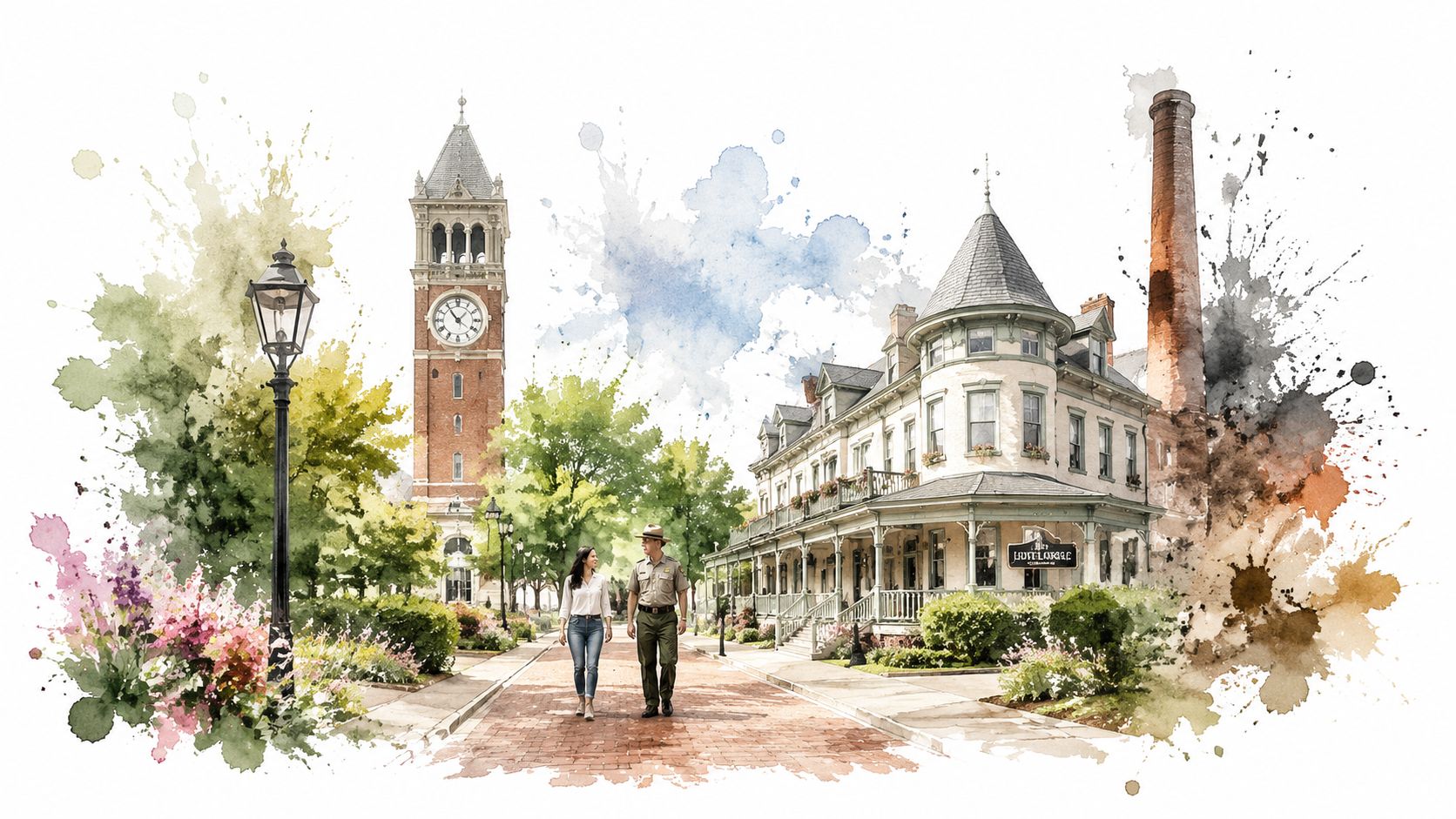
I turned a corner near 111th Street and felt that strange Chicago feeling where a block starts talking back to you. Brick rows, old factory bones, and quiet streets made me slow down and pay attention.
More Than a Monument It Is a Chicago Story
A few Saturdays ago, I watched a first-time visitor stop in the middle of Pullman and go quiet. Kids were riding bikes past red-brick homes. A neighbor was sweeping a front walk. The old industrial buildings stood in the background like they still had something to say. That mix is what gets me every time. Pullman does not sit in Chicago like a relic under glass. It lives as a neighborhood where history keeps bumping into ordinary life.
That is why Pullman grabbed me so hard the first time I came through with a coffee in one hand and cleanup gloves in the other. The National Park Service recognizes it as Chicago's national historical park, but the title only gets you so far. The full story shows up on the street, in the preserved architecture, in the homes that are still occupied, and in the long shadow of work, power, and organizing that shaped this part of the South Side.
I run a volunteer group that spends time in places people too often pass by. We pick up litter, talk to neighbors, and learn a block by walking it slowly. Pullman fits that ethic perfectly. You can come for the history and leave with a sharper sense of what community care looks like when real people keep showing up for a place.
That is what makes this park feel personal to me. The streets raise questions Chicago has been asking for generations.
- Who gets to shape a neighborhood
- What happens when too much control sits with too few people
- How a community protects its story while still living its daily life
I often tell friends to pair Pullman with other Chicago neighborhoods to explore, because the comparison teaches you something. In one part of the city, the story sits in a mural or a corner store. In Pullman, it sits in the bricks, the rail legacy, the worker housing, and the community memory that still holds the whole place together.
Pullman changed the way I think about public history. A monument asks for your attention. This neighborhood asks for your participation. Walk it, listen well, and you start to see that the lesson is not only about the past. It is about what kind of city we want to care for right now.
The Story of the Town Pullman Built
The first time I walked these blocks with the company-town history in mind, one detail stayed with me. The homes are handsome. The streets feel orderly. You can still sense why a working family in the late 1800s might have looked around and thought, at least on day one, that this place offered dignity.
Then you learn who held the reins.
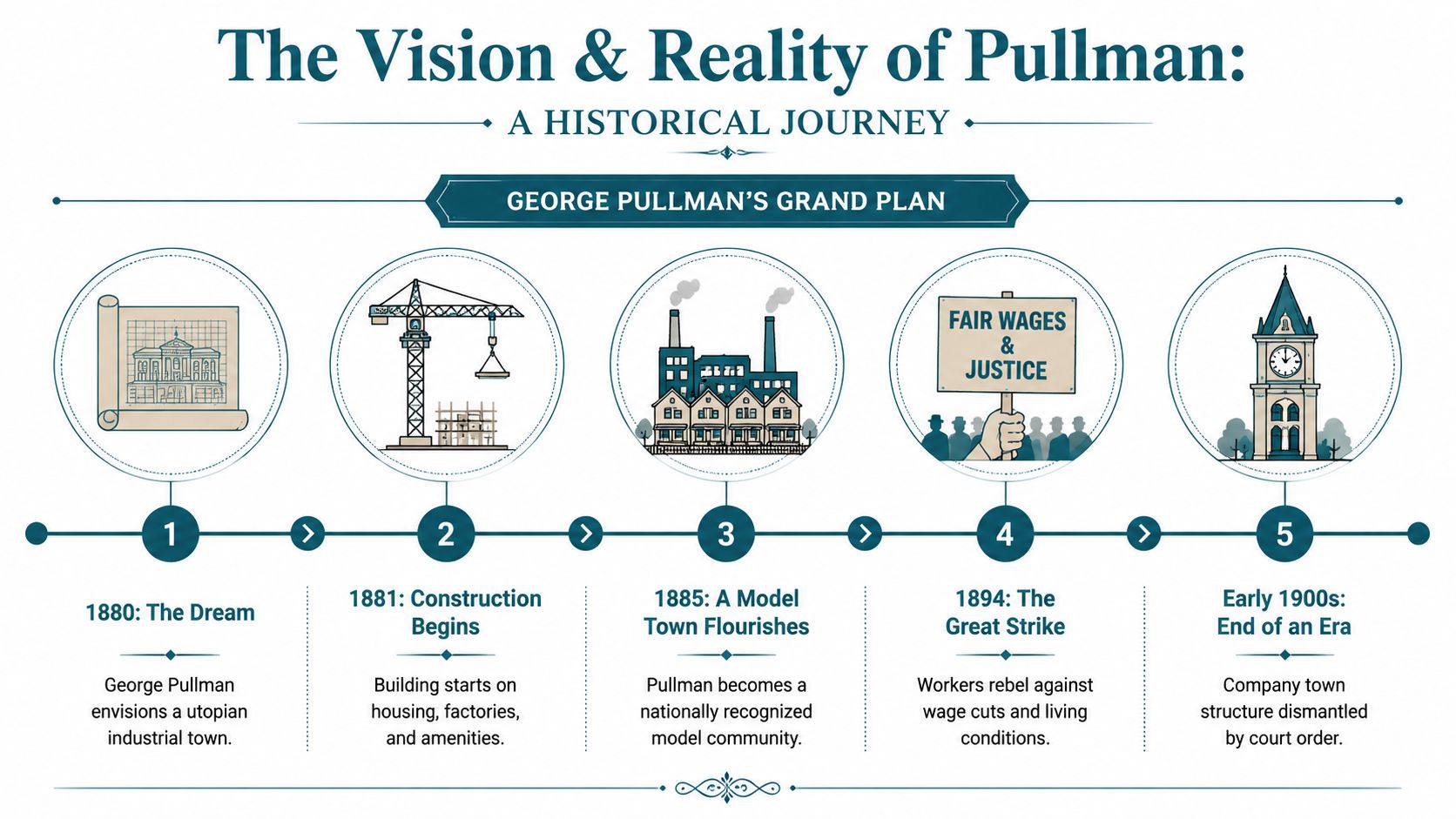
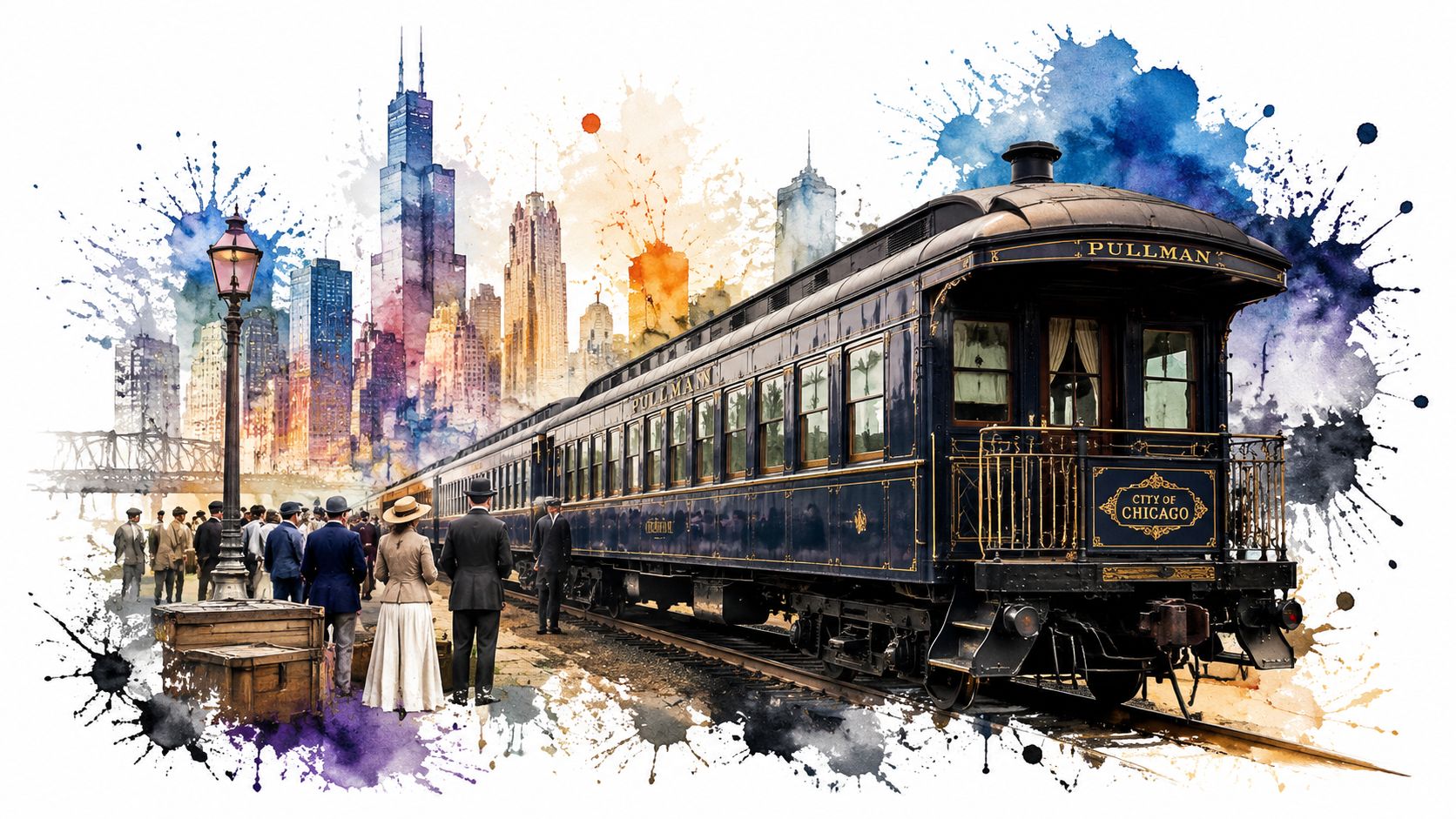
George Pullman built the neighborhood around his railcar business with a clear vision of how workers should live. Brick row houses, shared green space, civic buildings, and factory life were tied together in one planned community. From the outside, it could look generous, even enlightened compared with the rougher industrial districts of its time.
On the ground, the story gets more complicated.
A beautiful block does not automatically mean a fair one. Workers lived in a town shaped by company priorities, company rules, and company power. The same design that made Pullman feel orderly also limited how much control residents had over daily life. That tension is part of what makes a walk here feel alive. You are not just looking at architecture. You are standing inside a debate about work, housing, and who gets to decide what a good community looks like.
I often picture an ordinary evening here. Someone comes home tired from the factory, steps onto a clean street, then sits at the table to make hard choices about rent, food, and family needs. That is the part of Pullman that stays with me. History is not only in the grand plans of industrialists. It is in the private math of households trying to hold themselves together.
The conflict that followed gave Pullman its sharpest lesson. Workers resisted the imbalance built into the system, and the Pullman strike turned this neighborhood into one of the defining labor stories in the country. When I stand near the old industrial spaces, I do not think first about dates in a textbook. I think about people gathering, arguing, risking income, and asking for a measure of dignity that the town's design could not provide on its own.
That is why Pullman matters as more than a preserved historic district. It shows how a neighborhood can be carefully built and still fail its people if power only runs one way.
It also shows something hopeful. Residents, preservationists, organizers, and neighbors kept this story from being flattened into a neat company legend. They protected the buildings, yes, but they also protected the harder questions. That part means a lot to me as someone who believes places improve when regular people care for them together, the same spirit that drives groups like Litter Caterpillars to treat streets and public spaces as shared responsibilities.
Three questions from Pullman still feel close to home:
| Question raised here | Why it still matters |
|---|---|
| Who has power at work | People still fight for fair pay, stability, and respect on the job |
| What makes housing just | Neighborhood change still tests who gets security and who gets pushed aside |
| How do neighbors act together | Communities still rely on solidarity when formal systems fall short |
Pullman stays with you because it never resolves into a simple moral. It is a story about vision, control, resistance, and community memory, all on the same set of blocks. Walk slowly enough, and the lesson becomes clear. A neighborhood is not defined only by what gets built. It is defined by whether people who live there can shape its future together.
Your First Visit to Pullman National Historical Park
The best way to start is simple. Go to the visitor center at 610 E. 111th Street, Chicago, IL 60628, which is open daily from 9:00 a.m. to 5:00 p.m., according to the Pullman visitor center listing.
I like starting there because a neighborhood park can feel confusing at first. If you expect one big gate and one obvious route, Pullman may throw you off. The visitor center helps you get your footing.
What to do when you arrive
Walk in, slow down, and let yourself orient. You don't need a perfect plan before you step through the door. That's the whole point of beginning here.
A first visit works well when you do these things:
- Check the exhibits first. They help you connect the buildings outside to the people who lived and worked here.
- Ask for self-guided materials. That gives you a path once you step back outside.
- Look at the district as a neighborhood, not a single attraction. You're not done when you leave the building. You're just ready to start.
How I'd handle a first hour
If I brought you with me for your first visit, I wouldn't rush. I'd spend a little time inside, get the basic story straight, then head back outdoors with a loose plan. Pullman works best when you mix orientation with wandering.
Practical rule: Start indoors so the streets make sense later.
You don't need to memorize every detail. You just need enough context that the brick row houses, factory remains, and nearby institutions stop being anonymous. Once that clicks, the whole district opens up.
A good first-timer mindset
Treat your visit like meeting a person for coffee, not like cramming for an exam. Stay curious. Let a few buildings pull your attention. Read some signs. Skip others. Sit for a minute if you need to.
Here's the part many guides miss. You're not just visiting a building with historic objects inside. You're entering a public place where the story spreads across streets, corners, and everyday life. That shift matters. Once you understand it, Pullman gets much easier and much more rewarding.
Planning Your Trip Itineraries and Tips
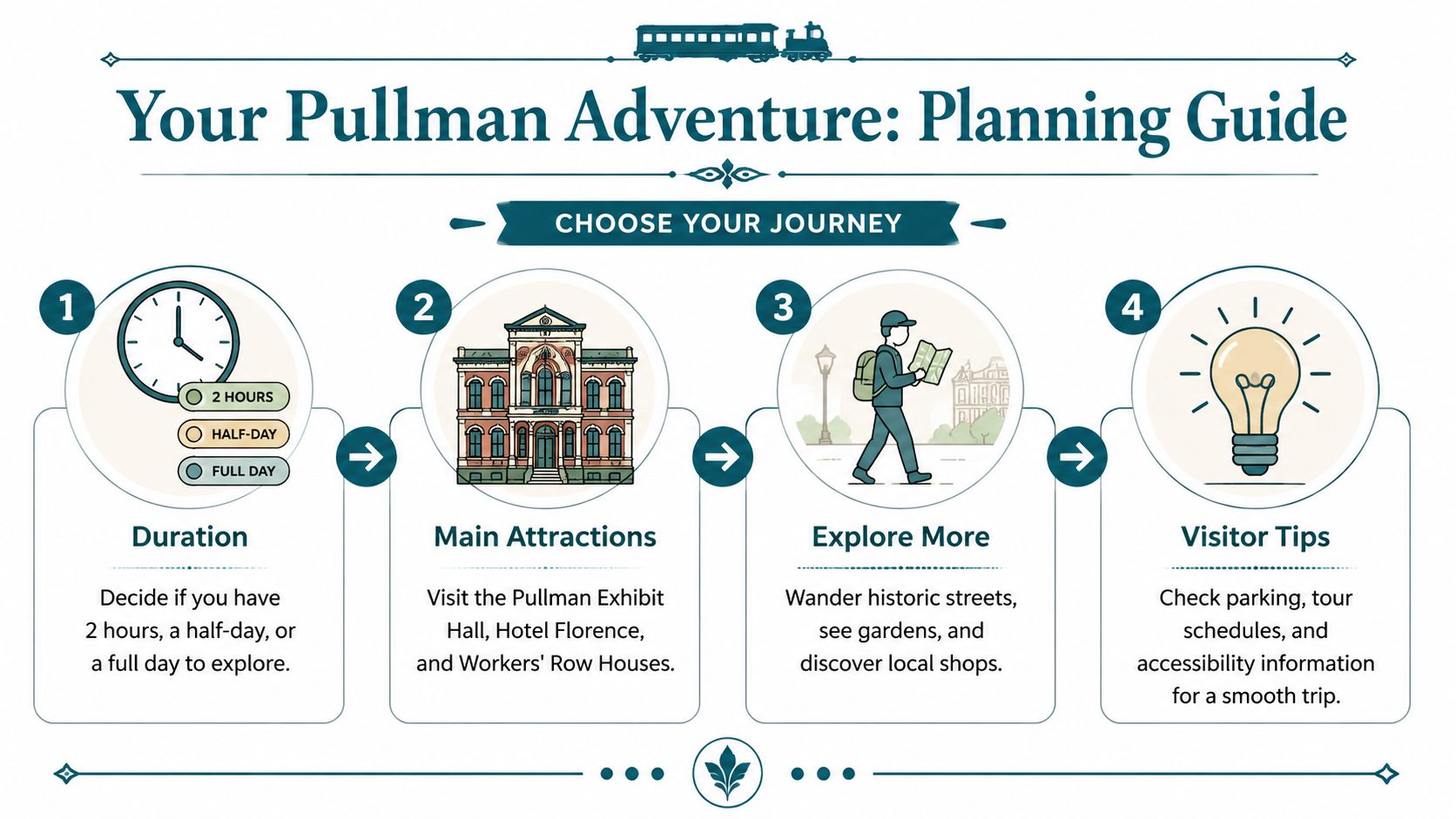
One thing I like about Pullman is that you can shape the day around your energy. If you have a short window, you can still get a real feel for the place. If you have a relaxed afternoon, the neighborhood gives you room to wander.
The park grounds are open dawn to dusk, which means you can explore the historic area as public space even outside visitor center hours, according to the National Park Foundation park page. That changes how I plan a trip. I don't think of Pullman as a single timed attraction. I think of it as a walkable field trip.
If you only have a short visit
A shorter outing works well if you want a clean, focused experience.
- Start at the visitor center. Ground yourself before you roam.
- Walk a few nearby blocks. Let the neighborhood scale sink in.
- Pick two or three stops, not everything. Pullman gets better when you move slowly enough to notice details.
I've found that a compressed visit still feels satisfying if you avoid checklist mode. This isn't the kind of place where speed makes you feel accomplished. Speed makes you miss the point.
If you have a half day
A half day is my favorite rhythm for Pullman. You can settle in without turning it into a marathon.
Here's a simple way to do it:
| Time shape | What I'd do |
|---|---|
| Early part | Begin at the visitor center and get oriented |
| Middle stretch | Walk the historic streets and stop at the major sites that catch your eye |
| Final stretch | Sit, reflect, grab food nearby, and take one more pass through the neighborhood |
If you enjoy city walking, you might also like these self-guided Chicago walking tours. Pullman fits that style well because the streets themselves carry so much of the experience.
Local mindset for getting there
I like using transit when I can because it changes the pace of the day. You arrive on the city's terms, not in a sealed bubble. But driving can make sense too, especially if you're visiting with family or anyone who wants fewer transitions.
A few practical tips help:
- Wear walking shoes. The best part of Pullman happens on foot.
- Bring water. Historic curiosity doesn't cancel out basic comfort.
- Plan food loosely. I'd rather leave space to notice a local option than lock myself into a rigid schedule.
Pullman rewards the visitor who leaves room for one extra block, one extra corner, one extra pause.
That's how I'd do it. Give yourself structure, then let the place interrupt you a little.
Walk Through History Key Sites to See
The visitor center gives you the map. The streets give you the feeling. Pullman's essence comes to life.
I always tell friends to stop trying to “cover” Pullman and instead let each site act like a chapter. Some chapters are about work. Some are about class. Some are about Black labor history. Together they make the district feel layered, not flat.
The factory grounds and the clock tower
The factory area hits me first because it makes labor feel physical. You don't have to stretch your imagination very far. You can almost hear the churn of production and the movement of workers coming and going.
The clock tower pulls your eye because clocks always do that in old industrial places. They remind you that work once ruled the day down to the minute. I stand there and think about how different time feels depending on who controls it. For an owner, time can look like efficiency. For a worker, time can feel like pressure.
Hotel Florence
Hotel Florence tells a different kind of story. This building lets you think about status, taste, and the social rules of the town. I like places like this because they show that power isn't only in the factory. It's also in the spaces where respectability gets performed.
Walk around it and you can feel that Pullman wasn't built only to produce railcars. It was built to project an idea of order. That idea reached into daily life. It touched how people lived, where they gathered, and what kind of behavior fit the town's image.
Some buildings tell you what happened. Others tell you what people wanted the world to look like.
Hotel Florence does both.
The A. Philip Randolph Museum
Then there's the A. Philip Randolph Museum, which changes the emotional temperature of the visit. If the factory grounds make you think about labor under pressure, this site makes you think about labor organizing, dignity, and Black workers refusing to stay invisible.
I always slow down here.
The museum adds a chapter that many first-time visitors need. Pullman is not only about one strike in one year. It's also about the lives of Black railroad workers and the push for fair treatment. That part of the story gives the neighborhood a different voice. More determined. More personal.
How I'd walk it
If you want a simple field route, I'd do it this way:
- Begin with the clock tower area so the scale of the industrial site clicks.
- Move to the residential streets and pay attention to repetition, design, and how the homes sit together.
- Pause at Hotel Florence and think about who the town was meant to impress.
- End with the A. Philip Randolph Museum when you're ready for the labor story to deepen.
That order works for me because it moves from structure to people. From the company's view of the town to the people who had to live and work inside it.
From History to Action Get Involved in the Community
The thing I love most about Pullman is that it doesn't leave me in spectator mode for very long. After a while, standing around and admiring old brick starts to feel incomplete. A place with this much history pushes me toward a simple question. What am I going to do for the neighborhoods I care about now?
That's where service comes in. Pullman is still a lived-in area. Since becoming a national park, the area has seen hundreds of millions of dollars in investment, according to a Pullman House Project video about the neighborhood today. I don't hear that and think, great, problem solved. I think, then this is exactly when ordinary people need to stay involved.
Small acts change how a place feels
If you care about Pullman, you don't need to arrive with a grand theory. Start small and stay consistent.
- Join a cleanup if one is happening nearby. A public place feels different when people care for it with their hands.
- Support preservation-minded community work. Attention matters. Presence matters.
- Walk respectfully and spend locally when you visit. Neighborhood care isn't abstract.
I believe service is one of the best ways to understand a place. You can read about labor solidarity all day, but picking up litter with other people teaches a related lesson fast. Shared effort changes strangers into teammates.
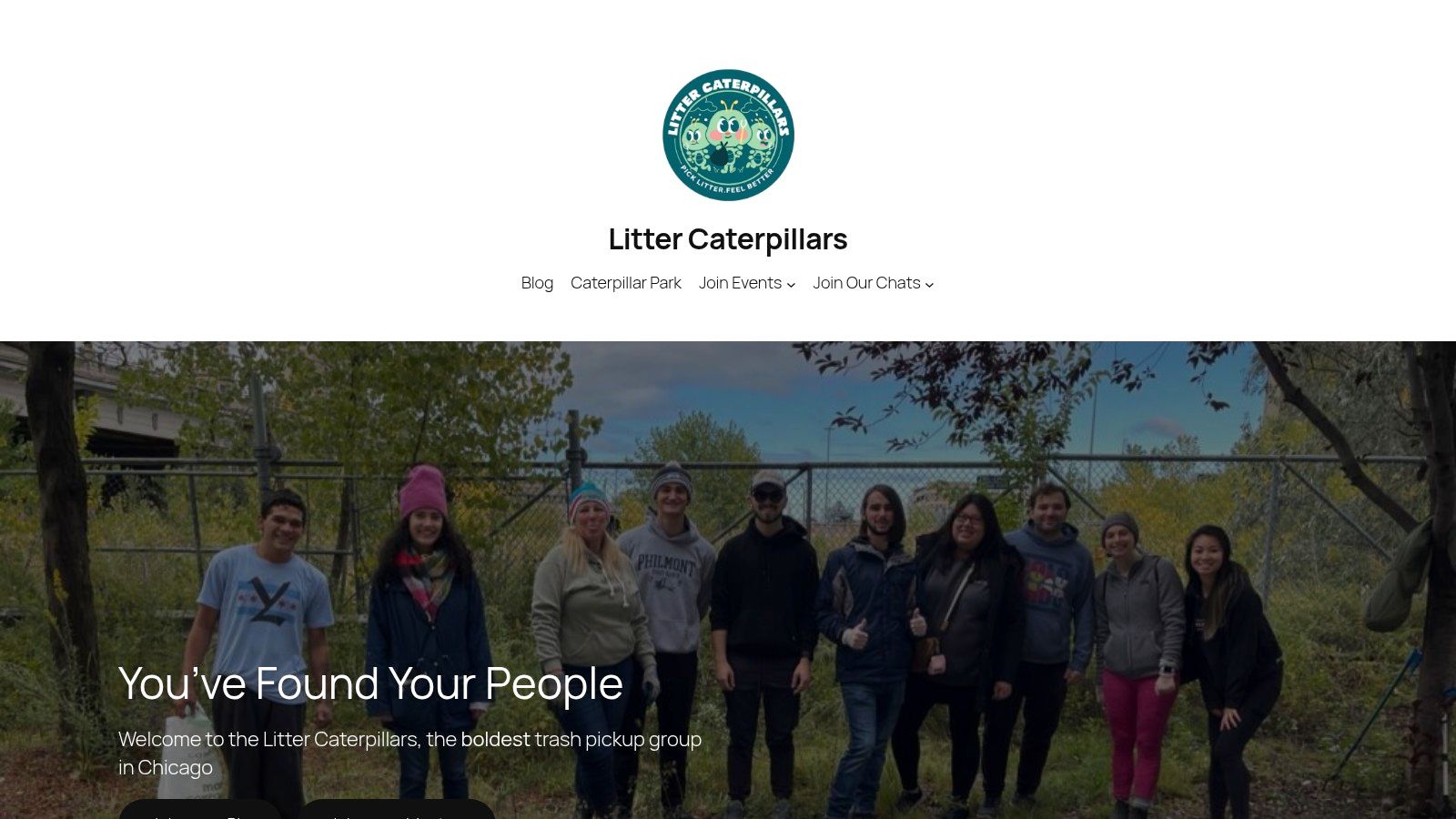
One option is to look at community engagement strategies that turn good intentions into regular action. Another is to join a local volunteer event when one is scheduled. For example, Litter Caterpillars has done cleanup activity at the Pullman National Historical Park Visitor Center with the National Park Service's Trash Trekkers program.
Care is a way of reading the city
I want to show you a piece of that spirit in motion.
When people sweep, plant, pick up trash, or help maintain public space, they aren't doing side work beneath the “real” story. They are writing the current chapter. That matters in Pullman because the neighborhood has always been about how people live together under shared conditions.
My rule for any historic district: leave it a little better than you found it, even if all you can give is attention, respect, and one hour of work.
That's the bridge for me. History becomes action when you stop asking only what happened here and start asking what care looks like here now.
Your City Is Waiting for You
Pullman stays with me because it asks for more than curiosity. It asks for honesty. When you walk those streets, you start thinking about work, fairness, housing, memory, and what neighbors owe each other. Then you leave and those questions follow you home.
I think that's a gift.
You don't need to become a historian to feel something at Pullman National Historical Park. You just need to show up ready to notice. Notice the brickwork. Notice the scale of the old company town. Notice how a neighborhood can carry conflict and care at the same time. Then notice your own block with that same level of attention.
Chicago gets better when more of us do that.
I've learned this through cleanup mornings, long walks, and conversations with people who love their neighborhoods in practical ways. The city opens up when you stop waiting for polished invitations. You pick a place. You go. You listen. Maybe you help. Then you come back different.
Pullman is a good place to begin that habit.
Go for the history if that's what pulls you in. Go for the architecture. Go because you want a thoughtful afternoon on the South Side. But once you're there, let the visit push you one step further. Join something. Care for something. Learn one neighborhood thoroughly enough that it stops being “somewhere else.”
Your city isn't finished. That's the exciting part. It still needs hands, eyes, patience, and people who are willing to love it in public.
If you want a hands-on way to explore Chicago while caring for it, take a look at Litter Caterpillars. It's a volunteer group that organizes neighborhood cleanups across the city and gives people a simple way to show up, meet others, and do real work together.