

Beating your fear of failure isn't some dramatic, life-altering leap of faith. It's more like a small, stubborn step forward. You've got to learn to take action even when that voice in your head screams about all the ways you could mess up. I want you to start seeing failure as just a part of the learning process, a way to build your confidence through small, low-risk challenges.
Confronting the Inner Critic Holding You Back
You know that voice. I know it. We all have it. It’s the one that whispers, "What if you fail?" the moment you stumble upon a brilliant new idea. I'm intimately familiar with that voice—it’s like a terrible roommate who delights in pointing out every single worst-case scenario, transforming a spark of excitement into a roaring fire of anxiety.
For me, overcoming this fear wasn't about a grand career change or a terrifying public speaking gig. It started with the disaster zone that was my own apartment after a messy relationship finally imploded.

When Your Own Mess Feels Unmovable
Every single piece of trash felt like a monument to a past failure, a physical anchor holding me in place. An old jar of jam from a trip four years ago. A bag of nuts from a health kick I abandoned. Each item weighed almost nothing, but to me, they were 500-pound anchors of regret and inaction. I was completely paralyzed, trapped in a shame spiral that made even thinking about cleaning my own space feel like an impossible mountain to climb.
This feeling is universal, even if your "mess" looks different. It's the exact same fear that holds you back from:
- Finally applying for that dream job you’re almost qualified for.
- Starting that creative project you've been daydreaming about for years.
- Just showing up to a local volunteer group like ours where you don't know a single soul.
That inner critic loves to make you feel isolated, convincing you that you’re the only one who feels this way. It tells you that even trying is a risk, because you might just confirm your deepest fear: that you’re not good enough.
The Turning Point Is Outside Yourself
I hit a breaking point that forced me to face the very things I was terrified of: consistency, action, and bravery. I couldn't handle my own mess, so I started with someone else's. I decided to go pick up litter in a public park. Imagine the stakes: they couldn't have been lower, but the act itself felt monumental. It was a physical, tangible way of moving forward—of cleaning up one small corner of the world when my own felt too chaotic to touch.
That simple act changed everything. It quieted my inner critic because my focus was on something external. I wasn't trying to "fix my life." I was just picking up a bottle. I was learning, in real-time, that this is how real change happens: one simple action, repeated. Figuring out what drives you is a huge part of this journey, and you can learn more about intrinsic motivation in our guide.
I realized something profound: cleaning other people's messes is way easier than cleaning up your own. It gives you a win when you desperately need one, building the momentum you can bring back into your own life.
This is the very first step you can take to get over the fear of failure. It's not about shutting that critic up for good. It's about finding an action so simple, so external, that you can do it in spite of that voice. It’s about just showing up.
Why 'Just Do It' Is the Worst Advice for Fear
Have you ever been totally frozen by fear, only for some well-meaning person to chirp, “Just do it!”? It’s supposed to be a kick in the pants, but honestly, it lands more like a slap in the face.
Telling someone you've paralyzed by the fear of failure to "just do it" is like telling someone caught in a Chicago blizzard to "just get warm." It's an instruction that completely misses the point, ignoring the crushing, invisible weight of the problem.
This isn't some minor personality quirk you can just power through. It’s a massive, global barrier holding people back. In fact, this fear is so powerful it stops nearly half of all potential entrepreneurs before they even write a single line of a business plan.
And it’s gotten worse. The Global Entrepreneurship Monitor Global Report found the percentage of people who won't start a business because they’re afraid of failing recently jumped from 44% to 49%. That's a huge spike, and it shows you just how much uncertainty has crept into our thinking. You can dig into more of these entrepreneurial trends at phys.org.
Your Fear Is a Rational Response
So, let's get one thing straight. Your fear isn't a flaw. It’s often a completely rational response when the stakes feel sky-high. You’ve poured your time, your hopes, and maybe your life's savings into a dream. Of course the thought of it all falling apart is terrifying.
This is exactly why cleaning up someone else’s mess—like me picking up litter in a park—feels infinitely easier than tackling your own.
The stakes are beautifully, wonderfully low. There's no emotional baggage. It’s just a simple, direct action with a tangible win. You show up, you fill a bag with trash, and you leave feeling better than when you arrived. It's a powerful way to detach the action from the outcome.
A Hailstorm and a Huge Realization
I learned this firsthand during our very first Litter Caterpillars cleanup. There were only three of us, and we got ambushed by a ridiculous Chicago hailstorm. I’m talking ice pellets coming down sideways. We were huddled under a flimsy tree, shivering, watching every single rideshare driver cancel on us. It was, by all objective measures, a miserable situation.
But right there in that moment, something incredible happened.
I realized that struggling together, even over something as small and absurd as a hailstorm during a trash pickup, was incredibly empowering. It became a shared experience. A story.
It wasn't about succeeding or failing. It was about moving the story of my life forward. The cold, the hail, the frustration—it all just became another interesting page in the story. It advanced the plot.
This mindset shift is everything. When you’re facing a big, scary challenge, stop thinking of failure as the end of the book. It’s not. It’s just an unexpected plot twist. It's the part that makes your journey compelling and teaches you something vital for the chapters still to come. It’s what makes your story worth telling.
Finding Your Own 'Fence to Paint'
You know the story of Tom Sawyer, right? His aunt saddles him with the world's most boring chore: painting a giant fence. But instead of moping, he flips the script. Tom turns this punishment into the hottest ticket in town, so much so that his friends actually pay him for the privilege of doing his work.
That story holds a secret weapon for you to crush the fear of failure. You don't just muscle through a scary task. You completely change what it means.
This is all about finding your own fence to paint. It's about taking something that feels like a drag—or is downright terrifying—and building a new, powerful story around it.

Here at Litter Caterpillars, our "fence" is picking up trash. Let's be real, you and I both know nobody gets excited about grabbing soggy fast-food bags off the sidewalk. But we've intentionally reframed it. It’s not a chore; it’s a mission. We’ve turned it into a game of bravery and taking back our community.
Building Your Narrative of Purpose
So, how do you actually do this? You create little rituals and symbols that inject the action with meaning. For us, it’s things like flags, badges, and even our own theme song.
When you’re marching down a street with a flag, you’re suddenly not just a person picking up litter. You're part of a movement. You're a team on an adventure, and that feeling changes everything.
This isn't about pretending something isn't hard. It's about you wrapping your actions in a story of purpose. You're not just cleaning your junk drawer; you're creating order from chaos. You're not just signing up to volunteer; you're deciding to be someone who shows up.
This works because fear is so often shaped by the stories we're told. It’s fascinating, actually—your fear of failure looks totally different around the world. A World Economic Forum analysis found that the European Union has the highest fear of failure rate at a whopping 40.7%, while the United States is much lower at 29.66%.
By creating visible pride through symbols and just showing up, again and again, we prove that fear isn't your destiny. It's just an emotion you can reshape with others. You can dig into these cultural differences in fear of failure on weforum.org.
The key is to find a task with low stakes and imbue it with high purpose. This flips the script on your fear, turning a potential failure into a noble effort.
A Checklist to Find Your Fence
Ready to find your own fence? The goal is for you to pick one low-stakes thing you've been putting off and give it a new story.
- What's a small mess you can tackle? That pile of mail, the closet that exploded, the weeds taking over your garden bed.
- What's a simple new skill you can try? Learning one song on the ukulele. Trying that one recipe you saved months ago.
- What's a community act you can join? Signing up for one volunteer shift. Attending one local meeting.
Choose one. That's it. This isn't your magnum opus; it's your training ground. It's your fence.
Now, give it a new story. You’re not just “doing a chore.” You are practicing bravery.
Building Your Low-Stakes Bravery Lab
Here’s a secret I've learned: courage isn't something you’re born with. It's a muscle. And you don't build muscle by trying to bench-press 500 pounds on your first day at the gym, right? You start small. You get used to the feeling. You build strength in a safe space.
Tackling a fear of failure works the exact same way. You need your own personal “Bravery Lab”—a low-risk space where you can practice doing things that make you a little uncomfortable.
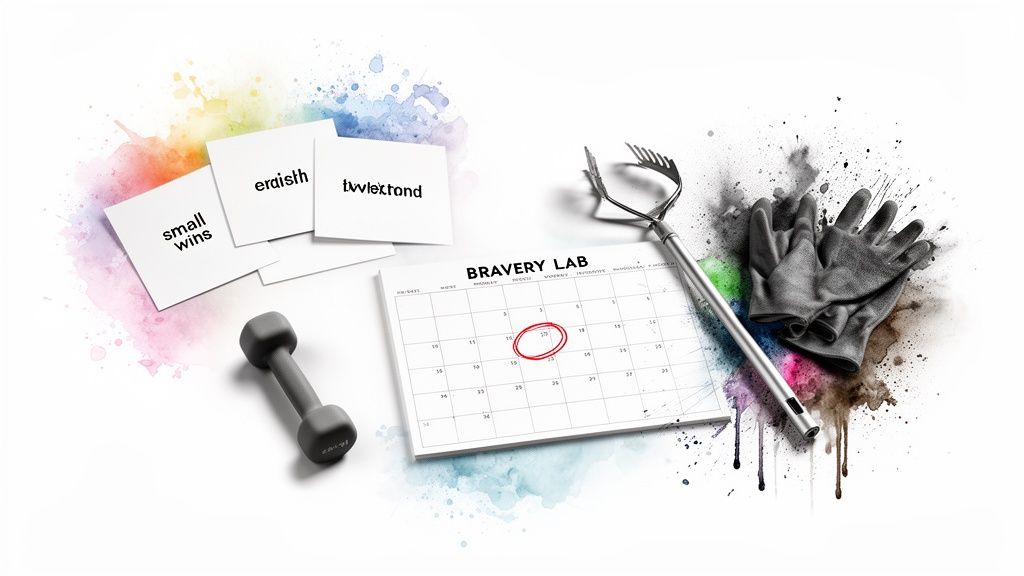
For us at Litter Caterpillars, every weekend cleanup is a Bravery Lab. The stakes are beautifully, wonderfully low. If you show up and pick up just one single piece of trash, you’ve succeeded. If you get caught in a Chicago downpour and have to bail, you didn't fail—you just left with a great story to tell.
This idea is so powerful because it separates your actions from some high-stakes outcome. Think about starting a business. The stakes are huge! Data from the U.S. Bureau of Labor Statistics shows a big chunk of new businesses don't make it past ten years, so that fear you might feel is totally rational. You can even read about how fear affects entrepreneurs at Harvard Business Review.
But picking up a bag of litter? The stakes are nearly zero.
Micro-Exposure Exercises to Rewire Your Brain
The whole point of this lab is to rack up small wins for yourself. These little victories teach your brain a new, crucial lesson: failure isn't fatal. It’s just feedback.
When our volunteers show up in negative wind chills, they're practicing the core skill that separates doers from dreamers: you take action even when it's uncomfortable.
You can do this in your own life with what I call micro-exposure exercises. These are tiny, intentional actions designed to push the edges of your comfort zone without sending you into a full-blown panic.
Let's break it down:
- The Fear: You're terrified of networking and talking to new people.
- The Big, Scary Action: Going to a massive industry conference all by yourself. (Yikes! Too much, too soon.)
- The Micro-Action: Tomorrow morning, make eye contact with the barista at the coffee shop and say "good morning."
That tiny action is your experiment. The risk is basically zero, but the psychological win is very real. You're collecting data that proves you can survive a moment of social risk. And you can.
Your First Week in the Bravery Lab
Ready to run a few experiments of your own? This is all about you taking small, manageable steps to build that courage muscle. Here’s a simple 5-day plan to get you started.
| Day | Micro-Action | Goal |
|---|---|---|
| 1 | Make eye contact with a cashier and give a genuine "thank you, have a good day." | Practice initiating a small, positive social interaction. |
| 2 | Ask for a recommendation at a bookstore or coffee shop, even if you don't plan to buy it. | Get comfortable asking for help or an opinion. |
| 3 | Wear an item of clothing you like but are slightly self-conscious about. | Survive a minor feeling of being "seen" and realize that nobody really noticed. |
| 4 | Take a different route on your commute or walk, just to see what happens. | Break a routine and embrace a tiny bit of the unknown. |
| 5 | Send a text to a friend you haven't spoken to in a while just to say "thinking of you!" | Overcome the small hesitation of reconnecting. |
Each action is a small rep. By the end of the week, you've completed a full workout and proven to yourself that you can handle these little moments of discomfort. You survived. You grew.
Scenarios for Your Next Experiments
Let's make this even more practical. Here are a few common fears and some lab-safe experiments you can try.
- If you fear being judged: Post an opinion on a social media story where replies are private. Maybe it's about your favorite pizza topping or a new movie. You get to express yourself without the pressure of a public comment section.
- If you fear rejection: Ask for a small thing that's easy to say "no" to. For example, ask a bookstore clerk if they have any spare promotional bookmarks. If they say no, you’ve just experienced a tiny, painless rejection. And look at that—you're perfectly fine.
- If you fear looking incompetent: Try a brand-new, slightly complicated recipe for dinner, but just for yourself. If it's a complete disaster, who cares? No one ever has to know. You just learned what not to do next time.
The victory isn't in the outcome; it's in the act of trying. Showing up is the win. This is how you build resilience.
By celebrating the simple act of showing up, you build the mental muscle you need for the bigger challenges. It's the exact same philosophy we bring when we team up with awesome organizations like the Care for Real food pantry. It’s all about taking that one brave first step.
How to Engineer Your Social Circle for Courage
Have you ever noticed how your mood completely flips depending on who you're around? Walk into a room of complainers, and suddenly you're spotting problems everywhere. But step into a group of people who are genuinely trying—people who are out there doing the work—and you feel a little braver yourself.
The people you spend time with are like the air you breathe; they shape your internal world, often without you even realizing it. I learned this the hard way. Years ago, I made a conscious choice to mindfully engineer my social circle to filter out selfish people, and it was a complete game-changer in my own journey. It’s about being intentional with your influences.
You have the power to curate your own personal team of courageous people.
Finding the Givers
Think about your social circle. Is it full of takers who just drain your energy, or givers who lift you up? Takers see obstacles everywhere. Givers, on the other hand, see a challenge and ask, "How can we help?" They make being brave feel normal because it’s just what they do.
This is exactly why we schedule Litter Caterpillars events on Saturday and Sunday mornings. It’s a natural filter. People who drag themselves out of bed on a weekend to clean up a stranger's neighborhood are, by their very nature, givers. They are the consistent, service-minded people who will support your growth, not hold you back.
Surrounding yourself with people who act in spite of challenges is the fastest way you can learn how. Their courage becomes contagious.
So, who are the givers in your life right now? Think about it. Who leaves you feeling more capable and optimistic after you talk to them? Those are your people. I want you to spend more time with them.
Plugging into the Right Communities
Finding these communities is easier than you think. You don't have to overhaul your entire life overnight. It’s about taking small, intentional steps to connect with people who align with the person you want to become.
- Look for action-oriented groups. Find clubs or volunteer opportunities focused on a shared activity, not just talking. Working side-by-side on a real mission is an amazing way for you to build friendships that actually mean something.
- Identify communities with strong values. Do they celebrate trying? Do they support each other through setbacks? Find a group whose core beliefs resonate with you. We believe failure and suffering are good because they lead to growth.
- Just show up once. The biggest hurdle is always that first step. I want you to commit to attending one meeting or event. No pressure. No lifelong commitment. Just see how it feels.
Building a support system that normalizes courage is one of the most powerful things you can do. When your friends are out there facing their own challenges, it makes your own fears seem much more manageable. If you're looking for ideas, you can even check out our guide on how to meet like-minded people in your city.
Your circle defines your reality—choose one that makes you brave.
Your First Step Starts This Weekend
Reading about bravery is one thing. Practicing it is everything. We’ve talked a lot about mindset and small steps, but now comes the hard part. The real part.
I want you to consider this a direct, personal invitation from me to you: stop thinking, and start doing.
This weekend, you can take your first real step toward crushing that fear of failure by just showing up.
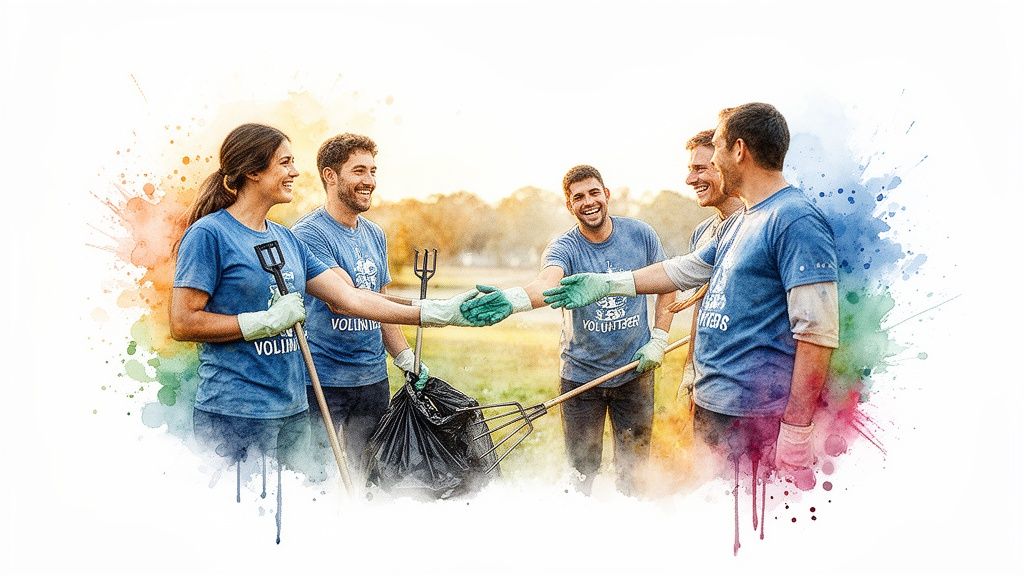
I know exactly what's going through your head right now because I hear the same questions from almost every single person before their first event.
- "What if I don't know anyone?" Perfect. Nobody does at first. This isn't a networking event. The whole point is for you to work side-by-side on a shared mission. Friendships just happen when you're focused on a task together, not on trying to be cool.
- "What should I wear?" Clothes you don’t mind getting a little dirty in. That’s literally it. We provide all the gear you need—gloves, pickers, and bags.
- "What if it rains?" Then we get a little wet and have a better story to tell. We're out there rain or shine, because consistency is part of the practice. Suffering a little together is what makes it fun. It advances the plot.
You Just Have to Show Up
I’ll never forget one volunteer, Sarah. She told me she circled the block in her car three times before she finally got the courage to park and get out. She was that terrified.
Fast forward a year, and now she’s leading her own cleanups.
Her story isn't some magical, overnight success. It's about one small, messy, imperfect step. She chose action over anxiety. She chose sunlight and new friends over staying home and worrying.
This isn't about being fearless. It's about you acting despite the fear. You don't have to be perfect to start. You just have to show up.
The beautiful thing about this first step is that the stakes are incredibly low, but the potential for your growth is massive. You’ll leave with a real, tangible victory—a cleaner park, a satisfyingly heavy trash bag—and a feeling of accomplishment you can't get from reading an article.
We’re out there every single weekend. Come find out what you're made of.
Common Questions About Facing Your Fears
But What if I'm Still Scared After I Try?
Good! Feeling scared means you’re on the right track. Seriously.
The point isn't to magically erase your fear forever. That's impossible. The goal is for you to learn to take action while you feel it. I always say, "Fear is good." It’s the compass telling you that you're stepping outside your comfort zone and into the growth zone.
Just keep showing up. Keep practicing in your low-stakes bravery lab. Celebrate the fact that you tried at all. Pretty soon, you'll look back and realize that feeling of fear is still there, but it's no longer the one driving your car.
How Can Picking Up Trash Possibly Help My Career?
Think of it like this: it's mental cross-training for your life.
When you choose to get up on a cold, rainy Saturday morning to clean up a park with a bunch of strangers, you're doing something hard. You're building muscles like consistency, resilience, and straight-up bravery.
You are proving to yourself, through real-world action, that you are the kind of person who shows up and does difficult things. That quiet, earned confidence doesn't just stay on the sidewalk after the cleanup is over. You carry that with you into your next big work project, your relationships, and every other part of your life.
Ready to see what you're made of? Come join Litter Caterpillars this weekend and take that first, real step.
Find your next cleanup event here: https://www.littercaterpillars.com