You know that feeling, right? That dream of a perfect beach day—sun, sand, waves crashing. But you arrive, and the dream shatters. The shoreline is a graveyard of plastic bottles, soggy wrappers, and cigarette butts. It’s more than just an ugly sight. It’s a punch to the gut, and for me, it was a personal call to arms, a siren's song I couldn't ignore.
Confronting the Reality of Littering on Beach
I remember a time my apartment was its own kind of polluted shoreline. A chaotic mess. It was a mirror, reflecting the clutter storming inside my head. Every single object held a story I felt I couldn't part with, and the sheer weight of all that stuff left me paralyzed.
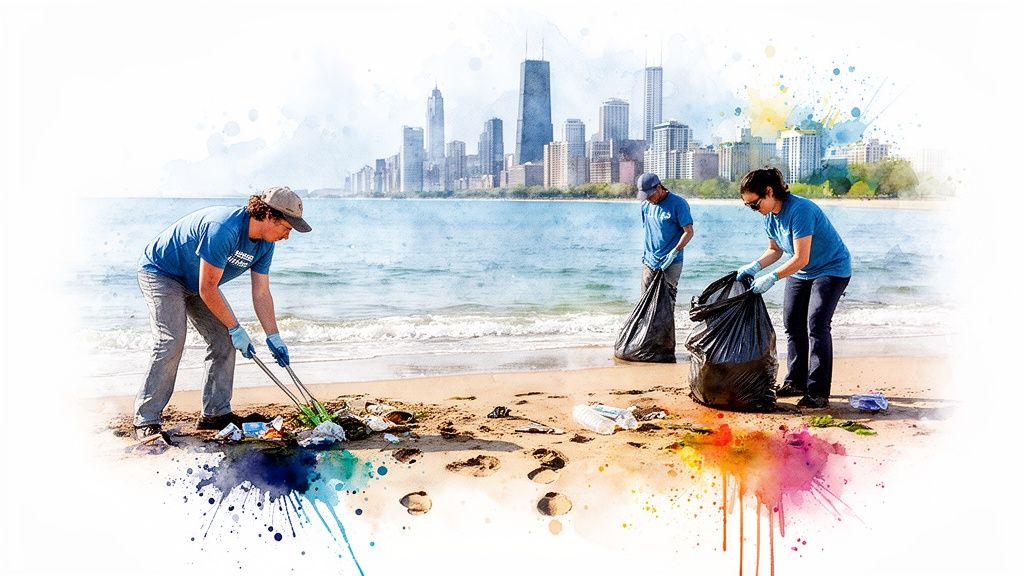
Funnily enough, clarity didn't come from cleaning my own disaster. It struck me when I started cleaning up someone else’s—our public mess. That simple, repetitive act of picking up trash on a Chicago beach began to untangle the chaos inside me, too. This strange connection, the one between our inner worlds and our outer spaces, gets right to the heart of the problem with littering on beach.
The True Scale of the Problem
When you see a single plastic bottle lying on the sand, what do you really see? Is it just one piece of trash? I want you to see it for what it is: the tip of an enormous, deadly iceberg.
Think about it like this. Imagine every person who visited a beach last year left behind just one small thing. A bottle cap. A stray straw. A chip bag. Now, multiply that by the millions upon millions of beachgoers across the globe. The number explodes into something so vast it’s hard to even imagine.
We’re not just talking about an eyesore here. We are talking about a relentless tide of harmful stories washing ashore. Each fragment of plastic is a potential killer for marine life and a real, tangible risk to our own health.
Why This Mess Is Deeper Than You Think
This isn't just about a few careless tourists. A gigantic portion of the trash on our beaches is a long-distance traveler. It gets swept from inland cities, flowing through storm drains and rivers, embarking on a secret journey that ends on our coastlines. A plastic fork dropped in a city park can, without a doubt, become part of the littering on beach crisis a hundred miles from where it was forgotten.
Think of our waterways as the planet's circulatory system. When you and I start clogging those arteries with our garbage, the whole system begins to fail. This hits us exactly where it hurts:
- Marine Ecosystems: Animals mistake our plastic for food. They get tangled in our discarded junk. They die.
- Human Health: I've seen sharp objects hiding in the sand, just waiting for a bare foot. And those tiny microplastics? They're getting into the very water you swim in.
- Local Economies: Those beautiful coastal towns you love? The ones that depend on tourism? They lose big when their main attraction is buried under garbage.
The mess on the sand is a physical symptom of a much bigger, systemic sickness. It’s the accumulated result of millions of individual choices and collective oversights, all piled up in one tragic monument.
Once you look at it that way, everything changes. It stops being someone else’s problem. It becomes our shared story. It becomes our shared responsibility. It’s an invitation to stop looking away and start seeing the solution, right there at your feet.
The Ghost Tsunami Clogging Our Shores
You know that feeling? You step onto a beach, bracing for the sand and sun, and it’s just… a warzone of waste. It looks like some invisible, ghostly wave of trash slammed the coast overnight. You’re not entirely wrong, but that wave didn't start in the ocean. Its source is often miles and miles and miles from the nearest shoreline.
Let me paint you a picture. I want you to imagine a plastic bottle, tossed from a car window onto a street in Chicago. It sits in the gutter, completely forgotten. Then the next big storm rolls in. That bottle gets washed into a storm drain, starting a secret, silent journey through the city's hidden arteries.
This is the real story of beach litter. It's a whole system, a complex web, not just one person being careless on one day.
The 80/20 Rule That Changes Everything
There’s a concept in this field that completely flipped how I see the problem. It’s the idea that roughly 80% of all the trash in our oceans and lakes comes from land. Let that sink in for a moment. The overwhelming majority of the junk we pull off our beaches didn’t come from boats or even from people at the beach.
It’s coming from places you’d never suspect:
- City Storm Drains: Just like that bottle in Chicago, tons of trash gets flushed from our streets straight into rivers and lakes.
- Inland Garbage Cans: I see it all the time. A windy day flips the lid on a full trash can in a park fifty miles from the coast, and that’s the beginning of the journey.
- Your Washing Machine: This one is a real shocker for people. Tiny synthetic fibers—microplastics—from our clothes wash down the drain with every single load you do, eventually making their way into our water systems.
This is why yelling at someone on the beach to "pick up your trash!" feels like I’m trying to bail out a sinking ship with a teaspoon. The real flood is starting way, way upstream. It’s a systemic problem flowing from the heart of our cities right to the shores we're trying so desperately to protect.
Think of it like this: Our cities are constantly shedding a skin of plastic wrappers, cigarette butts, and coffee cups. Our storm drains and rivers act like veins, pumping that waste directly into the heart of our planet—the oceans and the Great Lakes.
And this isn't some abstract theory I cooked up. A massive cleanup effort not long ago covered just over 53 miles of shoreline across 25 countries. Volunteers hauled away a staggering 47.4 tons of trash. You can’t imagine what they found—medical syringes in Tanzania, and the usual suspects like Marlboro and Coca-Cola products everywhere else. It’s a direct receipt showing how our daily habits on land are trashing our beaches. You can dig into the full global cleanup results and what they found.
This ghost tsunami of trash is relentless, a silent monster made of a million tiny choices happening far from the water. Understanding that path—from a street in Chicago all the way to the shores of Lake Michigan—is the first, most critical step. It shows me, and it shows you, that to really stop the littering on beach hotspots, we have to look upstream and choke off the source. We have to fix the system, not just point fingers at the person by the sea.
The Devastating Impacts of Beach Litter
When you see trash on a beach, it’s easy to feel that quick, sharp pang of disappointment. But that feeling doesn't even begin to scratch the surface. The real damage runs deep, like an invisible infection spreading through an entire ecosystem. What we see—the plastic bottles and bags—is just the symptom. The disease of littering on a beach is actively poisoning our wildlife, our health, and even our bank accounts.
The sheer scale of this is hard to wrap your head around. Picture this: a staggering 80% of all trash found polluting shorelines across the globe is plastic. Every single year, about 8 million tons of plastic waste floods into our oceans. And much of it doesn't just disappear; it washes right back up onto the very sand where you and I hope to relax and play. The data behind this is eye-opening, and you can dig into the specifics of beach litter's impact to see for yourself.
A Death Trap for Wildlife
Let me tell you a story I’ve seen play out in my mind a thousand times, because I know it happens every single day.
A sea turtle, ancient and graceful, glides through the water. It spots what looks like a jellyfish—its favorite food—dancing in the current. But it's not a jellyfish. It's a plastic bag that someone, somewhere, left behind.
The turtle swallows it. That one mistake becomes a death sentence. The plastic gets lodged in its gut, leading to a slow, agonizing starvation. This isn’t some freak accident; it’s a constant, heartbreaking tragedy I see in my nightmares.
And it’s not just about what they eat. Think of a seabird, trying to find food for its young, getting its legs hopelessly tangled in a discarded fishing line. The more it struggles, the tighter the invisible trap becomes, until it can no longer fly, can no longer feed, can no longer escape.
Every bottle cap, every plastic straw, every six-pack ring you see left on the sand is a potential weapon. It’s an indiscriminate killer that doesn't care if its victim is a curious dolphin, a soaring albatross, or a gentle sea turtle.
A lot of this trash travels a long way to become a coastal threat. The problem often starts miles inland, as this visual makes painfully clear.
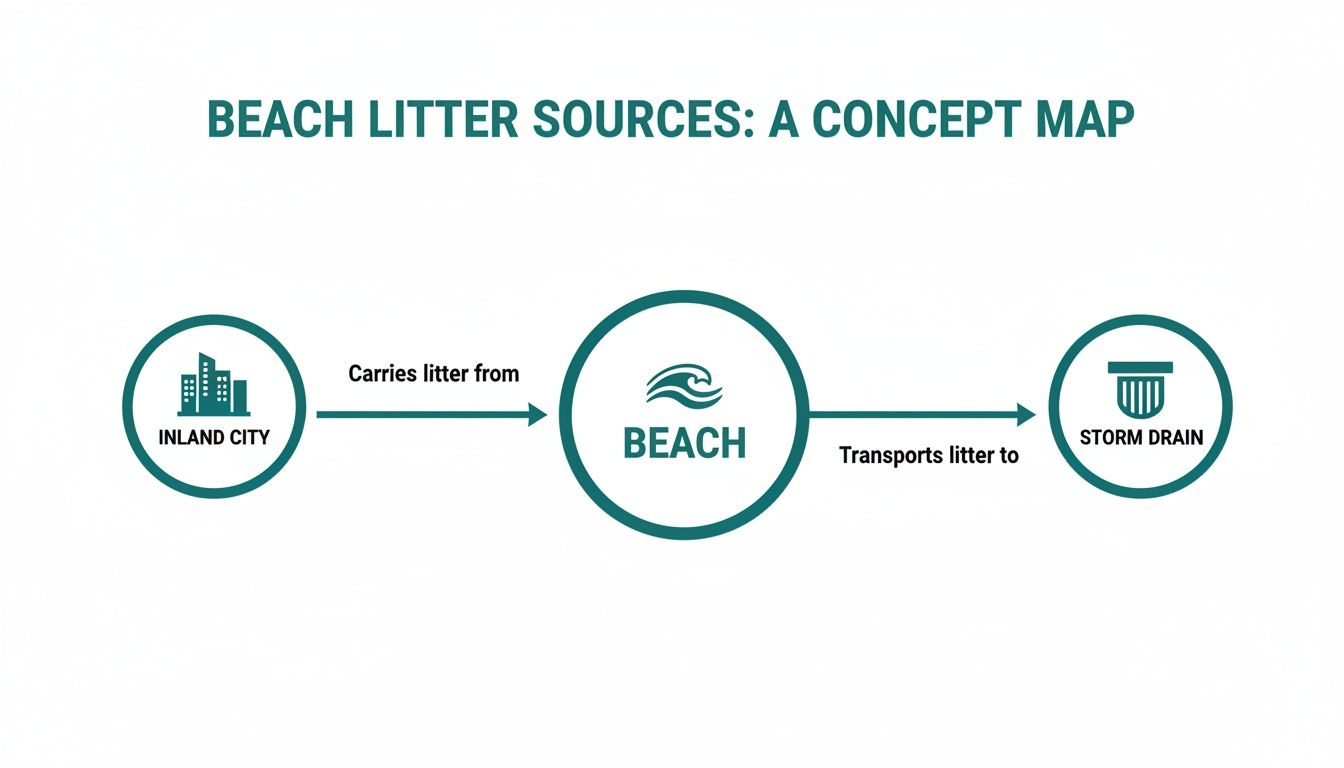
It’s a direct pipeline from our cities, down storm drains, and straight onto the beaches we cherish.
The Hidden Costs of Littering on a Beach
The mess on the sand is more than just an eyesore. It represents a web of consequences that ripple through our environment, our health, and our local economies. The table below breaks down these hidden costs, showing how a single piece of trash contributes to a much larger problem.
| Impact Area | Description of Harm | Real-World Example |
|---|---|---|
| Environmental | Wildlife can mistake plastic for food, leading to internal injuries and starvation. Animals also become entangled in discarded items like fishing nets and plastic rings, causing injury, drowning, or strangulation. | A sea turtle ingesting a plastic bag it mistook for a jellyfish. |
| Public Health | Sharp objects like broken glass, rusted metal, and medical waste buried in the sand pose a direct physical threat. Over time, plastics break down into microplastics and leach toxic chemicals (like BPA) into the sand and water. | A child stepping on a shard of glass hidden just beneath the sand, resulting in a deep cut and a trip to the emergency room. |
| Economic | Coastal communities spend millions on beach cleaning. Littered beaches deter tourists, which hurts local businesses like hotels, restaurants, and shops. Property values in areas with chronic litter problems can decline significantly. | A small beach town sees its summer tourism revenue drop by 20% after images of its littered shoreline go viral online. |
Each piece of litter contributes to this cycle of harm. It's a heavy price to pay for a moment of carelessness.
The Dangers to You and Your Family
The impact of beach litter isn't just "out there" in the ocean; it's right here, directly affecting you and me.
Imagine your kid running barefoot through the sand, laughing one second and screaming in pain the next. A buried piece of broken glass or a rusty can has just turned your perfect beach day into a nightmare. These are the booby traps left behind by others.
But the danger is also invisible. Over time, all that plastic trash doesn't just go away. The sun and waves break it down into microscopic pieces—microplastics. At the same time, those plastics leach toxic chemicals like BPA and phthalates right into the sand where we build castles and the water where we swim. You and I are literally soaking in a chemical soup of our own making.
The Crushing Economic Cost
On top of the ecological and health crises, beach litter comes with a massive price tag. Coastal towns are forced to spend millions of dollars every year—your tax dollars—just to clean up the mess. That's money that could be going to our schools, our parks, or our roads.
Think about a small town that lives and breathes on summer tourism. What happens when its number one asset, a beautiful beach, is consistently covered in garbage?
- Tourists Stop Coming: Families choose to go elsewhere. The photos they might have shared of a beautiful sunset are replaced with pictures of trash.
- Local Businesses Go Under: The hotels, cafes, and surf shops that depend on those visitors watch their income dry up.
- Property Values Plummet: Who wants to buy a house with a view of a landfill?
A trashed beach isn't just an environmental issue. It’s a community-killer. It’s a wake-up call showing us that the consequences are personal, painful, and incredibly expensive for every single one of us.
How Personal Mess Became a Public Mission
I have to be honest with you. I didn't start Litter Caterpillars from some grand, noble vision. I started it because my own life was a complete and utter mess. I mean that literally. My apartment felt just as trashed as a shoreline after a long holiday weekend—disorganized, chaotic, and totally overwhelming.
Looking back, my place was a perfect physical metaphor for the chaos storming in my head. Every single object had a story. That jar of blueberry jam from a trip I took four years ago? It wasn't just jam; it was a memory I was afraid to lose. That bag of nuts from a failed health kick? A stinging reminder of good intentions gone wrong.
Each item might have weighed less than a pound, but to me, it felt like it weighed 500 pounds. I was completely frozen, unable to clean up the trash in my own home. I was just… stuck. The real breaking point, the moment the dam finally burst, came after I ended a long, turbulent relationship that had mirrored the mess around me. I knew then I had to build a new life from the ground up, one centered on cleanliness, consistency, and a bravery I didn't think I had.
The Spark in the Storm
Here’s the crazy part: I found the solution not by tackling my own personal disaster, but by cleaning up someone else's. I discovered it was infinitely easier to clean up the public’s mess than my own. This strange little insight became the bedrock, the founding principle, of Litter Caterpillars.
Our very first cleanup was a true Chicago welcome. There were just three of us, buzzing with a nervous, electric energy, ready to take on the littering on beach problem one piece at a time. Of course, the second we started, the sky just tore open. Not rain. A full-on springtime hailstorm.
We found ourselves huddled under a tree, soaked and shivering, watching as every single Uber we tried to order canceled on us. But right there, in that moment of shared misery, something amazing happened. We started laughing. It was cold, it was uncomfortable, but it was also… fun.
We realized that suffering together, facing a ridiculous challenge, adds a special kind of flavor to life. It advances the plot. In that freezing hailstorm, huddled together while picking up strangers' trash, the very soul of Litter Caterpillars was born.
From Personal Struggle to Public Service
That first day taught me something profound. Cleaning up a public space wasn't just about making a beach look nicer. For me, it was a way to practice the very things I was struggling with in my own life.
- Cleanliness: By tidying a park, I was building the muscle for tidying my own life.
- Consistency: Showing up every week, no matter what the weather threw at us, taught me the discipline I craved.
- Bravery: Facing down a blizzard to pick up trash? That’s a crash course in courage you can't get anywhere else.
This journey, from a messy room to a city-wide movement, is my proof that you can change your inner world by changing your outer one. It’s not about being perfect from day one. It’s about taking that first small, absurd step. It’s about finding a weird new form of "fun" in the struggle and discovering that helping others is one of the best ways to help yourself.
That simple act of picking up trash became my mission. It’s grown from three people in a hailstorm to a community of hundreds who show up every single week, ready to build a better city and, in the process, better versions of ourselves. If this idea fires you up and you want to join us, you can learn more about how to volunteer and clean up beaches with us. It all starts with one small act.
Making Beach Cleanups Fun and Meaningful
How do you get people to give up their Saturday morning to pick up someone else's trash? It's simple. You don't ask them to do a chore. You invite them on an adventure. That’s the entire heart of what we do at Litter Caterpillars. It’s how I turn what sounds like a tedious duty into something you actually look forward to.
I have this little philosophy I call the 'Tom Sawyer' approach. You remember the story, right? He was stuck painting a fence as a punishment. He didn’t complain. Instead, he made it look like the most incredible, fun thing in the entire world—so much so that his friends started paying him for the privilege of helping out.
That's our entire playbook. Service isn't a burden; it's a privilege. It’s an opportunity to grow, to connect, and to build a type of resilience you can't find anywhere else. The moment you see it that way, everything shifts. It stops being about the littering on beach problem and starts being about our shared power to fix it.
Our Three Core Values
Everything we do is built on three simple, powerful ideas: Bravery, Kindness, and Unity. These aren't just empty words I stick on a website. They're how we operate, week in and week out.
- Bravery: This just means showing up. It means you are willing to pick up trash in a Chicago blizzard or a scorching summer heatwave. When you face challenges together, even when it’s uncomfortable, you build a unique kind of strength.
- Kindness: We have a volunteer-first rule. Your safety and your happiness come before anything else. It's not just about being nice; we intentionally create an environment where real friendships can actually grow while you work.
- Unity: We bring people together from every walk of life. You’ve heard the old saying: "If you want to go fast, go alone. If you want to go far, go together." We’re in this for the long haul.
The Power of Pride and Identity
Have you ever noticed how sports teams use flags, songs, and uniforms to build this intense, powerful feeling of pride and belonging? Why should that power only belong to sports or nations? I believe it’s time for kind people to step into our power, too.
That’s why we have flags. That’s why we award badges. That's why we even have our own theme song.
These aren't gimmicks. They are tools. They transform a scattered group of individuals into a unified team with a shared mission. They give us an identity to be proud of, turning a simple cleanup into a bold statement of who we are and what we stand for.
This gives you a sense of belonging that’s so hard to find these days. We aren't just cleaning a park; we are representing a movement. We are showing the world what it looks like when kind, brave people decide to take ownership of their community. It’s a powerful, incredible feeling.
Turning a Chore into a Calling
When you join one of our events, you’re not just some anonymous volunteer. You become part of a team, and that changes everything. You get to explore a new Chicago neighborhood, meet people who actually share your values, and see the immediate impact of your work with your own two eyes.
We've found that this structure helps people build consistency and purpose in their own lives. If you want to see exactly how we use these principles to create powerful group experiences, you should check out our guide on inspiring volunteer team building activities. It’s a deep dive into our methods.
By mixing a spirit of adventure with a strong sense of identity, we've turned the thankless job of cleaning up after others into a meaningful and joyful calling. This is an open invitation for you to join us, get your hands dirty, and discover just how good it feels to do good.
Your Guide to Taking the First Step
You feel that little spark, don't you? That quiet voice in the back of your head that says, "I should do something about this." I know that voice intimately. It's the same one that got me started.
It's so easy to feel that fire and then, almost immediately, feel crushed by the sheer size of the problem. But I'm telling you, taking real, meaningful action is so much simpler than your brain wants you to believe.
This is your map. It’s a practical, no-fluff guide to turning that good intention into a pile of filled trash bags. Let's take that first step together.
How to Join a Cleanup
If you’re in Chicago, finding us is easy. We always want new faces and new energy. The best way to link up with the Litter Caterpillars is through our main channels:
- Meetup: This is our home base for all event schedules. Every weekly cleanup gets posted here with the date, time, and exact spot we'll be.
- Instagram: Follow us for the play-by-play. You'll get real-time updates, see photos from our cleanups, and catch the vibe of our community.
Seriously, just show up. That’s the only rule. You don't need special equipment or experience; I promise we have everything you'll need. All we ask from you is a willingness to help.
The most important thing you can do is simply start. Pick up one piece of trash. Invite one friend. Every great journey begins not with a giant leap, but with a single, small, deliberate step forward.
Starting Your Own Cleanup Crew
What if you're not in Chicago? That's even better. It means you have the power to bring this same energy to your own community. This whole thing grows when people like you decide to start their own crew.
It feels like a massive undertaking, I get it. But remember our origin story: just three people caught in a hailstorm. You don't need a 501(c)(3) or a flashy website to make a difference. You just need a starting point.
Here's the blueprint, straight from my playbook:
- Pick a Spot: Find a local park, a messy riverbank, or a specific public beach that could use some love. Starting small keeps it from feeling impossible. If you want to know why some areas, like the public beaches near Lake Michigan, need so much consistent help, we break it down here.
- Set a Time: Choose a date and block out a two-hour window. Weekend mornings are magic for attracting the kindest, most dedicated people you'll ever meet.
- Get the Word Out: Make a simple event on Facebook, Meetup, or just text a few friends. Your invite can be as simple as, "Hey, I'm cleaning up [Location] on Saturday at 10 a.m. Want to join?"
- Gear Up (Simply): You only need two things to start: gloves and trash bags. That's it. I beg you, don't overthink it.
- Create a Vibe: On the day of the cleanup, just be a welcoming human. Thank every single person for showing up. Remember, the goal isn't just to clean—it's to build connections. Make it feel like a get-together, not a chore.
This process strips away all the excuses. It takes that huge, scary idea of "saving the world" and turns it into a simple plan you can launch this weekend.
Your First Cleanup Action Plan
Feeling ready? It’s normal to feel a little unsure of where to begin. This checklist is your simple, step-by-step guide to get you from "I want to help" to actually making it happen.
| Step | Action Item | Litter Caterpillars' Tip |
|---|---|---|
| 1. Find Your Spot | Choose a park, beach, or street that needs attention. | Start small! A single block or a small park is a perfect first mission. |
| 2. Pick a Date & Time | Set a 2-hour window on a weekend morning. | Saturday at 9 a.m. is our go-to. It attracts dedicated folks and leaves the rest of the day free. |
| 3. Rally Your Crew | Invite friends via text, social media, or a Meetup event. | Don't be shy! A simple, "Want to help me clean up our park?" is all it takes. |
| 4. Gather Supplies | Get basic gloves and heavy-duty trash bags. | Ask people to bring their own if they can. Many hands make light work. |
| 5. On Cleanup Day | Greet everyone, do a quick intro, and get to work. | The goal is connection as much as cleaning. Make it fun, not a chore. |
| 6. Share Your Impact | Take a "before" and "after" photo. Celebrate your success! | Post it online. Your small victory will inspire someone else to take their first step. |
Following these steps transforms a vague idea into a concrete plan. You've got this. Your community—and the planet—is waiting for you.
Got Questions? I've Got Answers.
I get it. When you look at the scale of the litter problem, it feels massive. It’s easy to feel overwhelmed, to think, what can one person even do? That hesitation is normal, but I've learned that clear answers are the best way to turn that doubt into action. Let's tackle some of the questions I hear all the time.
What’s the Worst Stuff We Find Out There?
It changes from place to place, but the villains are almost always the same: single-use plastics. We're talking bottle caps, food wrappers, and straws. But the number one thing we find, by sheer count, is cigarette butts. They look so small, but their plastic filters are like little poison sponges, leaching a nasty chemical cocktail straight into the sand and water.
Think about it—these tiny, throwaway items are landmines for birds and fish that mistake them for a meal. And don't even get me started on discarded fishing gear. Those nets and lines are devastating, causing a slow, cruel death for anything that gets tangled. The convenience you and I crave for a few minutes creates a disaster that lasts for centuries.
But I Don't Live Near a Beach. How Can I Help?
This is my favorite question because it cuts right to the core of the problem. A huge chunk of ocean trash doesn't start at the coast. It starts on a street, in a park, or along a river hundreds of miles inland. Your actions right here in Chicago matter. Immensely.
Start simple. Cut back on single-use plastics in your daily routine. And make sure your trash and recycling bins have lids that actually close tight. A strong gust of wind is all it takes to turn your garbage into street litter.
Every river, every storm drain, every little creek eventually leads to the ocean. Cleaning up a riverbank in the Midwest is a direct blow to the litter piling up on a beach far away. It’s all connected.
Does Picking Up Trash Really Make a Difference?
Yes. A thousand times, yes. It makes a world of difference, and don’t let anyone tell you otherwise. Every single piece of trash you pick up is one less hazard for an animal. Every cleanup you join shows your neighbors that you care, sparking something in them, too.
The numbers can be scary. Some studies say ocean plastic could double by 2030. But here’s another number for you: a recent Global Ocean Cleanup pulled 47.4 tons of trash out of the water across 25 countries. You can read more about these global plastic crisis insights and solutions.
That’s what we do at Litter Caterpillars every single week. We’re part of that hopeful, worldwide movement. Your action isn't just a drop in the bucket; it's the start of a wave.
At Litter Caterpillars, we turn that desire to help into real, muddy, satisfying action every week in Chicago. If you're ready to stop wondering and start doing, to build real friendships, and to be part of the solution, we're ready for you. Join our next cleanup and see for yourself how good it feels to do good. https://www.littercaterpillars.com